
Today’s article introduces one of the standout products, built on AdalFlow and quickly becoming a favorite open-source project among developers. DeepWiki, an AI-powered documentation generator. It automatically transforms GitHub, GitLab, and BitBucket repositories into complete, interactive wikis, analyzing code structure, generating clean documentation, creating diagrams, and even enabling developers to “chat” with their repos.
And in this post, I’d like to introduce a recent user case how developers are using DeepWiki in the real world, and why it’s becoming the go-to tool for teams who want their documentation to stay accurate, accessible, and always up-to-date.
Beyond DeepWiki, this article also highlights the flexibility and power of AdalFlow, the engine that makes code-to-knowledge workflows truly practical in real engineering environments. AdalFlow is not just a tool; it understands the deeper structure of a repository. It can trace relationships between modules, follow call paths, map out architectures, and capture the logic that ties the entire system together.
👉 Deepwiki
👉 Adalflow
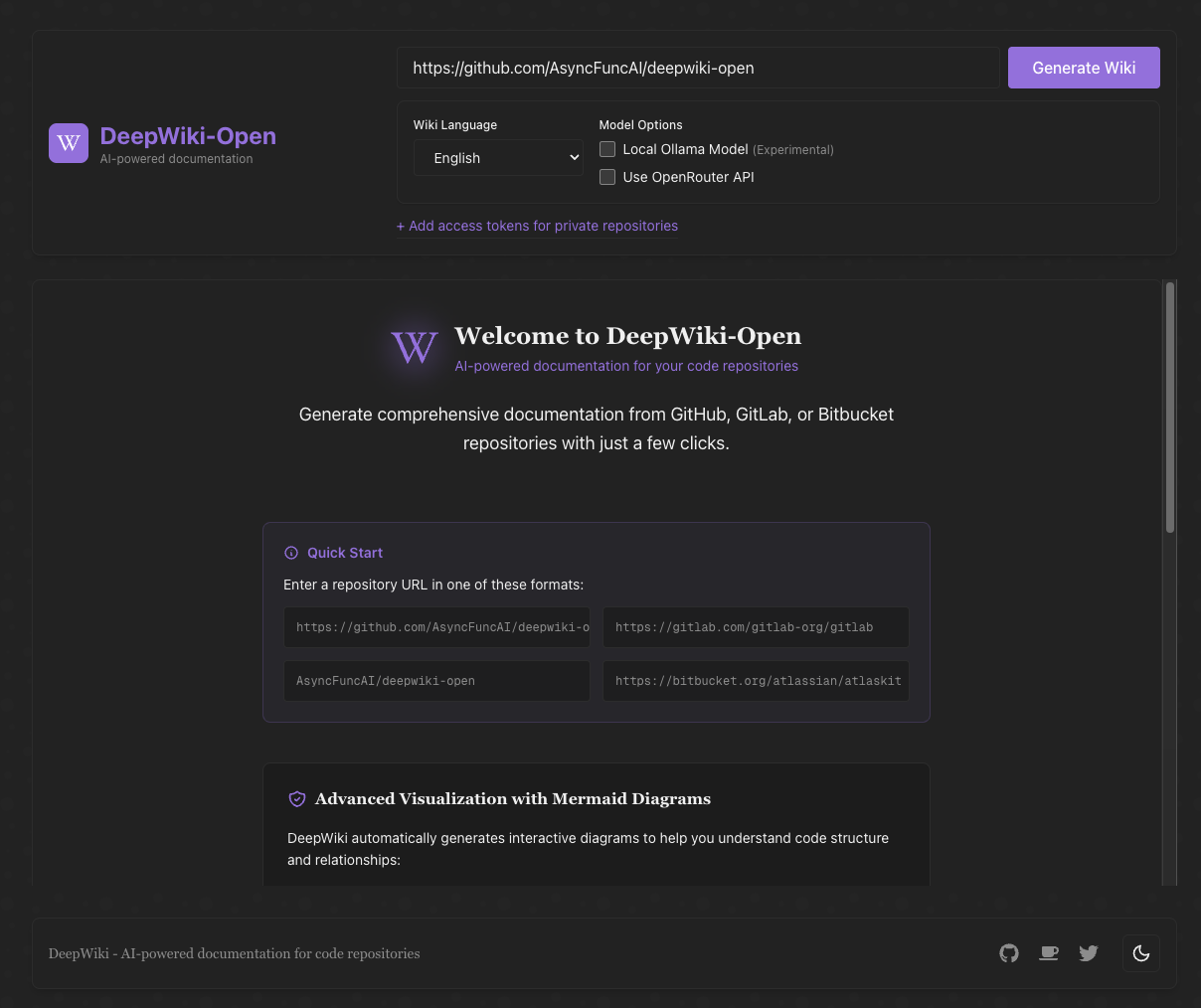
Documentation is the bridge between code and understanding, yet countless open-source and internal projects still struggle with docs that are incomplete, outdated, or missing altogether. Writing good documentation requires deep knowledge, time, and constant maintenance—something most developers simply don’t have. The result is a codebase that “works,” but is hard to navigate and even harder to onboard into.
DeepWiki is built on a simple insight: the code itself is the ultimate source of truth. If AI can read the entire repository, understand its structure, and generate the documentation automatically, we can dramatically improve engineering efficiency and eliminate repetitive, manual work.
What’s more, DeepWiki offers a DeepResearch mode. When enabled, the AI performs a multi-round investigation: DeepResearch doesn’t just answer a question; it performs a full analysis, updating its understanding across multiple rounds until it reaches a meaningful conclusion.
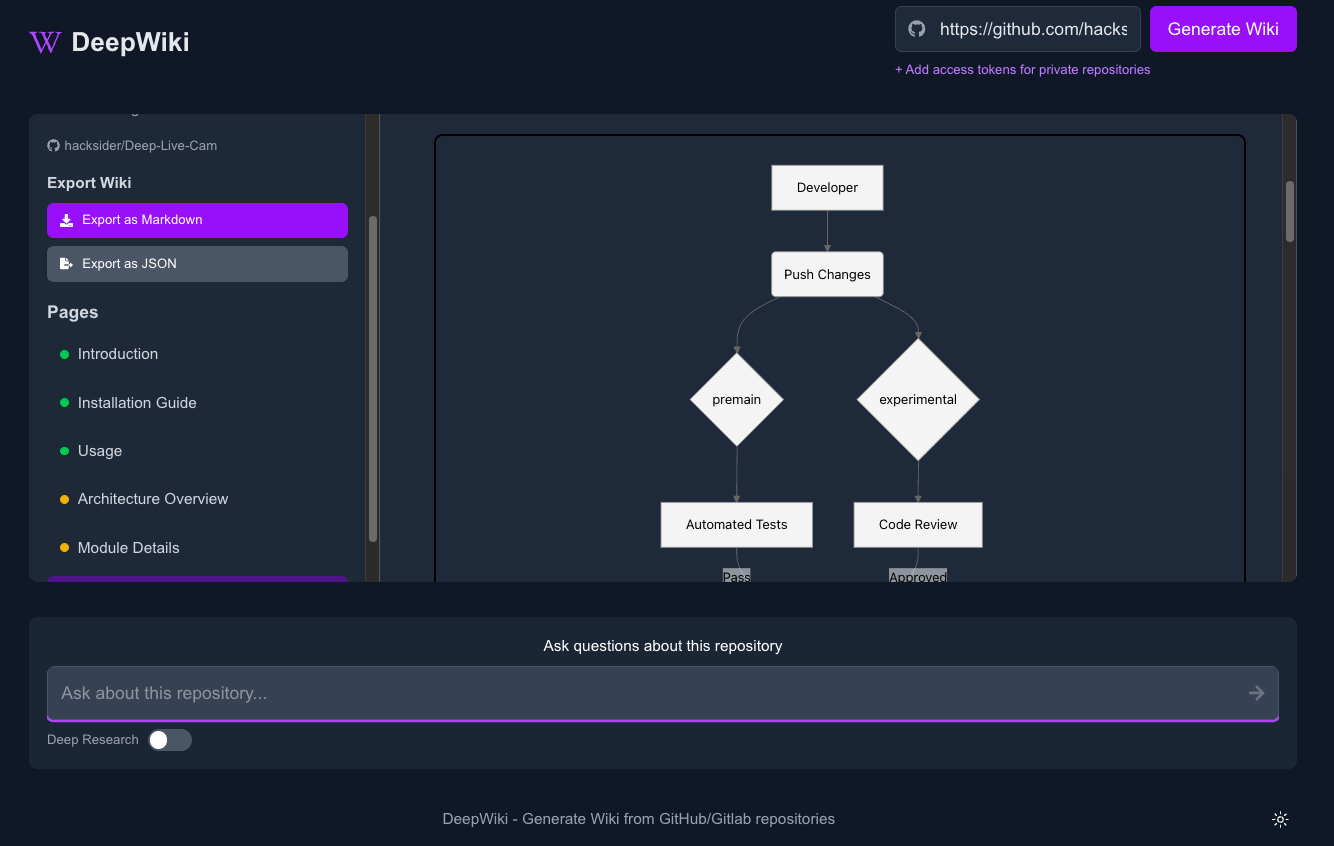
Everything in DeepWiki is designed to help engineers navigate and understand complex repositories more easily:
Instant Documentation: Turn any GitHub, GitLab or BitBucket repo into a wiki in seconds
Private Repository Support: Securely access private repositories with personal access tokens
Smart Analysis: AI-powered understanding of code structure and relationships
Beautiful Diagrams: Automatic Mermaid diagrams to visualize architecture and data flow
Easy Navigation: Simple, intuitive interface to explore the wiki
Ask Feature: Chat with your repository using RAG-powered AI to get accurate answers
DeepResearch: Multi-turn research process that thoroughly investigates complex topics
Multiple Model Providers: Support for Google Gemini, OpenAI, OpenRouter, and local Ollama models
Flexible Embeddings: Choose between OpenAI, Google AI, or local Ollama embeddings for optimal performance
👉 Adalflow
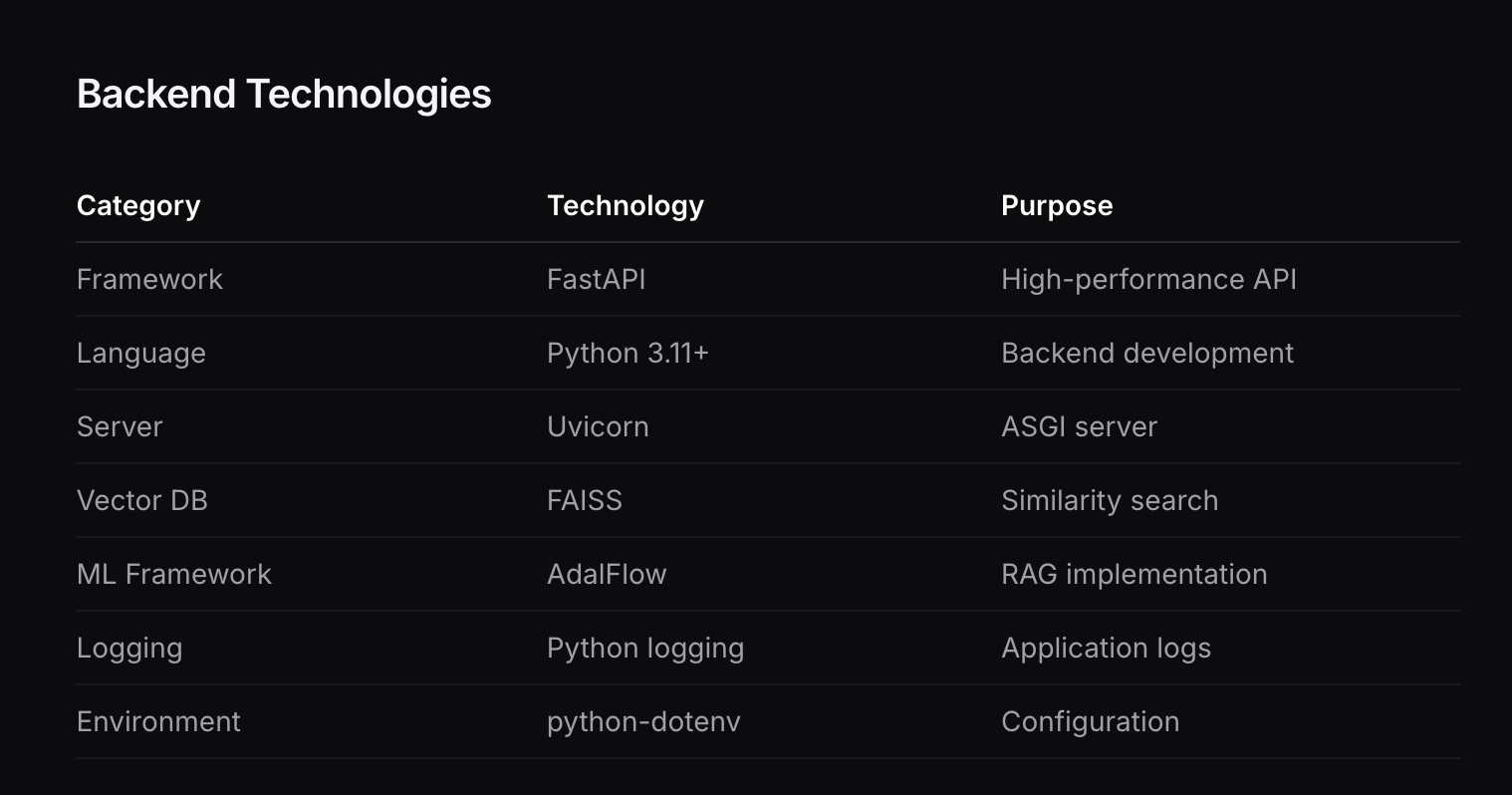
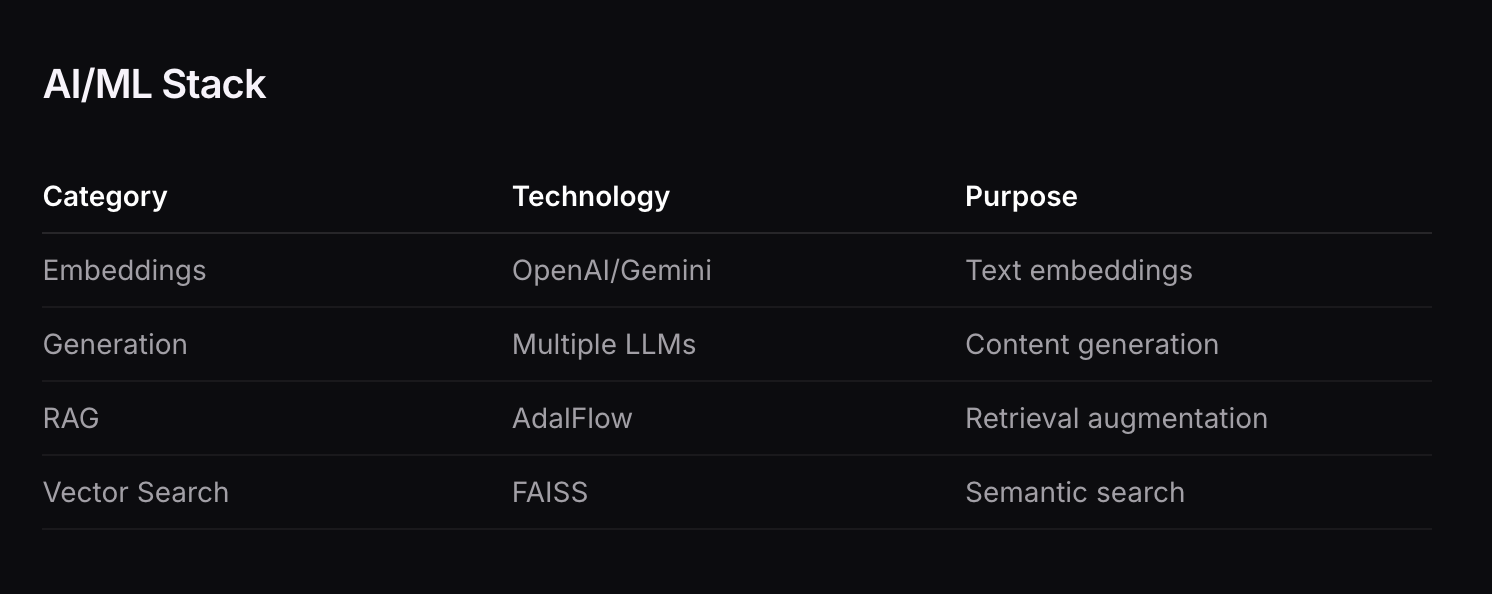
DeepWiki needs far more than a simple LLM call. It must read entire repositories, split them into meaningful chunks, embed those chunks using different providers, index everything for fast retrieval, and then generate structured, reliable documentation at scale. Doing all of this manually would require dozens of scripts, custom batching logic, provider-by-provider hacks, and a lot of fragile glue code.
AdalFlow removes all of that complexity.
Just as PyTorch changed deep learning by offering a clean, intuitive, modular framework, AdalFlow brings that same philosophy to LLM workflows. With AdalFlow, every part of the workflow—from data preprocessing to embedding, retrieval, and generation—becomes a composable, inspectable, optimizable pipeline.
AdalFlow is intentionally designed to feel like a modern ML framework. The Sequential component lets us describe a complete data pipeline the same way you’d write a PyTorch model: layer by layer, component by component, each with its own responsibility.
For DeepWiki, the entire flow
split code → embed chunks → store embeddings → retrieve contextis expressed as a single pipeline:
data_transformer = adal.Sequential(splitter, embedder_transformer)
db = LocalDB()
db.register_transformer(data_transformer, “split_and_embed”)
db.load(documents)
db.transform(”split_and_embed”)
db.save_state(db_path)
No scattered scripts.
No custom orchestration.
No brittle connections between steps.
AdalFlow turns the workflow itself into a first-class object, the exact clarity that speeds up development.
LLM infrastructure can be messy.
OpenAI embeds in large batches, Google has slightly different token rules, Ollama doesn’t batch at all. Token limits vary. Costs vary. APIs vary dramatically.
AdalFlow absorbs this complexity.
The same pipeline works regardless of provider. When Ollama behaves differently, we simply swap in a custom component such as OllamaDocumentProcessor, and the rest of DeepWiki remains unchanged.
This is the power of modularity: one pipeline, many interchangeable components.
👉 Adalflow
AdalFlow exposes a single interface across OpenAI, Google Gemini, Azure OpenAI, AWS Bedrock, DashScope, OpenRouter, and local Ollama. Switching providers is as simple as:
client = GoogleGenAIClient() # or OllamaClient(), OpenAIClient(), etc.Embedding models are equally easy to swap:
# In tools/embedder.py
def get_embedder(embedder_type: str = None) -> adal.Embedder:
    if embedder_type == ‘ollama’:
        embedder_config = configs[”embedder_ollama”]
    elif embedder_type == ‘google’:
        embedder_config = configs[”embedder_google”]
    else:  # openai
        embedder_config = configs[”embedder”]
    model_client = embedder_config[”model_client”]()
    embedder = adal.Embedder(
        model_client=model_client,
        model_kwargs=embedder_config[”model_kwargs”]
   )
    return embedder
Users set `DEEPWIKI_EMBEDDER_TYPE=google` (or `ollama`) and DeepWiki automatically uses their preferred embedder. This flexibility is a major feature we’re proud of.
No refactoring. No conditional logic. No provider-specific errors leaking into application code.
When DeepWiki supports six or more providers, this abstraction is not a luxury—it’s what keeps the entire codebase maintainable.
DeepWiki repositories may contain thousands of files and tens of thousands of chunks. Recomputing embeddings would be slow, expensive, and wasteful.
AdalFlow’s LocalDB solves this by giving us persistent on-disk storage for embeddings, plus automatic state tracking. If a document hasn’t changed, its embedding is reused. If a user switches from OpenAI to Google or Ollama, only the affected components rerun.
We didn’t have to build a vector store, a cache, or a custom hashing system. AdalFlow gave us all of that immediately.
AdalFlow integrates FAISS under the hood, so retrieval becomes a single call:
results = retriever.retrieve(”How does authentication work?”)No custom index management, serialization, or distance tuning. Embeddings stored in LocalDB stay perfectly aligned with the retriever. For DeepWiki’s interactive documentation, this speed and simplicity are crucial.
Like PyTorch’s autograd, AdalFlow includes auto-optimization tools, which is tailored for LLMs.
It supports zero-shot and few-shot prompt optimization, which means the system can learn to improve documentation quality automatically without constant manual retuning.
DeepWiki benefits heavily from this: the quality of generated documentation improves over time as the workflow accumulates examples and feedback.
This is something other LLM orchestration frameworks simply don’t offer.
👉 Adalflow
Many LLM tools are black boxes. You send a prompt in, get an output, and hope for the best.
AdalFlow is the opposite. It gives us complete visibility into:
how prompts are constructed
how retrieval context is selected
how model parameters are configured
how outputs are parsed, validated, and refined
how the pipeline is orchestrated end-to-end
This level of control is the difference between a demo and a production system.
This is the exact same advantage PyTorch gave ML researchers: Adalflow aims to remove friction and lets developers focus on the real problem.
👉 Adalflow
As we continue improving AdalFlow, it’s been incredibly exciting, and truly an honor to see such creative, practical, and widely-loved products being built on top of it. Watching developers turn ideas into real, impactful tools is the biggest validation of why AdalFlow exists.
We’re actively gathering real-world use cases from developers around the world. Your feedback is incredibly valuable to us. If you’re building something with AdalFlow—whether it’s an agent system, a code-understanding tool, an internal automation pipeline, or something completely new, we would love to hear about it. Let us know what you’re creating, what challenges you’ve run into, and what features you hope to see next.
Your needs shape our roadmap. Every suggestion, every pain point, and every idea helps us build a framework that truly supports how modern developers work. So please reach out and share your experience. We’re here to help. Together, we can push AdalFlow forward—and drive even more open-source projects forward with it. This is just the beginning, and we’re excited to keep building alongside all of you.
Reference:
- DeepWiki GitHub (https://github.com/AsyncFuncAI/deepwiki-open)
- AdalFlow Library (https://github.com/SylphAI-Inc/AdalFlow)
- AdalFlow Documentation (https://adalflow.sylph.ai/)
No posts
Comments
Nothing yet. Say the first thing.
Sign in to join the conversation.