
Polymarket and Kalshi have solved the "V1" hurdles: user acquisition, regulatory compliance, and trust. It took them five years. But while investors celebrate US approvals and record volumes, the technology underpinning these platforms has already begun to ossify. By continuing to extract easy profits from sports gamblers and 15-minute traders, they risk a slow descent into mediocrity – becoming just another bookmaker or a rebranded crypto exchange.

Almost every prediction market today relies on either a Central Limit Order Book (CLOB) or an Automated Market Maker (AMM). Both are fundamentally incompatible with markets defined by sudden, information-driven price shocks:
using a CLOB means market makers systematically lose money to toxic flow providers (news snipers, latency arbitrageurs, etc.);
using an AMM leads to essentially the same outcome, but with an even broader set of extractors, including MEV actors (frontrunners, sandwichers, etc.).
The resulting death spiral is inevitable: market maker losses lead to evaporating liquidity, which widens spreads and spikes price impact. As trading becomes prohibitively expensive, volume vanishes and the market withers.
Frequent Batch Auctions (FBAs) are the way to break this cycle, neutralizing the speed advantage and returning the edge to information, not infrastructure.
In current on-chain markets, every address, transaction, and position is public record. This radical visibility punishes the very people the market needs most – informed participants:
neither skilled predictors nor insiders can safely build positions without revealing their intent;
strategies can be reverse-engineered and copy-pasted;
as a result, traders are forced to hide their activity by spreading it across multiple accounts.
Privacy must be the default, with disclosure as an elective choice. We no longer need to sacrifice anonymity for trust: today, this is achievable through a combination of TEE-based execution, an off-chain data availability layer, and on-chain ZK proofs.
Ironically, the largest prediction markets reveal what should be private while hiding what must be public. We are forced to trade against “black box” matching engines. Because platforms like Polymarket and Kalshi operate behind closed doors, users have no way to verify if certain participants enjoy last look privileges, hidden rebates, or preferential order flow.
Rules can be changed at any moment without warning, at the pure discretion of the operators… and operators are already using this power: for example, Polymarket recently canceled the 500ms taker delay without any prior notice.
We don’t need more centralized, trusted intermediaries running opaque algorithms. Verifiable execution is the only viable long-term solution.
Despite the abundance of yield-bearing stablecoins, most prediction markets force users to forfeit all yield on funds locked in positions or resting in limit orders. To see the absurdity of this “opportunity cost tax”, one need only glance at any contract resolving in 2027 or 2028: under the current model, a trader must lock up capital for years at 0% yield just to express a long-term view.
To unlock true liquidity, the infrastructure must evolve in two directions:
Native Yield: all capital – whether resting in a limit order or locked in a position – must be held in yield-bearing assets. Participation shouldn’t require sacrificing the risk-free rate;
Atomic Multi-Market Settlement: we must move beyond 1:1 collateralization. In a batch auction with atomic settlement, the matching engine enforces a single constraint: your balance after all fills settle must be non-negative. Market makers can post orders across any combination of markets backed by a shared capital pool – the engine determines which fills are jointly feasible. The same dollar can back liquidity across far more markets than isolated collateralization ever allows.
Between 2024 and 2025, an estimated $29M was drained from multi-outcome prediction markets through “NegRisk” rebalancing. This occurs because retail traders typically anchor on 1-2 favorites and ignore the complementary probability space. In the absence of dedicated market makers, this behavior creates a massive arbitrage opportunity for external extractors.
A solid prediction market microstructure should not support this drainage: it should close these inefficiencies within the matching algorithm itself. Value should be preserved for those who risk their capital to convert beliefs into probabilities – not those who exploit mechanical gaps. Atomic arbitrage must be internalized by the protocol, not externalized to professional value extractors.
Overlapping questions, implicit equivalences, and hidden contradictions are inevitable in any permissionless ecosystem. Today’s markets are fragmented, forcing traders to manage these correlations manually. To scale, we must introduce Combinatorial Orders:
“buy 100 A at $0.5 and 100 B at $0.3, only if both are filled” (bundle)
“buy 100 A and sell 100 B, with net cost under $0.20” (spread)
“buy 100 A at $0.5, only if B is trading above $0.3” (conditional)
“buy 100 A at $0.55, only if the combined cost of A and C does not exceed $0.9” (cost constraint)
Without these tools, markets remain a collection of isolated silos. With them, they become a cohesive, interconnected web of information.
Today, there are four main approaches to the oracle problem
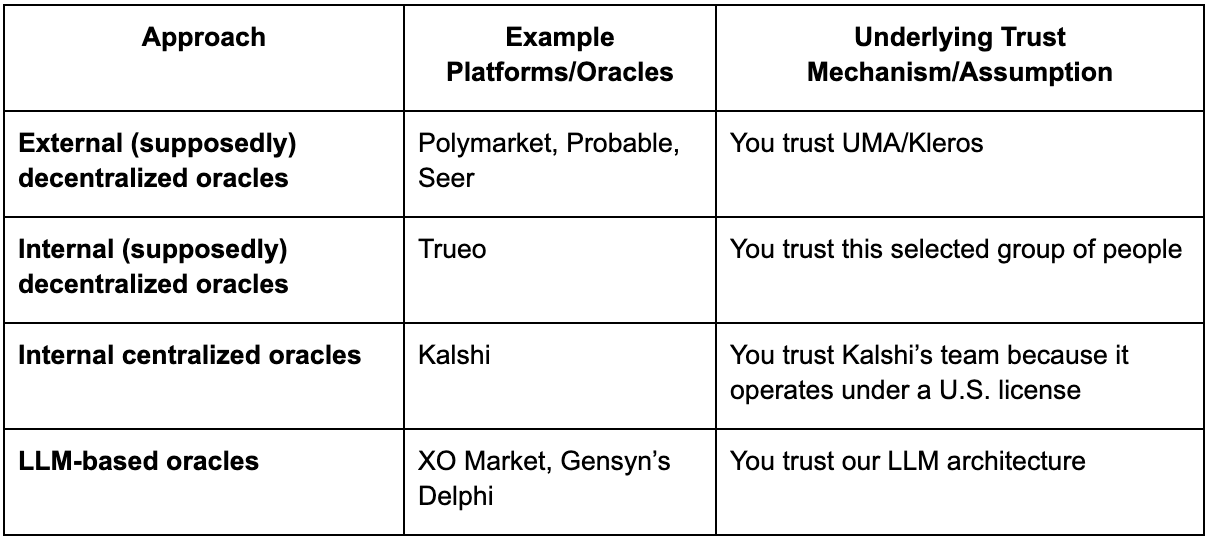
We must stop pretending that any single oracle is “objectively” superior. Trust is subjective, contextual, and often adversarial. A modern prediction market shouldn’t dictate which oracle is right; it should provide the infrastructure for Oracle Pluralism.
The next generation of markets must be built on a flexible, tiered resolution stack:
LLM-Based Resolution for Day-to-Day Operations: using specialized models for near-instant, low-cost day-to-day operations and dispute triage;
Human Oversight (at least until there is broad consensus that LLMs can reliably operate independently): allowing market creators to select the specific oracle system (e.g., UMA, Kleros, or an LLM-agent) that best fits the market’s requirements.
Both Polymarket and Kalshi have monopolized market creation. Permissionless market creation, along with the ability to incentivize liquidity for market creators, is simply a must-have feature for prediction markets. The promise of prediction markets – and the demands of their potential users – cannot be fulfilled with a centralized market creation pipeline.
Prediction markets that optimize for gamblers become casinos. While this approach is understandable, it is not viable in the long run. The likely fate of a prediction market trying to follow the classic bookmaker approach is… to become just another bookmaker or exchange-like venue. This is exactly what is happening with Kalshi (>90% of volumes are in sports markets) and Polymarket (15-minute up-down markets are their most successful market type so far).
Most volume on prediction markets will eventually be generated by autonomous AI systems with varying levels of human oversight. The entire stack — APIs, automation frameworks, documentation — must be architected for these systems from day one, not retrofitted onto a human-first UI. This isn’t a future consideration; it’s a design requirement.
If markets are to become true “truth machines,” they must solve discovery at scale: connecting those who possess knowledge — human or machine — to the markets where that knowledge has edge.
These problems are not independent. Outdated market microstructure and opacity prevent fair pricing. Unfair pricing drives away market makers. Illiquidity kills long-dated markets. Without long-dated markets, prediction markets struggle to move much further than gambling.
The infrastructure to change this exists today. What’s missing is the will to abandon the casino.
No posts
Comments
Nothing yet. Say the first thing.
Sign in to join the conversation.