
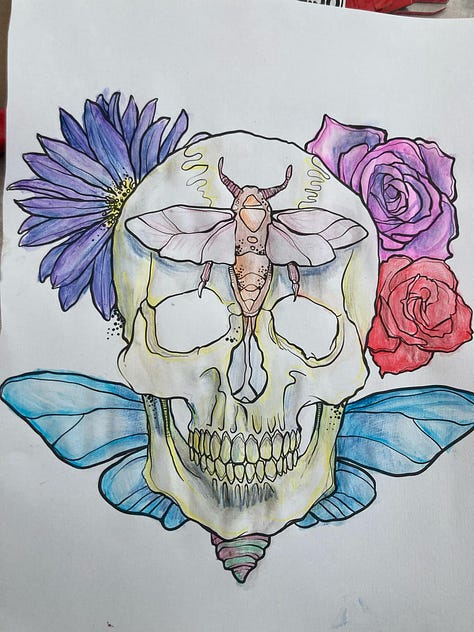
It is Samhain, where the year shifts into the darkness. Life begins to retreat as animals hibernate, plants shed and die, preparing themselves for renewal. This season invites us to draw inward, conserve our energies for the winter months, and truly integrate the lessons of our past as we get ready to set intentions for the new year to come.
So today, I am thinking deeply about how we model our relationship with death and the dead for our children. Halloween has its own magic, with traditions of ghosts and ghouls, vampires and witches, but its approach to death is often steeped in fear and fantasy, wrapped in consumerism.
Samhain, however, offers us a chance to draw close to the mystery of death and to our ancestors, a time to honor those who came before us. As we prepare for our Samhain celebration, I am asking myself; What do I want my children to know about death? What relationship do I want them to have with the dead?
I want them to know they come from a long, long line of humans. I want them to feel rooted in this lineage, to understand that they belong to a story far greater than themselves. I want them to know that, even though the people who came before are no longer with us in a physical sense, they aren’t truly gone. Energy doesn’t vanish—it only transforms, just as spirit and consciousness find new forms. I want them to know that death is not an ending but a transition, one that brings our loved ones into a different way of being close to us.
All my life, I have battled and wrestled with my internal story around death and the one our culture tells. When I was about 6, my best friend’s dad died—he would have been in his early 30s. I remember understanding this with extreme clarity… we would never see him again. I also remember knowing that a story could bring great comfort; in the playground, we played together, imagining him painting rainbows in the sky.
My grandad died when I was 9, and I remember crying on the bus, deeply sad about never seeing him again, only to be told by another girl to “just get over it.” I lost a friend in my early 20s, and shortly after, a relative of my partner died of dementia. I struggled to reconcile those losses, turning to every piece of atheist literature I could find because the idea of a godless life made the most sense at the time. Yet, I went through phases of extreme anxiety around dying, fearing I would be trapped in a meaningless job until my death, my biggest fear being to die without doing anything meaningful.
I know I want my children to have a healthier relationship with death than I grew up with; one that was rooted in fear and separation, causing me no end of anxiety throughout my life. Many cultures around the world celebrate their ancestors and hold deep wisdom around death. Colonialists have often sought to erase these traditions and, with them, the deep reverence they hold for death. Having been raised in Britain, a culture that has both been deeply harmed by colonisation and has caused deep harm by colonising much of the world, I recognise that these cultural narratives around death here have been largely erased. One thing I can do for my kids is to lay the cultural groundwork for them to navigate times of grief with understanding and strength.
So for Samhain, we will create an altar together, full of photos of our dead loved ones. Then we will speak their names and light a candle. As the flame burns, we will remember that their light lives on, their spirits still shining, guiding us, comforting us. We will tell their stories, even small ones—something as simple as how my Nan loved toffee and die hard. Each story is a bridge to them, a way to keep their memories alive. We set a place for them at our table, inviting them to feast with us, weaving them into the present and giving them a place among us. Through these actions, we give death a different story; a story where death is not something to fear or deny but a part of the larger cycle of life, as natural and sacred as the turning seasons.
My hope is that this grounds my children in a different way of being from the one I grew with. I hope they see themselves not as isolated individuals but as part of an ancient line, to know they carry the strengths, dreams, and even the burdens of those who came before them. I hope they know they are held by these connections and supported by them. And when they feel the inevitable weight of mortality, I hope they find comfort in knowing they’re not alone. They walk hand in hand with generations who have lived, loved, grieved, and laughed before them. I hope they understand that whatever traumas our ancestors experienced or mistakes they made were all for them; to enable them to be alive here, in this moment. That love is the thread weaving us together.
I hope they won’t feel isolated from death or fear it. I hope they won’t fear the dead or talking with them. I hope they see that this cycle of birth, life, and death is what makes life so incredible. I hope their relationship with mortality brings them into presence. I hope they grow to understand that death is not the end and that the energy and spirit flowing through the cycle of life are eternal, that they see death more like returning home. I hope they know we can reach out and speak to the dead, honouring them with every flickering candle, every whispered name, and in that way, we can continue our relationship with them long after they are gone.
In this culture we hide death and illness behind hospital walls, we clean it from our lives so we do not think about it. We see this with the news from Palestine and how difficult some people are finding it to bear witness to the suffering and loss. It is so important to honour the dead and acknowledge their stories, yet people feel need to disassociate in order to cope. When we live in fear of the only thing that is certain it serves no one, culturally or individually. The stories we tell ourselves about death make a significant difference in how we navigate our lives with resilience.
Happy Diwali and Samhain to all celebrating the light in the darkness.
Thank you for reading, If you like this do subscribe…
No posts
Comments
Nothing yet. Say the first thing.
Sign in to join the conversation.