Every month, Switch-Lit releases an original collection of five (5) story prompts to help launch your next collaborative fiction journey. Find the latest monthly collection on the Switch-Lit “Prompts” page, or explore our full archive of 100+ prompts.
This month’s theme: Scope
More than a sniper’s lens to kill, a project manager’s line to hold, and a stargazer’s instrument of choice, a “scope” is a snappy thing.
Taking a linguistic lens, we can observe that the word itself is a minor miracle of “etymological snapping”. Its latest iteration marks a rare, cyclical return to its original meaning after centuries of technological intervention and intellectual resurrection.
To trace its evolution is to watch the human mind expand and contract:
The Prehistoric Act (2500 BCE): Its deepest ancestor (spek-) —part of the Proto-Indo-European language native to India, most of Europe, and Central Asia — begins simply as the primal act of human observation.
The Target and Observer (5th Century BCE): In Ancient Greece, skopos looks outside the raw act of observation to now include both the observed object (a target), and the human observer (a spy or watcher).
A Higher Purpose(15th-16th Century): By the Italian Renaissance, scopo was still a physical target at which to draw one’s bow, but enters an abstract realm for the first time to pierce the meaning of a grander aim or purpose in one’s life.
An Open Room (16th-17th Century): In its English language debut, “scope” makes a poetic pivot. Elizabethan era humanists couldn’t fathom a precise target or rigid aim without demanding the freedom to pursue it. The word stretches to mean the space around the target: an open room to freely act, explore, and play.
The Instrumental Boom (17th–19th Century): The philosophical exploration comes back down to Earth as a suffix (-scope) to an explosion of physical instruments built to bend human perception and reality (tele-, micro-, stetho-, oscillo-, kaleido-, etc.)
The Business Restriction (1960s): The post-WWII tech and corporate worlds contract the word into a coding and project management boundary to hold tight against “scope creep”.
The Slang Return (1980s): Finally, modern-ish slang arrives. When we “scope out” a scene today, the corporate borders disappear, and we subconsciously return to that prehistoric act of human observation, nowadays driven less by a hunter-gatherer mindset and more by a social one.
🙈🏹🧐🔭🔬🕵️
Any scope reminds us that human beings think and perceive in circles. Our senses spark the imagination with metaphors. We use metaphors to escape the physical world, only to build new physical worlds out of those metaphors that, in turn, challenge our senses anew.
Here we are, five-hundred years after the word first entered the English language, now exploring our own “open room to freely act, explore, and play.” What unpredictable physical worlds might your shared metaphors necessitate someday?
Inspired by a monthly prompt, but need a writing partner? Join our monthly prompts Subrosa round to get paired with another Switch-Lit writer based on your sign-up preferences.
😶🌫️👹🥸🙈
Subrosa pairings are activated on a weekly basis (by Fridays at 12pm PST). Sign-up for this round ends on the last day of the month.
🃏 You can now also sign up as a “wildcard” writer to skip the weekly wait, get quickly paired without any preferences, and with a random partner on a “first come, first serve” basis. (This is a trial idea meant to help reduce “ghosting” in Subrosa pairings.)
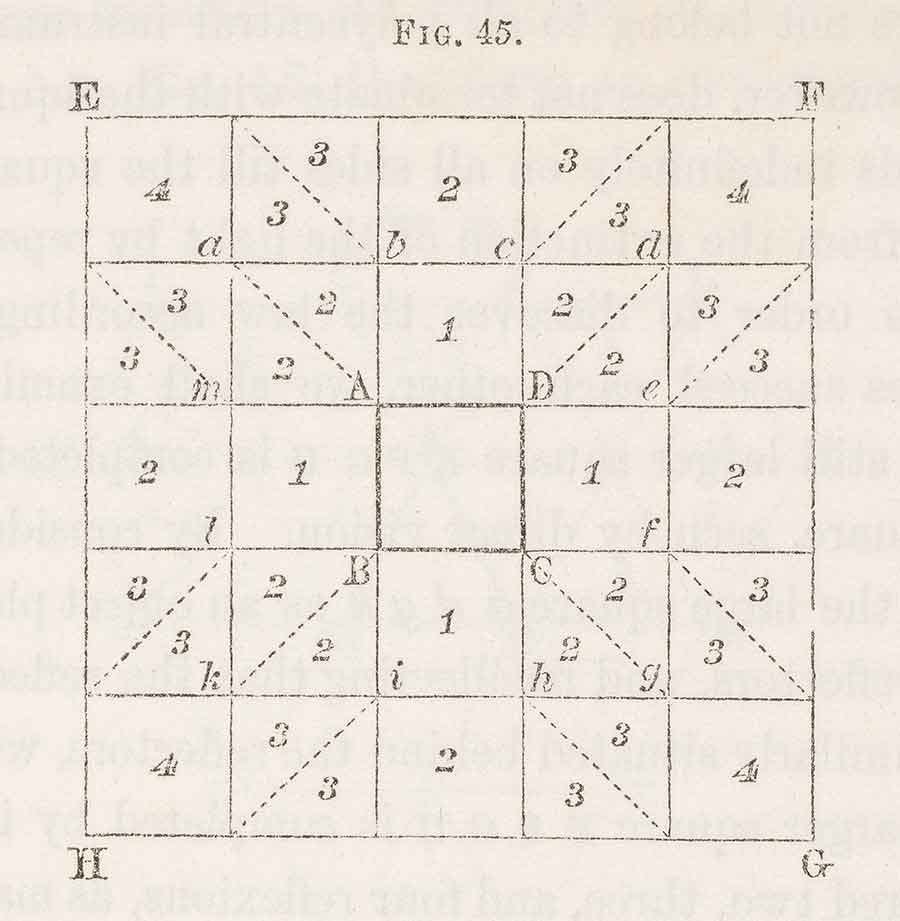
The kaleidoscope was invented on accident in 1816 by Scottish physicist Sir David Brewster during his experiments on the polarization of light. He placed several long mirrors in a narrow brass cylinder to reflect an image of a candle as it traveled from its source to the viewer’s eye. When Brewster looked into the tube, he was surprised to see it had transformed reality in unimaginable ways.
Diagram from A Treatise on the Kaleidoscope (1819) by Sir David Brewster
Brewster named his device the “kaleidoscope,” inspired by the Greek words kalos (“beautiful”), eidos (“pattern”), and skopos (“watcher”) given its ability to create an infinity of beautiful, symmetrical patterns. While he saw it as a useful instrument for “the ornamental arts” and “the purposes of rational amusement”, it has also become a metaphor for finding beauty in life’s complexities.
“Splendour” (2024) by British artist Damien Hirst
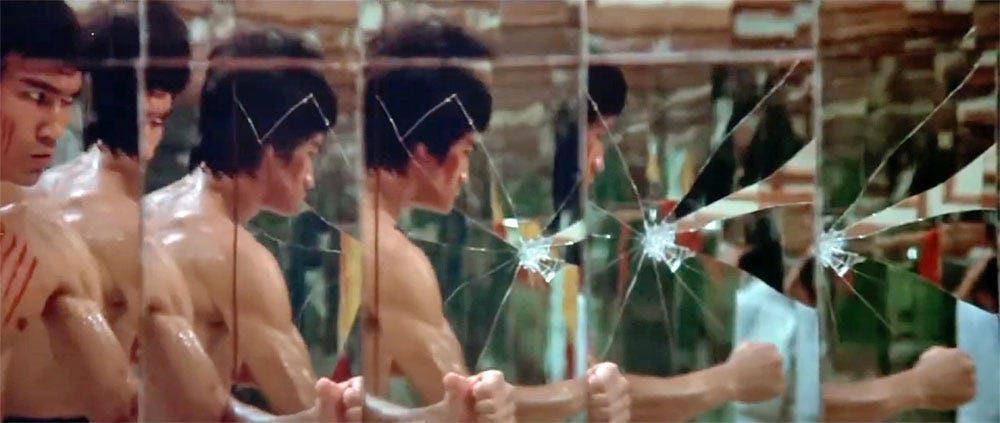
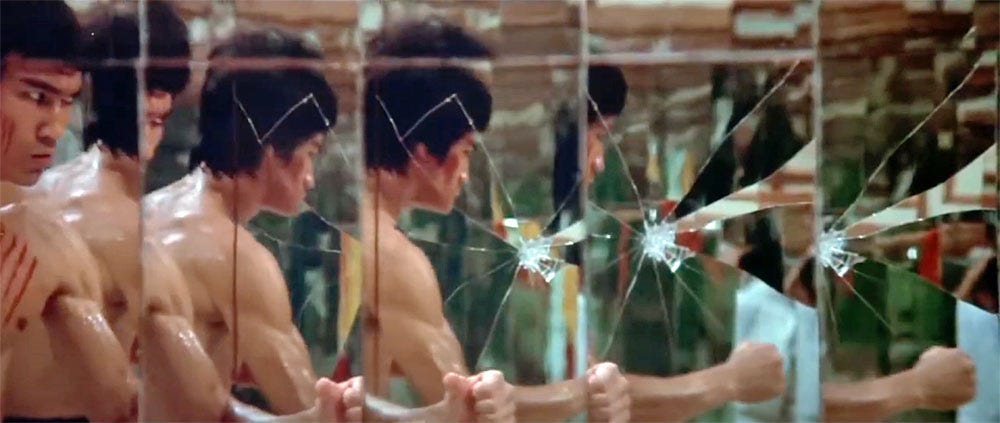
“The Hall of Mirrors” from Enter the Dragon (1973) by Bruce Lee
“Adapt what is useful, reject what is useless, and add what is specifically your own.”
– Bruce Lee
Switch-Lit is on a mission to manifest the collective imagination of diverse writing communities through the connective power of collaborative fiction, poetry, and prose.


Comments
Nothing yet. Say the first thing.
Sign in to join the conversation.