
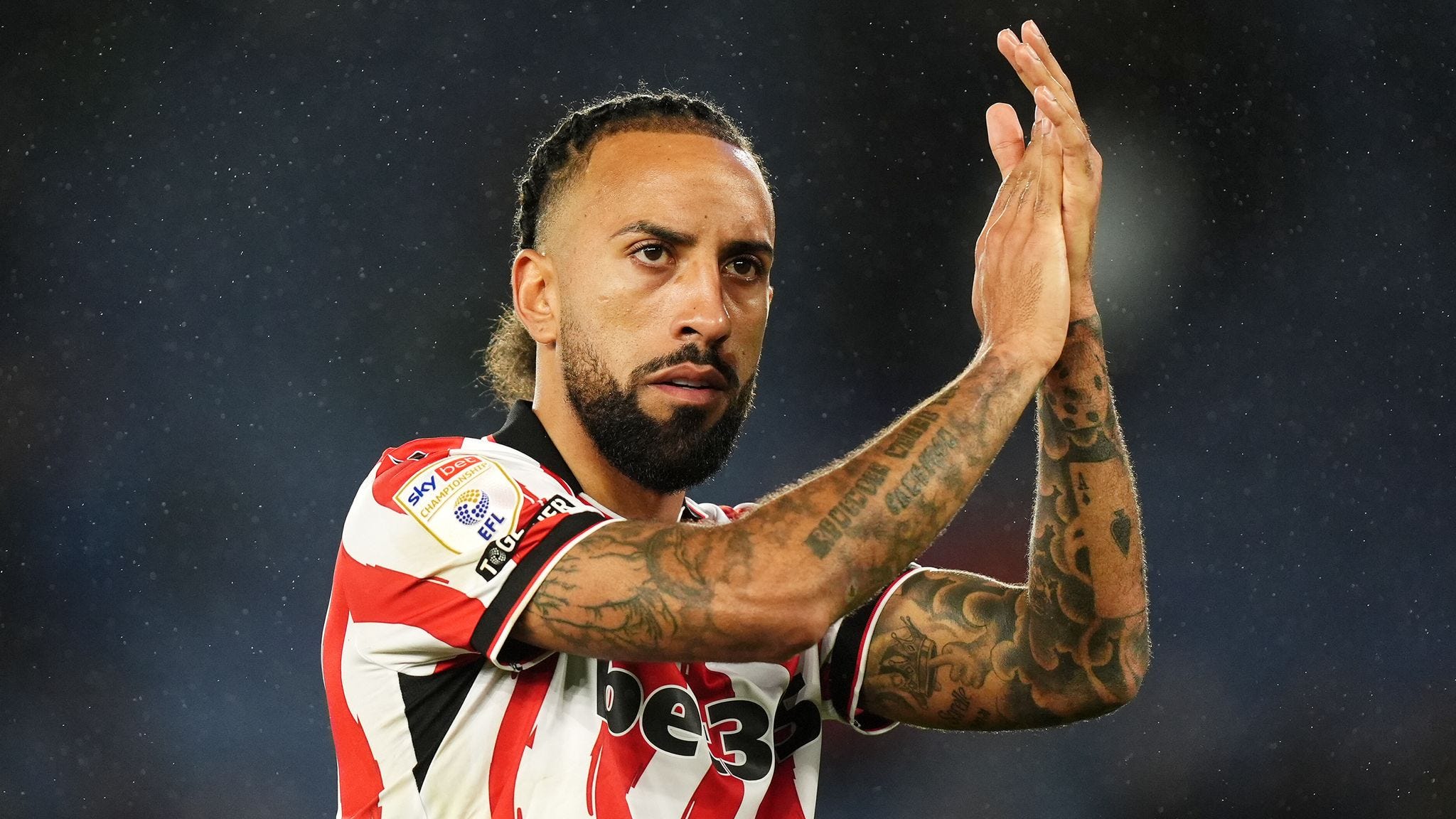
Stoke City fans might just be getting a little excited by this summer’s transfer campaign, as the club has already splashed out more than £20m in an attempt to build a squad that can mount a genuine challenge for the Championship play-offs.
To date they have brought in Ethan Galbraith from Swansea City, Milan Smit from Go Ahead Eagles, Djibril Soumaré from Braga, Luke Graham from Dundee, Svante Ingelsson from Sheffield Wednesday and Josh Griffiths from WBA.
Some optimism is much needed, as Stoke have consistently under-performed since their relegation from the Premier League in 2017/18, finishing in the bottom half of the Championship eight seasons in a row, despite being backed by the wealth of bet365.
Recent results are in stark contrast to Stoke’s time in the top flight, when they finished 9th in three consecutive seasons up to 2015/16.
The club would argue that it has been constrained by the need to comply with the EFL’s Profitability and Sustainability regulations, though it’s also true that they did not make the most of the parachute payments they received after relegation.
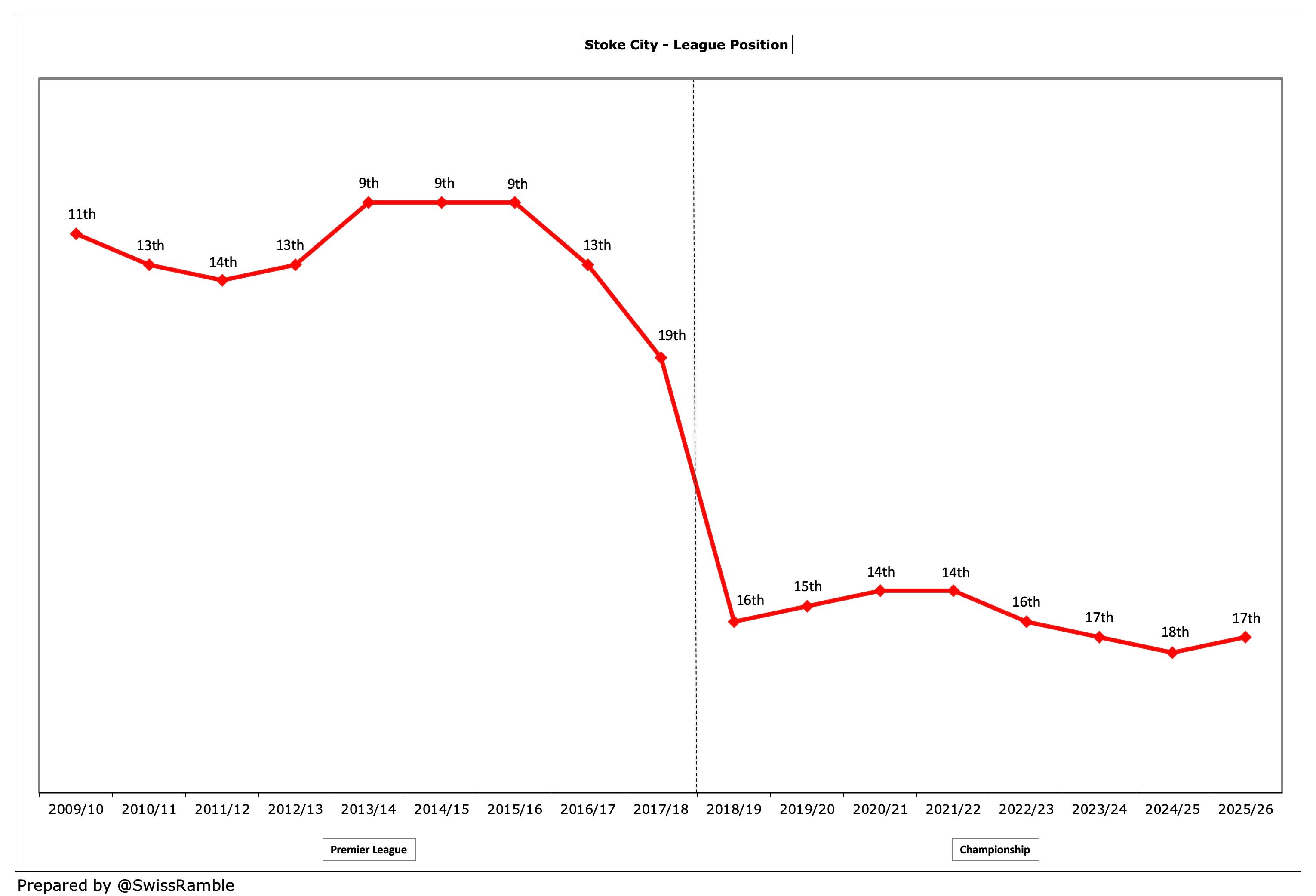
They have not been helped by the frequent changes in manager, which has led to much upheaval in the squad.
An incredible seven managers have been tasked with restoring Stoke’s fortunes on the pitch since the club dropped down to the Championship eight years ago (excluding caretaker appointments).
The current incumbent is Mark Robins, who has been in the hot seat since January 2025, which is a long time by the club’s recent standards.
Despite a disappointing end to the season, Jonathan Walters said that Robins’ position was not under threat,
The sporting director argued, “I think there comes a point in time where you need to offer stability to a football club, stability to players, stability to staff and say ‘actually we’re building something, we’re trying to do something’.”
Indeed, at one stage things had looked promising last season, as Stoke were second in the table in October, but subsequent performances then dropped away, partly because of an injury crisis, which meant that they only won three of their final 20 matches to end up in a lowly 17th place.
The question now is how likely it is that Stoke can improve on recent years, so we will try to better understand the magnitude of the challenge by taking a look at the club’s finances.
The latest available accounts are from the 2024/25 season, so are a full year out of date, but not a great deal has changed in the Potteries, so the figures are still relevant.
On first glance, Stoke’s results in 2024/25 appeared excellent, as they swung from a £25.7m pre-tax loss to a substantial £60.8m profit.
However, this was entirely thanks to the waiver of £90.5m of inter-company loans as part of the demerger from bet365 during the summer of 2024.
If this exceptional item is excluded, Stoke’s loss before tax would have actually widened from £25.7m to £29.7m.
Revenue rose £3.1m (10%) from £32.3m to £35.4m, but this was more than offset by cost growth, as operating expenses increased £3.6m (6%) from £63.0m to £66.6m, while profit on player sales also reduced from £4.4m to £0.2m.
This was slightly mitigated by net interest receivable more than doubling from £0.6m to £1.3m.
The reported profit after tax was even higher at £63.9m, due to a £3.1m tax credit.
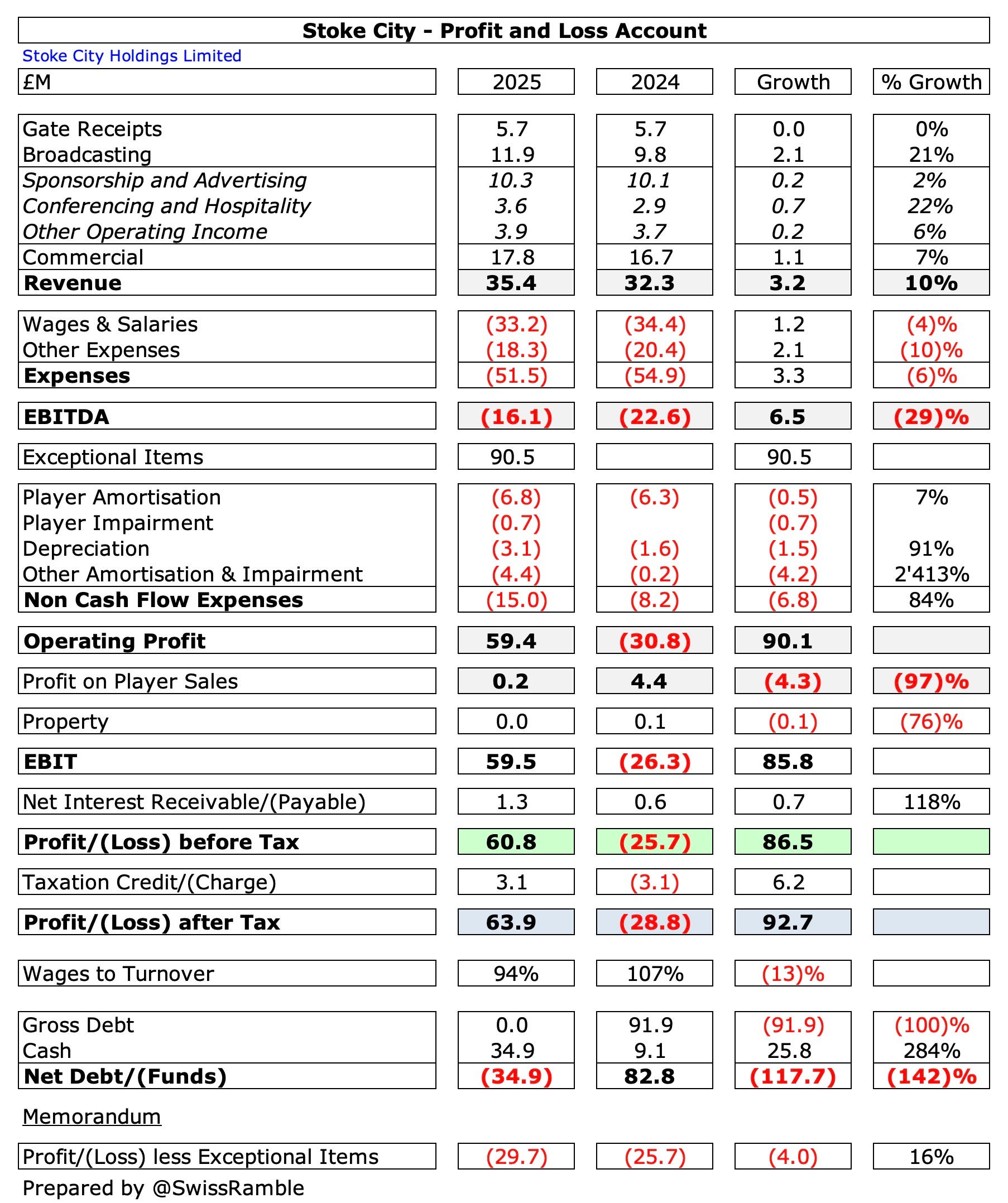
As a technical aside, these figures relate to Stoke City Holdings Ltd. The football club accounts exclude the loan write-off, so they show a £28.3m pre-tax loss.
Wages, depreciation and other impairment are all lower in the football club, but other expenses are higher.
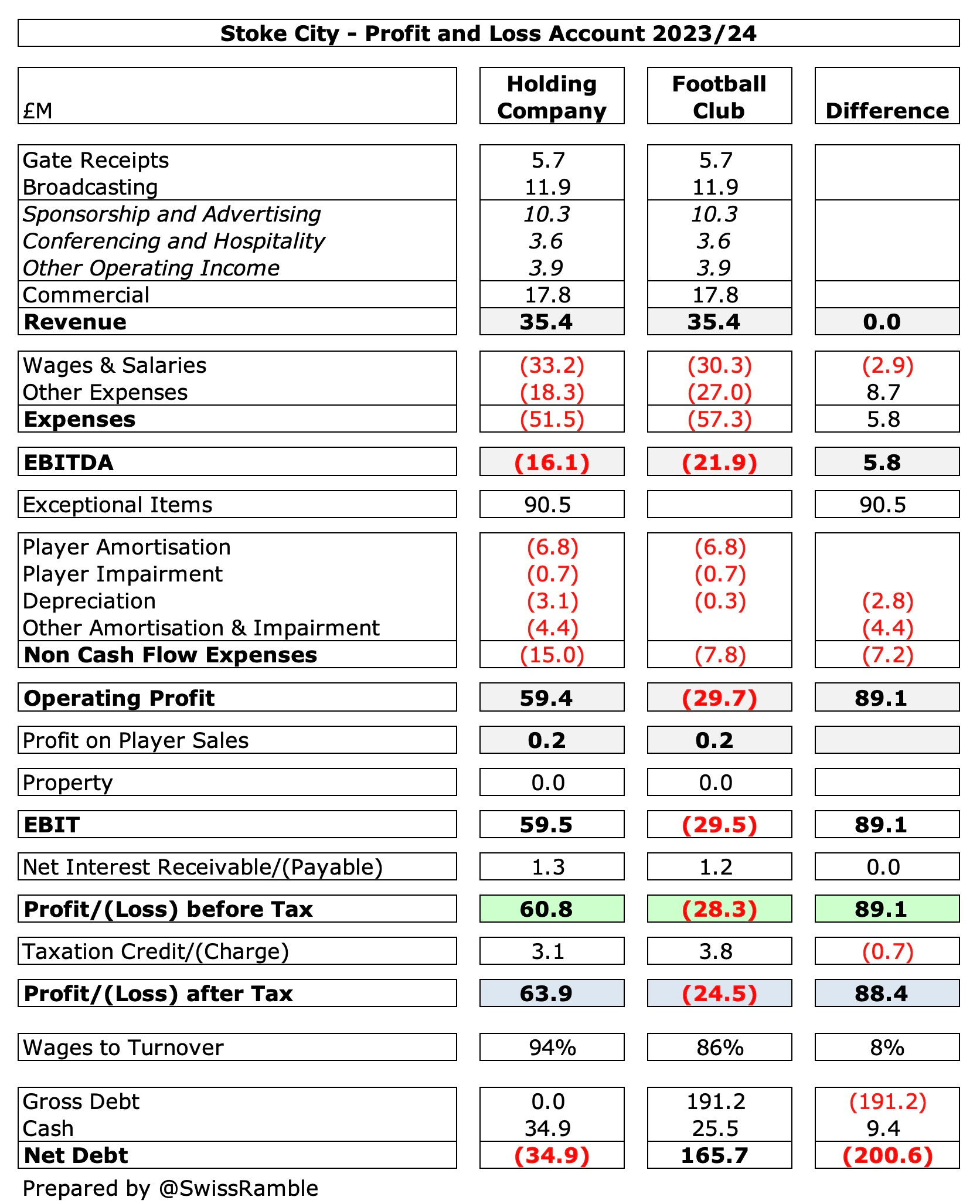
The main driver of the revenue growth was broadcasting, which rose £2.1m (21%) from £9.8m to £11.9m, due to an uplift in central TV rights, though commercial also increased by £1.1m (7%) from £16.7m to £17.8m. Gate receipts were flat at £5.7m.
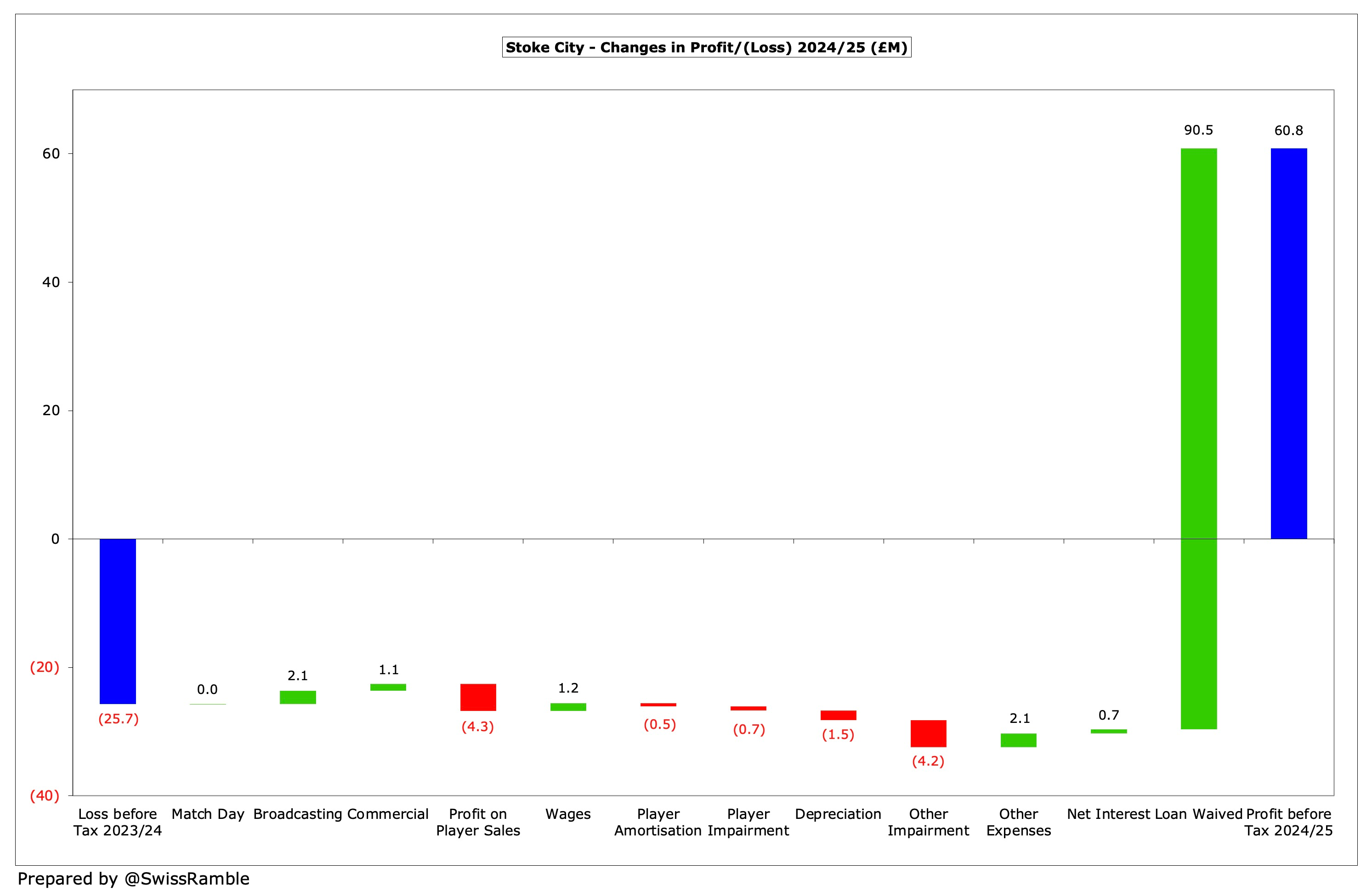
It was a mixed bag on staff costs, as Stoke cut the wage bill by £1.2m (4%) from £34.4m to £33.2m, but player amortisation increased by £0.5m (7%) from £6.3m to £6.8m.
Depreciation almost doubled from £1.6m to £3.1m, though other expenses were trimmed £2.1m (10%) from £20.4m to £18.3m.
In addition, there were a couple of once-off charges: £0.7m player impairment and £4.3m other impairment.
Comments
Nothing yet. Say the first thing.
Sign in to join the conversation.