
It’s difficult to keep up with everything that’s going on at Leicester City.
As the club’s chairman, Aiyawatt “Top” Srivaddhanaprabha said, “It’s like a movie, like a super drama on Netflix or something. Too many dramatic things have happened at the club.”
Most recently the Financial Times reported that Leicester’s Thai owners, who acquired the club back in 2010, have asked investment bank Citigroup to sound out potential buyers.
This came as a bolt from the blue, especially after Top’s comments in January, “Selling the club is not the way to exit. I have to make sure that I complete everything that I did here before I want to leave. I still love it here. I want to make sure the club is successful again.”
However, it is fair to say that the relationship with the supporters has deteriorated, with ‘King Power Out’ banners being seen in the stands on a number of occasions.
Furthermore, King Power’s core business, duty free shopping at airports, has been hit by a drop in visitors to Thailand in the wake of the pandemic, especially from China, leading to a restructure of its operations.
Last season’s relegation from the Championship to League One meant that Leicester became only the fifth club to suffer back-to-back relegations to the third tier. This is only the second time that they have ever played at this level, the last occasion back in 2008/09.
In fact, Leicester have suffered three relegations in the last four seasons, the only bright spark being their promotion back to the Premier League on 2023/24, but it has been downhill since then.
Going down last season represented a significant under-performance, as they enjoyed one of the highest budgets in the Championship, boosted by a hefty parachute payment, and a squad that contained internationals and numerous players with Premier League experience.
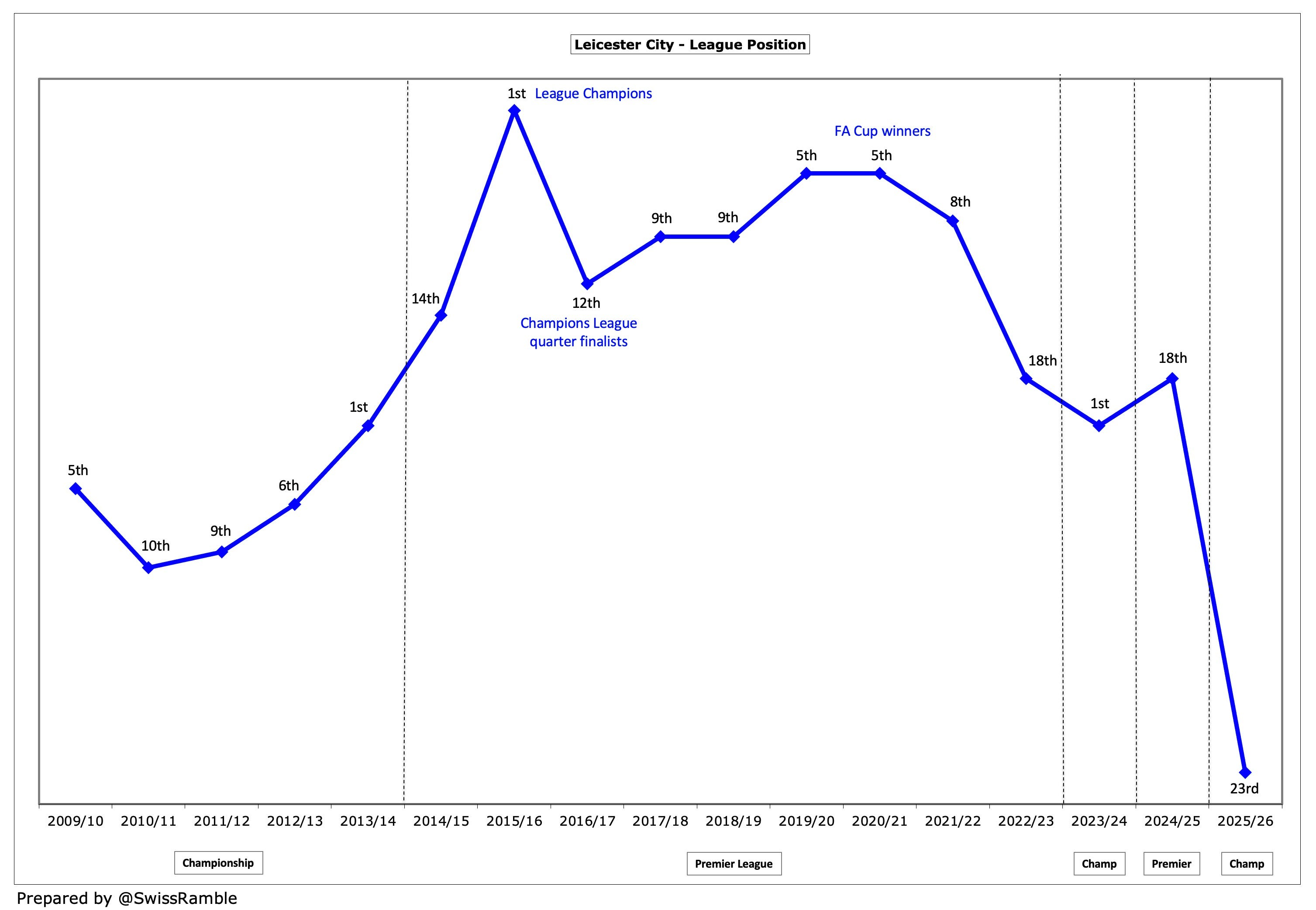
Leicester had enjoyed nine consecutive seasons in the Premier League before their relegation in 2022/23, including a purple patch when they spectacularly upset the odds to win the title in 2015/16. They followed up this remarkable success by reaching the Champions League quarter-finals, where they were only beaten by Atlético Madrid.
They also won the FA Cup in 2020/21, when they defeated Chelsea, while they twice finished fifth, narrowly missing out on again qualifying for the lucrative Champions League.
However, results turned after the coronavirus pandemic, with the club relegated to the Championship in 2022/23, which seemed somewhat inexplicable.
Most worryingly, Top still seems confused about what went wrong, “If you ask me about that time, I still do not understand why we go down. I have no idea. I think the main problem was we had no experience of a relegation fight.”
Whatever the reasons, the fact remains that just ten years after winning the league, Leicester now find themselves in League One.
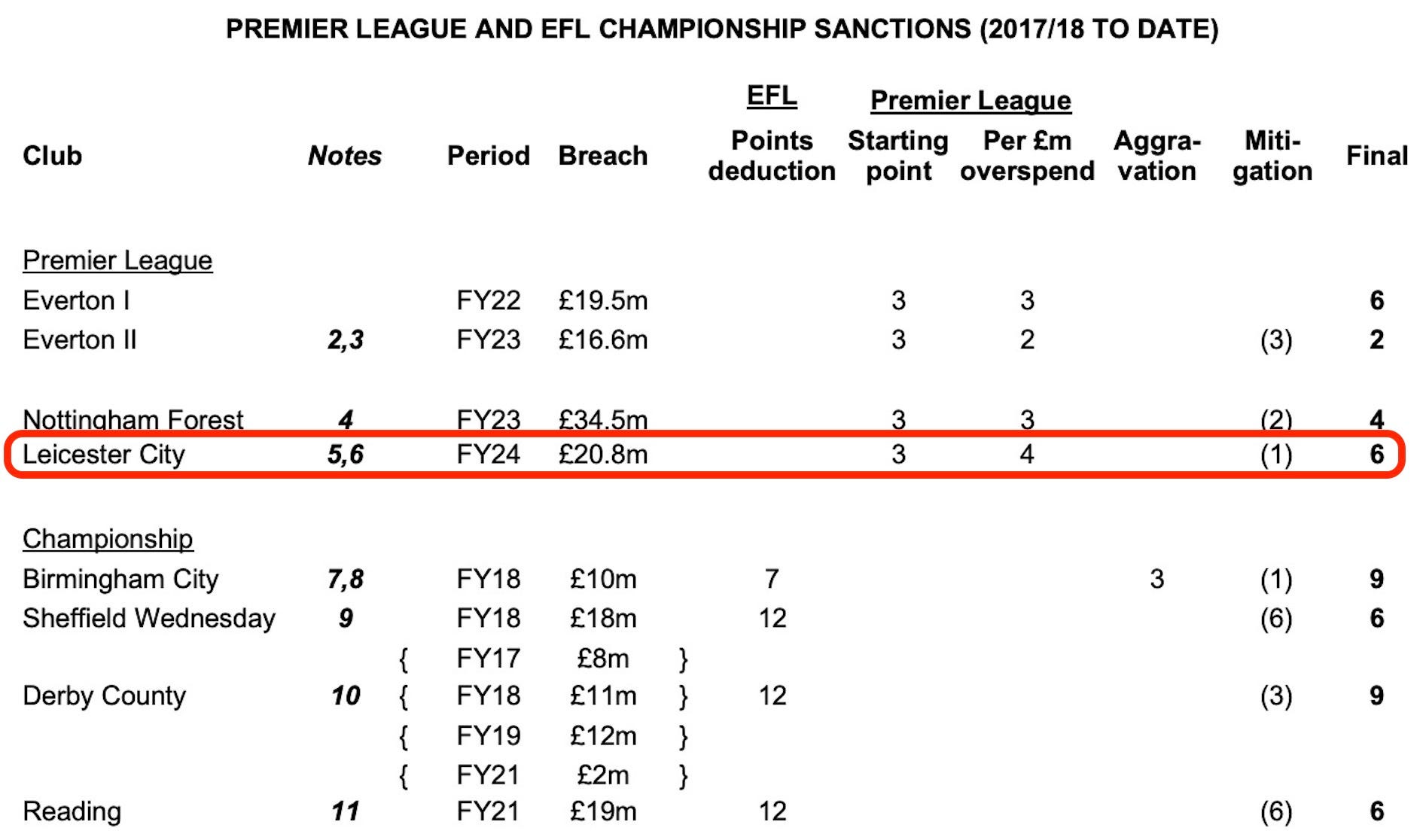
Leicester weren’t helped by being hit with a six-point deduction for breaching the EFL’s Profitability and Sustainability Rules (PSR) by £20.8m for the 3-year monitoring period up to 2023/24. The club appealed, but every one of its arguments was dismissed.
They had managed to avoid a similar fate for the 2022/23 assessment, when they successfully argued that they could not be charged for a breach, as they were no longer a member of the Premier League when the PSR calculation was carried out, having been relegated to the Championship.
Their legal team played a blinder here, effectively winning the appeal on a technicality (or by finding a loophole in the rules), but this ultimately turned out to be something of a Pyrrhic victory when the authorities finally caught up with them.
Whatever people might think about PSR, Leicester’s breach was essentially driven by their own actions, specifically by spending their money badly on transfer fees and wages.
On the basis that “it never rains but it pours”, Leicester are now also facing a claim for damages after Leeds United started legal proceedings, having been denied automatic promotion in 2023/24, when the Foxes were found to have broken financial rules.
Leicester won the Championship title that season, while Leeds lost in the play-off final, so they had to play another season in the second tier, losing out on Premier League riches.
This follows Burnley’s recent legal victory over Everton, when they were awarded £35m after they were relegated in a season when Everton reached PSR in 2021/22.
Leicester’s decline can also be attributed to the many changes the club has gone through in the last few years at all levels: managers, players, chairman and executives.
As former captain Ricardo Pereira explained, “It’s a lot of things that went wrong. We’ve had different managers, different players, and it didn’t work out.”
Having just appointed Russell Martin, the club is now on its ninth manager in just over three years. Since Brendan Rodgers was sacked in April 2023, Leicester have experienced significant upheaval.
Dean Smith completed the 2022/23 season before Enzo Maresca led the Foxes to promotion from the Championship, though the Italian’s success led to him being headhunted by Chelsea.
The board then made the somewhat strange decision to appoint former Nottingham Forest manager Steve Copper, given the two clubs’ rivalry, and he lasted less than six months. They then opted for Ruud van Nistelrooy, a Manchester United legend as a player, but painfully inexperienced as a manager.
Last season alone featured three different managers: Marti Cifuentes, caretaker Andy King and Gary Rowett.
Foxes fans will hope that they get the Russell Martin that led Southampton to promotion from the Championship in 2023/24, as opposed to the version that presided over the Saints’ failure in the Premier League or indeed the one that was sacked by Rangers after a fairly disastrous period.
Following relegation to League One, many players have left Leicester on the expiry of their contracts, including Ricardo Pereira, Patson Daka, Jordan Ayew, Asmir Begovic, Jamaal Lascelles, Wanya Marcel and Silko Thomas, while Jannik Vestergaard was released.
In addition, the loan spells of Jordan James, Aaron Ramsey, Joe Aribo, Dujuan Richards and Divine Mukasa came to an end, so those players returned to their parent clubs.
They have made a fair bit of money after selling Abdul Fatawu to Ipswich Town for £20m and Jeremy Monga to Manchester City for £10m, while the loan of Bilal El Khannouss to Stuttgart was made permanent for £15m. In addition, Harry Winks and Amani Richards moved to Cagliari and Barnsley respectively.
In short, there has been significant turnover in the squad this summer.
Of course, Leicester were also hit hard by the tragic death of owner Vichai Srivaddhanaprabha from a helicopter accident outside the stadium in October 2018 with control passing to his son Aiyawatt.
Top held his hands up after the second consecutive relegation, “Relegation to League One is now confirmed. As chairman, that responsibility sits with me. There are no excuses. I am truly sorry for the disappointment we have caused.”
There have been other changes off the pitch with a significant restructure of senior management.
Chief executive Susan Whelan was replaced by finance director Kevin Davies, who focuses on the business and financial side of the club, while director of football Jon Rudkin assumed the role of chief football officer, overseeing all aspects of the football side of the club. In addition, James McCarron was appointed as sporting director, reporting to Rudkin.
Fans have been unhappy with the club’s poor leadership and bad decision-making, so the new team has a lot of ground to make up in their eyes.
Any potential investors will obviously be very interested in Leicester’s financial situation, so let’s take a look at the latest available accounts.
Unfortunately, these are only from the 2024/25 season, which means that they are a full year out of date and cover the most recent Premier League campaign, when they were relegated to the Championship after finishing 18th, some 13 points from safety.
That said, the 2023/24 comparatives do provide a useful indication of how the club’s finances would have looked last season, when they competed in the second tier.
Despite promotion to the Premier League, Leicester’s pre-tax loss significantly increased from £19.4m to £71.1m, largely due to a steep reduction in profit on player sales from £71.8m to just £7.3m and the absence of £12.5m non-recurring other operating income.
Revenue rose £81.2m (77%) from £105.3m to £186.5m, but this was partly offset by an increase in operating expenses, which were up £56.4m (28%) from £198.9m to £255.3m. Net interest payable slightly educed from £10.4m to £9.8m.
Chief executive Kevin Davies said, “These accounts reflect the reality of returning to the Premier League. Our revenues increased significantly during the year, but so too did the costs of trying to compete at that level, and the loss we are reporting is a substantial one.”
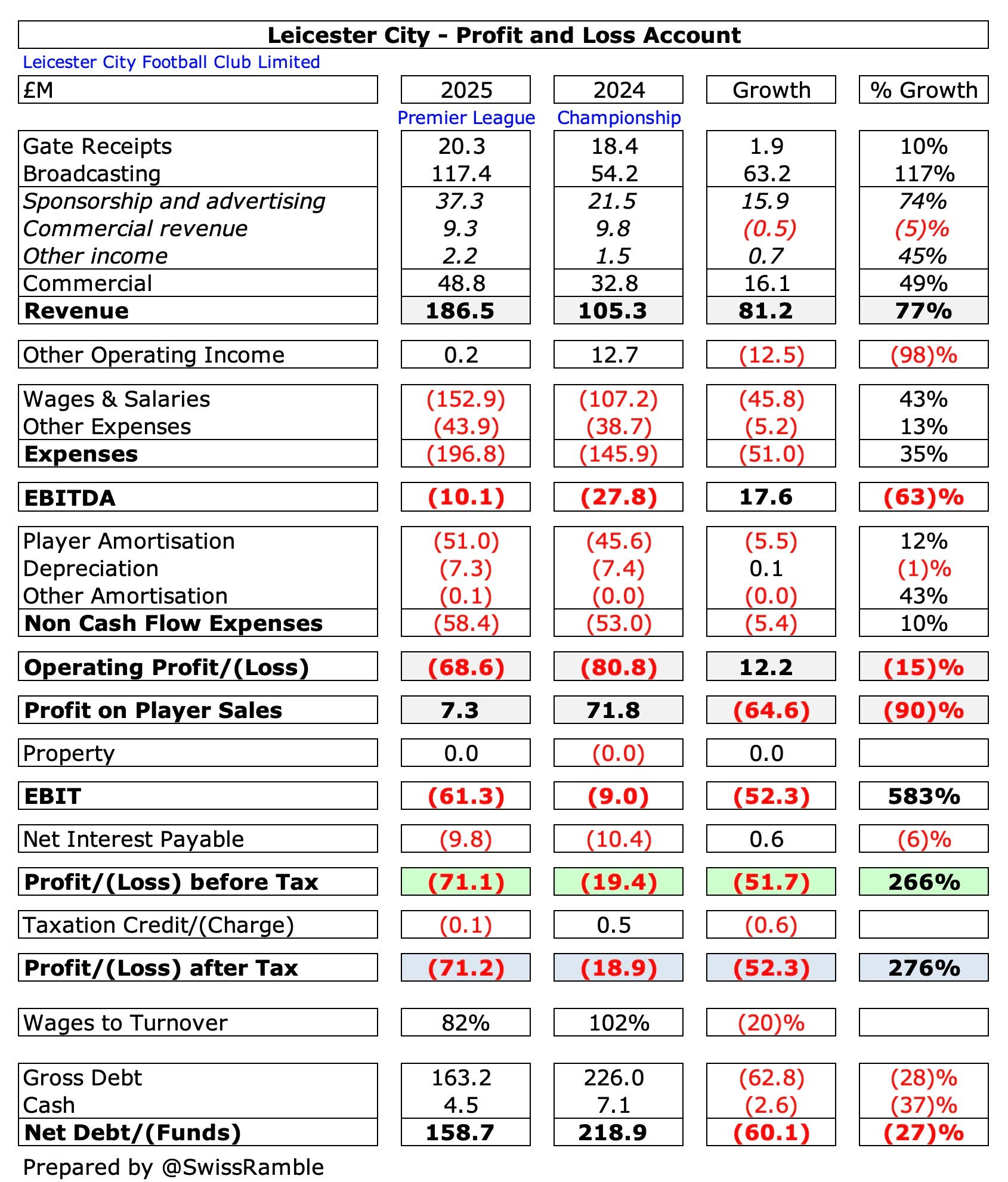
The main driver of Leicester’s £81.2m revenue increase was broadcasting, which more than doubled, rising by £63.2m from £54.2m to £117.4m, as the rights deal is significantly higher in the Premier League than the Championship.
The other revenue streams were also up as a result of promotion, with commercial rising £16.0m (49%) from £32.8m to £48.8m, while match day increased £1.9m (10%) from £18.4m to £20.3m.
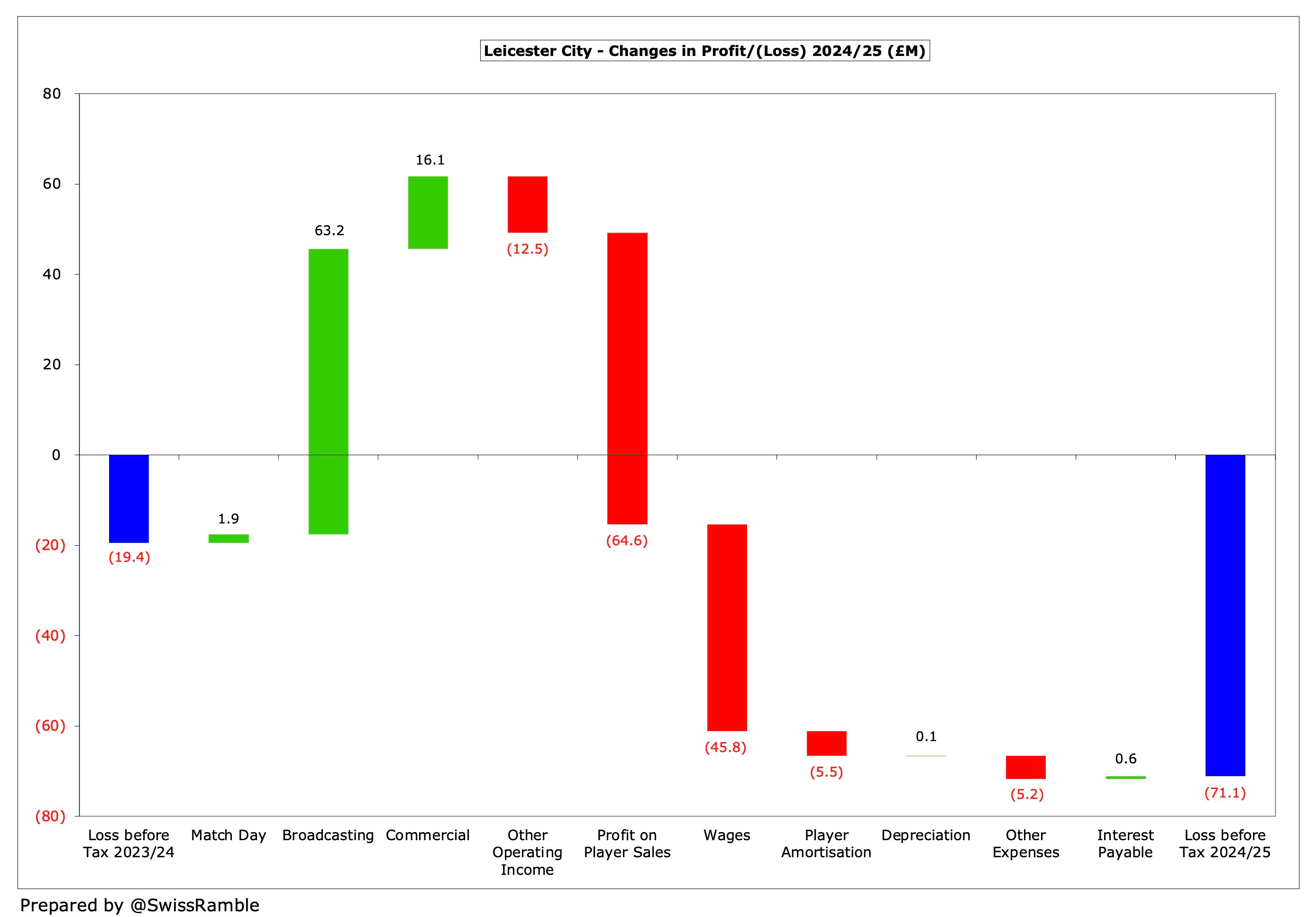
As would be expected, Leicester’s wage bill was a fair bit higher in the Premier League, rising £45.7m (43%) from £107.2m to £152.9m, though the other staff cost, player amortisation, was only up £5.4m (12%) from £45.6m to £51.0m. In addition, other expenses increased by £5.2m (13%) from £38.7m to £43.9m.
Comments
Nothing yet. Say the first thing.
Sign in to join the conversation.