
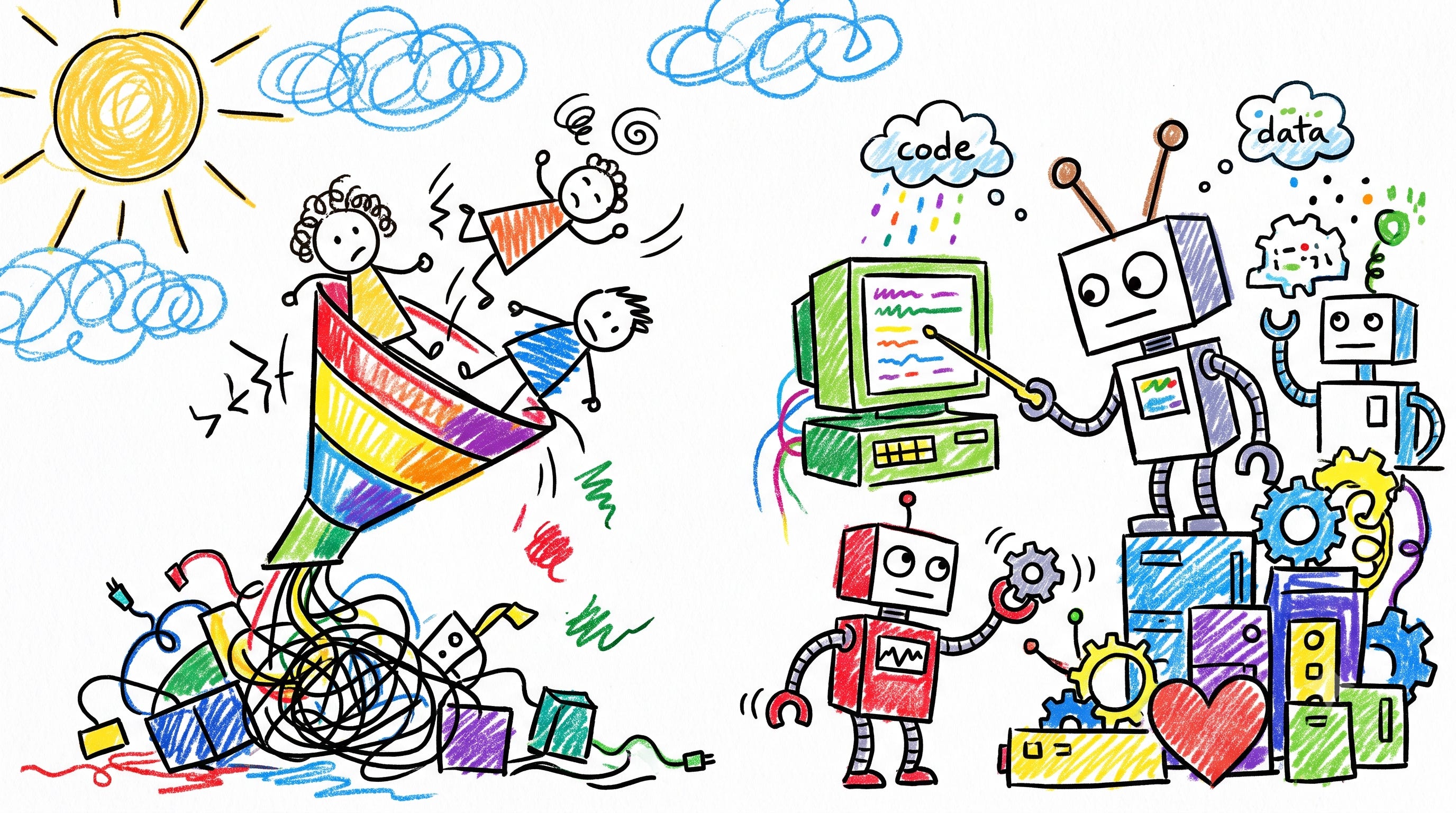
While losing sleep over agentic frameworks and prompt-injection vectors, we’ve probably been completely ghosting marketing over the last couple of releases. I mean, we shared links, but never really took the time to comment it. Well, it turns out that while we were busy building the AI future, the suits actually figured out how to weaponize it, and they’re quietly winning corporate battles and closing deals in this space right now🤬
The big takeaway from this week’s stack of links is a brutal reality check: search is no longer about farming cheap clicks with blue links, because LLMs are summarizing your hard work into brief answers while withholding the citation 76% of the time. If you want your business or code to survive the impending collapse of traditional blogging, you have to ditch the keyword stuffing and architect an open, machine-readable semantic core that AI bots can actually crawl and recommend.
Back to our comfort zone: deep tech specs, framework updates, and avoiding human interaction at all costs. The big theme is that the AI hype wave has officially collided with software engineering, yielding highly practical results. Vercel’s dedicated agent frameworks and Apple’s Safari MCP servers for local LLM DOM debugging prove that making apps “agent-ready” is the new baseline. Meanwhile, AI code generation hasn’t replaced engineers; it has simply shifted structural bottlenecks to pull requests, code reviews, and dependency security.
Just when you thought you were safely hidden in your terminal writing elegant edge functions, AI has evolved from simple autocompletion into systemic disruption. Low-effort software generation and boilerplate templates are dead; you can’t unit-test your way to human taste. As Chrome’s Agent-Ready Toolkit and WebKit protocols bypass traditional web design to speak directly to machines, tech stacks are evaluated on API quality and semantic clarity over polished UIs. With code generation commoditized, your value as an engineer shifts from typing speed to orchestrating complex, sandboxed agent harnesses without hidden technical debt.
Happy reading.
PLEASE🙏 Should you find emails from SWIPE unwanted or annoying, unsubscribe. If you’re interested in learning how and when you might end up in SWIPE and what you can expect in the future, check it out here.
RAG vs Graph RAG vs Agentic - An architectural breakdown exploring the key differences, ideal use cases, and evolutionary shifts between standard Retrieval-Augmented Generation (RAG), Graph RAG, and agentic AI systems. By ByteByteGo Newsletter.
Influencer marketing for startup founders: a lean playbook for pre-Series-A - A tactical guide outlining how early-stage startup founders can run high-impact, affiliate-first influencer marketing campaigns using tight, relational nano-creator strategies rather than massive enterprise budgets.
👀Reimagining eCommerce: Crystallize and the Semantic Core for the Agentic Era - An exploration of how modern commerce platforms must shift away from page-based models to establish a structured semantic core that can be effectively read, trusted, and navigated by both humans and autonomous AI agents.
YouTube shorts vs long-form content: How to find the right content mix - A strategic comparison showcasing how brands can balance high-reach short-form video discovery engines with deep-engagement long-form content libraries to optimize user watch time and subscriber loyalty.
Organic vs paid social media: Everything you need to know - An in-depth comparison detailing how to build a unified marketing footprint by blending organic social relationship-building with targeted, scalable paid ad campaigns.
6 content audit workflows to build in Claude - A practical framework detailing how content teams can turn one-off generative AI prompts into scalable, repeatable workflows within Anthropic’s Claude to unearth topical gaps and audit brand consistency.
📊New Research from Similarweb: How AI Brand Mentions Influence Direct Visits & Traditional Search Queries - An analytical look at new data showing how getting recommended by AI engines drives a measurable lift in subsequent direct website visits and branded navigation queries for major consumer businesses.
How AI Mentions and Cites Your Brand (New Study) - A comprehensive data study tracking 12,000 AI responses to analyze why large language models frequently mention brands in text conversations while only offering actual source citations roughly one-quarter of the time.
The Great Blogging Collapse: What Happened to 100 Successful Blogs? [Study] - A multi-year cohort study analyzing the staggering traffic declines experienced by prominent independent publishers following Google’s updates and explaining why authentic, firsthand experiential content is the only remaining path to survival.
How to Perform a Complete SEO Audit in 20 Steps - A thorough masterclass updating traditional site auditing techniques for modern search requirements, mapping out technical, architecture, and AI-bot visibility optimizations.
My honest opinion about Personal Branding (as a B2B Marketer) - A candid B2B strategist’s perspective detailing the practical advantages, common pitfalls, and sustainable alignment techniques needed to build an authentic personal brand layout that supports real business growth. By Strategic Marketing Bites.
Marketing on Reddit: How to reach and connect with your audiences - A comprehensive guide exploring how brands can navigate Reddit’s unique community rules to secure unfiltered consumer insights and boost their overall placement in search engine results.
Google Ads Unveils New Overview Powered by Gemini - An announcement outlining the integration of Google’s Gemini LLM into ad management dashboards to automatically surface performance trends and generate contextual text summaries for PPC campaign optimizations.
💰What Is Subscription Ecommerce? Models, Examples, and How to Build for Recurring Value - A structural deep-dive illustrating how subscription models must transcend basic automated monthly billing mechanisms to offer integrated, relationship-focused digital or physical customer experiences.
Build for asking: How to make your content count in the age of AI search - A content strategy manifesto explaining why brands must pivot from classic keyword-first targeting toward question-first planning to effectively claim visibility in citation-heavy AI-driven answers.
Theory of constraints, AI, and code review - An architectural examination of why AI-driven code generation shifts the engineering bottleneck directly onto pull requests and code reviews, rendering extra coding speed useless without optimizing the review pipeline.
Lies, Damn Lies and Database Benchmarks - A technical deep-dive evaluating the ClickBench suite to demonstrate how subtle modifications in process persistence and database architecture heavily alter ranking metrics.
Building Event-Driven Systems That Can Recover With Confidence - An exploration of “Recovery Contracts” as a structured approach to building predictable replayability and state reconciliation safeguards into Kafka-based architectures.
Component Communication Patterns in React Applications - A breakdown mapping out standard React state transfer patterns, comparing when to stick with simple props or elements composition versus reaching for heavy context hooks.
✨Next.js 16.3: Instant Navigations - An announcement breaking down new tooling that automatically prefetches a single loading layout shell per distinct route to bring instantaneous single-page app responsiveness to server-centric builds.
Introducing eve - A product launch unveiling an open-source, filesystem-first TypeScript framework designed to supply out-of-the-box sandboxed compute, human approval steps, and durable multi-channel execution loops for AI agents.
Coding an Extension that Summarises Web Pages with HTML, CSS, and JS - A step-by-step beginner-friendly tutorial on assembling a custom web extension that parses on-screen content to generate brief text summaries.
Introducing the <usermedia> HTML element - A technical overview detailing Chrome’s shift from imperative JavaScript capability calls toward a secure, declarative, browser-controlled element for native camera and microphone streams.
How Kent Beck shapes the software engineering industry - A profile and podcast interview tracking the foundational history of TDD and Agile, where industry pioneer Kent Beck warns that rapid AI code accumulation is running ahead of our ability to accumulate trust.
Most rewrites serve the engineer, not the business - A sobering reflection arguing that long-running legacy code represents a battle-tested ledger of hidden bug fixes that shouldn’t be discarded unless a quantifiable velocity tax or dependency vulnerability forces a rewrite.
Learn to Code - An educational essay exploring the mental shifts required to build software, emphasizing logic composition and data flow structures over raw syntax rote memorization.
Why AI Hasn’t Replaced Software Engineers - An analytical look at the limits of current large language models, explaining that engineering remains a complex process of systems integration, business constraints management, and domain alignment that goes far beyond typing code.
6 security settings every GitHub maintainer should enable this week - A guided security blueprint highlighting immediate, free guardrails open-source maintainers can use to protect their defaults from compromised dependencies and push-protection leaks.
Introducing the Safari MCP server for web developers - An announcement detailing WebKit’s implementation of the Model Context Protocol, enabling local coding agents to natively inspect the DOM, parse console failures, and audit accessibility flows directly inside Safari.
How to apply professional design principles in AI app development - A visual design manifesto outlining how to move past sterile, utilitarian AI layouts by injecting fundamental principles like visual weight, contrast, and three-tier hierarchy into your generated interfaces.
Hidden Technical Debt of AI Systems: Agent Harness - A technical deep-dive breaking down the orchestration layers sitting between LLMs and their execution environments, warning that overly complex, customized agent harnesses are fast becoming massive architectural liabilities.
✨The End of Storefront Boilerplate: Why Templates are Technical Debt in the AI Era - An architectural look at how ready-made templates and lazy data modeling create restrictive technical debt, calling for a shift to skill-based, semantic configurations that AI agents can natively navigate.
OpenAI Codex lead on the new shape of product work - An inside interview with Andrew Ambrosino exploring how generative tools have completely flipped the product cycle, shifting the most valuable human engineering capability from raw code output to human “taste.” By Lenny’s Newsletter.
You can’t unit test for taste - A engineering reflection explaining that while AI can infinitely validate syntax and test coverage parameters, it lacks the subjective artistic empathy needed to refine intuitive user interfaces.
The AI era requires a different kind of growth playbook - A growth engineering analysis detailing how the commoditization of software creation requires software businesses to pivot from simple feature velocity toward usage-based and community-moat acquisition tactics. By Elena’s Growth Scoop.
AI and Liability - A sober legal assessment from security expert Bruce Schneier tracking the impending shift toward holding software companies strictly liable for the real-world operational failures and hallucinations of their deployed agents.
Claude Fable 5 and Mythos 5 - An API announcement introducing Anthropic’s latest specialized model derivatives tailored explicitly for complex creative structure tracking and long-context deterministic reasoning loops.
How ChatGPT Picks Sources - A technical breakdown detailing how OpenAI’s hidden retrieval pipelines rank and extract live content data, prioritizing highly structured semantic authority over traditional keyword density.
Software Engineering in the Age of AI - A reflective article detailing why engineering is evolving from an exercise in manual code writing into a practice of systemic supervision, system boundary enforcement, and token orchestration.
How we really build production-grade AI agents: Beyond models toward data and API quality - An architectural roadmap proving that functional autonomous agents are entirely bottlenecked by the technical clarity, deterministic guarantees, and typing precision of your existing API ecosystem.
What’s next for AI? - A developer perspective tracking the ongoing shift from chat-centric prompt boxes to silent, background multi-agent workflows running inside sandboxed operating environments.
AI-First Operations: Compounding Engineering Productivity - An operational breakdown showing how integrating deterministic AI loops directly into monitoring frameworks accelerates site reliability incident response and system self-healing.
5 ways I use AI to think better - A productivity layout demonstrating how to use LLMs as adversarial sounding boards for restructuring logic loops, refining outlines, and challenging cognitive biases. By Wonder Tools.
The State of CLI Coding Agents in 2026 - A technical review comparing terminal-bound programming assistants, analyzing their context window utilization, directory manipulation capabilities, and error recovery rates.
ChatGPT vs Gemini vs Claude: How they crawl the web - A visual systems deep-dive tracing the network behaviors, request headers, and algorithmic parsers used by major labs to fetch real-time data for search queries. By ByteByteGo Newsletter.
Teaching AI to write less like AI - A practical prompting guide highlighting how to systematically strip out programmatic fluff, corporate buzzwords, and predictable transition phrases from model text outputs.
Training your PMs on AI tools is the easy part - A management essay explaining that the true friction of AI adoption isn’t teaching teams how to write prompts, but completely rewiring organizational KPIs to reward fast outcome validation over raw feature output.
The Agent-Ready Toolkit for Web Developers - An engineering announcement detailing new browser protocols designed to expose interactive site accessibility trees directly to local LLMs for reliable browser automation.
ChatGPT performance benchmarking - A technical dashboard tracking real-world time-to-first-token latency, token-per-second velocity, and prompt-caching cost efficiencies across current public APIs.
Cloudflare Workers and Hyperdrive with TanStack Start - A full-stack deployment tutorial walking through edge database pooling and lightning-fast connection preloading inside modern full-stack React frameworks.
¯\_(ツ)_/¯
🛠TOOL you should check out: pool is Poolside’s coding agent. It can run in several modes (In your terminal as a standalone interactive application; As an ACP server with a compatible editor; As an ACP client connected to an ACP server).
🎸LISTEN TO: Underworld Live at EDC Las Vegas 2026 (Official Full Set)
Happy reading /bookmarking!
If you enjoyed these, please SUBSCRIBE, recommend 👏 and share to help others find us! Let us know what you think in the comments section below.
🐦Follow SWIPE on TWITTER
No posts
Comments
Nothing yet. Say the first thing.
Sign in to join the conversation.