
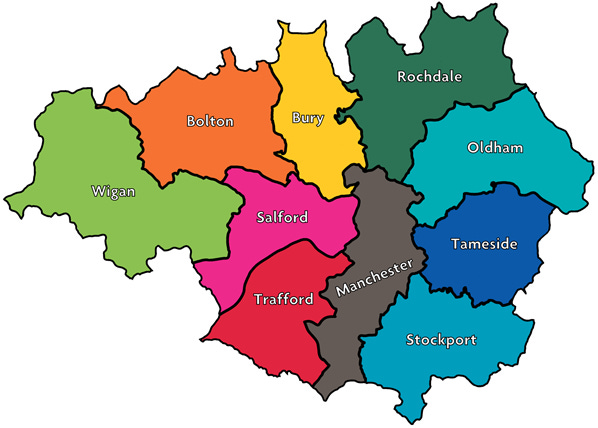
Ten boroughs - nine of them do not like being referred to as “Manchester”
The largest by-election in British political history takes place next week. Don’t worry if you haven’t noticed. The Greater Manchester by-election was automatically triggered when Andy Burnham won the Makerfield by-election last month, and the political calender has been a little packed since Burnham arrived in Westminster. Keir Starmer resigned as Labour leader and Prime Minister, triggering a leadership contest which morphed into a coronation delivering the new Makerfield MP to Downing Street, a whole host of new faces around the Cabinet table and a flurry of new policies to deal with the cost of living. Oh, and the bookies’ favourite to become the next Prime Minister after Burnham, Nigel Farage, sought to distract attention from a host of corruption scandals by resigning his Westminster seat, only to end up in a prolonged argument with an intergalactic bin. With such a packed news agenda, we can see why the small matter of a local contest featuring 2 million voters struggles to get a look in.
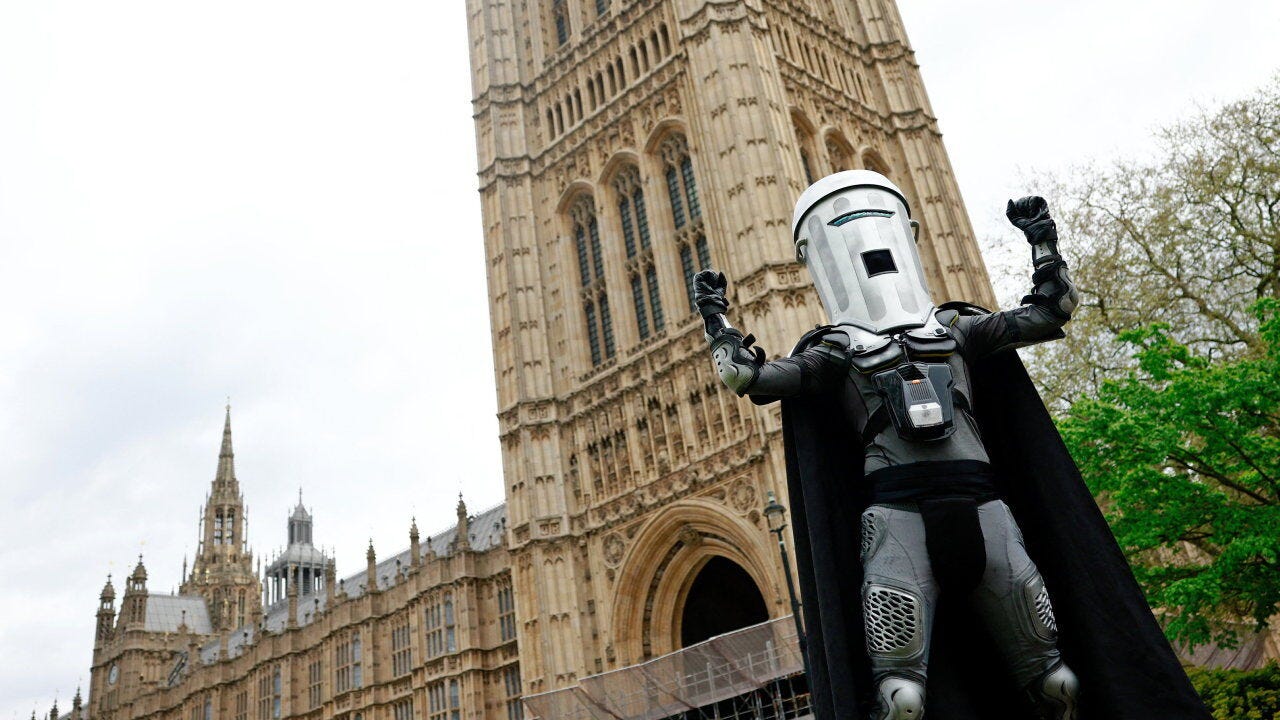
Count Binface: Political Silly Season in Humanoid Form
On the other hand, we may wonder if the greater attention paid to the bin bonced novelty campaign in Clacton than the contest for the second most powerful devolved office in England, and second largest direct electoral mandate in Britain, might be an example of the marginalisation of the North our new Prime Minister often complains about. To be fair, London journalists must by now be tired of trundling up from Euston on the reliably-unreliable Avanti West Coast mainline to cover big ticket by-elections in the North West, which seem never to end. First there was the shock Reform win in Runcorn and Helsby last May, then the Greens’ breakthrough in Gorton and Denton in February, and then Burnham’s turning of the teal tide in Makerfield last month.
Yet while all concerned would likely have preferred an opportunity to pause for breath, when a vacancy arises in the Mayor’s office it must by law be filled within 35 days. Thus it is that the most politically consequential Westminster by-election in modern history will be followed next Thursday by the biggest by-election Britain has ever held.
Westminster journalists react to the announcement of the Greater Manchester Mayoral by-election
How big is this by-election?
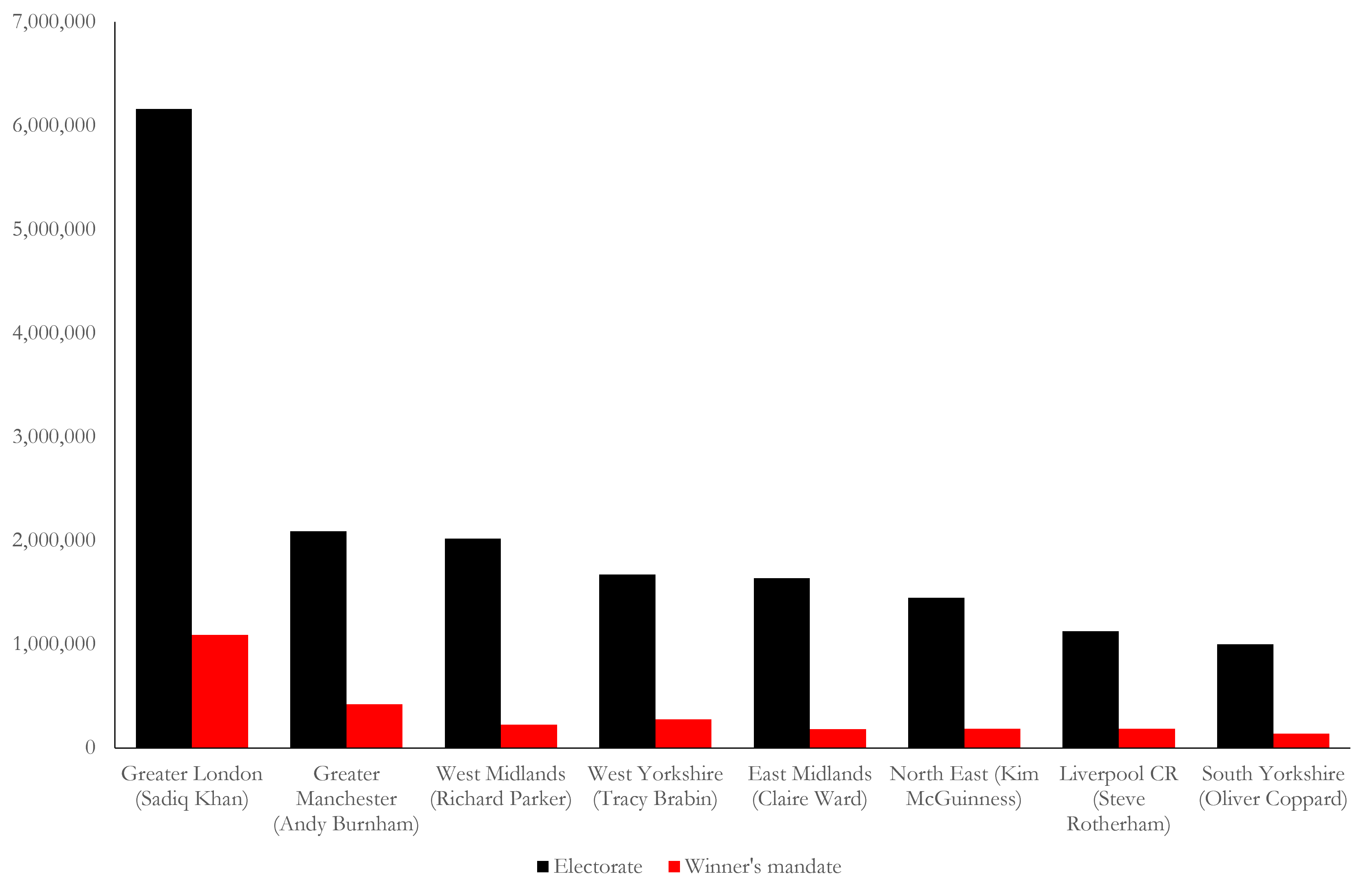
Very big. Greater Manchester is the largest of the Combined Authority Mayoralties which have spread across the urban regions of the Midlands and North of England over the past decade, all directly elected posts with mandates far larger than any other in Britain except the similar, but longer established Greater London Mayor. While Sadiq Khan has by far the largest personal mandate in British politics, representing an electorate of over 6 million, Andy Burnham’s successor as the second elected mayor of Greater Manchester will have the second largest, with a 2024 registered electorate of nearly 2.1 million voters. That is larger than the electorates of six EU member states1, and not far off the 2.4 million voters eligible to participate in this years Welsh Senedd election.
There are another half a dozen “electoral millionaires” - combined authority mayors who represent a million voters or more - all are based in the Midlands or the North and all are currently Labour held. The Conservative with the largest direct mandate is Paul Bristow, who represents 650,000 voters in Cambridgeshire and Peterborough, while the Reform UK politician with the largest mandate is the former Conservative MP Andrea Jenkyns, who represents over 800,000 voters as Mayor of Greater Lincolnshire. More political millionaires from multiple parties will emerge in the next few years as the Mayoral model is rolled out across populous parts of Southern England.2
Electoral millionaires: Mayoralties with electorates of 1 million plus3
Combined authority Mayoralties are still a constitutional novelty - Andy Burnham was among the first half a dozen such Mayors elected in 20174 - and this is the first time a vacancy has ever arisen requiring a by-election to fill.5 The result is a by-election contest without precedent in its scale and scope, which will put pressure on the organisational machines of all the main parties, and may well test the patience of Greater Manchester voters, some of whom will have been obliged to trudge to the polls three times in six months or less.6
Who is standing?
Bev Craig (Labour) Originally from Northern Ireland, Craig came to Manchester to study politics at the University of Manchester (she has two degrees from my department) but discovered a greater passion for doing politics than studying it. She was first elected to the city council in 2011, aged 26, and rose rapidly through the ranks of a large Labour group, succeeding the long serving Richard Leese as MAnchester City Council leader at the end of 2021. These were big shoes to fill - alongside council Chief Executive Howard Bernstein, Leese was widely praised for his role driving Manchester’s economic and political renaissance.
The succession has proved largely seamless, and Craig, who was worked effectively with Burnham as both Manchester’s council chief and as Vice Chair of the Combined Authority, was universally seen as the likeliest candidate to follow Burnham if a vacancy arose. Like Burnham’s in Westminster, Craig’s selection was a coronation rather than a contest, with no other candidates putting their names forward. Craig was the first female and LGBT Manchester City Council leader, and if elected will be the female and LGBT politician with the largest direct electoral mandate in Britain.
Sian Astley (Reform) The Reform candidate is also a current Manchester councillor, but of much more recent pedigree. Astley is the leader of the Reform group on the council, and like all of her half a dozen Reform colleagues, she was only elected two months ago. Her career prior to politics has been in design and property development, and she has made regular TV appearances on property shows including DIY SOS (BBC1) and Your Home Made Perfect (BBC2). This extensive media experience would have been an asset in a higher profile campaign, so Astley will no doubt be frustrated that her run for Mayor has been overshadowed first by Andy Burnham’s extended coronation and then more recently by her own party leader’s decision to trigger a by-election contest of his own.
Geraldine Coggins (Greens) Coggins, the leader of the seven strong Green group on Trafford council, is a veteran Green campaigner who has stood for the Greens in four general elections in the Trafford area, and served as a councillor since 2018. An Irish born former academic philosopher representing a prosperous and once Tory leaning suburub, Coggins personifies the more intellectual, middle class form of Green politics which was prevalent before the rise of current leader Zack Polanski. She may struggle to mobilise the wave of radical populist sentiment which Hannah Spencer rode to victory in Gorton and Denton, particularly as the Labour leader Spencer and the Greens were railing against is now departed.
Marlon West (Restore Britain) This is by far the biggest contest Restore Britain have contested. The far right party was only founded by former Reform UK MP Rupert Lowe earlier this year, and secured a surprisingly strong third place finish on 6.8% in last month’s Makerfield by-election. Voter knowledge of this very young party has been much boosted by Rupert Lowe’s high profile on social media, particularly Twitter, whose owner Elon Musk frequently reposts and offers to Lowe.
In an effort to build further support for their polarising form of ethnic politics, they have picked Marlon West, a campaigner against child sexual exploitation, who took up this issue after his daughter Scarlett West was the victim of grooming gangs in Greater Manchester. West has not stood for elected office before, but provides Restore Britain with an authoritative and powerful voice to channel voter anger about past failures by councils and police in the Greater Manchester area. a trend which has continued in this campaign. West was suspended this week by the Nursing and Midwifery Council over past social media comments, a decision which has already attracted the attention of Restore fan and Twitter owner Elon Musk.
Phil Eckersley (Conservative) While many Conservatives have recently been defecting to Reform UK, Eckersley’s political journey has taken him in the opposite direction. He stood as a UKIP candidate in two general elections and one local contest before switching to the Conservatives. Eckersley is still in his first term as a councillor, having been elected in 2023. The Conservatives are marginal players in this election so the the best he car really hope for is to raise his profile within his party and in the region, and perhaps improve Conservative prospects in his home patch of Trafford, where he is deputy leader of the Tory group.
Richard Kilpatrick (Liberal Democrat) Kilpatrick, a Manchester councillor, is the veteran of a decade’s worth of election campaigns, including a last place finish in Andy Burnham’s former seat of Leigh in the 2017 general election. He will be fighting another lost cause this time, as the Liberal Democrats are bit part players in this contest, with a support base particularly open to tactically switching towards Labour to prevent a Reform win. The Lib Dems will likely concentrate their efforts on keeping their profile high in Stockport, the one Greater Manchester borough they currently control.
Marcus Farmer (Independent) is a Manchester businessman and perennial though not very successful independent candidate. He has stood (and come last) in three Westminster contests in the Manchester area, and also stood in the first two GM Mayoral elections, coming last in the 2017 contest and seventhout of nine in 2021. Farmer’s 2026 campaign does not have much media or online presence, but in 2021 he argued for merging all the local authorities in Greater Manchester into a single mega-council, a proposal unlikely to endear him to voters in the outer boroughs, who already resent Manchester’s regional dominance.
Could this be a close race?
Probably not. Which is a bit of a surprise. Based on recent polling and local election results, this giant by-election should be an intriguing three cornered fight between the traditionally dominant Labour party and the two insurgents who have successfully challenged it in recent local contests and by-elections - Reform UK and the Greens. If we aggregate the votes cast accross all ten Greater Manchester boroughs in this May’s local elections, we get Reform 30% Labour 24% Greens 20% - all three parties look in close contention, with Reform narrowly in front. This is a huge shift from the 2024 Mayoral result, when Andy Burnham won 63% of the vote, and both Reform and the Greens polled in single digits.
But this by-election is neither as close, nor as favourable to Reform, as the recent local election results suggest. The two polls published since candidates for the by-election were announced, by FindOutNow and YouGov, both give Labour a substantial lead on first preferences.7 On average, Labour win 38%, with Reform on 22%, narrowly ahead of the Greens on 20%. Perhaps the anti-Labour sentiment which drove the party to record lows in May is already abating, or perhaps voters are coalescing behind Labour as the obvious anti-Reform choice in the Mayoral contest. Either way, a 16 point lead is a pretty solid position to hold going into the final week. Constituency polls for both Gorton & Denton and Makerfield proved pretty accurate, and Greater Manchester is a much larger region, so it should in principle be easier to poll.
Greater Manchester voting patterns - 2024 mayoral election, 2026 local election and in polls to date for the 2026 by-election
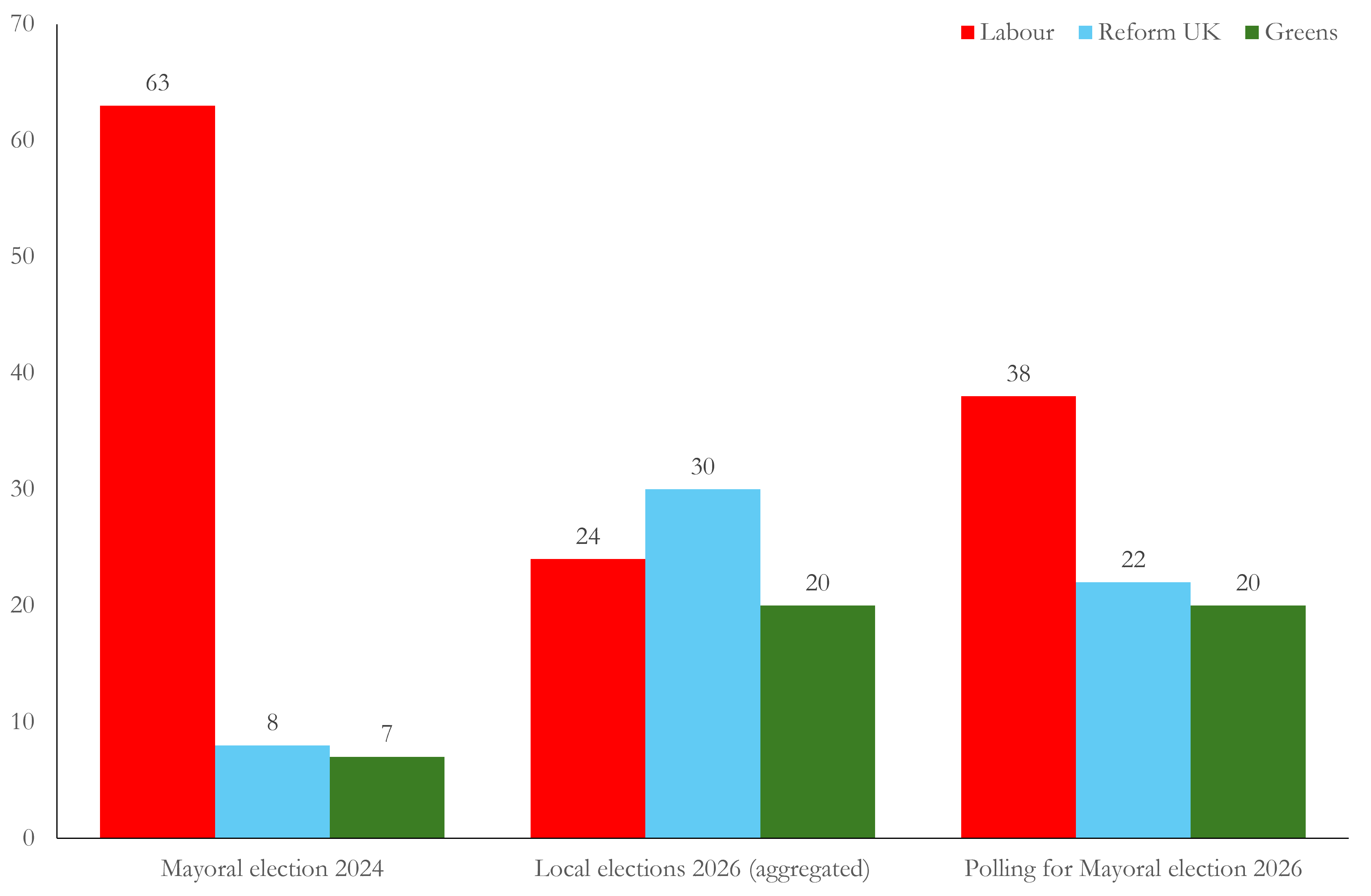
Polling figures are average of two polls published by FindOutNow and YouGov
But Labour don’t need to rely on a first preference lead alone, as the electoral system for the Mayoral contest, which was changed from Supplementary Vote (SV) to First Past the Post (FPP) by the Conservatives ahead of the 2024 contest, has now been switched back to SV again. Under SV, voters can cast two ballots. If no candidate gets 50% on first preferences, there is a run-off between the top two candidates, with the second preferences for eliminated parties added to their totals.
Low voter awareness about this system and how to use it may well limit its impact - in one recent campaign report the (excellent) local newspaper the Manchester Mill found virtually none of the voters they talked to were aware they could cast two ballots this time.8 However, when the two pollsters tracking the race offered people a chance to express a second preference, most were happy to do so, and the net impact is heavily favourable to Labour, with both pollsters giving Bev Craig victory in the second round by very large margins - 62-38 vs Reform in the YouGov poll, and by 64-36 over the Greens and 66-34 over Reform in the FindOutNow poll.
The reasons for this are fairly obvious - Greater Manchester as a whole tilts towards progressive parties demographically and politically - even when Labour were hammered in the May local elections, the combined Labour-Green-Lib Dem vote (53%) was substantially larger than the combined Reform-Conservative vote (40%). By providing a mechanism to coalesce progressive support, the switch to SV eliminates the only plausible route to a Reform victory - winning on a very low vote share due to an even Labour-Green split.9
While the Greens are also fishing from the larger pool of progressive voters, they would need the second preferences of Reform and Conservative voters to break heavily to them to overtake Labour in a run-off. This seems unlikely given the parties’ images, and in the FindOutNow poll the second preferences of the minority of Conservative and Reform 2024 voters willing to cast a second ballot in a Labour-Green runoff lean somewhat to Labour. In short, the Greens need to be either ahead or running Labour very close on first preferences to be in with a shot, and there is little evidence of this happening at present.
What’s at stake for each party?
For Labour, before 2026 the largest if not the dominant party in all but one of Greater Manchester’s ten boroughs10 the goal in this election is very clear: hold the Mayoralty with as big a lead as possible, and recover as much ground as possible in as many boroughs as possible following May’s disastrous set of local election results. Andy Burnham will be eager for early signs of recovery in his former backyard, while his likely successor Bev Craig will be keen to show that she can help return Labour to winning ways quickly.
Labour leads over second placed party, council-wide aggregate vote shares in 2024 and 2026 local elections
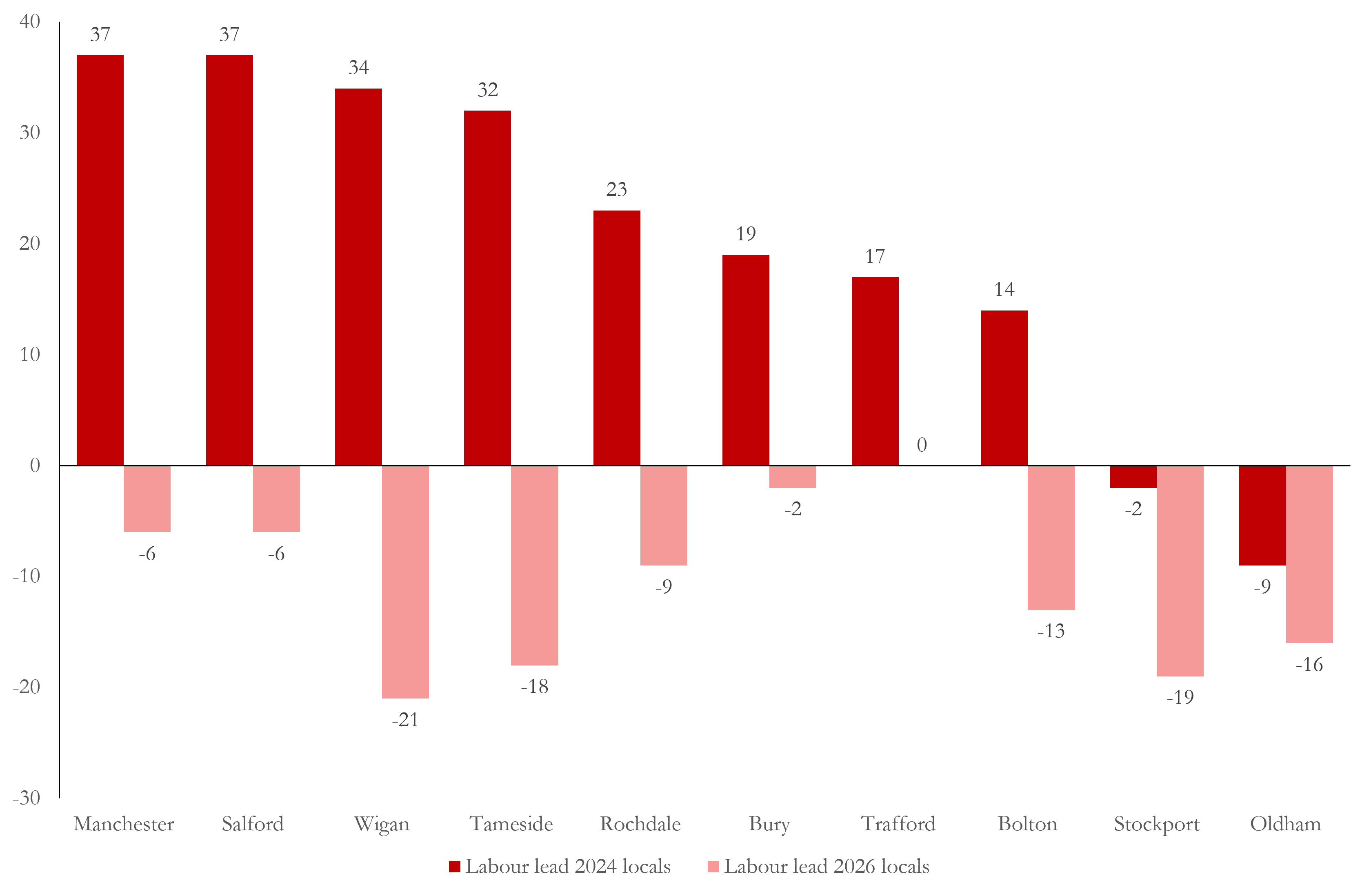
Greater Manchester was a Labour heartland going into the 2024 general election. In the May 2024 locals, the party topped the poll in eight of the ten boroughs, only falling short in the longstanding Lib Dem stronghold of Stockport and in Oldham, where the fallout from the Gaza crisis was particularly acute, with a large cohort of Labour councillors quitting and running against their party. In the other eight boroughs, Labour ran ahead of their nearest rivals by between 14 and 37 points.
This picture changed completely two years later. Labour did not top the poll in a single GM borough this May - the closest they came was a tie with the Conservatives in Trafford and finishing two points behind Reform in Bury. Everwhere else they were behind, following enormous swings to their opponents, resulting in unprecedented losses of council seats in councils such as Manchester, Salford, and Wigan, all of which have had majority Labour councils for the whole 52 years of the modern local government era.
While there is little prospect of Andy Burnham’s remarkably dominant wins being repeated, Labour will watch the mayoral results for evidence of a rebound on two fronts - turning the Green tide in Manchester City Council and in the neighbouring boroughs of Salford and Trafford where the Greens also made big advances, and closing the gap with Reform in outer boroughs such as Tameside, Bury, Bolton and particularly Wigan, home council of the new Prime Minister. The more local boroughs report a Labour lead in first preference votes, and the bigger these leads are, the happier the party will be.
Reform were exceptionally successful in May’s locals, winning over 30% and topping the poll in seven of the ten GM boroughs, only falling short in Manchester itself, and the wealthy middle class boroughs of Trafford and Stockport. With a Labour rebound looking likely, Reform’s task is to try and hold on to as much of this advance as possible, and thus demonstrate that recent scandals over Nigel Farage’s finances and advisors have not tarnished the party’s appeal.
Reform borough wide vote shares and leads over second place party, 2026 local elections
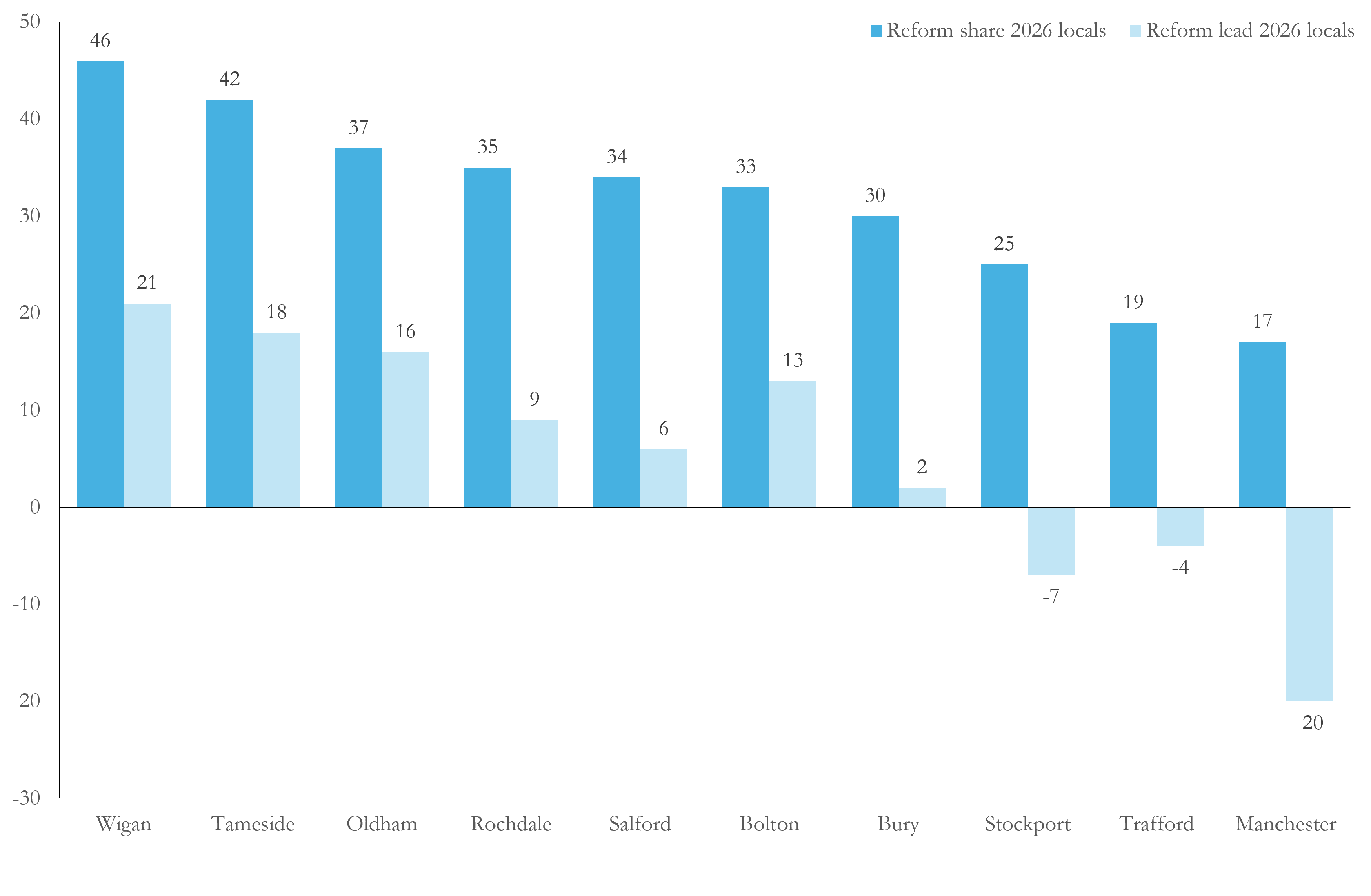
Their best prospects will likely come in the more divided and deprived outer boroughs such as Rochdale and Oldham and in particular Wigan, where the party will be eager to show they remain a force to be reckoned with despite their defeat in the Makerfield by-election.
Reform will also watch the results closely for evidence of anti-Reform tactical co-ordination on second preference ballots. If the party top the poll on first preferences in a borough, but then falls behind Labour in the second round, that might be an early indicator of an emerging anti-Reform voter coalition, something which could hinder the party’s progress in future local elections.
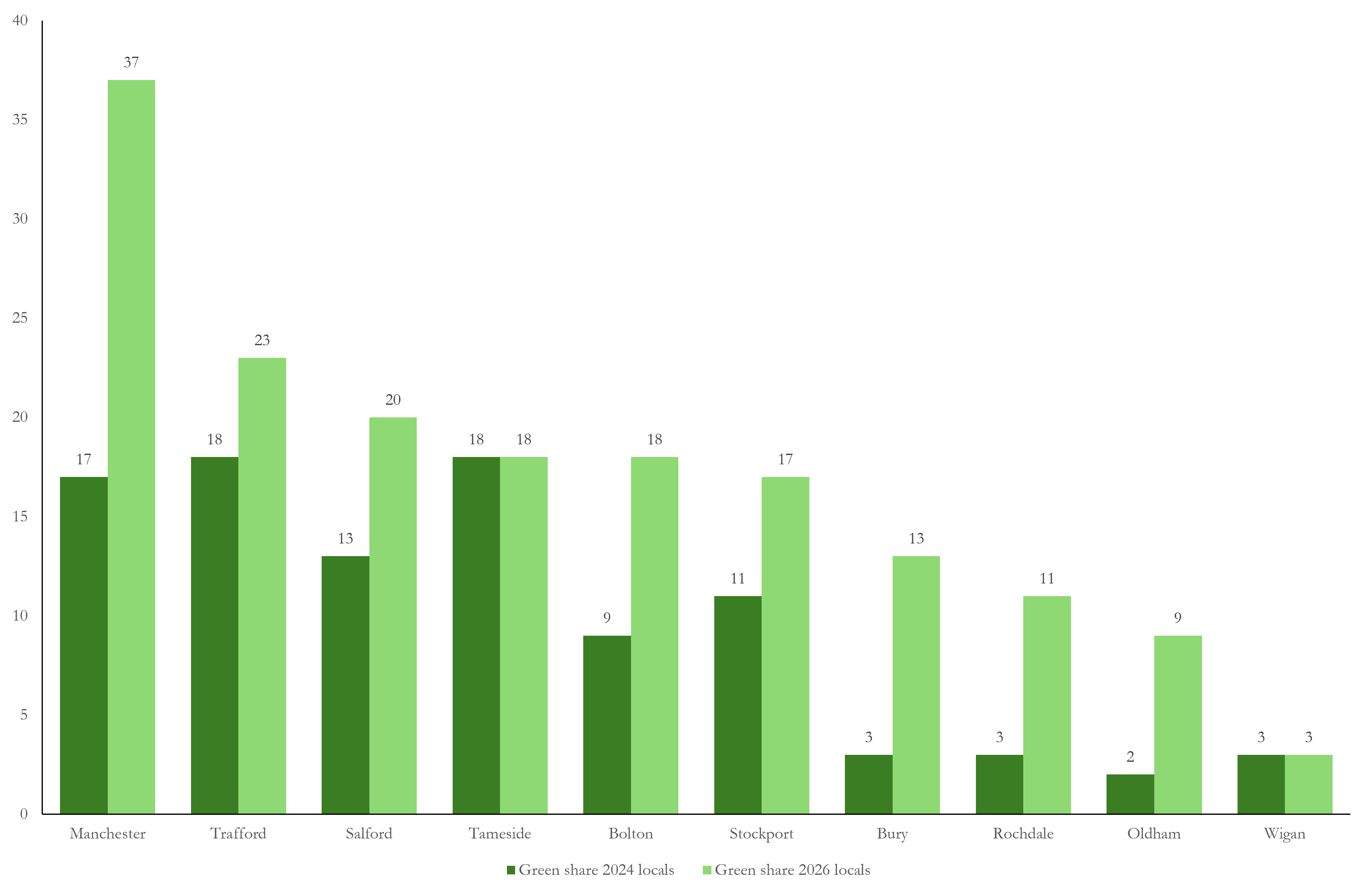
For the Greens, this election is also most likely an exercise in defending and consolidating recent gains, as the polling suggests an upset win is unlikely. The Greens made substantial advances in eight of the ten GM boroughs in 2026, but by far their best performance came in Manchester itself, where the party topped the poll with 37% of the vote and won 17 of the 32 seats up, including every city centre ward. The better the Greens do in Manchester and the neighbouring boroughs of Trafford and Salford, the happier they will be. In the outer boroughs, the party may find itself squeezed, as the greater local stregnth of Reform may encourage Green curious voters to opt instead for Labour on either the first or second ballot.
Green borough wide vote shares, 2024 and 2026
The Conservatives and the Liberal Democrats are both bit part players in this contest, as they were for the most part in May’s local elections. Both parties will be watching for a solid first preference performance in their one remaining stronghold borough - Trafford for the Tories and Stockport for the Lib Dems. But low voter understanding of the reintroduced SV system may depress their support even where they start strongest, as each party’s voters will see a strong incentive to switch tactically to one of the front running candidates with a better chance of victory (Reform for the Tories, Labour for the Lib Dems).
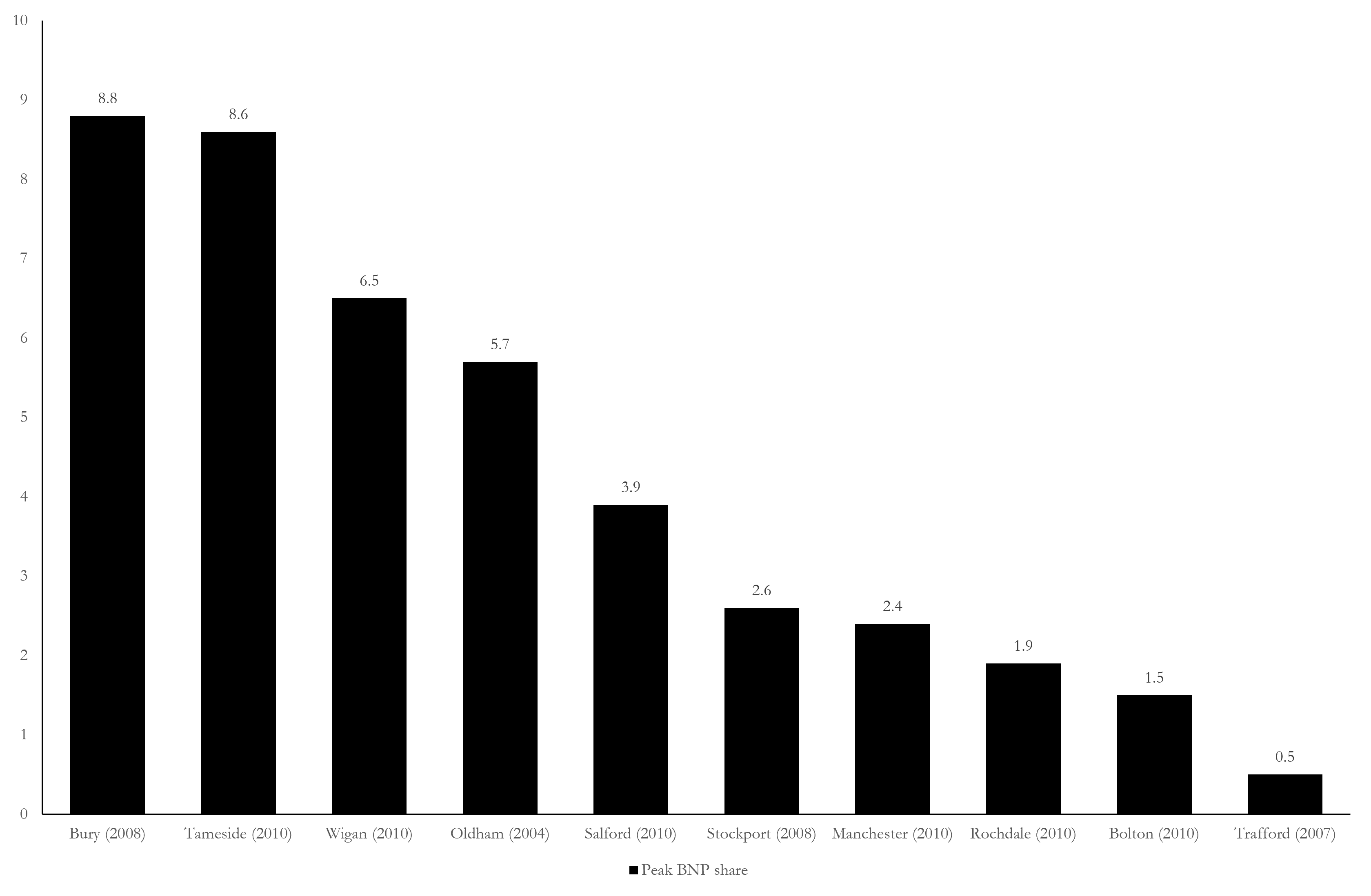
Restore Britain are the wildcard in this race. They are certain to run heavily on the polarising issue of Muslim grooming gangs, one where both Greater Manchester police and several GM councils have been criticised for past failings. Far right campaigns framing local Muslim communities as threatening and dangerous have found receptive audiences before in Greater Manchester, particularly in the ethnically divided former mill towns of Bury and Oldham, and the more deprived and less diverse boroughs of Tameside and Wigan - the BNP peaked at over 5% in all of these boroughs in local elections 15-20 years ago. These are the areas to watch for evidence that Restore’s revival of far right politics is gaining traction, and any hints that Restore might be splitting off votes that might otherwise go to Reform.
Peak BNP support in past local elections across the Greater Manchester boroughs
Tl;dr: A test Labour should pass (but watch the fine print)
Andy Burnham’s first electoral test as Prime Minister looks likely to be one he passes easily. Labour look very likely to hold the Greater Manchester Mayoralty, though the party also look almost certain to see a big drop in support compared with Burnham’s past wins. Both Reform and the Greens are likely to secure best-ever results in a Mayoral contest, and both will use this campaign to inform and strengthen their campaigns in next year’s local elections across GM’s ten boroughs, when thanks to heavy losses this year many once safe Labour boroughs will be up for grabs.
If the insurgents can achieve even a fraction of the gains they made this year in next May’s contests, then the new Mayor will face a much tougher task, presiding over a politically balkanised combined authority where opposition parties with wildly different agendas wield power in the boroughs. Thefore, while the headline next week is likely to be a straightforward Labour win, the real story of this by-election may be in the detailed borough result, which may give us the first hints of troubles to come for the new Greater Manchester Mayor - and for the devolution focussed new occupant of Downing Street.
Luxembourg (287,000 eligible voters in its last general election); Malta (357,000); Cyprus (569,000); Estonia (966,000); Latvia (1,542,000); and Slovenia (1,695,000).
2028 in particular looks set to be a bumper year for big Mayoral elections, with four big patches of Southern England (Greater Essex, Hampshire and the Solent, Norfolk and Suffolk and Sussex and Brighton) expected to elect their first Mayors, while another nine existing combined authority Mayoralties (including Greater Manchester) will be up for election, as will the Greater London Mayoralty.
South Yorkshire’s electorate in 2024 was 998,000. I am assuming population growth since has taken it past the million mark.
Two of that original half dozen remain in post - Conservative Tees Valley Mayor Ben Houchen and Burnham’s close friend and co-author, Liverpool City Region Mayor Steve Rotherham. The original West Midlands Mayor Andy Street narrowly lost his bid for a third term in 2024, while both the West of England and Cambridgeshire and Peterborough are on to their third Mayors already.
In part this is because Mayors could until recently combine mandates. Dan Jarvis “double jobbed” - remaining a Westminster MP after winning the South Yorkshire Mayoralty in 2018, though he declined to seek a second term as Mayor in 2022. However, a change in the rules introduced in 2026 English devolution and in force from the end of June 2026 now means any Mayor who wins office as an MP will have to step down within eight days of being elected to the Commons. So we may get more big Mayoral by-elections in future, if any other Mayors run for Westminster.
Voters in both Gorton and Denton (Manchester/Tameside councils) and in Makerfield (Wigan council) will have had ballots to cast three times this year - to elect an MP, a councillor and a Mayor. In Makerfield those three elections have come in three consecutive months. If Labour candidate Bev Craig wins next week as expected, the voters of Burnage ward in Manchester will get the rare honour of voting four times in around six months, as according to the Electoral Commission, Combined Authority Mayors cannot also be councillors for a constituent council, so a Craig win would trigger a by-election for her Manchester council seat. This might be a tricky defence for Labour, as the Greens won in Craig’s ward in May. Nor is this an outcome weary GM voters can easily avert: a win for any of the other four main parties would also trigger yet another by-election for the same reason.
The guidance for voting is also not the most helpful - inviting voters to cast their first ballot for their “first choice” party and their second ballot for their “second choice” party, but this advice encourages a lot of wasted votes, as only second choices for one of the two parties in the run off will count. For example, if a voter’s preferences were Lib Dem 1st Green 2nd Labour 3rd, but the top two parties were Labour and Reform, casting a ballot for the Greens would be pointless, as they would not be in the run off. The correct way to use the second ballot is to pick the party you prefer out of the two you expect to be in the runoff (assuming neither party was your original first preference). This is not an intuitive system, and past research suggests quite a lot of voters struggle to use it properly, with perhaps a fifth of votes in past Mayoral contests being “ineffective” because they fail to express a preference between the top two candidates who make the run off. This problem could be largely resolved by switching the electoral system to one where voters rank their preferences across all candidates - something discussed at greater length here.
This very nearly happened in the West of England Mayoral contest last year, where Reform’s Arron Banks won 22%, just 3 points behind the victorious Labour candidate Helen Godwin. Had Banks won then the West of England would have had a radical right mayor despite nearly 60% of its voters backing progressive candidates (Labour 25%, Greens 20%, Lib Dems 14%).
Labour has had unbroken majority of Manchester, Salford and Wigan boroughs since the modern system of local government was introduced in 1974; had majority control of Tameside (which it still runs) from 1974-2026, has run Bolton council for all but six years (2004-6 and 2019-23) since 1980, though not always a majority; ran Oldham council for all but six years from 1980-2026 (2000-3; 2008-11), though not always with a majority (Oldham has yet to choose new leadership after the May elections); has run Bury council for all but four years (2007-2011) since 1986, though not always with a majority; has had a majority on Rochdale council since 2011; and has run Trafford council since 2018, with a majority since 2019. Labour also ran Stockport from 2016-2022 though it has since reverted to the Lib Dems, who controlled it for twenty years prior to the brief Labour takeover.
Comments
Nothing yet. Say the first thing.
Sign in to join the conversation.