
— Atlanta
A rather long time ago now, in Montpellier, I encountered an Argentine whose interest in the ongoing women’s world cup could only be awakened by the news that England and Argentina were, in fact, playing each other as we spoke. The man became animated, really alive behind the eyes, and said, “we hate each other”. I know, I said, pointing to the nearby television where England was beating Argentina 1-0 with a goal from Jodie Taylor.
A separate time, at a distance of shorter breadth, I was somewhere having a wonder in Yorkshire. In a patriotic football pub, at the latter end of the witching hour, Margaret Thatcher came up. “A cunt and I’m glad she’s dead” said a woman whose father was a miner (a bit of history there) before caveating that, you know, she’d have stopped the boats, and—- here, all parties in the pub which numbered about four english people plus me, in addition to two enormous dogs wreaking havoc about the place, paused to praise the nation’s victory in the Falklands.
Yesterday in Atlanta, England and Argentina met for the first time since 2005 for a football rivalry as contentious as their martial encounter during the dying embers of one of their empire’s (you could quibble over the end point) and the other’s military junta. The Falklands, still British, but known to the Argentines as Las Malvinas, did force their way into the fabric of yesterday’s semi-final, though the memory of hand balls or defeats with the ball at their feet was enough in itself to preordain yesterday’s meeting as extraordinary.
It began with God Save the King rendered completely inaudible by Argentina’s undulating supporters, who were jeering, singing, “Anyone who doesn’t jump is English”. England’s outnumbered support responded with an interlude of hisses before Argentina’s anthem set off, drowning us once more.
With caveats for the joy of being the victor, games like these are sometimes best as a neutral observer. Despite their antipathy, if not always in reality (though perhaps it does seep there) than certainly on a football field, they are in many ways a match made in heaven. At times infuriating and alluring in equal measure, their football heritage runs deep. So has the mutual sense of their inevitability at this tournament. While facing bespoke adversities but equipped with game-changing players, both teams overcame several hurdles in what seemed like an inevitable march toward the final—- until yesterday, when they met each other.
The first half elapsed like an increasingly unkind re-introduction, both sides asserting themselves in places while careful not to expose themselves, either. Argentina held slightly more of the ball but it felt that England (emphasized by my view above and to the left of the Argentine supporters, and so above Argentina’s defensive third where England had more entries in the first half) had the wind at their back. When the whistle blew to mark the midway point, neither team had clocked a shot on target. Both had accrued a list of grievances: the match official spent the first minutes of his half being lobbied by both teams for explanations. By my eye, it seemed Messi and Bellingham were last to depart their duty.
Argentina emerged from the locker room with a few daunting threats (including two near-range shots from Julián Alvarez to force Pickford’s first save of the affair). But England scored within ten minutes of the break, and deserved it. Tuchel, soon to be named a villain of the doomed affair, later commented that the game was “totally, totally even” but that it was “deserved, not undeserved” when England were able to, “take our moment and go one-nil up”.
Making good on their first shot on target, Declan Rice collected a bicycle-kick clearance from Argentina defender Nicolás Tagliafico and settled it wide to Morgan Rogers, who crossed it to Anthony Gordon crashing the net for the goal.
Argentina’s response was not immediate in the goal sense. But it was stark in its momentum shift, as both team and blue-drenched stadium re-awakened to take hold of their new mission.
England, not for the first time in the tournament, took on a defensive shape and attitude that Tuchel refused to take accountability for when it backfired, saying instead that they’d simply not been “active” enough in their set up, failing to win duels or stop crosses.
What he did concede is that: “I think it’s two completely different matches. It’s until the goal, and then after the goal.” On Argentina’s resurgence: “Argentina played with more risk, played with more rhythm, played with a feeling maybe that they have nothing to lose anymore, which freed them up and hold us back because we’ve obviously played suddenly with a feeling that we have a lot to lose.”
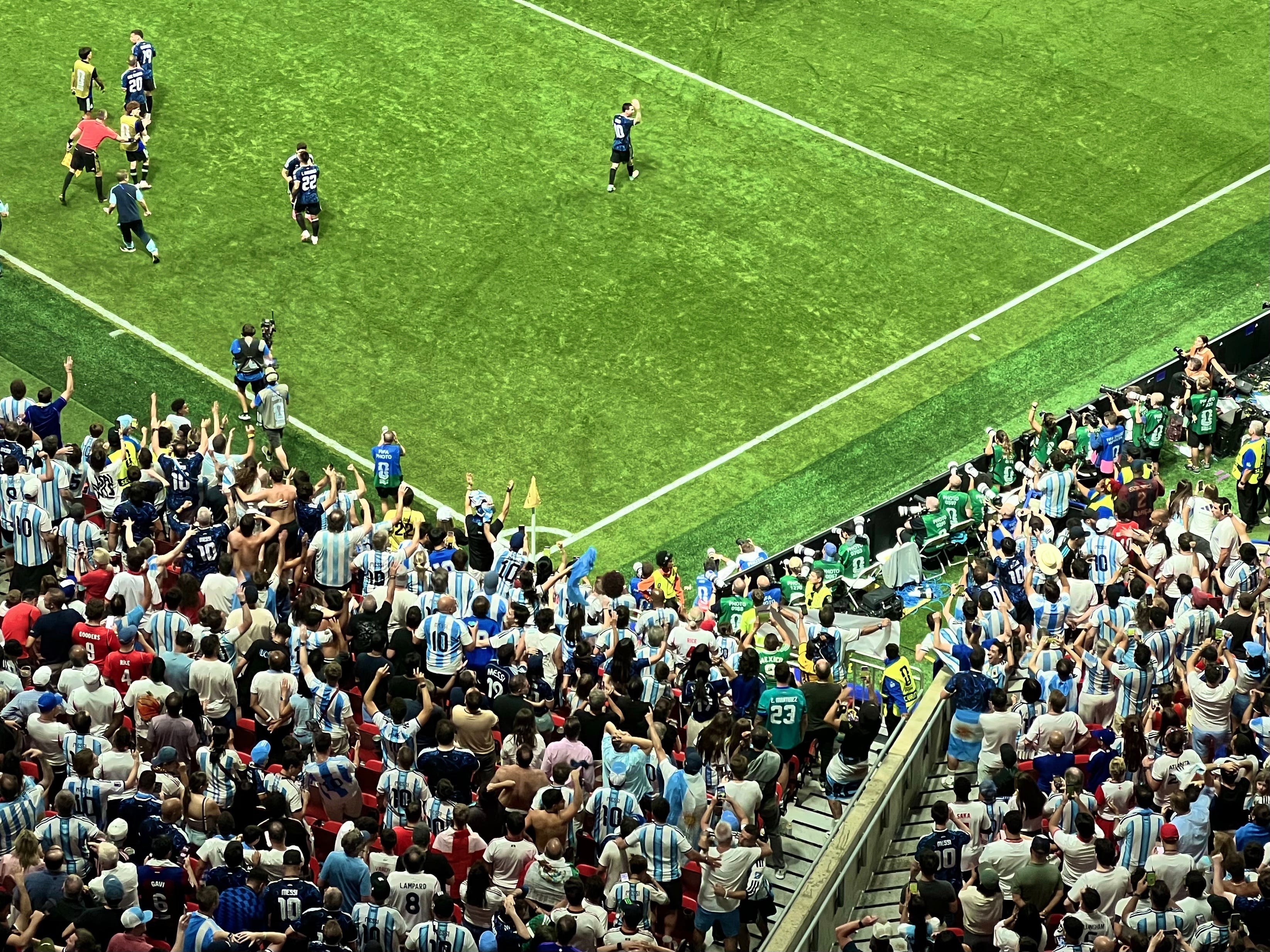
In the space of 35 minutes plus stoppage time Argentina clocked 10 shots to England’s three while taking total control of the ball and showing, with a mounting menace, what they could do with it. In the 85th minute, with eight English defenders forming a deep line in front of the goal and two others crashing Messi, Argentina’s No. 10 found Enzo Fernández wide open at the top of the box to launch the equalizer past Jordan Pickford’s outstretched fingers. Seven minutes later Messi collected a rebound off the post, befuddled multiple defenders, and crossed the ball for Lautauro Martínez to head home the death knell. Shortly after the match ended 2-1 in Argentina’s favor.
Whatever blood-deep wave of myth and mission (“For the Malvinas, for Diego, for Leo’s last one”) carries teams like Argentina to their second-straight World Cup final, it proved more powerful than the wind at England’s back which felt, to me, like one with trophy-winning potential since the night they beat Mexico with ten men at the Azteca. Thwarted by tactics—or their inactive application if you ask the manager—as well as an Argentina side that won’t die despite repeated evidence that they should have, led by the still-indomitable Lionel Messi and the split-seconds of time or space he needs to sink you, England settled for their second semi-final exit in three consecutive World Cups.
It began with a national anthem you couldn’t hear and ended with a line of dancing Argentines holding a white sheet reading, “Las Malvinas son Argentina” (The Falklands are Argentine) in front of a supporters section that doesn’t empty until hours after the final whistle.
Comments
Nothing yet. Say the first thing.
Sign in to join the conversation.