
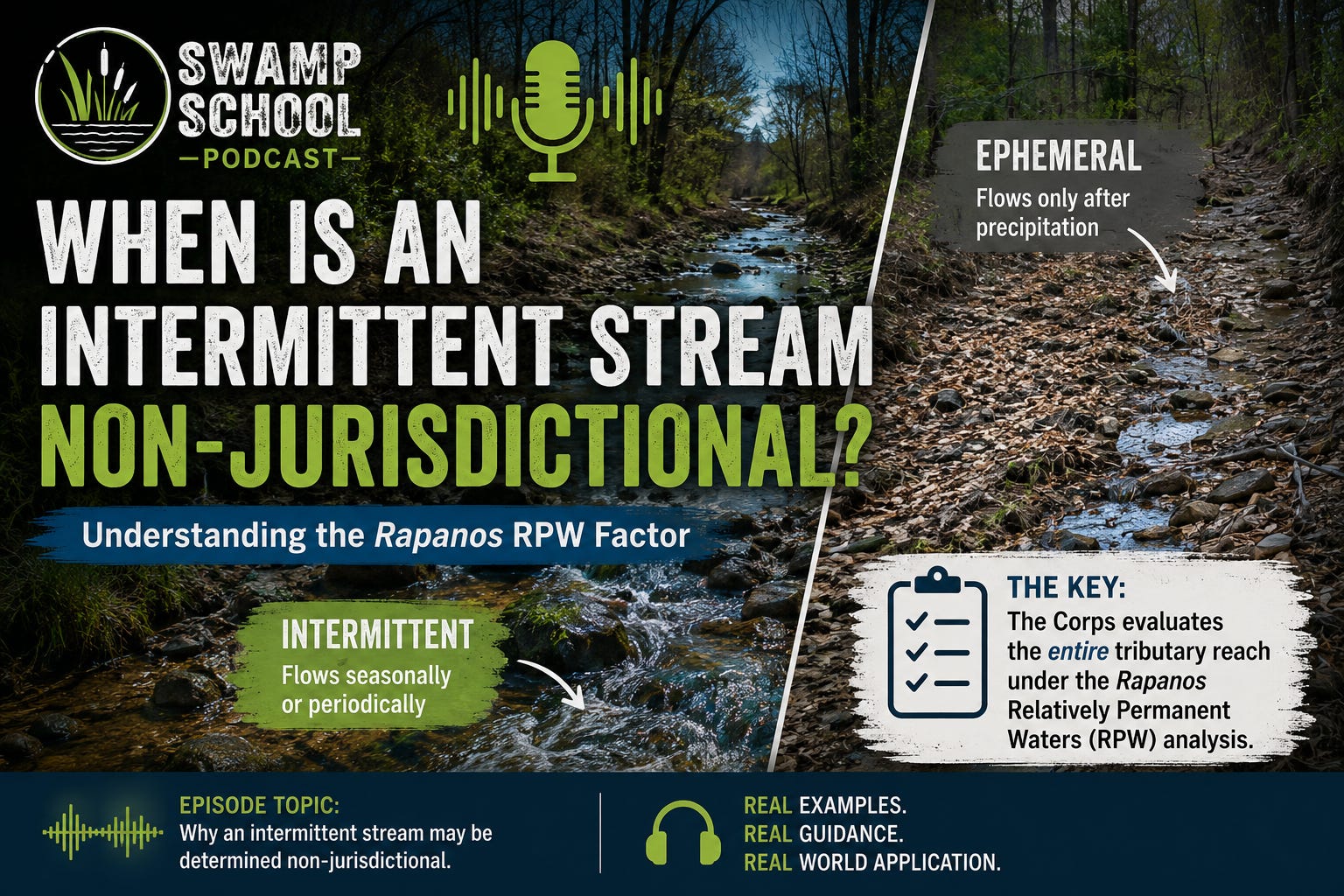
When Is an Intermittent Stream Non-Jurisdictional?
Welcome to the Swamp School podcast. Today, I want to talk about an interesting jurisdictional issue that has started showing up in some Corps-approved jurisdictional determinations.
The question is this:
Can an intermittent stream be determined to be non-jurisdictional because a larger portion of that same channel is ephemeral?
The short answer is: yes, we are seeing examples of this.
But there is an important distinction in how the Corps appears to be making that determination.
I have not found a nationwide Corps rule that says, “If more than 50 percent of a stream is ephemeral, the entire stream is automatically non-jurisdictional.”
Instead, what appears to be happening goes back to the Rapanos relatively permanent waters, or RPW, analysis.
Under the EPA and Corps *Rapanos* guidance, the Corps can evaluate the relevant tributary reach as a whole, rather than looking at one short intermittent section in isolation.
So, imagine you have one continuous channel.
Part of it is intermittent.
Another, perhaps longer, portion is ephemeral.
The Corps may look at the hydrology of that overall reach and ask:
Does this stream, taken as a whole, have relatively permanent flow?
If most of the reach only carries water for short periods following precipitation, the Corps may determine that the reach does not meet the Rapanos RPW standard—even though one portion of the channel has been classified as intermittent.
There is a good real-world example in a Sacramento District Approved Jurisdictional Determination, SPK-2023-00796.
In that case, the Corps evaluated a stream reach containing both intermittent and ephemeral characteristics. The Corps estimated that only about 35 percent of the reach exhibited relatively permanent flow characteristics and ultimately determined that the entire reach was non-jurisdictional.
That is very similar to what some consultants are now reporting from other Corps Districts.
The important lesson here is this:
Calling a stream “intermittent” does not automatically make it jurisdictional.
Streamflow classification and Clean Water Act jurisdiction are two different things.
The intermittent classification describes the hydrology.
The jurisdictional determination asks whether that water satisfies the applicable WOTUS criteria—including, where appropriate, the Rapanos relatively permanent waters analysis.
So if you are reviewing an AJD and see the Corps comparing the amount of intermittent channel with the amount of ephemeral channel, don’t assume they are applying some new percentage rule.
They may instead be using those percentages as evidence to characterize the hydrology of the entire tributary reach under the Rapanos RPW framework.
If you want to dig into this yourself, I recommend looking at two documents.
First, the 2008 EPA and Army Corps Rapanos Guidance, which explains the relatively permanent waters concept and how tributary reaches are evaluated.
Second, take a look at Sacramento District AJD SPK-2023-00796, which provides a very useful example of this type of analysis in an actual jurisdictional determination.
This is an area I would continue to watch, because individual Corps Districts may be developing somewhat different approaches to documenting how intermittent and ephemeral portions of a stream are evaluated.
Thanks for listening, and we’ll continue to follow these jurisdictional developments here at the Swamp School.
Comments
Nothing yet. Say the first thing.
Sign in to join the conversation.