
Versione italiana. English Version below.
Nel 1997, Roald Dahl pubblicò una raccolta di racconti, fra i quali ce n’era uno, The Great Automatic Grammatizor (Lo Scrittore Automatico) che sembra molto adatto all’epoca che stiamo vivendo.
Ragionando sul fatto che le regole della grammatica sono fissate da principii certi, quasi matematici, un uomo crea una grande macchina che riesce a scrivere, in meno di quindici minuti, un romanzo in grado di vincere qualsiasi premio letterario.
La storia di Dahl termina in modo inquietante (e molto plausibile ai nostri tempi), poiché un numero sempre maggiore di scrittori è costretto a cedere alla macchina il proprio nome in licenza, finendo così per abdicare alla creatività umana.
Nell’era dell’Intelligenza Artificiale, il racconto di Dahl appare tanto attuale quanto sinistro, in particolare per quanto riguarda le storie cinematografiche e televisive.
Ma l’interazione fra tecnologia e creazione di storie è una costante nella storia del cinema. Questo rapporto crea un meccanismo che si replica ogni volta che vengono introdotte nuove tecnologie. In termini industriali il meccanismo comporta una divisione netta tra autorialità e sfruttamento commerciale, ma non “uccide” né l’una, né l’altra.
Sin dalla nascita del cinema, la produzione di storie per immagini ha sempre oscillato fra due vocazioni: la spettacolarizzazione della tecnologia e la creatività autoriale.
La nascita di ogni nuova tecnologia (il cinema stesso, il sonoro, il colore, i formati larghi della pellicola, il digitale, ecc.) ha sempre prodotto un periodo in cui l’industria ha sfruttato la fascinazione del pubblico per essa, producendo soprattutto film che ne mettessero in evidenza le qualità.
A queste fasi sono sempre seguiti dei periodi, altrettanto lunghi, nei quali il pubblico si era ormai abituato alla nuova tecnologia, divenuta standard, e durante i quali l’industria ha prediletto invece la qualità dei contenuti creativi sul fattore “meraviglia” della realizzazione.
E’ importante sottolineare che nessuna delle due modalità produttive è “esclusiva”, ma coesistono.
Quando la maggior parte dei film si fonda sulla meraviglia per la tecnologia, l’industria mantiene viva una quota minoritaria di “film d’autore”, e viceversa. L’equilibrio tra tecnologia e contenuti è infatti necessario alla sopravvivenza stessa dell’industria.
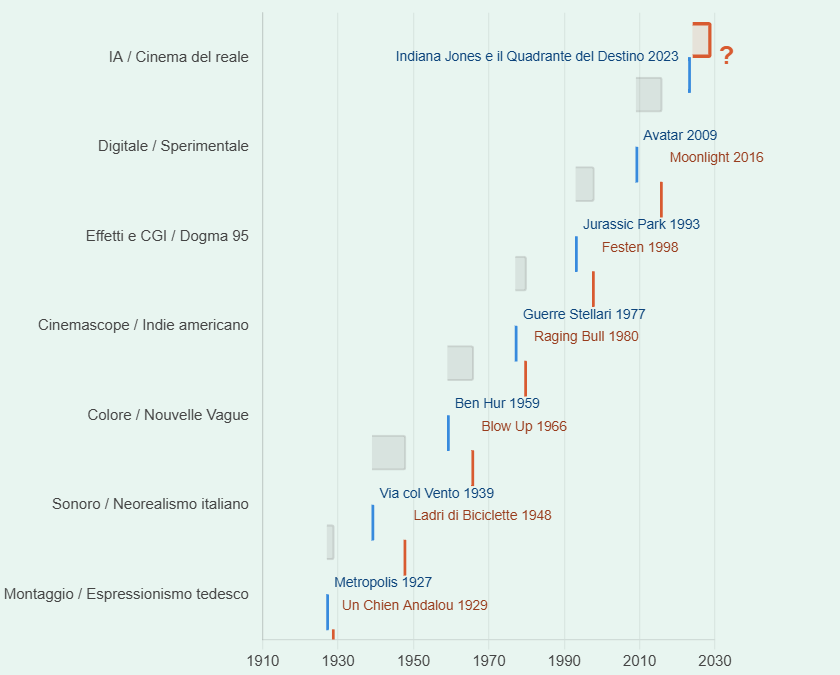
La produzione di storie per la televisione segue questo stesso trend.
Negli ultimi trent’anni questo meccanismo si è ripetuto due volte in rapida successione. L’avvento del digitale ha spinto gli Studios verso il cinema spettacolare dei fumetti e dei videogiochi, allontanando i grandi autori verso la televisione a pagamento: è nata così la grande serialità, e per la prima volta le serie hanno cominciato a somigliare a film. Poi sono arrivate le piattaforme di streaming, che hanno trasformato quel prodotto d’autore in fenomeno di massa, abbassandone progressivamente la qualità. Oggi le serie assomigliano di nuovo ai vecchi telefilm. La terza evoluzione è già in corso: nel 2026 scadono gli accordi tra sceneggiatori americani e Studios sull’uso dell’IA, firmati all’indomani dello sciopero del 2023. Quello che succederà dopo cambierà il mercato in modo strutturale.
La domanda che tutti si pongono è se l’Intelligenza Artificiale possa o meno sostituire gli esseri umani nella creazione di storie. A proposito di questo, bisogna ricordare che le storie “mainstream” oggi seguono in massima parte gli schemi strutturali tradizionali. Il “viaggio dell’eroe” del cinema svolge lo stesso ruolo delle regole della grammatica del racconto di Dahl.
Hollywood, e poi la televisione commerciale, applicano da sempre, in modo automatico, questi stessi modelli. Che si tratti della Scarlett O’Hara di Via col Vento o dell’Ethan Hunt della saga di Mission: Impossible, la struttura narrativa del racconto segue percorsi analoghi.
Essendo queste strutture per definizione modelli narrativi replicabili, l’Intelligenza Artificiale è perfettamente in grado di replicarli all’infinito, applicandoli a vicende e personaggi “diversi” fra loro in termini di caratteristiche psicologiche, ma identici in termini di funzione narrativa.
Penso, quindi, che a meno di evoluzioni al momento impossibili da prevedere, e non necessariamente legate al cinema (catastrofi climatiche, guerre, incompatibilità energetica dell’uso generalizzato dell’IA, ecc.), la prossima evoluzione del mercato dell’audiovisivo sarà dunque presumibilmente la produzione “automatica” e a basso costo di storie. Questo produrrà una forte, e strutturale, diminuzione del personale umano necessario a crearle.
Tuttavia, non c’è motivo per cui questa evoluzione non segua lo schema proposto per tutte le altre evoluzioni tecnologiche nella storia del cinema.
E’ pensabile una nuova fase di fascinazione del pubblico per la nuova tecnologia, che riempirà il 70/80% del mercato, lasciando uno spazio del 30/20% per storie non replicabili dall’IA. Così come è sempre avvenuto per qualsiasi fase di oscillazione del mercato fra tecnologia e creatività.
Ma per riempire quel 20/30% di spazio mainstream lasciato libero dall’IA, bisogna produrre film e serie che l’IA non è ancora in grado di produrre. Cioè bisogna evitare i modelli strutturali replicabili.
Il punto non è se gli sceneggiatori siano minacciati dall’intelligenza artificiale, ma quali storie possano essere scritte dall’IA. Quelle storie che nascono da una trama lo sono tutte.
Il metodo Characters Generate Worlds, offre la possibilità di fare esattamente questo. Il metodo si basa sull’assunto che la trama e il mondo visivo di un film o di una serie, scaturiscano in modo naturale dalla psicologia del personaggio. Il punto di partenza di qualsiasi storia, quindi, non è una struttura, ma una psicologia. E’ l’evoluzione psicologica del personaggio che determina le svolte strutturali della storia, il suo andamento, la divisione in atti, le scene madri, eccetera.
Questo destabilizza il modello strutturale. Il momento e il modo in cui deve accadere l’incidente scatenante, o qualsiasi altra svolta narrativa strutturale, non sono più imposti dall’autore (o dall’IA), ma dipendono dal personaggio.
Per raccontare le persone non servono modelli, ma empatia. Ma, per provare empatia, bisogna avere un Bisogno Nascosto, cioè una necessità psicologica inconsapevole che entra in risonanza emotiva con quella del protagonista. L’IA può imitare una forma, può replicare un modello, può persino replicare un Bisogno Nascosto. Ma non sa riconoscerne uno. Non può riconoscere nella vita di qualcun altro qualcosa che risuoni con la propria esperienza, e sentire il proprio bisogno di scriverne. L’IA non evoca nulla.
Lasciate che i personaggi producano la struttura delle loro storie, e non viceversa, e l’IA sarà solo un’altra tecnologia che può essere usata per aiutare, e non per sostituire, la creatività umana. Perché le storie non sono strutture, ma persone.
Per maggiori informazioni sul metodo Characters Generate Worlds: www.voltaggiodev.it
In 1997, Roald Dahl published a collection of short stories that included one tale particularly suited to the age we are living through: The Great Automatic Grammatizor.
Reasoning that the rules of grammar are governed by fixed, almost mathematical principles, a man builds a giant machine capable of writing, in less than fifteen minutes, a novel worthy of winning any literary prize.
Dahl’s story ends in a disturbing—and, today, highly plausible—way, as an increasing number of writers are forced to license their names to the machine, effectively surrendering human creativity itself.
In the age of Artificial Intelligence, Dahl’s tale feels as relevant as it is sinister, particularly when it comes to film and television storytelling.
Yet the relationship between technology and storytelling is nothing new. Throughout the history of cinema, every technological revolution has generated the same pattern. From an industrial perspective, this pattern creates a division between authorship and commercial exploitation, but it never completely destroys either one.
Since its birth, cinema has always oscillated between two competing impulses: technological spectacle and creative authorship.
The arrival of every new technology—cinema itself, synchronized sound, color, widescreen formats, digital filmmaking, and so on—has always produced a period during which the industry capitalized on audiences’ fascination with the new medium, creating films designed primarily to showcase its capabilities.
These periods have invariably been followed by equally long phases in which audiences became accustomed to the technology, which then faded into the background and became standard. At that point, the industry shifted its focus back toward the quality of stories rather than the wonder of their execution.
It is important to stress that these two modes of production are never mutually exclusive, but coexist. When most films are driven by technological spectacle, the industry continues to sustain a smaller but significant share of auteur cinema, and vice versa. The balance between technology and content is essential to the industry’s survival.
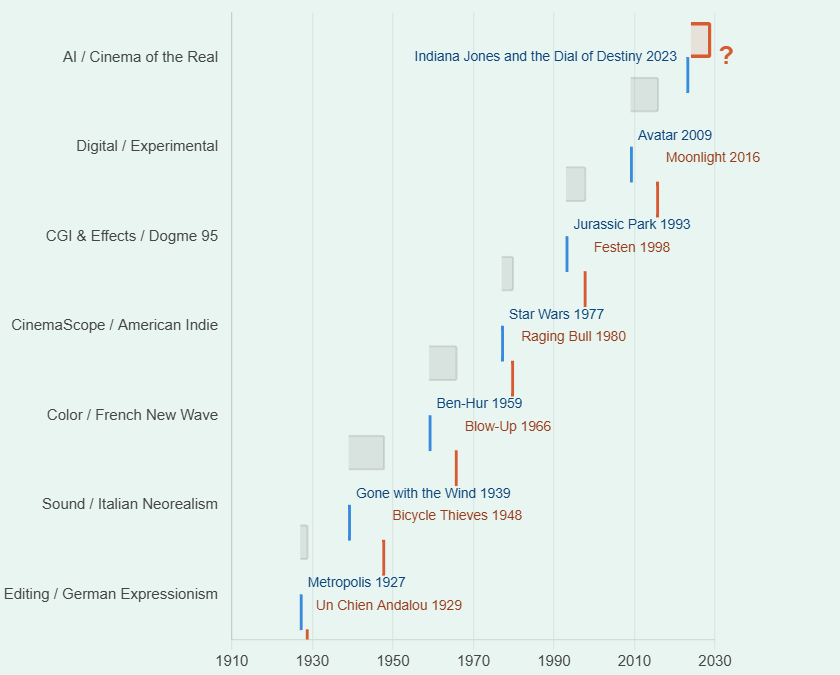
Television storytelling has followed the same pattern.
Over the last thirty years, this cycle has repeated itself twice in rapid succession. The rise of digital filmmaking pushed major studios toward increasingly spectacular productions inspired by comic books and video games, while many significant filmmakers migrated toward premium television. This was the birth of what is often called the Golden Age of Television, when television series began to resemble feature films in both ambition and production value. Then came the streaming platforms, which transformed what had originally been an auteur-driven product into a mass-market phenomenon, gradually lowering its overall quality. Today, television series increasingly resemble the traditional network shows that preceded them. The third transformation is already underway: in 2026, the agreements reached between Hollywood studios and American screenwriters following the 2023 Writers Guild strike concerning the use of Artificial Intelligence are set to expire. What happens afterward may reshape the audiovisual industry in a fundamental way.
The question everyone is asking is whether Artificial Intelligence can replace human beings in the creation of stories. To answer that question, it is worth remembering that most mainstream storytelling today already follows highly standardized narrative structures. The Hero’s Journey serves essentially the same function in storytelling that grammar serves in Dahl’s story.
Hollywood—and later commercial television—has relied on these structures for decades. Whether we are talking about Scarlett O’Hara in Gone with the Wind or Ethan Hunt in the Mission: Impossible franchise, the underlying narrative architecture follows remarkably similar patterns.
Because these structures are, by definition, replicable models, Artificial Intelligence is perfectly capable of reproducing them indefinitely, applying them to characters and situations that may appear psychologically different while serving identical narrative functions.
Unless unforeseeable developments intervene—climate catastrophes, wars, energy constraints, or other disruptions unrelated to storytelling itself—the next phase of the audiovisual industry will likely involve the automatic, low-cost generation of stories. This will inevitably lead to a significant and structural reduction in the number of human professionals required to create them.
There is, however, no reason to believe that this technological shift will not follow the same historical pattern as every previous one.
A new period of fascination with the technology may well occupy 70 or 80 percent of the market, leaving the remaining 20 or 30 percent for stories that AI cannot easily replicate, just as every previous oscillation between technology and creativity has done.
But to fill that space, creators will have to produce films and television series that resist structural replication. In other words, they will have to avoid replicable narrative models.
The question is not whether screenwriters are threatened by Artificial Intelligence, but which stories can be written by AI. Stories that begin with plot can all be written by AI.
This is where the Characters Generate Worlds method becomes relevant. CGW is based on a simple assumption: the plot and visual world of a film or television series should emerge naturally from the psychology of its characters. The starting point of a story is therefore not structure but psychology. It is the character’s psychological evolution that generates the story’s turning points, its pacing, its acts, its climaxes, and its dramatic reversals.
This fundamentally destabilizes the traditional structural model. The inciting incident—and every other major narrative turning point—is no longer imposed by the author, or by AI. It emerges from the character.
To tell stories about people, models are not enough; empathy is required. And empathy requires a Hidden Need: an unconscious psychological necessity that resonates emotionally with the protagonist’s own hidden need. AI can imitate a form, reproduce a model, and even replicate a Hidden Need. What it cannot do is recognize one. It cannot recognize something in another person’s life that resonates with its own experience and feel compelled to write about it. AI evokes nothing.
Allow characters to generate the structure of their stories rather than forcing stories to generate their characters, and Artificial Intelligence becomes what every previous technological innovation eventually became: a tool that can assist creativity rather than replace it. Because stories are not structures, but people.
For more information about Characters Generate Worlds: www.voltaggiodev.it
No posts
Comments
Nothing yet. Say the first thing.
Sign in to join the conversation.