
In November 2025, I spent 16 nights in the hospital at Cleveland Clinic for a 2nd open-heart surgery. I needed the 2nd OHS because the first one was not done correctly. I had every reason to be upset and at times, I allowed all the appropriate emotions to surface. I found myself in a daily tug and pull to maintain my peace, autonomy and sense of time. Ultimately, I did lose all sense of time. In fact, I lost where I was on the calendar completely (that’s its own post for another day). However, with incredible support and a willingness to ask for what I needed, peace and sanity remained when I left the hospital.
I share the following list as a way of paying it forward. I do not hold all the answers, but I do have lived experience. Surely this can help those who will come after me. This list isn’t the end all be all, but I do credit all of the following for helping me keep my cool.
Print this out and take it with you if a surgery is looming. Or if you haven’t, download the Substack app so you can easily access this on your phone.
I swapped the hospital gown for my own clothes which allowed me to preserve some autonomy. I asked first, of course. Sometimes I had to wear a gown for testing, but most of the time, I wore my own cozy clothes. I didn’t have to worry about my bum poking out the back and I was much more comfortable. I didn’t feel as sick either.
My family brought me food. Hospitals’ main focus isn’t necessarily flavor. Food is produced on a mass scale. Along with the white walls, the food felt mundane and like I was living in the movie Groundhog Day. By day seven, I couldn’t take it anymore and I ordered out. The food was much more nutritious, and it brought me joy.
Add color. In most hospitals, the walls are white. The floor is white. The equipment and cabinets are white, and everything is just … not cozy. Because I was far away from home, I didn’t bring decorations (I highly suggest decorating if you are able), but my friends gave me adult coloring books. I was thoroughly entertained, and I could feel my nervous system calm every time I colored. The best part: each page had cuss words.
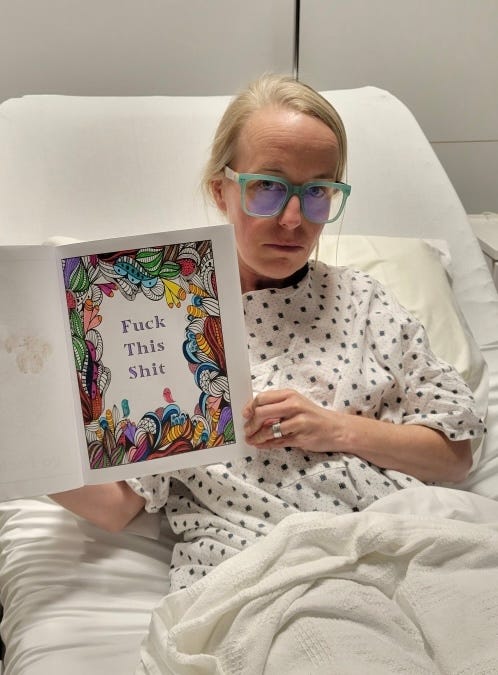
Here I am in a hospital gown. So much white. I had just had another heart catheterization and still didn’t have a surgery date. I was not ok. Swearing helped.
Outside drinks. My family brought me lattes, tea and smoothies. The best. In normal life, I timestamp my days by what’s in my mug. Coffee first then black tea then green tea then ginger turmeric tea. Of course, there’s always water mixed in. Again, to have some sense of autonomy and time, I asked my family to bring me tea bags, and I used the hot water dispenser in the nurses’ station to make my tea. Easy peasy. And it their effort made a difference.
Bundle Care. It’s a weird name, but it will save your sleep. When I wasn’t in the ICU and was stable, I requested no vitals between 10pm and 6am which is called Bundle Care. The nurse had to put a request in the system for doctors’ approval, but it was worth the hassle. There was even a sign put on my door so no one would wake me.
Face mask. Speaking of sleep, it’s not dark in a hospital room. The heart monitor and other equipment give off just enough light to interrupt healing sleep. My mask truly saved me.
Say no to early morning lab draws, if allowed. I don’t know how the phlebotomists do it. They are up and at it by 5am, marching into each patient’s room with lab orders, a butterfly needle, code scanner, and cart. For me, all the lights were turned on, and they talked at a volume level as if I was awake. It felt rude (I’m sure it wasn’t intentional) and it sure was painful, but they had a job to do: draw blood before the doctors arrive to start their rounds. I get it. Numbers don’t lie and labs tell an important story. Yet, I still asked for my night nurse to draw my labs prior to leaving their night shifts at 7am instead. It made for a more peaceful night’s rest. Of course, it was a team decision. There were a few mornings where I just had to deal with an early morning lab draw. But overall, I had more mornings than not where I didn’t have to be startled awake.
Ask for a view. When I first arrived at the hospital, I was put in a room that had a view of a concrete wall. It was the last room available on all the cardiac floors. It was what it was. After 3 days, I requested a room with a view of trees. It took another day or so, but I got that view and it made all the difference.

Better than a concrete wall.
Noise canceling headphones. If you don’t already own a pair, buy a pair. No need to listen to the phrase “code blue” all day. Headphones are handy on airplanes, too. While you are at it, rock some sick beats.
Say no to room cleaning. Unless you’ve made a mess, you don’t have to have your room cleaned every day. Cleveland Clinic ran a tight and clean ship. On one hand, it was lovely to see such a well-run, clean operation, but on the other hand, I grew tired of folks in and out of my room all day, every day. After my surgery, I said no more than yes, so I could rest. The mental and emotional bandwidth it took to engage with multiple people all day everyday took its toll. Cleanliness was the first to go.
Flowers. Many friends sent me flowers, and I was so grateful. Each vase made a difference in my outlook. So, if you are reading this and you have a loved one in the hospital, send them flowers. It helps.
Request spiritual care, pastoral care or a chaplain. It’s all the same. I’ll forever be grateful for a Saturday afternoon visit with a chaplain who was able to witness and validate my stress and pain. My nervous system calmed and I felt seen and heard.
Reiki. Ask if your hospital provides this service. Cleveland Clinic does and the nurse giving it helped me feel safer in my body.
Talk to fellow heart patients on your floor while you are out and about. I still keep in touch with one fellow patient I met in the hallway. We are wired for connection. You never know what an interaction can do for either you or the other person. Our road as heart patients is hard enough. Let’s not travel alone.
This list doesn’t take away your diagnosis or need for intervention. What it can take away is the feeling of helplessness that inevitably comes with any heart issue.
I went more in-depth on this list and the surgery, in general, on my recent episode on Open Heart Surgery with Boots. If you found this helpful, please forward to a friend.
I love you. I’ll be back next week with a new episode on the podcast and more writing here. xo boots
No posts
Comments
Nothing yet. Say the first thing.
Sign in to join the conversation.