
This is part 3 of a series on my 2nd open-heart surgery on November 2, 2025. This is for anyone who’s ever wondered about the experience of open-heart surgery. If you are new here (welcome!), please go back and read OR61 and 26 hours in the ICU first. If you don’t, you’ll be lost with some of the references in this piece. This is NOT medical advice, and it is my experience that is unique to me. Everyone’s experience is different.
My transport nurse flirted with every female nurse we passed as he pushed me from the ICU to the 6th floor. He was so busy flirting that he dropped my urine collection bag and my oxygen tank.
Apparently, seeing nurses in uniform really makes a 20-something guy tremble.
We rolled into PCU J61-06. It was quiet. No one was yelling Cheryl. My view included the famous Cleveland Clinic oval with fall colors beyond. It was a nice change from the previous 26 hours. The transport nurse flirted with my new nurse as she got me set up in the bed. Anne Marie and Jason situated my belongings. There was a collective sense of relief among us to be out of the ICU. An important milestone had been reached.
I quickly got to work ordering food, scrolling through the app searching for comfort food (yep, there’s an app for that in the hospital). I do not remember what I ordered, but I do remember how relieved I was to eat some solid food.
Ok, fine… I ordered cake.
And then came the arm band slapped onto my left wrist. It stated, “fall risk.” Fall risk? I’ve climbed mountains, skied couloirs, mountain biked down steep hills, and now I was considered a fall risk. I hadn’t fallen. I hadn’t even stumbled. The nurses were just following hospital policy. So, the nurses booby-trapped my room and put a sign outside my door.
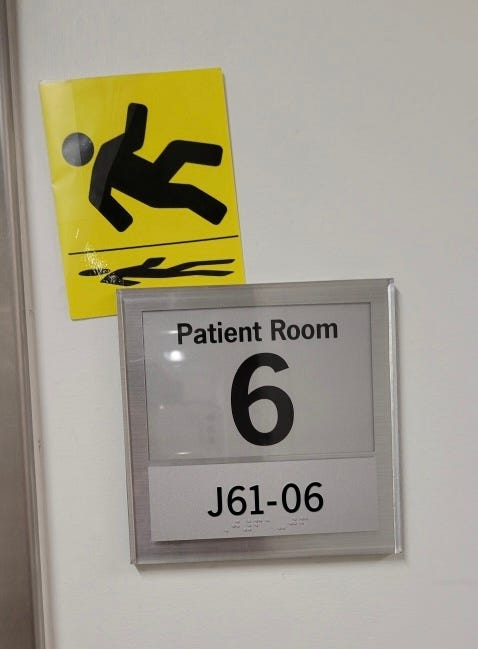
Yep. I. Was. Booby. Trapped. True story.
If I were in my bed and got out of it on my own, the bed would shake violently, and a loud alarm would ring. If I were sitting in the recliner and stood up on my own, another startlingly loud alarm rang out. Demoralizing doesn’t begin to describe how I felt. What was much worse was the impact on my already frayed nervous system.
(As I write this now, I am remembering that I hadn’t even taken a step yet. I had just been through major surgery. My heart had been stopped for over two hours. Of course, my room was booby-trapped. I still hadn’t found my sea legs yet. And me being me, I fought for my independence anyway…)
The booby trapping lasted about 2 hours, and then, I took matters into my own hands. It was patient vs policy, and I was going to win this one.
The last straw….er startling alarm… was when I stood up from the recliner. I just wanted to go pee. The alarm rang out, but I remained focused on my task, removing the booby trap (aka wireless chair exit sensor). I returned it to the room’s nursing counter. Enough of that, I thought.
The alarm kept ringing, and I walked myself to the bathroom on my own using a walker. My first steps post-op.
Of course, the alarm got the attention of the staff, and the nursing assistant came running. After a friendly debate about my safety and hospital policy, the booby-traps were removed. I wasn’t going to stand for the constant assault on my nervous system, mostly because the alarms were unnecessary. I obviously could walk on my own (mostly in my mind).
There were many events that humbled me during the 17 days I was in the hospital, but nothing humbled me more than cardiac and occupational rehabilitation during the post-op part of the stay.
During my first official walk with rehab, I aimed for just a few doors down from mine. When I reached the goal, I had to sit and rest for multiple minutes before I could walk back. I can still feel the chair beneath me as I write this. Other patients slowly walked the hallway. Nurses hurried from room to room. I sat. I’ve had big days in the mountains, but nothing felt bigger than walking a few doors down a hallway.
The next day, I walked a little further.
The following day, I tried the stairs. Avery, my favorite person of all on the rehab team, set me up for success to climb… wait for it… FIVE steps. Not five flights. Five steps.
She insisted we take he wheelchair to get to the steps, and I am glad she did. Climbing those five stairs took the little bit of strength I had.
Each day, I regained a little bit of myself, but stairs remained the crux for several weeks. I aimed for a little bit faster around the PCU each day, and by day five, I was free of the walker.
I had daily visits with the hospitalist and frequent insulin checks due to post-op insulin resistance (a common complication). Usually, an insulin shot followed. This went on for six days. I don’t know how diabetics do it.
On day 2 post-op, the Foley catheter was pulled. On day 4 post-op, the three abdominal drainage tubes were pulled along with the pacing wire that was in my ventricles. Amazingly, none of it hurt, and I barely remember it now. A true miracle.
There was a Code Blue two doors down from me. I could see the ventricular tachycardia (V-tach) on my own monitor, which was a strange thing to see when it had nothing to do with me. V-tach is so serious that the arrhythmia is broadcast to all patient rooms to catch the attention of the nurses.
The code team was called. A crash cart was rushed by my door.
Beeping. Commotion. Chest compressions.
Silence.
The death certificate was signed outside my door.
Day 17 arrived, and I sort of bounced out of the hospital bed. How much can one really bounce after an open-heart surgery? Still, it was discharge day, and I had a bit of pep to my step. I had already been startled awake at 5 am by a very rude phlebotomist who clearly had not read the Bundle Care sign on my door. As she poked me, she was also checking her work voicemail on speaker with the volume all the way up. I dealt with it, thinking that the sooner the docs read my lab results, the sooner I’d get out of there.
By 9 am, the physician assistant came by and granted my discharge wishes. He waved his hands as if baptizing me, “I hereby declare you discharged.” And that was that.
So, Anne Marie and I grabbed my things, walked out, and conveniently forgot that I was supposed to sign paperwork and get a wheelchair transport to the front door (that silly hospital policy again). We were both so tired and fried (and Jason had already flown back home to get our dog and van to meet me where I’d be recovering) that we just plain forgot about paperwork. Amazingly, I walked all the way from J61-06 to the hotel. It was at least a half mile. We made it all the way to our rooms, and I was about to take the world’s longest shower when my phone rang, and we were called back to finish what we had left undone. We were in trouble.
Anne Marie earned stepmom of the year by going back on my behalf and sweet-talking the nurse and signing for me. What a hilarious and fitting way to end a 17-day lifesaving slog.
Now that I have written these installments describing my recent experience with a 2nd open-heart surgery, what strikes me most is how I was in a constant battle to protect my nervous system for 17 days. It truly was a battle with my mind, body, spirit, and the hospital’s policy. Very little support for my nervous system was provided, so I had to support myself (I wrote about it here already).
In future writings, I want to explore what is possible in hospitals to provide more ease and comfort for patients. Cleveland Clinic really did their best as a whole to provide as easy an experience as they were able, given the circumstances. Yet, the shortcomings of the US medical system shone through, and six months later, my nervous system is still paying the price.
What has been your experience as a patient? Have something to share? Comment below. Restack this post if you found it helpful! Thank you! xo Boots
No posts
Comments
Nothing yet. Say the first thing.
Sign in to join the conversation.