
This is my first newsletter distributed by Substack but, if you’ve received them previously, you’ll find the format remains the same:
1. A Little Bit of History, 2. My News & New Releases, 3. A Question for You.
1. A Little Bit of History
In 1586, Elizabeth I’s government discovered (or fabricated, the jury is out) the Babington Plot to dethrone the English Queen and put Mary, Queen of Scots in her place (more about that here). The problematic thing (or the absolute coup) was that Mary, when asked if she consented to the assassination attempt, had signed on the dotted line. The powers that be still needed, though, to search Mary’s rooms and question her staff to be sure of having sufficient evidence to convict her of treason. This meant removing Mary from Chartley Hall, but where to take her?
Happily, just three miles down the road lived Sir Walter Aston, Sheriff of Staffordshire and a Justice of the Peace. His house, Tixall Hall, had been considered by Sir Amyas Paulet (Mary’s new keeper) and Sir Francis Walsingham (Elizabeth I’s Principal Secretary) as the primary place for Mary’s captivity a year earlier. They had decided on Chartley chiefly, as Paulet writes, because ‘yt [it] shall not stand with her Majesty’s service to overthrowe such a household as this in this infected shire’. Read: Aston was a fully signed-up, Protestant-professing Faithful among the Catholic-”infected” Traitors of the local gentry. The proof was that he had sent several of his neighbours to gaol and their priest, Father Sutton, to a traitor’s death. His now seemed like a safe pair of hands to hold Mary for a couple of weeks.
Just six years earlier, Aston had added to Tixall Hall a magnificent gatehouse in the latest style: with the classical order of pillars, domed octagonal towers, a balustrade, and carvings of knights, angels and heraldry. Large casement windows let in light on every side. Fit for an outgoing queen.
On the allurement of coming to Tixall to hunt, Mary was housed here for two weeks. We don’t know if she stayed in the main Hall or in the brand new gatehouse, but the latter seems more than plausible.
Mary must have known she was in trouble. Outside the gatehouse, in tears, Mary told some poor folks, “I have nothing for you; I am a beggar as well as you; all is taken from me.”
The rest is history (other history podcasts are available, see below). Elizabeth’s government found the evidence they needed. About a month later, Mary was taken to Fotheringhay, where she was tried, found guilty, and executed on the morning of 8 February 1587.
2. News & New Releases
The Old Hall at Tixall is long gone, but the Gatehouse remains. It was rescued by the Landmark Trust in 1968 when it was little more than a mouldering ruin. The roof, floors and windows had vanished, and the Gatehouse itself was in danger of collapse. Landmark has been restoring it ever since.
Over the last 18 months, Tixall has been beautifully refurbished: think, your dream open plan oak-panelled sitting room, kitchen and dining room where the leaded casement windows cast their shadow across a long monastic table. Imagine comfortable armchairs by a log burner, en suite bathrooms in the towers, and French oak flooring with underfloor heating from a ground source heat pump.
I know this because the Landmark Trust doesn’t just preserve historic buildings – it opens them up for everyone to stay in them as holiday lets.
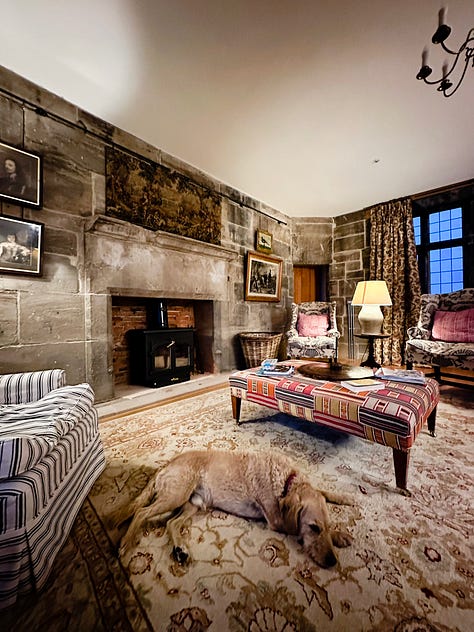

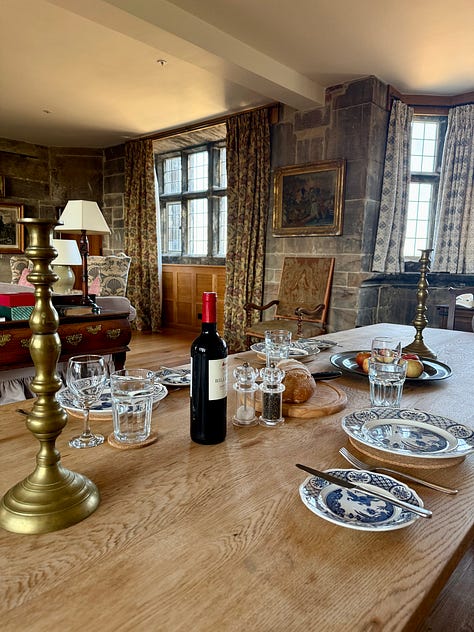
As Director of the Landmark Trust, Dr Anna Keay (who is also an award-winning historian) brilliantly puts it, ‘For those who feel that real luxury is not a spa and wellness centre ... but bathing in an Elizabethan turret watching stately clouds through an open casement or falling asleep with the glow of a dying fire reflected on the beams of a medieval ceiling, Landmark is the answer.’
Reader, this week I have bathed in an Elizabethan turret. For a few magical days, Tixall Gatehouse has been home to me, my family and our dogs. The combination of beauty and history has been calming for my soul. To dine on the roof (where the original clock tower solemnly tolls 19 o’clock no matter the hour) and to watch the Perseid meteor shower under its dark skies was particularly special.
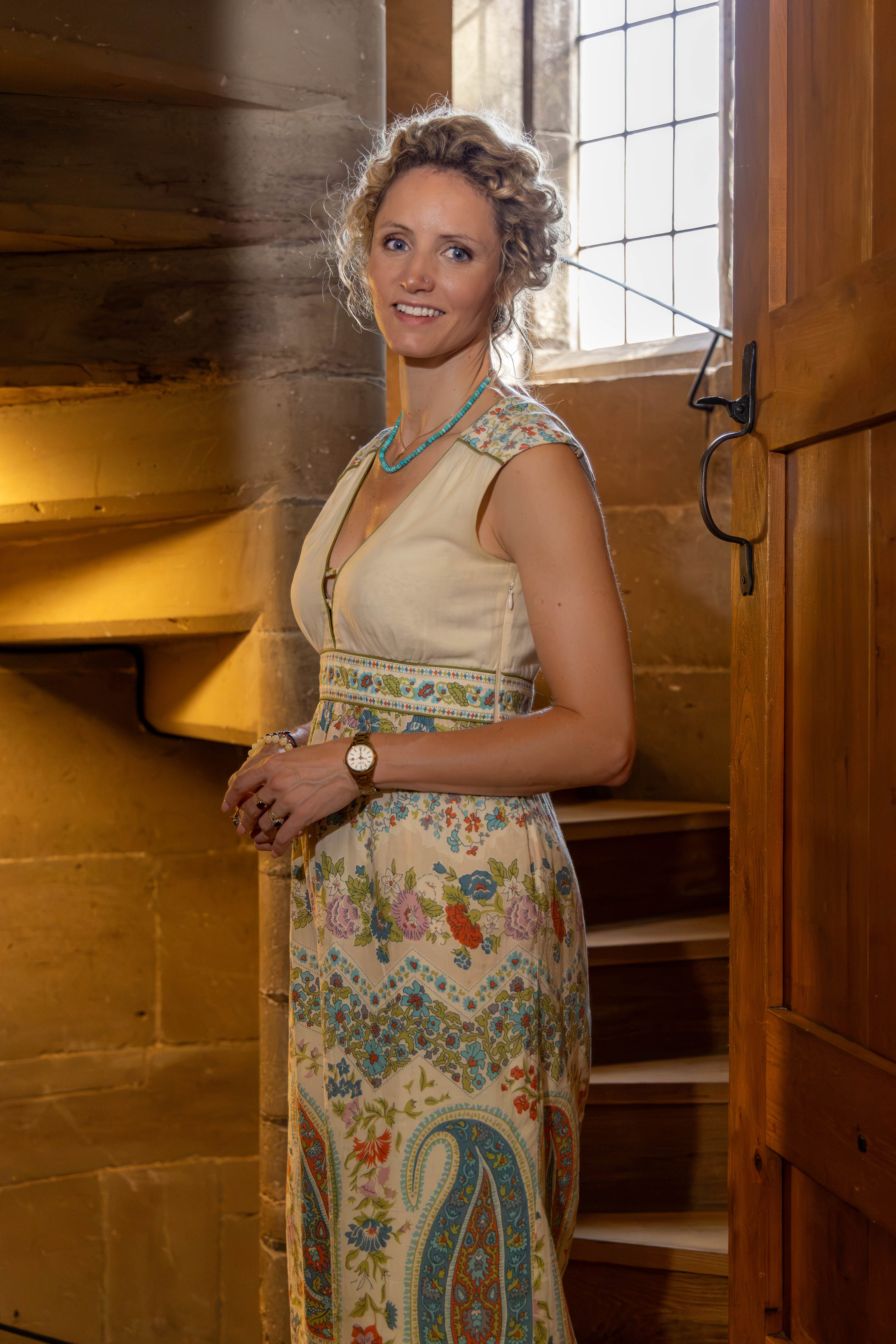
I have made a few reels about Tixall, which I am releasing on Instagram and Facebook over this long weekend. Please have a watch. If you haven’t yet stayed in a Landmark, you should; I reckon it’d be right up your street.
And thank you to those who voted: I did get all my work done before I went! I was grateful both for those who said they didn’t like my chances – it was good to feel the reality principle that it was a tough load! – and for those who said I could do it – your encouragement really helped.
On Not Just the Tudors, this week, we released podcasts on
– in which I spoke to Dr Daniel Gosling about what really happened inside England’s most feared court
and
– in which I spoke to Prof. Alister McGrath about the intellectual and historical influences on C.S. Lewis’s Narnia
If you’d like to hear more about Mary, Queen of Scots and Elizabeth I, Professor Kate Williams and I take our show TO KILL A QUEEN on tour this autumn, with dates at York, Edinburgh, Cheltenham, Chester, Guildford, and Nottingham, and a worldwide live stream. Please come or watch! Trailer and info here.
Also, my new series HOW THE TUDORS LOST THEIR HEADS, beginning in the UK on Sunday 6th September at 8pm on National Geographic and Disney+, may have a word or two to say about Mary and her head. The show will air in America in October.
3. A Question for You
I’ve been pondering Anna Keay’s definition of ‘real luxury’. It makes me think of muddy boots, a good book in front of a fire, seeing a dear friend, shared laughter over wine. What is real luxury for you? How could you make it happen in the coming days?
Thank you for reading.
Yours ‘til Mars and Venus kiss,
Suzannah
x
P.S. I seldom comment on current news but I want to express my shock and dismay at the news of Jason Arday’s death.
In my research on the consistory – the church court – of the 16th/17th-century French Protestants, I came to doubt the accepted wisdom, which was that consistorial sentences of public shaming were light. They were anything but. In 1589, when Jacques Mingaud was told to make public reparation before the entire church of Nîmes for his confessed sin, he said that the consistory was being ‘too severe against him’ and that he would ‘prefer to suffer death immediately than make the said public reparation’.
The public hounding of Professor Arday over claims of plagiarism and exaggeration has been pursued with a bloodthirsty zeal that we rarely see applied to white scholars. And shame can kill.
~
This newsletter is free and always will remain so. For the next week or so, my entire archive of letters are available to read here. There is also a new subscriber chat, which is open to all subscribers (free and paid).
After that, access to the full archive will be available to paying subscribers only. Paid subscribers will also get:
· additional subscriber-only posts;
· from September, an audio recording of each newsletter, read by me
· access to my occasional live videos
· and the opportunity to pose questions to me (which I’ll pick from to answer in the subscriber-only posts).
In whatever guise you are here, thank you. I am so grateful for your interest and support.
No posts
Comments
Nothing yet. Say the first thing.
Sign in to join the conversation.