
It took only two weeks of war before Simon Stiell, the head of the United Nations’ climate change arm, told Reuters “if there was ever a moment to accelerate that energy transition [away from fossil fuels], breaking dependencies which have shackled economies, this is the time.”
It reminded me of a scene in the historical drama Schindler’s List, when Oscar Schindler explains to his wife why he’s finally successful.

Oskar Schindler: In every business I tried, I can see now, it wasn't me that failed. Something was missing. Even if I’d known what it was, there’s nothing I could have done about it because you can’t create this thing. And it makes all the difference in the world between success and failure.
Emilie Schindler: Luck?
Oskar Schindler: War.
Whether war speeds up the energy transition away from fossil fuels—the success Stiell and others hope for—is still to be determined. But speeding up the energy transition would help mitigate climate change. It could also reduce the amplitude of future geopolitical shocks on energy price volatility. All together that sounds like a more sustainable future.
Despite those hopes, though, the kind of “sustainability” most amplified by the war isn’t mitigation. It’s adaptation. In particular, the fossil fuel industry is adapting to the war, making short-term profits because of higher oil prices and using its financial power and political influence to ensure the industry’s own “sustainability” for decades to come.
"The United States is the largest Oil Producer in the World,
by far, so when oil prices go up, we make a lot of money."
U.S. President Donald Trump, 12 March 2026
Since 28 February, when the U.S. and Israel attacked Iran, leaders of countries whose economies are—to use Stiell’s term—“shackled” to fossil fuels have employed various tactics to stay that way. In the U.S., a net exporter of fossil fuels, those tactics include spreading misinformation from the fossil fuel industry, making deals for new fossil-fuel power plants (e.g., in Pennsylvania and Ohio), and cancelling billion-dollar wind farm projects and redirecting that money to fossil-fuel production.
Now, the Trump Administration has even lifted sanctions to allow 140 million barrels of Iranian oil that was “already in transit” to be sold on the world market (though reporting suggests financial sanctions will keep Iran from receiving any money from the sale for the time being). After all, more oil on the market—whatever the source—keeps consumer prices from getting too high. And that, in turn, helps maintain the fossil-fuel-dependent status quo.
So although the war has made some people, like Stiell, hopeful for breaking dependencies on fossil fuels, the political will is not there. Instead, the will of leaders from the dozens of nations that make up the International Energy Agency (IEA) seems to be to ensure consumers remain reliant on fossil fuels: On 11 March 2026, the IEA voted to release a record amount of oil from worldwide stockpiles. And they’re already considering doing so again.
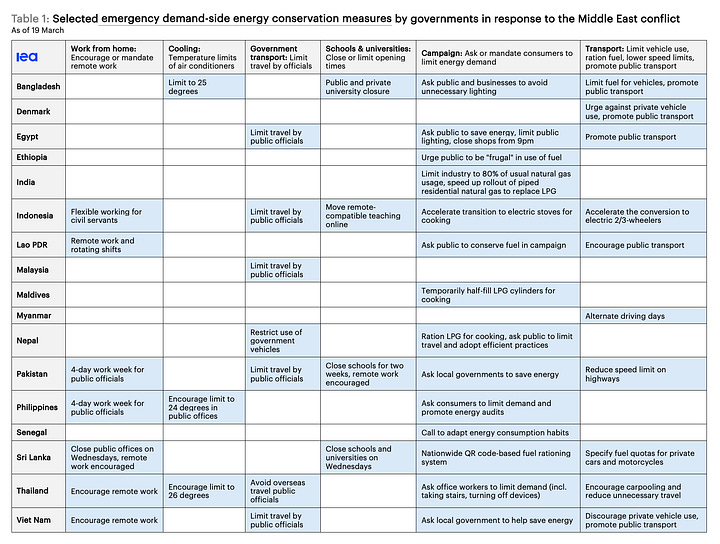
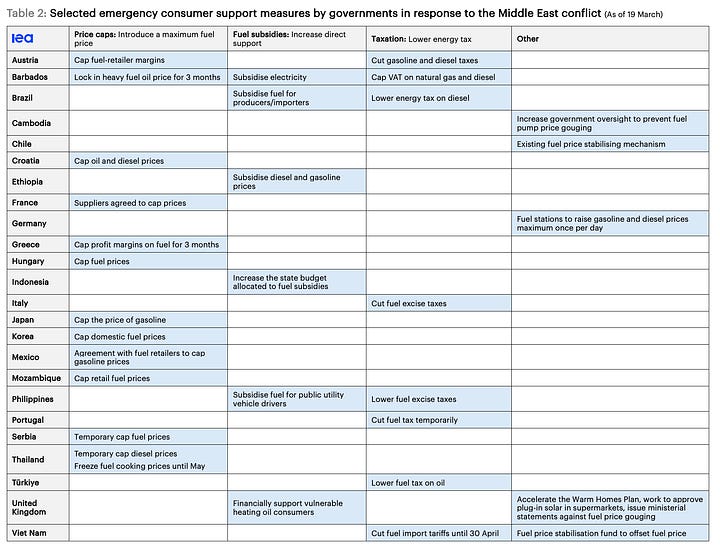
Simultaneously, the IEA is advising member nations both on “emergency consumer support measures” and “emergency demand-side energy conservation measures,” both of which help maintain the fossil-fuel-dominated status quo.
And the only IEA advice related to any kind of energy transition is to Indonesia to transition to electricity for cooking and for some very limited transportation needs, and to the U.K. to accelerate installing solar panels at homes and supermarkets.
Neither emergency list includes any advice for the U.S..
Going Nuclear?
Even so, some analysts unequivocally state the war “will accelerate the global energy transition especially to nuclear power” (Bulletin of the Atomic Scientists). Others’ arguments are more nuanced, saying the “decisive factor” of whether war is an accelerator or an anchor on the energy transition needed to achieve net zero carbon emissions is “how governments respond under war pressure: if they use the shock to drive structural decarbonisation and strengthen the resilience of grids, minerals, circularity, and finance, the transition can accelerate, but if they fall back on broad fuel subsidies, long-term fossil contracts without a decarbonisation pathway, and delayed climate tools, the crisis will likely slow net zero by locking in short-term fixes and undermining investor confidence” (Centre for Environment and Development for the Arab Region and Europe).
“Sustainability”: Polysemic, Polyvalent, and Phatic
Of course, nuclear power has its own sustainability problems, too. But with increasing electricity demands—driven by heavy investment in Artificial Intelligence (A.I.), data centers, and one-upmanship—some nations are choosing instead to avoid new investments in energy generation by banning new data centers. So just as some nations perceive the demands of A.I. as threatening their sustainability, others are arguing for A.I.’s increased use as perhaps the only way to solve sustainability challenges.
“To Save Everything, Click Here: The Folly of Technological Solutionism”
—discussed in The A.I. Sustainability Paradox
(SustainLab, 25 November 2025)
With all these different uses of the term “sustainability”—be it climate change mitigation, war adaptation, business longevity, technological solutionism, et cetera—it is important to reiterate that standardizing what “sustainability” means isn’t possible because what is sustainable in one culture, economy, political environment, or geography is not necessarily sustainable in another.
“No single blueprint of sustainability will be found, as economic and social systems and ecological conditions differ widely among countries. Each nation will have to work out its own concrete policy implications.”
—United Nation's World Commission on Environment and Development report, “Our Common Future” (1987)
In other words, “sustainability” is a term that is polysemic, polyvalent, and phatic because it
has many related meanings (polysemic),
refers to different, but often overlapping values (polyvalent), and
sometimes gets used without really any meaning at all, simply as a kind of social gesture (phatic).
So Dear Reader, as you consider the many analyses, hopeful statements, and nuanced forecasts about what may come—sustainability-wise—because of the war on Iran (especially this week, being CERAWeek), you may be tempted to think of the story of Oskar Schindler. His war profiteering ended after a crisis of conscience from his exposure to the suffering he was helping cause. Or you may be tempted to think of the story of Lee Scott, Walmart’s CEO, and his “key personal moment” (as retold on SustainLab) with Hurricane Katrina’s aftermath, which prompted Walmart’s ongoing sustainability efforts. No doubt, individual conversions of people who put profit over planet matter, and protests, among other means, do work to inspire such conversions. But the persistent action needed over long time scales to transition away from unsustainable fossil fuels is not accomplished one conversion at a time, whether one war profiteer, one CEO, or one political leader. It’s through political decisions (or lack thereof) with worldwide collaboration that anyone can help make happen by provoking discourse.
If you, like me, are a citizen of the United States — whatever your political persuasion or ideology — please keep your sustainability focus local, but also consider provoking discourse, including contacting and urging your representatives in Congress to undertake the persistent action needed over long time scales to transition away from unsustainable fossil fuels.
Appreciate this post but are thinking “No, I do not need another subscription, another newsletter, another micropayment to keep track of”? I get it. Please consider getting me a virtual coffee or contributing to my virtual tip jar.
No posts
Comments
Nothing yet. Say the first thing.
Sign in to join the conversation.