
In my last article (click here if you missed it), I tried to offer a way of thinking about what we even mean when we say community, distinguishing between abstract community (values-aligned but often scattered) and concrete community (close-proximity, resource-sharing, daily life interdependence). That matters because when I frequently hear people say they don’t have community, I often wonder which kind they are talking about.
From what I see, most people who feel this lack are talking about community more on the concrete side of the spectrum. They may have close friends, coworkers they like, or even family nearby, but they don’t feel enmeshed in a shared life. They might have relationships, but they are looking more for a sense of collective home.
The internet and social media have made it easier than ever to find abstract community. Online networks connect people across geography around shared identities, values, hobbies, interests, etc. For many, this has been life-giving. But translating abstract community into concrete embodied community is often where things get stuck. Moving from “we connect online” to “we show up in each other’s lives” is a leap many long for but don’t know how to make.
There’s another layer worth mentioning. Some people seem to use community and friend group interchangeably. A circle of friends can feel like community, but it’s not always the same thing. Friendships are often based on affinity, liking each other and enjoying each other’s company, while community, especially in the concrete sense, carries additional dimensions of responsibility and care. Confusing or conflating the two can leave people feeling unsatisfied because they’re expecting enmeshment from relationships that don’t provide it.
So if you’re someone who feels like you lack community, it’s worth pausing to ask: what exactly do you feel is missing? Do you lack values-aligned companions and partners for collective work? Do you lack friends who bring you joy and ease? Do you lack neighbors or companions who share daily life and shared responsibilities? Or do you have pieces of all of these, but long for them to overlap more? Asking these, you can begin to move toward a clearer picture of what you truly want, toward the kinds of relationships that actually meet those desires, rather than chasing a vague idea of community that leaves you unsatisfied.
Part of why so many people feel the ache of “lacking community” is because the longing itself is ancient. Humans evolved to be social, interdependent beings. Our survival depended on closeness: hunting and gathering in groups, raising children across generations, pooling labor, protecting one another. Interdependence isn’t just a preference, it’s embedded deep within us. To want community is to want something profoundly human.
Dominant systems have conditioned a contradiction into us. They all benefit from people seeing themselves as separate, independent units. When we are convinced that independence is a virtue, we stop building interdependence. We internalize the idea that to need others is weakness, even though everything in our history and bodies knows otherwise. I’ve talked about this at length before, especially in my seven-part series Beyond the Nuclear Family. That series explored how the nuclear family is a tool of dominant systems by isolating us, shrinking our circles of care, leaving us vulnerable to economic and emotional precarity.
Many of us live in tension. We want interdependence but we have been trained to pursue independence. We long for the daily togetherness of community but many of us have lost the practice and imagination for how to build it. The result is a constant dissonant ache, an evolutionary pull toward closeness colliding with cultural conditioning that says if you don’t stand alone, you’re a failure.
Check out the spectrum below
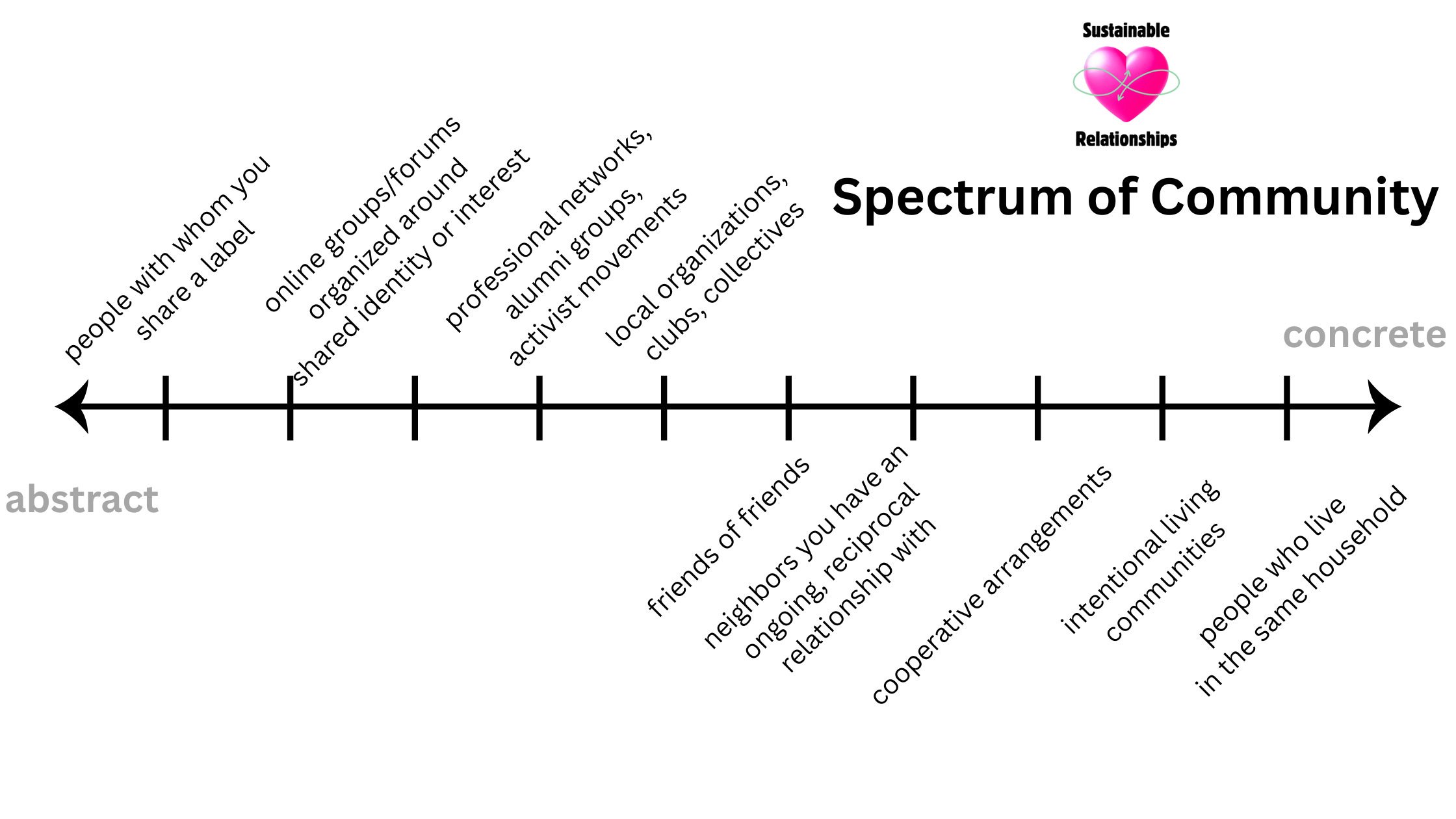
On the far left are the most abstract types of community such as people who share a label or identity with you like queer, polyamorous, Black, etc., online groups or forums organized around a shared identity or interest, and professional networks, alumni groups, and activist movements. The middle left includes local organizations and collectives you participate in, friends of friends, and social media circles. The middle represents relationships like ones you might have with a neighbor where you may borrow tools, briefly keep an eye on children, etc. The middle could also be where we place sibling, cousin, or other familial relationships that carry history but no longer share everyday life. The middle right might be cooperative arrangements like a community garden, carpooling, homeschooling pods, etc. The far right would be the people you live with in the same household.
This spectrum does not prioritize one kind of community over another. Like most things, some people thrive more on the left, some on the right, and most of us need a mix. Also, remember many relationships shift over time, like with siblings as we have mentioned before and also with parents.
Even with its shortcomings, thinking about community systematically can help us think differently and maybe come up with solutions that were not available to us before. Sometimes I suspect that a lot of the frustration people feel about not having community comes from a mismatch of expectation. Sometimes we treat abstract community as if it were concrete. We expect people who share our labels or values to show up for us in the way only people in close proximity really can. Abstract community can give you solidarity, inspiration, and a general sense of belonging but it’s really not set up to bring you soup when you’re sick, help you pack to move, or help with childcare. That’s really more where concrete community comes in. When we conflate these, we can end up feeling disappointed and it isn’t because anyone failed us. We weren’t looking in the right place for support.
If what you crave is the intimacy of being known up close, abstract community won’t fill that gap. And yet, many of us, especially with the internet, spend a lot of our time building abstract networks. We may have hundreds of people who share our values online, but still feel lonely at the kitchen table. The problem is not that abstract community is less than, it’s that we sometimes expect it to provide what only concrete community can. Abstract community can be nourishing but it can’t substitute for the closeness of people who are physically, practically, and emotionally enmeshed in your daily life.
Sometimes the opposite problem arises. A person may have concrete community and still feel like they don’t fully belong. They may feel loved and cared for, but not seen in their entirety. They might feel mostly safe but not fully understood. You can belong in the everyday sense, yet feel like an alien. This is where abstract community comes in. Abstract community can offer mirrors for the parts of you that your concrete community can’t always hold. Maybe your family loves you but disagrees with your politics or doesn’t understand your queerness. You might feel like you’re not from this planet, even if you can’t name it exactly. Abstract community is where you can find resonance for those deeper identities and values, the ones that don’t always fit neatly into the communities you inherited and inhabit everyday.
Recognizing this distinction matters because it clarifies what kind of community you’re missing. IF you crave daily interdependence, online groups and political alignment aren’t going to cut it. Likewise, if you really want recognition of your deeper core identity, family loyalty might not quench that loneliness. Naming what you lack clearly is the first step. When you can tell the difference between needing closeness and needing resonance, you can move with more intention. Instead of chasing some vague idea of community, you can pinpoint the specifics that will meet you where you are. When you know what you’re missing, you can start to activate by deepening what you already have or by building new spaces where your whole self can land.
Most of us already have some community, even if it doesn’t look or feel exactly the way we want. Discernment can start with naming what is present. Who shows up for you? Where do you feel safe? Which circles affirm parts of you, even if they don’t affirm all of you? Sometimes the path forward is about building on what you already have by clarifying expectations or widening the role someone plays in your life. Other times, it’s necessary to create new circles for yourself. That can feel daunting, especially if this idea conjures up the idea of starting movements or hosting gatherings. It can be as simple as finding social media groups or showing up at events where the kind of alignment you’re craving already exists. What matters is not that you construct the perfect community, it’s that you move with clarity about which kind of community you’re missing.
Building the “perfect” community is not the goal. The goal is to move with clarity about which kind of belonging you’re missing. Community just has to be enough so that you feel held in ways that feel real to you. That will likely only be built slowly, piece by piece, from the ground you already stand on.
Comments
Nothing yet. Say the first thing.
Sign in to join the conversation.