
Another workshop I monitored at Sex Down South was called “Church Girls to Sex Pros: Reclaiming Spirituality in Sexuality Education,” facilitated by the beautiful and dynamic Dr. Clarissa Francis and Chanel Jaali Marshall. The purpose was to help decolonize sexuality, to disentangle people’s desires from the weight of indoctrinated religious judgment. As someone who has never been religious and did not grow up heavily steeped in church, I wasn’t sure this session would resonate with me. What resonated with me wasn’t necessarily the content, but the shared recognition in the room. One participant said that everyone who grew up in Black American churches are like cousins. Heads nodded and laughter tinkled throughout the room. There was shared experience between them and it bonded them.
I realized how often I have felt on the outside of that kind of shared cultural inheritance. I grew up “Black” in America, but in a Caribbean household. My reference points, stories, rhythms, and habits were different. I’ve always felt more immediate camaraderie with Caribbean people, and yet, I’ve also never been fully accepted by those who were born in the Caribbean because I was born and raised here in the US. That leaves me in a complicated in-between space. And it’s not the only arena in life where I find myself in-between or on the margins.
I have learned to look for commonalities where I can find them. Not always in the categories of race or ethnicity, which were handed down from dominant systems, or shared background, which is deeply influenced by dominant systems, but in deeper places like values, where convention is bucked. Sometimes belonging is less about who shares your past and more about who shares your inner landscape.
I’m reminded that belonging is not always guaranteed by our “obvious” categories. Those categories mean something but they are also rooted in power-over systems which have a tendency to flatten us. Race often organizes us by what has been done to us collectively. Ethnicity can bind us through culture and tradition. But both can leave people who live at intersections feeling like there is no place to land. I’m reminded that it’s better to build belonging not from categories inherited through dominant systems, but from chosen values. We can recognize kinship in the people who share our refusal of oppression, and the willingness to unlearn, and the insistence on living fuller lives. Belonging, in this sense, is not about conformity or fitting in, it is about alignment.
Instead of trying to force belonging, we can come together around what we do share without demanding uniformity. We can build solidarity in the places where our values meet, even if our histories don’t overlap. For me, this is essential. I may not fully belong in the easy shorthand of anyone’s categories, but I belong deeply with those who are decolonizing their minds, questioning dominant systems, and refusing to be defined by them. This chosen kinship builds connection and unity despite our differences.
Every time I find people and spaces where I feel like I belong, I come into myself more. I may never have the effortless belonging that others find, but I’ve come to see that as part of my gift. It’s part of the reason why, even if I try, I’m not really able to think in a binary way. I am forging a path that does not rely on fitting into categories. And I’m not doing it alone. For every moment I have felt in-between, I have found people with me in the cracks, who are willing to question what they were taught and imagine something freer. With them, I am not on the outside, I am aligned. With them, I feel both the pride of charting my own way and the gratitude of being witnessed and supported along the journey. Belonging, I have learned, is not about being folded into someone else’s definition. It’s standing in your own truth and finding the ones who recognize themselves there too.
This is a huge part of why Sex Down South was a powerful experience. I felt something rare, to be in a space where my belonging didn’t have to be earned or explained. Just by showing up, I belonged. And unlike so many other spaces in my life, the assumptions people made about me actually approached the truth of who I am. That is belonging. And it’s also a reminder that I don’t have to let dominant systems define me because I am not theirs to categorize or flatten. My belonging is not inherited. It is created by alignment, not conformity. I am not boxing myself in because I am not theirs to define. The greatest reflection I am taking away is the depth of my agency and self-sovereignty.
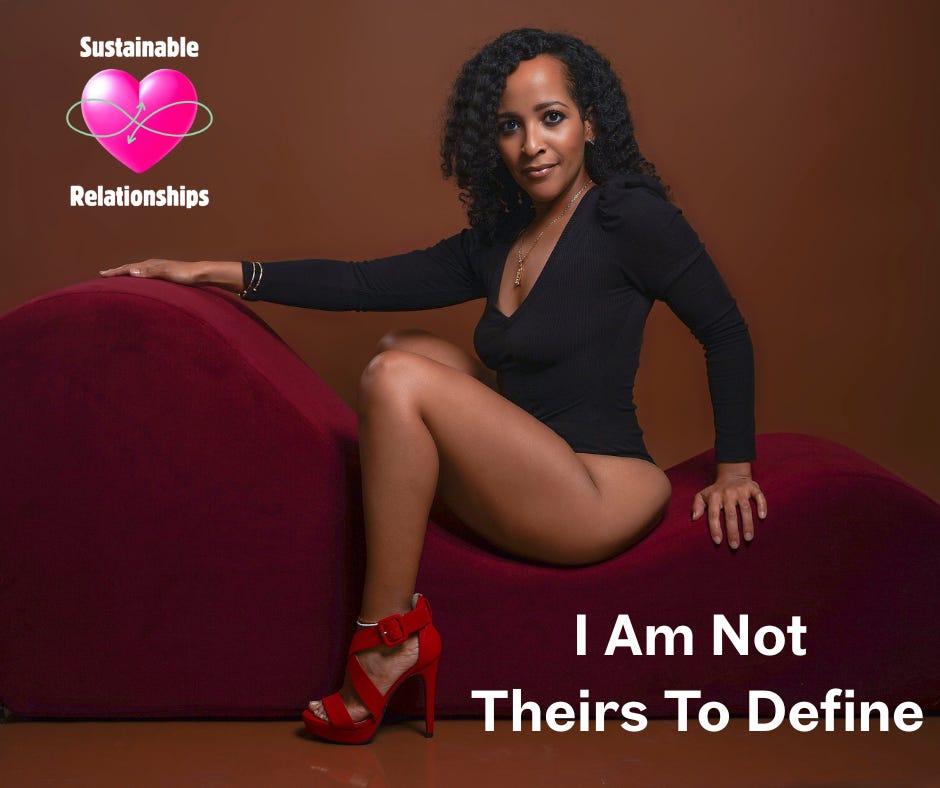
This is also why I chose the photo you see in the graphic for this article. It’s from a photoshoot I did for my 40th birthday, where I kind of wanted to mark my own “becoming.” I know that for some, the immediate assumption will be that I am seeking attention. But that assumption comes from a worldview that has been shaped by dominant systems, where bodies, especially women’s bodies, are always immediately sexualized, where nudity is coded as sex. Sex, and by extension, bodies, can only be framed as commodity or shame.
When I show my body, I’m not surrendering to that narrative, I am actually refusing it. My body is not just for sex and it certainly isn’t only for someone else’s consumption. It’s mine to define, to celebrate and to reveal on my own terms. In a culture where sex is “everywhere and nowhere at the same time,” as I wrote in my first reflection this week, reclaiming my body’s visibility is part of reclaiming my sovereignty.
I am not asking for permission or validation anymore. I’m not striving to belong or fit in anymore. I’m declaring alignment with myself. I am refusing to let anyone else, least of all the dominant systems that flatten and categorize into binaries, dictate what my self-expression looks like. Just as belonging isn’t inherited but created, acceptance of myself isn’t inherited but chosen.
This thread runs through all my reflections from Sex Down South: liberation is about living in our own definitions, creating belonging through alignment instead of conformity, practicing autonomy and sovereignty in how we love, connect, and how we show up in the world. Nothing about me is theirs to define. It’s all mine.
Comments
Nothing yet. Say the first thing.
Sign in to join the conversation.