
[For publication August 9, 2026]
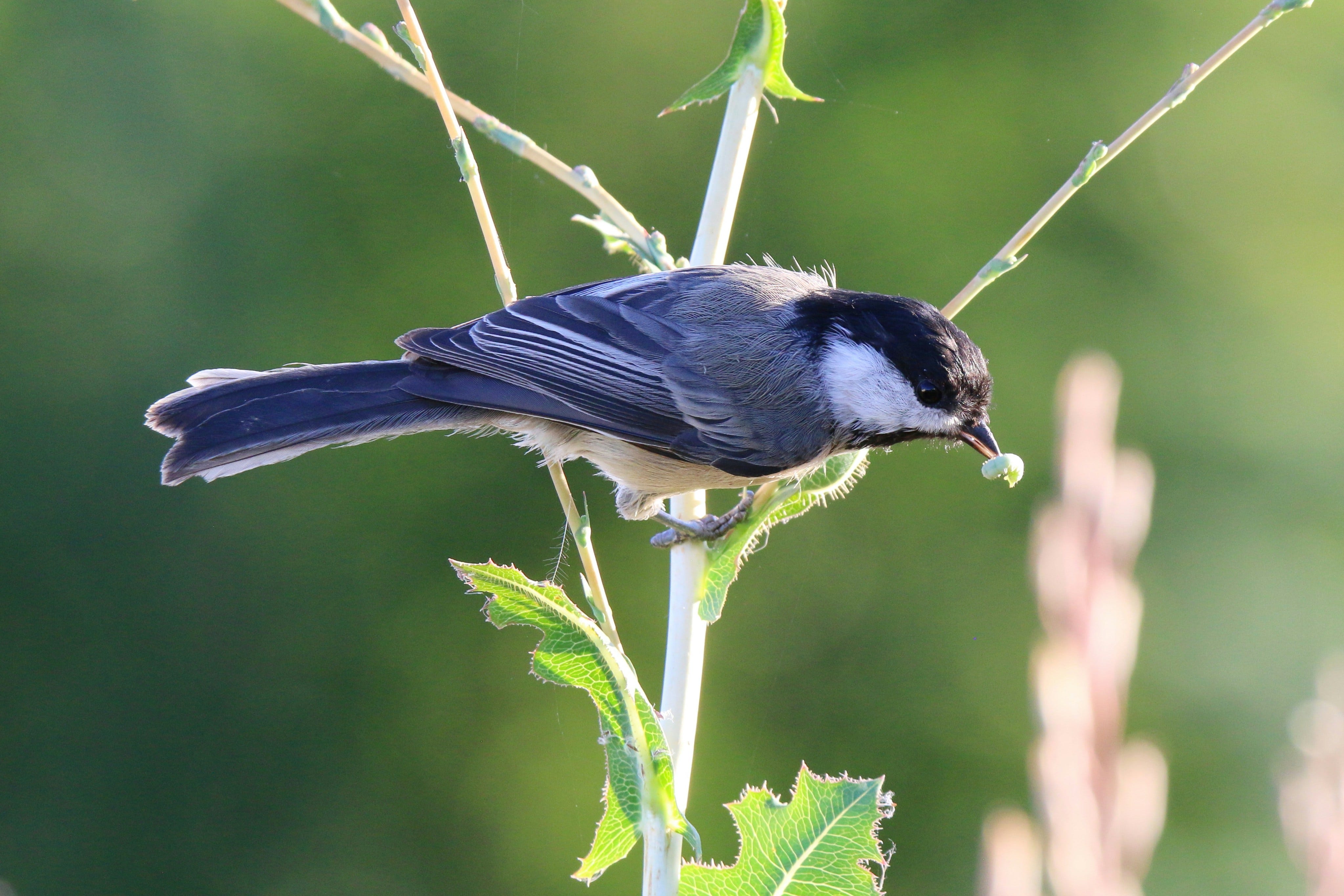
Most insect-eating birds in North America are declining, and the reason isn’t a mystery once you look at what’s growing (or not growing) in the yards around them. Non-native, mowed grass doesn’t host the insects and arthropods that birds devour, especially while those birds are raising young. A chickadee pair needs thousands of caterpillars and other creepy crawlies to fledge a single brood. You can help every avian parent in your neighborhood by filling your yard with plants that support the diverse forms of life native to your area.
That’s the gap this week’s step closes. Habitat—one of the seven pathways to sustainability—covers how we shape our land and structures, from the buildings that shelter us to the soil, water, and species that share our immediate surroundings. A yard is one of the most direct pieces of habitat most of us control outright. What you choose to plant in it either wisely sustains the local ecosystem or unknowingly subtracts from it.
Today also marks the International Day of the World’s Indigenous Peoples. Long before subdivisions and sod farms, plant communities were influenced over thousands of years through fire stewardship, cultivation, and land management practices that kept forests, prairies, and wetlands productive and diverse. A 2019 study in Environmental Science & Policy, based on more than 15,000 sites across Canada, Brazil, and Australia, found that vertebrate biodiversity was highest on indigenous-managed lands, even higher than in formally protected parks and reserves. Imagine tending your yard with exactly the kind of attention and relationship to the land that endures in indigenous cultures around the world.
According to a NASA-led analysis, turf grass (the kind of grass suburban homeowners mow every week) covers roughly 40 million acres in the United States—about the size of the entire state of Wisconsin. Lawn, which is nothing more than a pleasant view and a nice place to walk or sit, is the single largest irrigated “crop” in the United States, ahead of corn or wheat. Watering all that grass accounts for most of residential water use during the growing season in many parts of the country.
If you are willing to give up a little lawn, how much native planting is enough to provide real benefit to wildlife? In a study published in the Proceedings of the National Academy of Sciences, researchers Desirée Narango, Douglas Tallamy, and Peter Marra tracked more than 150 yards in the Washington, D.C. area and found that yards needed at least 70 percent native plant biomass before Carolina chickadees could successfully raise enough young to sustain their local population. Below that threshold, breeding success collapsed regardless of how many bird feeders or nest boxes were nearby. At that level or higher, populations held steady. The same research shows that a relatively small share of native species does most of the work—Tallamy’s broader analysis found that with just a few “keystone” plants —often native oaks, willows, cherries, goldenrods, and asters —a small yard yields outsized results.
Being a wise steward of your land does not require ripping out an entire lawn. You can convert a border strip, a bed by the driveway, or a cluster of large containers on a balcony into regionally native plants without adding to a water bill or a lawn-chemical budget. Once established, native plants are adapted to local rainfall and soil conditions and require little maintenance.
Look up your county’s native plant list through the National Wildlife Federation’s Native Plant Finder. Search by zip code to prioritize keystone plants. Pick two or three of those species, choose a spot in your yard (or a couple of large pots, if a yard isn’t part of your life right now), and make a plan this week. Skip pesticides on the new bed, and if you can stand to leave the fallen leaves there through winter, you’ll be giving overwintering insects a place to survive until spring when the birds will need them.
Even a small planting will compound: one patch of native plants becomes a stepping-stone for pollinators and migrating birds moving between the next native patch and the one after that. If you’d like to explore more along the Habitat pathway today, visit our archive of articles at SustainablePractice.Life/archive and filter by Habitat. And when you do encourage a native plant to put down roots in your soil, think about the countless generations of people before you who cared for these same plants in this same part of the planet we all share.
Looking for Lawns — NASA Earth Observatory (turf grass covers roughly 40 million acres in the U.S., the largest irrigated “crop,” using an estimated 50–75 percent of residential water in summer)
Nonnative plants reduce population growth of an insectivorous bird — Narango, Tallamy & Marra, Proceedings of the National Academy of Sciences (2018) (the 70 percent native-biomass threshold for sustained Carolina chickadee breeding)
Biodiversity for the Birds — University of Delaware UDaily (plain-language summary of the chickadee/caterpillar research, including the 6,000–9,000 caterpillars per clutch figure)
Biodiversity highest on Indigenous-managed lands — University of British Columbia News, summarizing Schuster et al., Environmental Science & Policy (2019) (vertebrate biodiversity on Indigenous-managed lands equaled or exceeded that on formally protected areas across Canada, Brazil, and Australia)
Native Plant Finder — National Wildlife Federation, based on Dr. Douglas Tallamy’s research (zip code–based tool ranking native plants by caterpillar and butterfly support; keystone species support about 90 percent of caterpillar diversity)
The Other 4,000 Bees — Sustainable Practice, One Step This Week (native wild bees depend on the same native plants, and outperform honey bees at pollinating home gardens)
A Switch You Can Flip Tonight to Save Migrating Birds — Sustainable Practice, One Step This Week (another low-effort Habitat step that protects the same birds a native yard feeds)
Expand your positive impact on Earth by becoming a sustainable practitioner today! www.sustainablepractice.life
Sustainable Practice empowers you to protect our planet in practical ways. Share this article with someone who’s proud of their lawn and might be even prouder to expand the range of species they are tending—let them know how meaningful a single bed of native plantings can be for the wide and wild world around them.
Comments
Nothing yet. Say the first thing.
Sign in to join the conversation.