
Readers and friends,
If you’re new here, the About page on my Substack will tell you more about Thyme, Place & Story, and what to look for during the month.
If you’ve been here at Substack for a while or if you’ve come via any of my books, thank you for your interest, your friendship, and support. You are deeply appreciated!
To all, welcome to a hot and muggy El Niño August!

Herb of the Year for 2026: Turmeric (Curcuma longa). Selected by our friends at the International Herb Association.
The Celtic tree calendar is a 13-moon lunar calendar. August honors two trees:
Holly (Jul 8-Aug 4), often used for hedges, symbolizes persistence, protection, strength, endurance, courage, justice, hope, and growth. It rules the eighth moon.
Hazel (Aug 5-Sep 1), traditionally associated with wisdom, inspiration, intuition, and poetic knowledge, is used in spells for creativity, learning, divination, and protection. It rules the ninth moon.
The Zodiac for August includes the seasons of Leo (Fixed Fire, ruled by the Sun, Jul 22-Aug 23); and Virgo (Mutable Earth, ruled by Mercury, Aug 23-Sep 22). Jupiter, the planet of growth, abundance, and opportunity, is now traveling through Leo. Think big, create boldly, and let yourself be seen!
Flower of the Month for August: Gladiolus, symbolizing integrity, faithfulness, remembrance, and persistence. The plant takes its name from the Latin gladius, or sword, a reference to its long, blade-shaped leaves. That martial name later linked the flower with courage, victory, and strength of character.
August is National Peach Month and National Sandwich Month.

Week 1
August 6. The Shakers (who would become America’s premier herbalists) arrived in New York Harbor on this day in 1774, on a ship called Mariah.
Week 2
August 10. Chicago, IL, was incorporated as a village on this day in 1833, with a population of 200.
August 15. Today is the birthday of Julia Child (1912–2004), also known as Our Lady of the Ladle, who introduced Americans to the art of French cuisine.
Week 3
August 17. National Vanilla Custard Day.
August 19. National Potato Day.
Week 4
August 27. Banana Lovers’ Day. The familiar Cavendish variety is increasingly vulnerable to disease and extreme weather intensified by climate change.
August 28. Pepsi-Cola (originally an herbal drink to treat indigestion) got its name on this day in 1898.

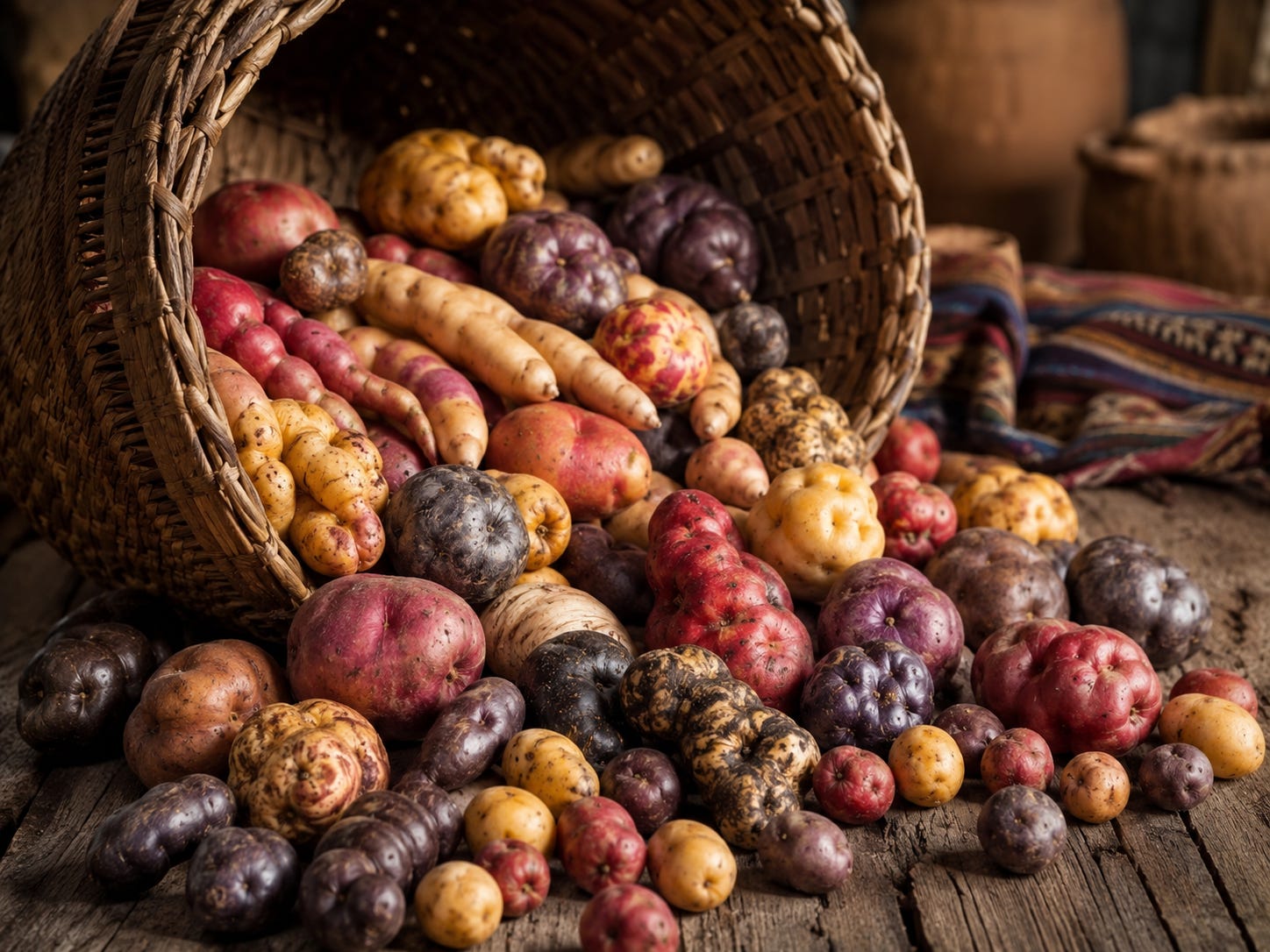
National Potato Day is one of those food things that’s easy to skip. Who wants to celebrate the humble potato? Doesn’t take much effort to find one. It’s not going to cost a day’s pay, either.
But that ubiquitous veggie in the plain brown wrapper represents a family with a lot more color and variety, as well as a long history. The story starts some 8,000 years ago in the highlands of Lake Titicaca, in present-day Peru and Bolivia, where the nights are cold and the soil is thin. The early wild potatoes were bitter and sometimes toxic, but indigenous people figured out which ones were edible, survived the frosts, and produced best at which elevation. By the time Europeans first laid eyes on a potato, Andean farmers had been using selective breeding to tame a recalcitrant wild plant and turn it into a daily meal and insurance against famine. Then the Spanish showed up, discovered the potato, and took it across the Atlantic with them, along the same east-bound routes that ferried silver, sugar, tomatoes, avocados, chocolate, and enslaved people. At first, it wasn’t a big hit. For one thing, it grew underground, and pious folk associated it with deviltry. For another, it was a nightshade, with several poisonous relatives. It got blamed for leprosy and, well, lust. (Some varieties bore a definite resemblance to a phallus.) And because it was a cold-weather plant bred for short equatorial days, it would take more selective breeding to produce a potato that felt at home in the longer summer daylight of northern Europe.
A few supporters took on the potato as a project. Agronomist and pharmacist Antoine-Augustin Parmentier, for instance, met the potato as a prisoner during the Seven Years’ War. Back home in France, he threw potato dinners for la noblesse and talked Marie Antoinette into pinning potato blossoms on her party dresses. There’s story (perhaps apocryphal) that when Louis XVI gave him a large plot of land, Parmentier plowed it and planted potatoes. He then stationed heavily armed guards around his valuable crop. The news got around that something so well-guarded might be worth a quick dig. The quiet part: the guards were told to let the thieves make off with the potatoes.
The publicity helped, and as the Industrial Revolution ramped up, the high-calorie, low-cost potato was feeding the people who worked in the mines and mills and factories. Local famines helped, too: when droughts decimated French grain crops in the 1780s, driving bread to unaffordable heights, potatoes kept whole villages alive. The Royals lost their jobs and in 1793, the newly-installed French government began promoting the potato. In 1794, Madame Merigot published a revolutionary cookbook — all about the potato.
The potato’s most consequential European story unfolded in Ireland, where British land policy packed poor tenant families onto tiny plots while landlords exported the grain and livestock they raised, leaving the tenants with a small patch of lumpers. These could reliably feed the family — until1845, when the fungus-like microorganism Phytophthora infestans crept across the countryside, infecting the crop. The blight destroyed the crop; British colonial policy turned that crop failure into mass death. When it was over, a million people had died of starvation and disease and another two million had fled the country. That’s when the Andean potato crossed the Atlantic again, west-bound this time, carried by Irish immigrants who preserved their native foodways in their new country. And it has just kept spreading — Asia, Africa, Australia, anywhere that climate and soil allows it to grow. Today more than a billion people eat potatoes in an astonishing variety of dishes: Indian aloo gobi, Spanish tortilla, Polish pierogi, Swiss rösti, British chips, French gratin, Israeli latkes, Peruvian causa, American hash browns, and, inevitably, the fast-food french fry. But while there are many potato dishes, industrial farming is turning the potato into a monoculture. Commercial potato production depends on a few genetically similar varieties, selected for uniform size and the ability to survive storage and processing. The Russet Burbank, for example, became America’s french-fry potato primarily because its shape can produce those long fries we expect with our quarter-pounders. But it’s susceptible to potato virus Y, net necrosis (brown lines inside the potato) and common scab. Shades of the Irish Lumper. Meanwhile, climate change is already bringing longer, hotter seasons, water shortages, and larger and hungrier insects. A crop heavily pinned to a handful of commercial varieties may not adapt very well. Scientists are now suggesting that the potato’s future may loop back through its past — through the many varieties Andean farmers are still tending and the wild relatives stowed away in seed banks. In Peru, for example, Quechua communities in the Potato Park are conserving native potatoes along with the land, the indigenous farming practices, and the folk traditions that go with them. This isn’t just a heritage project. It’s a hedge against a hotter, less predictable future. So go ahead, celebrate National Potato Day any way you like. Just don’t forget what you’ve got on your plate. Over thousands of years, farmers on cold Andean slopes bred this plant from an unprepossessing, unpalatable wilding. Europeans were frightened by it, then intrigued, and finally obsessed. It fed empires without belonging to them and got blamed for a famine that was really about who got to eat and who didn’t. It crossed oceans in both directions and landed on every continent, cooked a hundred different ways by billions of people who mostly had no idea where it came from. It deserves a little respect, don’t you think?
The Shakers are a Christian sect that practices celibacy, communal living, egalitarianism, and pacifism. After beginning in England, they left for America in 1774, where they established communities that supported themselves by gardening and craftwork. By the mid-1800s, the Shakers were the largest producers of medicinal herbs in the United States, growing and selling hundreds of herbal remedies, salves, and extracts. You can learn more in Wormwood, China Bayles’ seventeenth mystery.
Okay, so what’s the connection between Chicago and herbs? Well, you probably know that the onion is an herb. But you may not know that the place-name “Chicago” means “onion field.” The word was first recorded in a 1688 French document, where it appears as Chigagou, an Algonquian word. The document explains that wild onions and garlic grew profusely in the area. And if you’d like to try something a little different with your onions, marry them with mint, in this intriguing recipe: Roasted Sweet Onions with Mint.
Celebrate St. Julia’s Day by reading her book, My Life in France. You might also enjoy the memoir Julie and Julia: My Year of Cooking Dangerously, by Julie Powell, who cooked all 524 recipes in Mastering the Art of French Cooking—and lived to blog about it. And then of course the blog became a book (naturally) and the book became a film, Julie & Julia, starring Meryl Streep as the irrepressible Lady of the Ladle. Cooking doesn’t get any better than this.
Observe Vanilla Custard Day by getting better acquainted with vanilla, perhaps the best-loved flavoring of all time. Vanilla pods are the fruit of the vanilla planifolia, the only orchid to produce an edible substance—and after saffron, the second most expensive herb to grow. Go here for an overview. And if you haven’t read it yet, now is a great time to indulge in A Plain Vanilla Murder, China’s twenty-seventh mystery. For a classic plain-vanilla baked custard recipe, try this one. Top with fresh strawberries or peaches for an elegant dessert.
If you’d rather make your vanilla custard with condensed/evaporated milk, here’s how. And while you’re at it, you might want to know how Gail Borden came to develop canned condensed (or evaporated) milk and how it was related to the Shakers — a bit of food history that you probably didn’t learn in school. What’s the difference between condensed and evaporated milk? Here’s the low-down.
Learn the history of one of the most famous soft drinks of all time. Pharmacist Caleb Bradham brewed up a drink he called “Brad’s Drink,” designed to ease indigestion and boost energy. It was concocted of carbonated water, sugar, vanilla, “rare oils,” and high-caffeine kola nuts. He didn’t think his name did much to sell his product, so on August 28, 1898, he gave it a catchy new name: “Pepsi-Cola.” A main ingredient of modern Pepsi: high-fructose corn syrup.
You’re curious about AI use? I used ChatGPT to help me compile the Almanac and To-Do sections of this post, and to draft the feature section on the potato, which I rewrote. (I insist on keeping my em dashes.) Still curious? More here.
Thanks for reading, everyone! I’ll be back on Thursday, August 3, with the first of four posts about my experience with Beatrix Potter. These are reprints of posts I published earlier but which I thought you might enjoy while I’m on sabbatical this month — and while you’re reading The Tale of Hill Top Farm, the first book in our upcoming slow read of my English village mystery series, The Cottage Tales of Beatrix Potter.
If you missed a week or two of our recent slow read of The Darling Dahlias and the Cucumber Tree, you can find links to the posts and the extras on the Dahlias’ home page, here.
Also, a quick reminder: On May 1, I “paused” all paid subscriptions indefinitely, effectively making all of my work available free to all subscribers. You can read more about that here.
Have a good week, everyone. I’ll see you on Thursday.
Comments
Nothing yet. Say the first thing.
Sign in to join the conversation.