
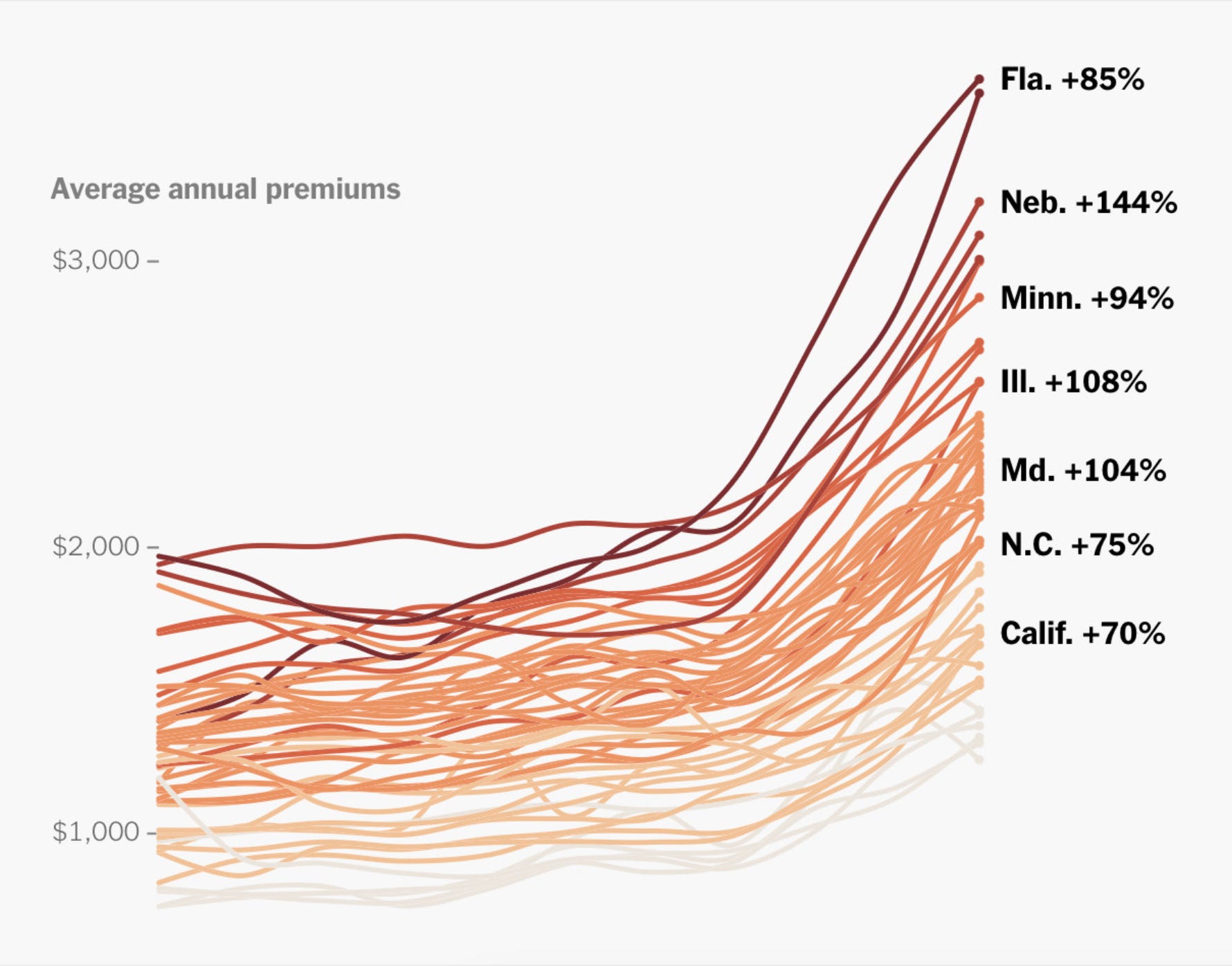
Thanks to Benjamin Keys and Philip Mulder, we now have a glimmer of insight into how disaster risk is likely affecting what owners of mortgaged single-family homes actually pay for property insurance in the US — and what those homes are worth. (Their study was covered by The New York Times here.) The authors’ conclusion, based on reverse-engineering premium payments from overall escrow amounts for millions of homes, is that people are paying more for insurance in more physically risky places—independent of rising construction costs and inflation. They also find that price increases by global reinsurers explain nearly 25% of the total increase in premiums paid between 2018 and 2024. And they present evidence that houses in areas prone to hurricanes and wildfires are worth less in the eyes of buyers—that there are sizable, lasting reductions in home values in exposed markets.
Keys’s and Mulder’s work shows that the most liquid elements of our housing finance system—reinsurance, which is altogether unregulated and global, and insurance, which can reprice each year—are flashing warnings about physical climate risks, and that these signals are being priced into the value of homes. They also find that these dynamics are changing quickly and unpredictably. From a homeowner’s perspective, uncertainty is rising fast—as insurers charge more for any given increase in risk, passing their concerns along to consumers. The same level of increased risk is now leading to higher premium costs than in the past.
Also, reinsurance prices have basically doubled over the last eight years, and insurers are increasingly shifting these amounts to their policyholders. Keys and Mulder are able to show that US counties with “correlated risk,” where many properties experience losses from disasters at the same time, see bigger increases in insurance premiums, independent of other local factors. These are places where insurance companies are buying reinsurance to protect themselves from those large, all-at-once losses. And these bigger increases seen in “correlated risk” counties are evidence that reinsurance increases are a substantial driver of rising premiums in disaster-prone areas.
This is a story of acceleration. Because of increasing insurance costs, what a homeowner might have thought was a fixed 30-year mortgage on a house that increases in value is turning into an adjustable-rate obligation covering an asset that might not find a buyer at the price the homeowner believes is fair.
Crucially, the authors can study only the simplest of signals: “price” and “insurance.” But what perils is the insurance covering? How narrow is it? “Groceries,” that beloved word, is a category that covers both salmon and crackers—we do not know from studying overall monthly spending in that category whether people are thriving. Similarly, these researchers can report only about “insurance” broadly, because the details of the policies involved are hidden from them. They are forced to infer overall policy costs from escrow payment data alone, rather than knowing directly what those amounts are, and have little visibility into what those policies cover (or not). Two homes paying the same premium could have very different policies: one might have a low deductible and full replacement coverage, and the other might have broad exclusions and skimpy payouts.
And because the databases these researchers are relying on cover just mortgaged single-family homes, they are not able to look at condos, rentals, or properties that are owned outright without a mortgage.
Policymakers, like these researchers, are in the dark when it comes to making plans for the future based on the signals being conveyed by insurance providers. The real story, the accelerated erosion of risky housing markets, is mostly hidden. But bravo to Benjamin Keys and Philip Mulder for doing their level best to provide rigorous evidence of the rippling effects of climate risk on property markets, and for making their data available to all.
This week Americans celebrate Thanksgiving. The traditional elements of the meal are distinct—brussels sprouts, cranberry?—and may not actually fit in a logical sequence. In celebration of Thanksgiving, here’s another Moving Day story I am thinking about this week: We can’t rely on the insurance industry to be the only risk-signaler for homes. These companies may be tracking hurricanes and wildfires, and translating those risks into higher premiums, but they are likely to exclude things like saltwater intrusion coverage entirely. And salty water is a really important risk for homeowners.
Why do I think they’ll exclude it? Here’s a 2022 technical advisory bulletin from a trade association for insurance agents in Louisiana listing a host of reasons why drinking water contamination would not be covered by property insurance. If you find insurance entertaining, you will enjoy this document. Basically, they’re finding a million reasons why salty drinking water is not the same as physical damage to a home.
Why did this trade association publish this document? Because drinking water in New Orleans was threatened as a saltwater wedge moved up the Mississippi River—in 2023, the Army Corps had to bring millions of gallons of fresh water to the city.
Who is tracking the threat to coastal and riverine housing and human life posed by salt water? It’s a huge risk along the East Coast of the US. Here’s a good explainer from NASA. And it isn’t just a coastal issue: Tidal rivers are increasingly vulnerable to saltwater intrusion. New York City is worried about its drinking water. It’s a problem in North Carolina. It’s a major issue for South Florida.
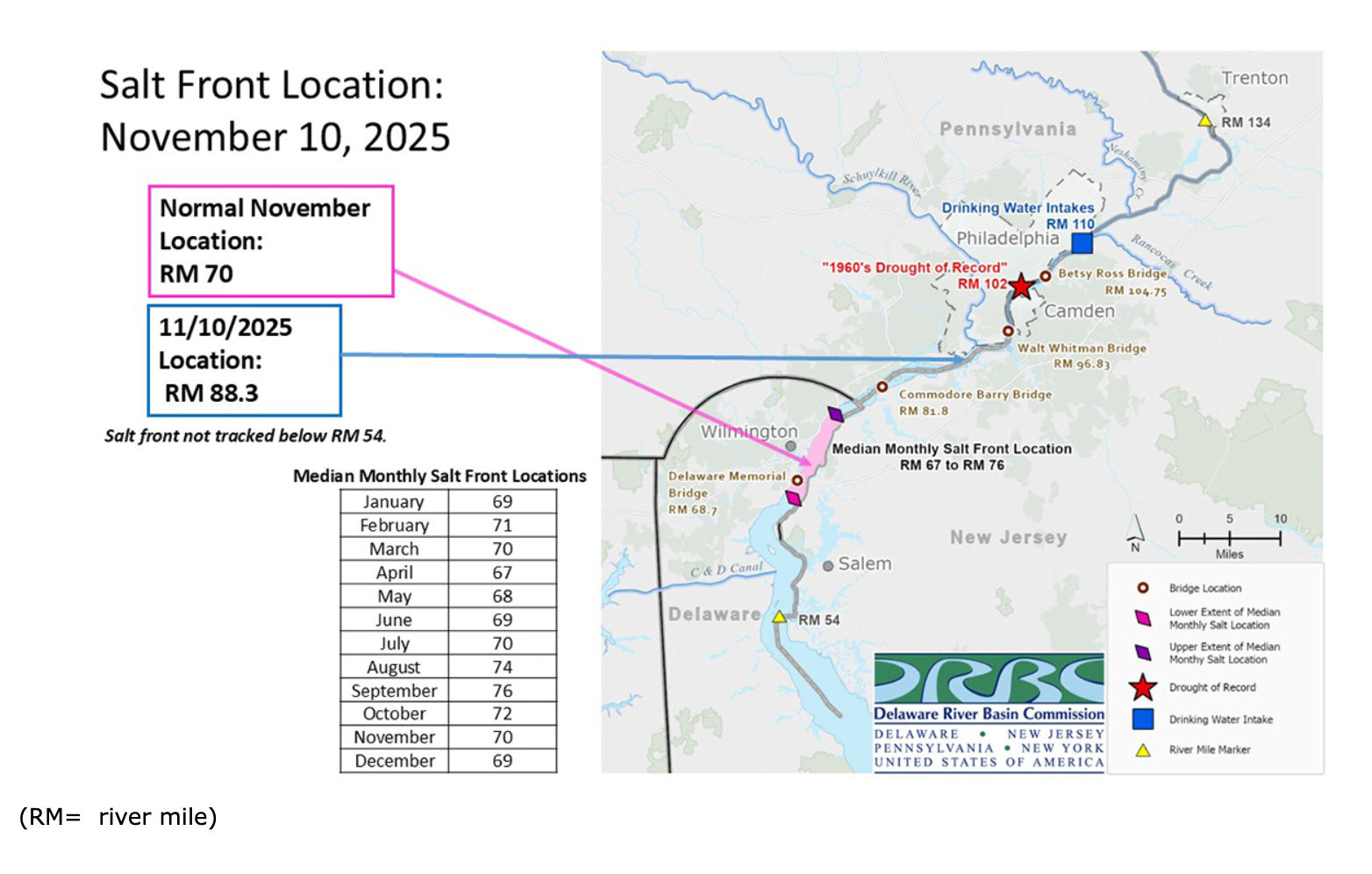
The Delaware River Basin Commission worries about salt water coming up the Delaware—affecting millions of people in New Jersey and Pennsylvania. You can worry, too: Here is the “salt front” tracker for the river, showing it advancing toward Philadelphia, eighteen river miles above where it should be at this time of year.
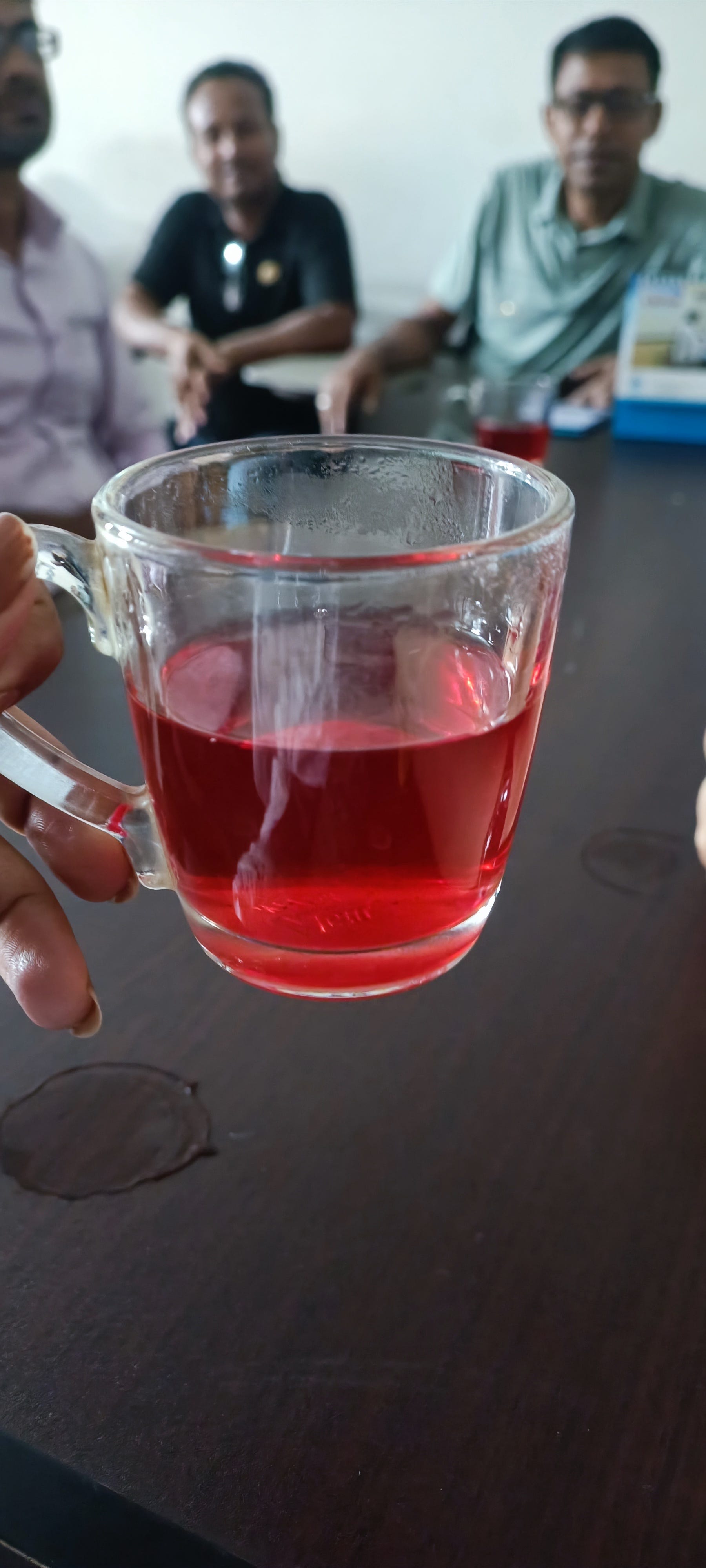
I’m thinking about salt water intrusion because I remember being served tea that tasted salty to me near Khulna, in Bangladesh, last year.
One of the friends I made there sent me a piece yesterday about the effect salt water is having on life there. When I was in Bangladesh, I saw the compounding effects of rising sea levels and out-of-control saltwater farming of shrimp—it was a disaster, a human cataclysm, rolling inexorably onward. Read the piece. Bangladesh may seem far away and the risks remote. Not so much. They are on the front lines, but we are not far behind.
In sum: It is good to have expert researchers inferring what is happening to insurance premiums and assessing rigorously how global reinsurance costs are being increasingly shouldered by US homeowners. We need this work to be done. My hope is that it will help persuade policymakers to treat physical climate risk as material and urgent. It would be even better if all of the physical climate risks we confront were being assessed and planned for. Just one of those, saltwater intrusion, likely isn’t being taken into account just yet in home values—but will have a fundamental, corrosive impact (literally) on lives along our coasts and rivers, sooner rather than later.
No posts
Comments
Nothing yet. Say the first thing.
Sign in to join the conversation.