
Listen to the author read the following piece by clicking below.
0:00
-6:39
I started getting my chops teaching the Enneagram to residents at the local county jail in 2014. People told me, “You can’t teach that thing to ‘them,’ they’re going to manipulate you.”
But that’s not what happened.
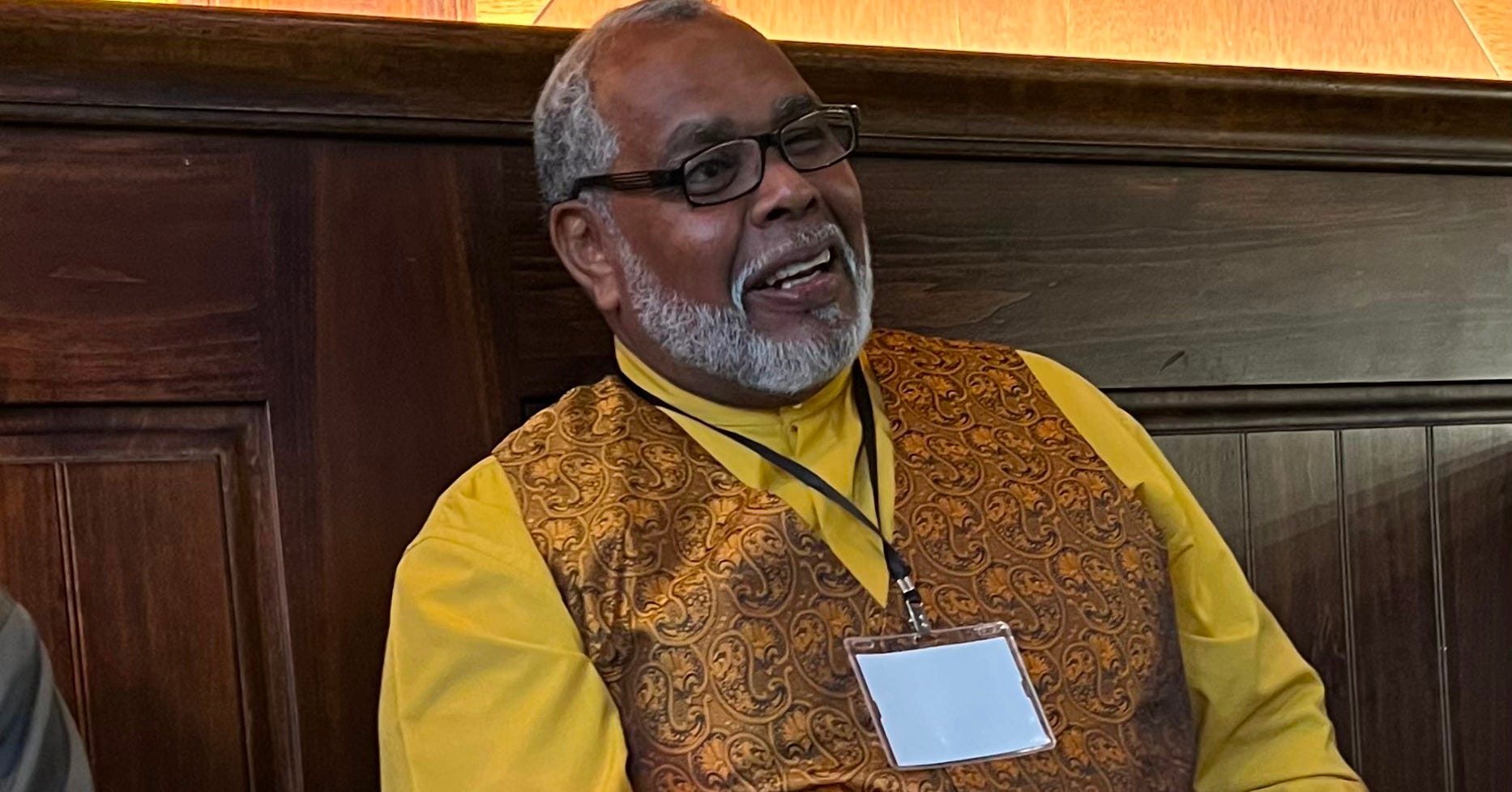
Among the first people I met “inside” was a man named Alex. He was built like a football player, but when he spoke, Alex sounded more like a preacher. He turned out to be both of those things. Alex quickly identified with Type Nine on the Enneagram, The Peacemaker. Type Nines come to teach the rest of us about belonging. It didn’t take but a minute in Alex’s presence to sense that he’s a special soul. Everyone felt more relaxed around him, including me. Everyone but Alex, that is.
Alex says, “I seen that symbol and thought that thing’s a cult!” Lucky for both of us, Something compelled Alex to linger long enough to find out more about the Enneagram and more about himself. Today, Alex loves to ask people: “Y’all know Somethin’? How Somethin’ told you this, or Somethin’ told you that? Well, now just what do you think that Somethin’ is?”
That’s a great question.
What is it that interrupts us from our habituated behavior? Author Henry Cloud says, “We begin to change when the pain of staying the same becomes greater than the pain of changing.” By the time I met him, Alex had spent well over two decades in prison; he had lost and rebuilt his life time and again. Once, he walked off a life sentence, and was out for just thirty days before getting arrested and starting the cycle all over again. It had been ten years since his last incarceration when I met him, and he was looking at a lot of time.
I’m not going to tell you Alex’s whole story; it’s his story. What I will tell you is that on that day in jail, Alex’s dignity was palpable. He listened intently, defying the black-and-white stripes he wore. He had a tightly trimmed beard and a glass eye that held the place of the real one Alex lost to a billy club in a shootout with a cop. His “good” eye was chestnut brown, with lashes so long women would kill to have them. Slowly, Alex blinked back what he calls “A life of almosts.” He insists that he sees more out of that one eye than most people can see with two good ones. If there is a book in everyone, then I felt there must be a whole library in Alex Senegal.
And, there is.
The Type Nine child is meant to arrive in the world fully connected to their essential qualities of Being, Wholeness, and Belonging, but I’m not so sure Alex actually did. Don’t get me wrong, those qualities are absolutely him. But Alex will be the first to tell you that he never felt any sense of belonging as a child. He’s so sensitive that I can imagine, even in his Mama’s belly, Alex was already picking up on how hard it would be to find any peace in the family he was about to be born into. The Nine’s basic desire is simple: just to be at peace. The first thing Alex would have to do is make peace with a worldview fundamentally at odds with his own—his Mama’s. Their family lived in a neighborhood riddled with violence and violations.
Alex told me he was on the FBI’s most violent list. You might be wondering how a Peacemaker ends up on the FBI’s most violent list. People aren’t born gang leaders, murderers, rapists, drug dealers, or thieves. These roles are modeled and fostered within families where children are just trying to survive, like their parents. When we’re not sure if our parents will come home drunk or come home at all, we’re in survival mode. When a child’s not sure whether they’ll have enough food, clothing, or money for rent, when we’re wondering if someone will hurt our mother, or us, the brain saves us by narrowing the choices to keep us alive: to fight, flee, or freeze. Against every fiber of his peaceful being, Alex made a choiceless choice: to fight. By the time we met, it had become such an ingrained habit that Alex came to believe that’s who he was.
“We begin to change when the pain of staying the same becomes greater than the pain of changing.”
—Henry Cloud
When I began teaching in the jail, I had been studying the Enneagram system for over a decade. I was certified to teach it, but still immersed in my studies. I was extremely insecure, unsure of myself—my own good-enoughness, just like Alex. In a way, I knew too much. I knew I had a Type One personality pattern, formed in childhood, with significant trauma. But I hadn’t figured out how to stay with myself when things got stressful. I had a great cover, but inside, I was always anxious, afraid of doing the wrong thing.
It was in the safe space we co-created inside the jail that I finally learned how to apply the wisdom of the Enneagram in real life. Alex will tell you that I held his feet to the fire when I insisted that he be accountable for his homework; that’s true. And I will tell you that he held mine to the fire when he insisted that I take up my own curriculum. He schooled me in self-acceptance and taught me to be the change I so badly wanted to see in the world.
We came for each other, of that I’m sure.
Alex ended up doing far less prison time than he expected. When he was released, after 54 years of gang life and running the streets, he went right instead of left. Alex made a conscious choice to belong to himself. He took up the curriculum, and as Alex would say, we’ve been rollin’ together ever since. And Somethin’ has had our backs all this time.
Today, Alex is part of a dedicated team growing two organizations—Enneagram Prison Project (EPP) and The Human Potentialists (THP)—one for the work on the inside and one for the work on the outside, knowing full well that everything is connected. If you listen to Nines, it’s crystal clear that there just is no difference between people. As Alex says, “It does not matter where you grew up, how much money you have, or if you can spell the Enneagram, or not.
“There are no big I’s and no little You’s.”
—Alex Senegal
Next month, Enneagram Prison Project will be turning 14, that’s right. We’re celebrating our birthday all month long by “chopping it up” with EPP Ambassadors who learned how to be free long before they were released from prison and jail. We have so much room inside ourselves and in our collective heart. If you have ever wondered, “What is it like to belong to a community of people who are bound and determined to grow, to become more conscious, and to be a part of a vision to free people all over the world from the prisons of our own making?” Please stick around, because we are just getting started.
Want to know your Enneagram Type? Take a test HERE.

Comments
Nothing yet. Say the first thing.
Sign in to join the conversation.