
I’ve mentioned to a few folks that there are a whole bunch of song references nestled Easter-egg-like in The Come Apart. (Because of course.) There are 18, in fact.
I thought about challenging readers to find them, unassisted. However, upon further reflection, it seems clear that there isn’t a human alive who would [bother to/be able to] detect every single one. That is not a game anyone is going to play.
But I’m hooked on the notion of some kinda hunt for the references in all their veiled glory. What can I say? It’s Ughust, my kid is leaving for college, I’m begging for distraction.
So I’m going to throw you a big ol’ bone. Wanna play? I’m making it way easier.
Below, find the pages on which the references appear. How many can you fill in? I’ll even provide a few clues.
Neil Young is in there, duh, and not just for “Stupid Girl” and “Mr. Soul,” which I don’t count among the 18, as these song are referenced by name; in other words, they’re not hidden/embedded like the others are.
Taylor Swift is in there, too.
So are Hurray for the Riff Raff and Stereolab.
And the reference on page 140 works for two songs. (Well, at least two. I have two in mind.)
That’s all I’m giving away for now!!!
Darlings, I have such low expectations for anyone trying to win this wicked game1—notwithstanding the cheat sheet—that I might as well offer $10k and a chicken dinner to the winner. If anyone even manages to score in the, like, 10-or-more-out-of-18 range, I’ll come through on the chicken part2— and note that you and I should absolutely be friends if we’re not already.
Here are the page numbers:
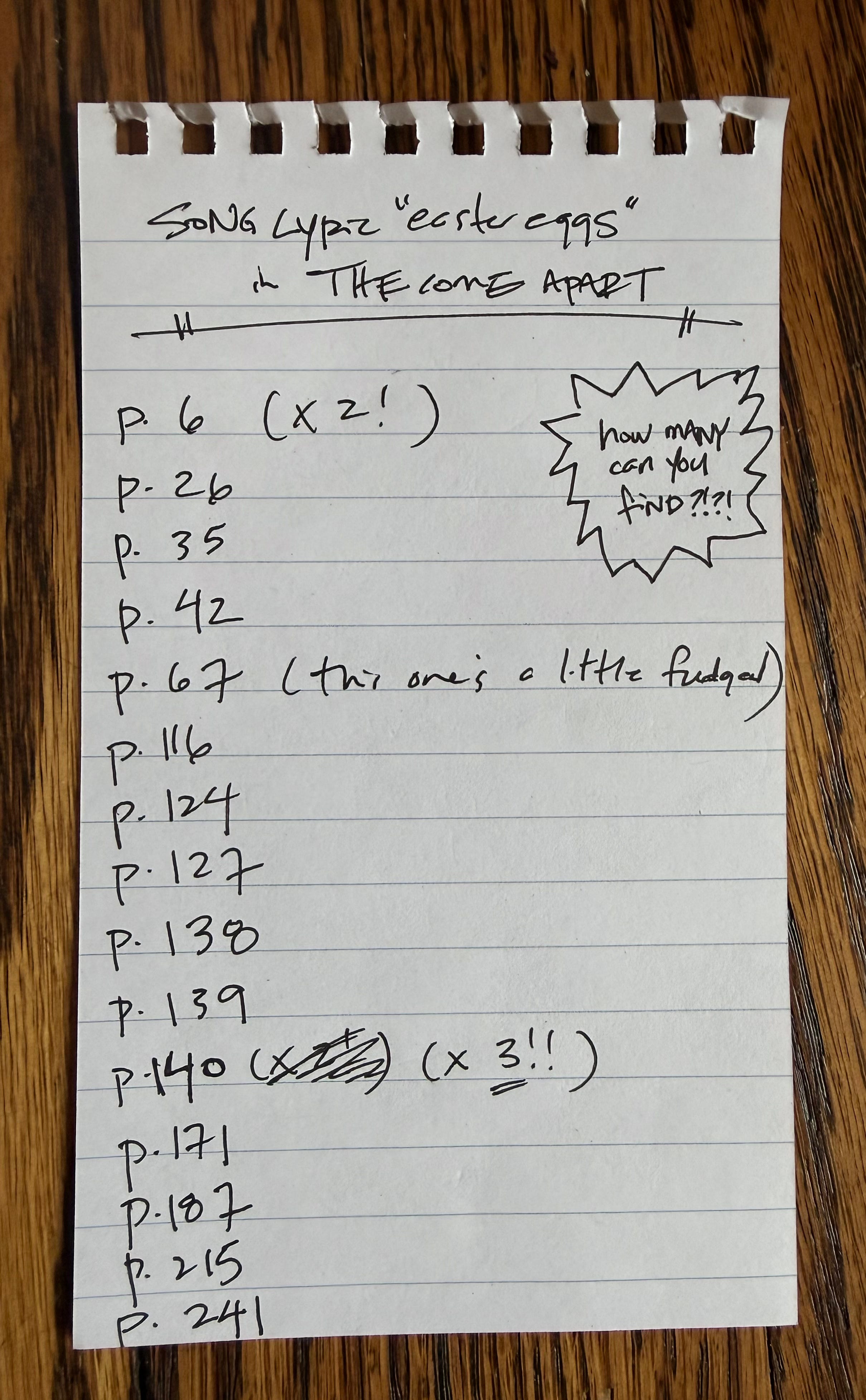
Eventually, I’ll give up on y’all and post the answers.
A few thoughtful write-ups of The Come Apart that I haven’t yey mentioned:
From Melodic Magazine, a piece by Christine Sloman:
The concept of murmuration, which refers to a group of birds in flight, is prevalent throughout The Come Apart. For their debut album, Spinning Birds named it Murmuration. “The whole idea of murmuration or the way birds flock is so fascinating and mysterious,” Felts explains. “And then the idea beyond that—what is a solitary bird? What is a bird in flight? Sometimes, you see a lone hawk and they’re just so magnificent. They just seem so completely possessed of their own space, so I think there’s something going on there.” It represents Maggie’s journey so well, from being in a band in Chicago to venturing to Nashville in order to find her purpose.
Maggie’s journey is one of messiness and unease, embodying the “come apart” concept throughout the book. An artist’s life can be full of inspiration, but it can also have its heavy moments. “The creative life as an artist in modern times…I feel like it’s getting even harder,” explains Felts. “But there is value to sticking with your passion, your talent, and finding the way that you can fit it to the world. Keep going. Keep making things. Keep creating because the world needs creators. Keep making art because the world needs artists.”
When life does become too much, as it does for Maggie, it makes sense to unplug for a while. One of the messages that Felts wants readers to take with them from The Come Apart is to have more appreciation for nature. When in nature, a primitive form of belonging can surface, which helps us to better center ourselves and make sense of our lives. “I sort of gestured at this, but one of themes of the book is stillness,” shares Felts. “The word ‘still’ is in the book quite a bit. Very intentional. I hope readers may come away with a new sense of appreciation for slowing down, taking a pause, and refusing the relentless churn that our culture encourages us to participate in every waking moment.”
And this piece, by Penny Kiley, from Louder than War, a UK-based music publication:
Susannah Felts’ novel about a female musician is as authentic as indie and as melancholy as the best country song.
Felts creates a believable world of people and places that is very recognisable to anyone who has spent time with musicians and artists, either side of the Atlantic. It’s also very believable about life as a woman in that world, like all the times that Maggie arrives for a soundcheck and is mistaken for “the merch girl”.
But at the heart of the book is a personal story. It’s partly about Maggie’s relationships with people: family, band members and those unrelated folk who provide more sanctuary than either. And it’s also about her relationship with creativity, as she discovers that she can’t run away from her identity as a performer and a songwriter.
In a publishing world full of musicians’ memoirs, when truth is often stranger than fiction, what can a novel about a fictional musician bring to the reader? It can tell a story slowly, it can create a world of fully rounded characters, and it can get deeper inside a musician’s life and soul. And it can make you think more widely about art and culture and what happens to the people who create.
Thank you Christine, Penny, and everyone who has read TCA and gotten something out of it. xoxo
Earlier this week I watched Montage of Heck, a documentary about Kurt Cobain. I want to write more about deciding to watch this film now, long after my friend Kat Brock first mentioned it to me, and how the film seemed to speak to things going on in my life right now. (Cobain’s performance of “Where Did You Sleep Last Night” at the end absolutely wrecked me.) This was yet another occasion on which I felt led to a work of art by some invisible hand, ably nudged to consider it in juxtaposition with other focal points of my life at the moment. I fully believe that if we stay porous, and keep our antenna raised, such works will enter our lives when they are most needed.
Anyway, after watching Montage of Heck, I’ve been listening all week to Nirvana’s In Utero, an album I once loved and haven’t listened to at all in at least thirty years. In particular, I’ve had “Scentless Apprentice” on repeat, with “Frances Farmer Will Have Her Revenge on Seattle” close behind. In the latter, the way Cobain lets loose the most ear-splitting (and Albini-fied) howl, and then goes on to strangle-scream-cry GO AWAYYYY several times over has been an unexpected salve for me the past few days, a timely response to overlapping waves of grief. While navigating the major life transition of a child leaving home, some parents take to Facebook groups with desperate questions about bed height and mini-fridge measurements. Me, I guess I retreat to the soundscape of my own college-age years and find release in Cobain’s snarl and screeching guitar feedback. (Each to her own, said the lady who kissed the cow, my mother used to say to me, on repeat.) I feel a strange peace under this sonic assault, and I can’t help but wonder if there are other Gen X parents in here with me. I miss you, Kurt. I miss you already, Thal.
[[I MISS THE COMFORT IN BEING SAD.]]
More to come on all this, I hope. (Also in the drafting queue: some writing about our trip to the California coastal redwoods.)
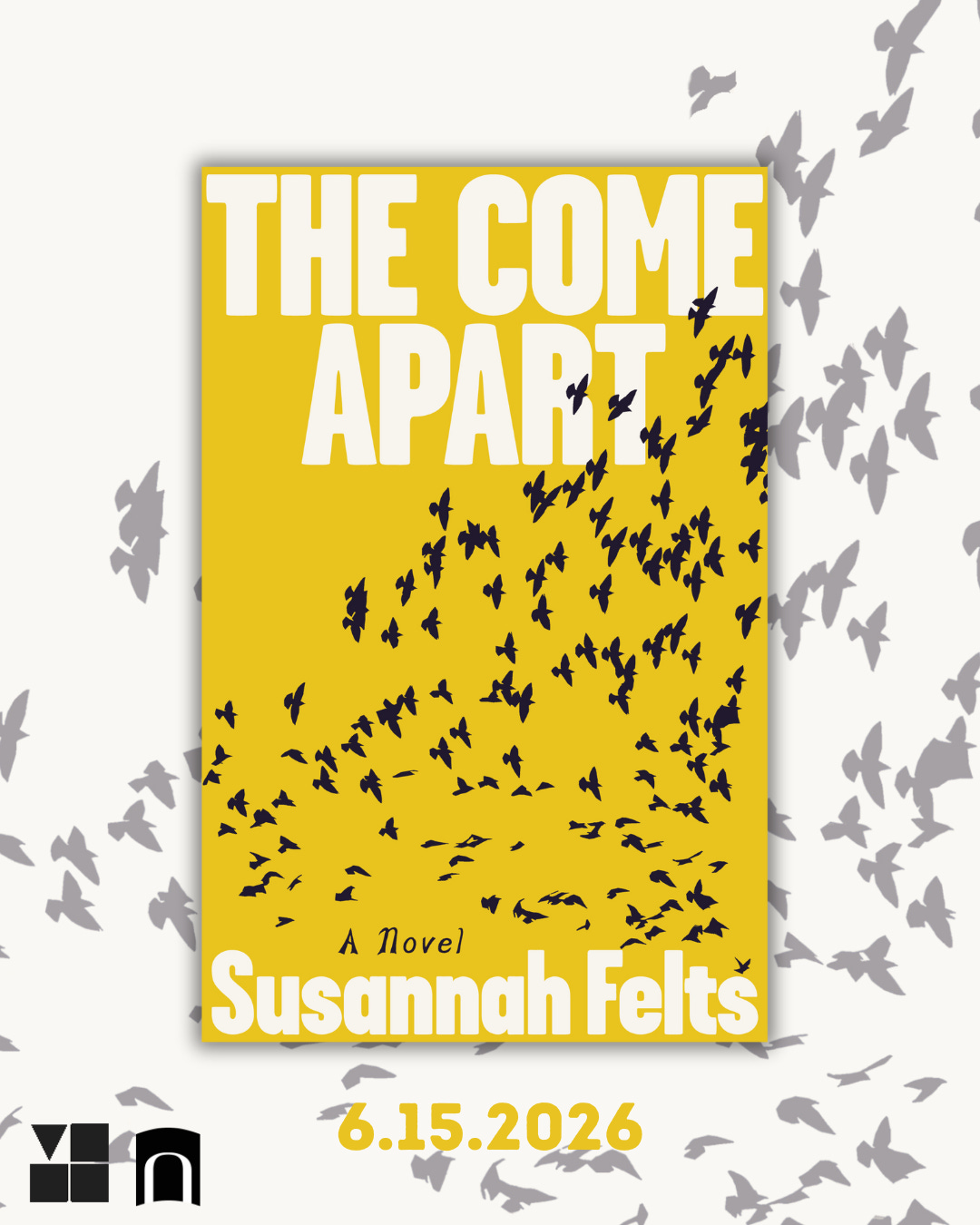
My rock ‘n’ roll/prodigal daughter/spiritual/literal homecoming novel, THE COME APART, is out now from TriQuarterly Books.
i.e., will enlist Todd, master of meals involving animal products
No posts
Comments
Nothing yet. Say the first thing.
Sign in to join the conversation.