
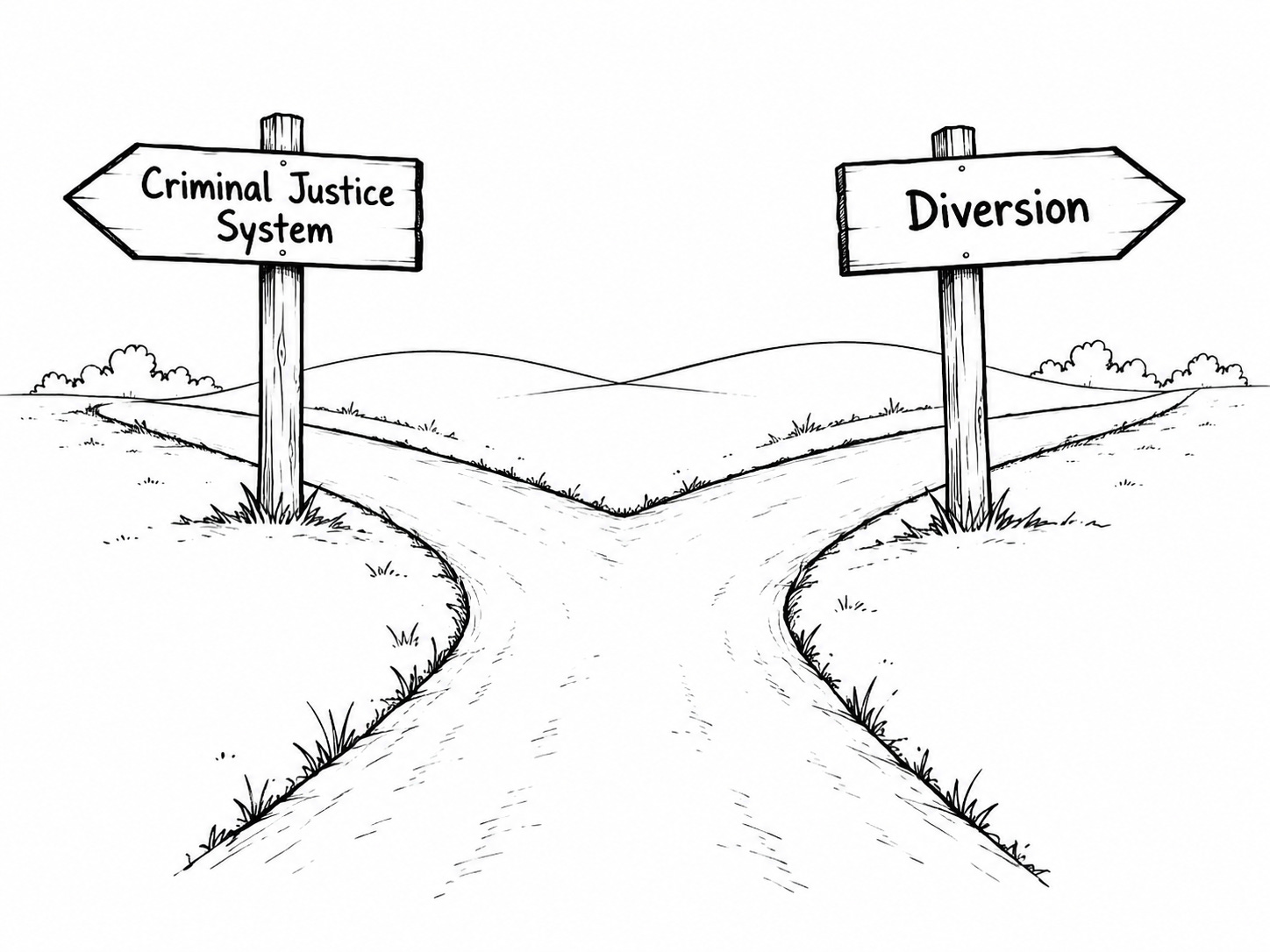
When an autistic person or someone with an intellectual or cognitive disability enters the criminal justice system, the question is often framed too late.
What did they do?
Did they understand the police officer?
Did they comply?
Did they confess?
Did they seem remorseful?
Did they know right from wrong?
Those questions matter. But Australia’s recent disability reform work asks a better one much earlier:
That is the heart of Recommendation 8.21 from Australia’s Disability Royal Commission, which focused on diverting people with cognitive disability away from criminal proceedings when appropriate. The recommendation appears in Volume 8 of the Royal Commission’s final report, which examined criminal justice and people with disability and included 24 recommendations addressing human rights, screening, supports, advocacy, staff training, and data collection.
For families of those with autism, this matters because diversion is not a soft idea. It is a practical one. It recognizes that some people enter the justice system not because they are dangerous, but because their disability-related behavior was misunderstood, unsupported, escalated, or mishandled.
The Australian Government’s 2025 progress report notes ongoing work around Recommendation 8.21, including efforts in Western Australia to evaluate specialist courts and diversion programs. One example is the Intellectual Disability Diversion Program, which seeks to address the overrepresentation of people with intellectual or cognitive disability, including autism spectrum disorder, by addressing both offending behavior and support needs.
Too often, the criminal justice system treats behavior as the only story. Diversion asks what came before the behavior. Was there a communication breakdown? A sensory overload? A lack of supervision? A mental health crisis? An inappropriate interrogation? A missing diagnosis? A family that tried for services and could not get them?
In the United States, we tend to talk about diversion in narrow categories: mental health courts, drug courts, Veterans courts, youth diversion programs. Those models can be helpful. But families with autistic teens and adults know the gap. Autism does not always fit neatly into the programs that already exist.
An autistic adult may not have a substance use disorder. He may not qualify for a traditional mental health docket. He may not be incompetent to stand trial. He may be verbal, employed, and outwardly “high functioning,” yet still deeply vulnerable during police questioning, court appearances, probation conditions, or plea negotiations.
That is where Australia’s approach offers a useful lesson. It does not treat cognitive disability as an afterthought. The Royal Commission placed disability squarely inside the criminal justice conversation, including diversionary pathways for people with cognitive disability who come into contact with the system.
A true diversion-first model would not wait until an autistic person has already been charged, pressured, shamed, and swept into a process he cannot fully navigate. It would create earlier checkpoints. Police would be trained to recognize disability-related behavior. Dispatchers would know when a call may involve autism or cognitive disability. Prosecutors would have clear policies for reviewing disability-related cases before filing charges. Courts would have access to evaluations, advocates, and service plans. Families would know what information matters and how to present it.
Most important, diversion would not mean “nothing happens.” That is the argument critics often make. But good diversion is not the absence of accountability. It is accountability paired with reality.
For some people, that might mean counseling, supervision, education, behavior supports, restorative justice, family safety planning, or community-based services. For others, it may mean court monitoring with disability-informed conditions. The key difference is that the response is built around preventing future harm, not simply punishing a person whose disability may have played a central role in what happened.
That distinction matters for parents. When your child is autistic, legal risk often looks different. A misunderstanding can become obstruction. Panic can look like defiance. Silence can be misread as guilt. A desperate attempt to explain can become a damaging statement. A meltdown can become disorderly conduct. Online vulnerability can become a life-altering criminal case.
The law is not built to slow down and ask why.
Diversion does.
Australia’s work also highlights another lesson for the U.S.: these reforms cannot be left to individual goodwill. Families should not have to hope the officer understands autism, hope the prosecutor cares, hope the judge is patient, or hope the public defender has time to learn the disability history. The system needs policies, training, screening, data, and defined pathways.
The Australian progress report is still just that, a progress report. Implementation varies by state and territory, and not every recommendation has been fully realized. But the direction is worth studying: identify disability earlier, build alternatives to prosecution, evaluate what works, and treat overrepresentation in the justice system as a policy failure, not an inevitability.
Ask the lawyer whether autism, intellectual disability, ADHD, traumatic brain injury, or another cognitive disability could support a diversion request. Ask whether the jurisdiction has a mental health docket, specialty court, deferred prosecution option, restorative justice program, or disability-informed alternative. Ask whether the prosecutor has a policy for neurodevelopmental disabilities. Ask whether an evaluation, school records, therapy history, waiver application, disability benefits file, or behavior plan could help explain context.
And ask before a plea is entered.
Because once a case moves forward, the consequences can harden quickly. Probation, court costs, restrictions, registration concerns, loss of employment, housing barriers, and lifelong stigma can follow a person who may have needed intervention long before prosecution.
Australia’s diversion recommendations gives us a useful model and a hopeful one. They remind us that justice does not have to begin with a charge. Sometimes justice begins with recognizing that a person’s brain works differently, that the system missed chances to help, and that the best public safety strategy may be support before punishment.
The U.S. does not need to copy Australia exactly. Our laws are different. Our courts are different. Our services vary wildly from state to state.
But the principle travels well.
When disability is part of the story, diversion should be part of the conversation.
Comments
Nothing yet. Say the first thing.
Sign in to join the conversation.