
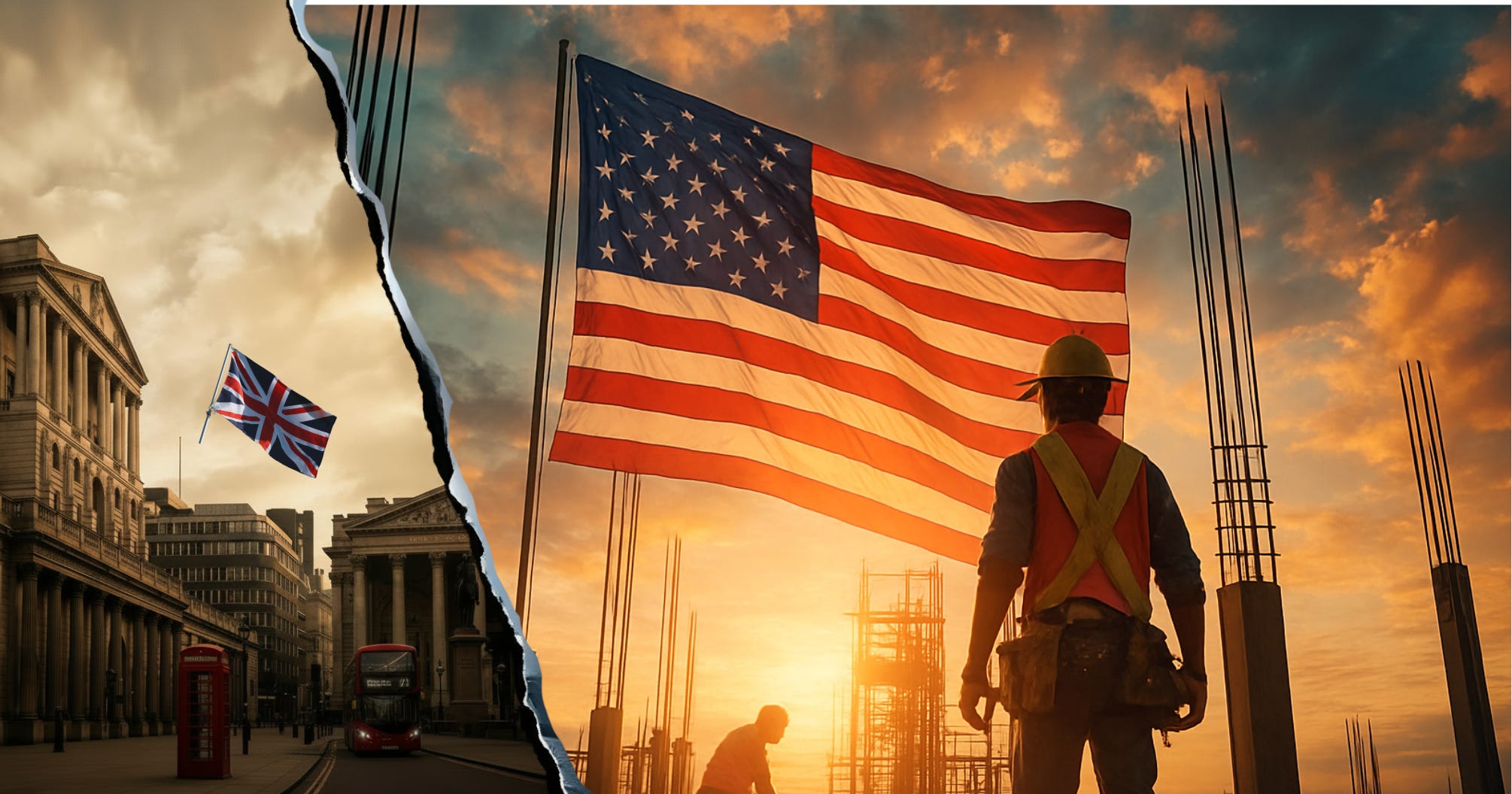
Three moves in ten days. President Trump’s executive orders on energy. Kevin Warsh’s “regime change” testimony at the Federal Reserve. Scott Bessent’s Economic Fury — the on-the-record Treasury warning to London about the banks laundering money for the Iranian regime. Taken together, they reveal something almost no one is naming: an economic regime change, from the British System of financial control to the American System of production.
Start with the finding that President Trump signed on April 20th. Under the Defense Production Act, the President issued a formal Presidential determination on large-scale energy and energy-related infrastructure. Buried in the legalese is this finding:
“Our Nation’s current inadequate and intermittent energy supply leaves us vulnerable to hostile foreign actors and poses an imminent and growing threat to the United States’ prosperity and national security …
Consistent with that declaration, I find that ensuring the domestic capability for development, manufacturing, and deployment of large-scale energy and energy-related infrastructure is essential to United States national defense, yet due to financing risks, regulatory delays, and market barriers, these cannot be met in full under existing market conditions.
Read that again. Under existing market conditions. This is the President of the United States, on the public record, declaring that the free market has left America economically defenseless. Transformer production is “dangerously limited,” in the President’s words. Large scale disruption of American transformers would leave us vulnerable to years-long replacement delays. The country that invented modern industry can no longer manufacture the equipment that keeps its lights on.
That isn’t a policy statement. It’s a legal indictment of a system.
The President signed a series of Executive Orders and Findings on April 20, addressing the full-scope of vulnerabilities of our existing energy production and distribution systems. This is the American System in action. Use the power of government to protect vital sectors of your economy from the not-so-invisible hand of empire.
That is what regime change looks like in an executive order.
The second move, on Capitol Hill, fits directly on top of the first. When Warsh told the Senate Banking Committee that the Fed needs “a regime change in the conduct of policy,” the press ignored it and instead chased Elizabeth Warren’s “sock puppet” line. Warsh wasn’t just complaining about the post-COVID inflation episode. He laid out a completely different theory of what monetary policy is for.
Warsh described the Fed’s inflationary policies as a “fatal policy error,” and then said this:
My view of inflation is a bit different from some. I don’t think inflation comes about when the economy grows too much or hardworking Americans get an increase in their wages. I think inflation comes about the the government prints too much, by which I mean the central bank.
He added that bailing out markets and saving asset prices doesn’t help the average American. Half of Americans, he pointed out, don’t own any financial assets — which means the post-2008 bailouts served the other half while leaving working Americans with rising prices and stagnant wages.
Treasury Secretary Scott Bessent made the same point on the record in December. In his Chairman’s letter introducing the Financial Stability Oversight Council 2025 report, he wrote:
“Economic security requires the U.S. financial system to reliably provide the resources necessary to enable the real economy to support domestic production capacity, Americans’ standard of living , and our core values.”
That is not Quantitative Easing, that is not building up the balance sheet of the Fed to maintain financial assets. That’s Hamilton in central-bank language. Credit directed to production. Not credit flowing wherever speculation pays best.
Line it up — the DPA determination, the Warsh testimony, the FSOC statement — and you’re looking at something coherent. The administration is reorienting the entire American economic architecture around one question: what are financial flows for?
That question is the fault line between two systems. It is also the fault line that defines the regime change.
The British System answers that question one way: financial flows exist to extract. To price commodities through London nodes that take a cut on every barrel. To insure the shipping chokepoints. To launder the proceeds of managed instability through a network of banks and exchanges reaching from Dubai to Zurich to Mayfair.
The American System answers it the other way. Financial flows exist to build — to channel credit into the physical economy that makes a sovereign nation possible in the first place. The third move is the administration shutting the British answer down.
Start with Lloyd’s of London, which cancelled Strait of Hormuz shipping insurance the moment the confrontation with Iran turned serious. Trump had Bessent move U.S. underwriting in the same day, breaking a protection racket the City of London has run for a century. Bessent invoked Section 311 of the Patriot Act against MBaer Merchant Bank in Zurich for laundering IRGC money— the nuclear option of financial warfare — and MBaer is now being liquidated.
Then came April 16th. Bessent met with three finance ministers the same day: Japan, Italy, and the UK. The Treasury readout of his meeting with British Chancellor Rachel Reeves contained this:
During their discussion, Secretary Bessent underscored the U.S. Treasury’s commitment to Economic Fury, leveraging all tools and authorities against those who continue to support Iran’s terrorist activities.
Bessent didn’t bring up Economic Fury with either the Italians or the Japanese. Only London got an on-the-record commitment to “leveraging all tools and authorities” against the financiers of Iranian terrorism. That is not a coincidence. That is a mailing address.
Because the next dominoes are in London. Two UK-registered crypto exchanges processed roughly a billion dollars for the IRGC since 2023. Santander UK ran Iranian petrochemical front companies a short walk from Buckingham Palace. Bessent read the books. London knows he did.
So here is the real picture. The Trump administration is not just building up America’s physical economy — it is dismantling the way the British have used the financial system to sustain their geopolitical position. It was never really a debate about free markets or free trade. It was always about what financial flows are used for. The British System uses them to finance empire. The American System uses them to finance production.
Trump signed that distinction into federal law on April 20th. Warsh argued it on Capitol Hill. Bessent is executing it at Treasury, one institution at a time. Three moves in ten days. One regime changing into another.
It is happening right now, right in front of you. The Empire can read what is written on the wall. The American press, apparently, cannot.
Promethean Action hosts my YouTube videos and other content from me and my colleagues. If you want to stay in touch or help more, I encourage you to head over there.
No posts
Comments
Nothing yet. Say the first thing.
Sign in to join the conversation.