
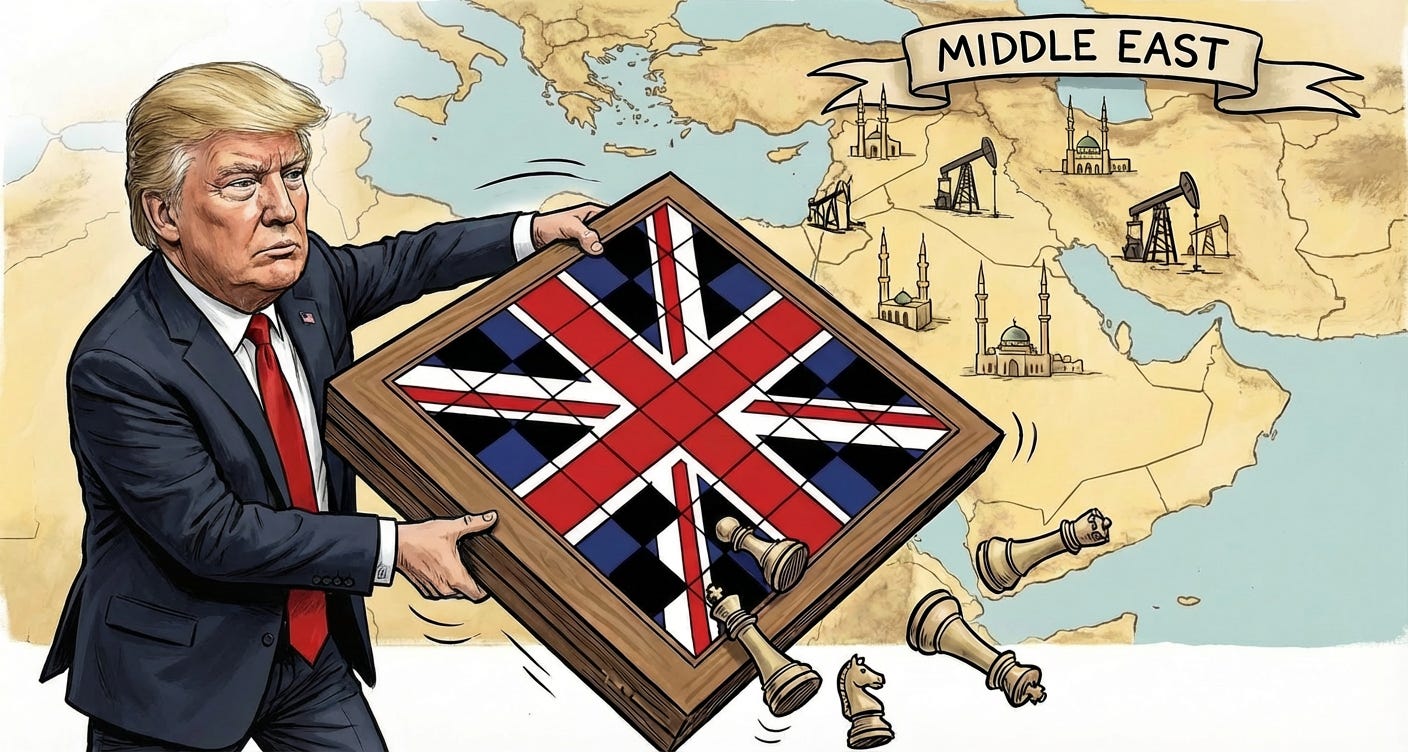
For over a century, the Middle East has been the British Empire’s playground. Until now.
That is the story of what just happened with Iran. Not the strikes themselves. The fact that Britain opposed them — and that it didn’t matter.
The Great Game is the British imperial strategy of controlling the world’s critical resources, trade routes, and sovereign nations through financial leverage, intelligence networks, and carefully managed conflict. It has never ended. It simply moved. And for more than a hundred years, the Middle East has been its central theater.
The tools were varied: but the outcome was the same.
Coups — the British and American overthrow of Iran’s nationalist Prime Minister Mosaddeq in 1953, engineered to restore control of Iranian oil. Installed regimes — the Shah, managed from London and Washington until he became a liability. And when the Shah fell, a replacement just as useful: the Mullahs themselves, brought to power through networks that British intelligence had cultivated for decades. The Iranian theocracy was not a revolution that escaped British control. It was a managed outcome.
The fueling of religious extremism across the region — Muslim Brotherhood, Al-Qaeda, Taliban, radical Zionism, sectarian warfare kept at a precise simmer — never hot enough to threaten the system, always hot enough to justify the next intervention.
Regime change — Iraq. Libya. Syria. Each one shaped by British strategic institutions — Chatham House, MI6, the City of London — with American soldiers and innocent civilians paying the price.
The Great Game seldom required British boots on the ground. It required British hands on the steering wheel.
There was one moment when that pattern broke. In 1956, Britain and France seized the Suez Canal after Nasser nationalized it. Eisenhower said no — threatening to crash the pound if they didn’t stand down. It was the last time Washington defied London in the Middle East. And it was, not coincidentally, a fight over a maritime chokepoint.
After Suez, the steering wheel went back to London. Until February 28.
Donald Trump struck Iran, without British permission. Britain blocked US use of Diego Garcia and other RAF bases. The President publicly called out the British as “uncooperative” — and moved on. For the first time since Suez, an American president bucked the arrangement — and again, the pivot point is a maritime chokepoint.
The British and their stable of neocons and think tanks — Bolton, Pompeo, Chatham House, the CFR — are shrieking that Trump has no plan, that this is strategic incoherence. This isn’t opposition to war. This is shock, as they watch a President act on the basis of American, not imperial, interests.
But the Trump Administration’s next move showed that he knows what he is up against.
When Iranian strikes rattled Gulf shipping, Lloyd’s of London cancelled war-risk insurance coverage for tankers transiting the Strait of Hormuz. Every cargo vessel running through the chokepoint that carries roughly a fifth of the world’s oil was suddenly uninsurable.
Lloyd’s has been the empire’s financial enforcement arm for three hundred years. Control marine insurance, and you control who can sail, where, and at what cost. When Lloyd’s pulls coverage, ships don’t move. When ships don’t move, economies don’t run. This isn’t an actuarial decision. It’s a weapon.
Trump’s counter was immediate. He directed the US Development Finance Corporation to step in with political risk insurance — and put the Navy on notice to escort tankers through the Strait. Three centuries of the King’s insurance market, replaced by an American sovereign guarantee.
And then there is the arrest which is not a coincidence.
In 2008, then Prince Andrew — serving as Britain’s Special Representative for International Trade — sat down in Kyrgyzstan with businessmen, government officials, and the American ambassador. The ambassador wrote it up in a cable later published by WikiLeaks. Andrew told the room, with what the cable described as “astonishing frankness”:
“The United Kingdom, Western Europe, and by extension you Americans too, are now back in the thick of playing the Great Game — and this time we aim to win.”
He was describing — to an American diplomat, on the record, in his official capacity — the actual operating framework of British foreign policy. Not the public version dressed up in democracy and human rights. The real version: resources, leverage, sovereign nations as pieces on a board.
In the weeks before the Iran strikes, Andrew was arrested — the first royal arrest in centuries — on suspicion of misconduct in public office. The Epstein files contain evidence he was passing confidential trade reports into Epstein’s network. The man who bragged about winning the Great Game was running British strategic intelligence through Jeffrey Epstein. That is not a personal scandal. That is the operating method of the imperial apparatus — now on the public record. (Four days later, Peter Mandelson, the man Starmer picked as Ambassador to the U.S. to try manage the Great Game — was implicated in the same files for passing advance knowledge of British financial policy into the same network.)
Both arrested. Both exposed. At the exact moment the apparatus they served is being dismantled.
This is what the end of empire looks like. Empires do not go quietly, and President Trump knows the risk. But the risk is worth it.
No posts
Comments
Nothing yet. Say the first thing.
Sign in to join the conversation.