
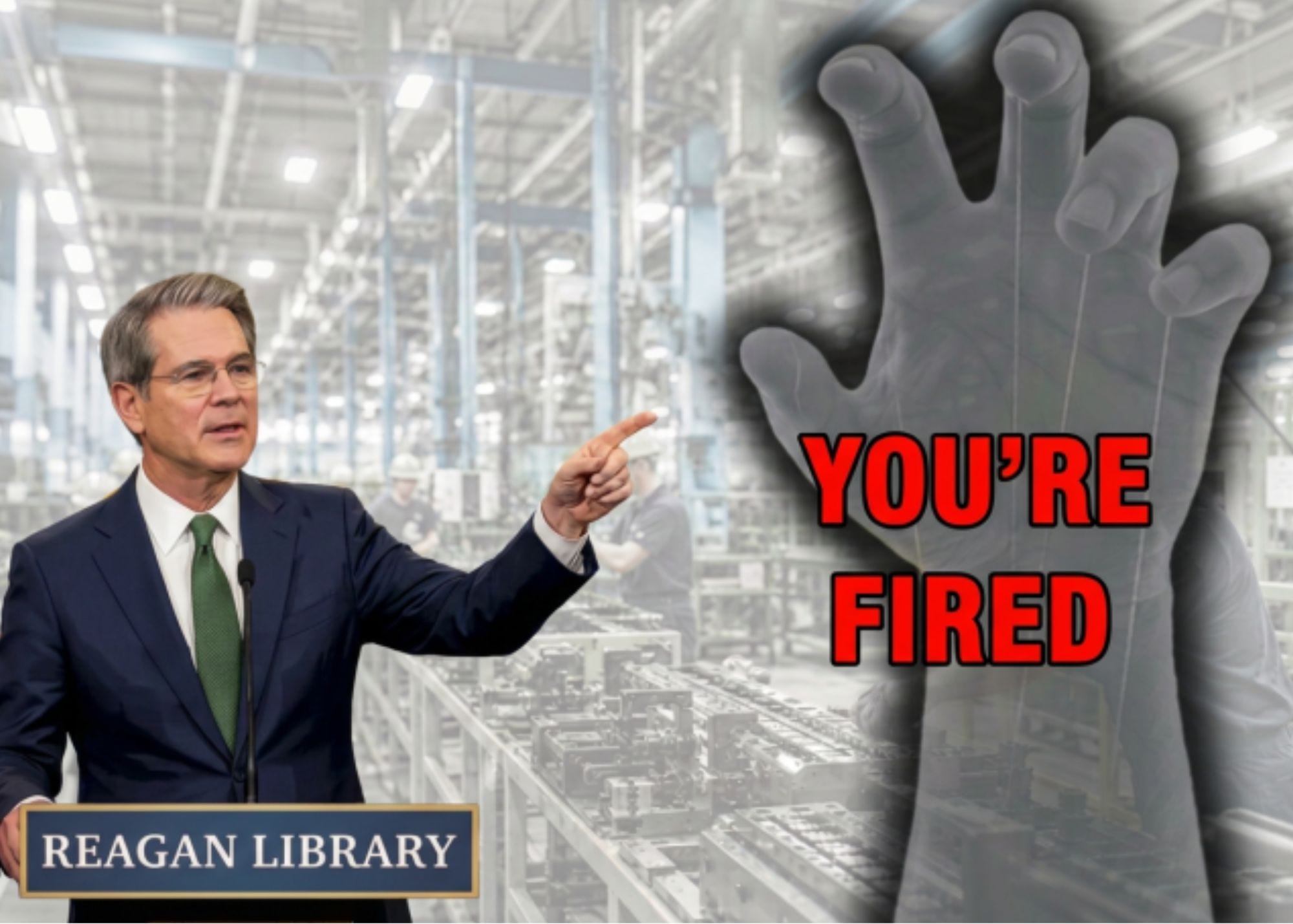
“We assumed... the invisible hand would correct vulnerabilities that too few in public life had the courage to confront. And while we reassured ourselves with those assumptions, risks accumulated all around us.” — Treasury Secretary Scott Bessent, Reagan National Economic Forum, May 29, 2026
“I don’t believe that we have a cruel choice...What I believe is if we do our job, we can make strong growth — low prices and strong employment mutually compatible.” — Federal Reserve Chairman Kevin Warsh, first press conference, June 17, 2026
Treasury Secretary Scott Bessent and the brand-new Chairman of the Federal Reserve, Kevin Warsh, spoke several weeks apart, but they were reading from the same script — and it wasn’t written by Adam Smith.
Start with Bessent. Standing in the Reagan Library, the Treasury Secretary turned the past several decades of economic orthodoxy on its head.
The truth is that for too long, America had been asleep. We mistook comfort for strength. We treated efficiency as a substitute for resilience, and consumption as a measure of prosperity. We told ourselves that so long as goods were cheaper overseas, it did not matter whether factories went dark in Michigan, Ohio, or Pennsylvania. We assumed that supply chains would always function smoothly, adversaries would always behave responsibly, and the invisible hand would correct vulnerabilities that too few in public life had the courage to confront.
A few days later, in an interview with Oren Cass of American Compass, he continued: “…while America slept for the past 25 years, we had this kind of slavish devotion to free markets and things would recalibrate automatically, and they didn’t.”
Did you catch what just happened? The invisible hand isn’t a throwaway phrase. It comes from Adam Smith’s Wealth of Nations, published in 1776 — the same year as our Declaration of Independence — and it is the founding metaphor of British classical economics. The whole theology of free trade rests on it. But until Donald Trump came along with America First, the Republican Party was wedded to that theology. Bessent’s Reagan Library speech made clear that this Administration understands the consequences of that philosophy and rejects it.
The warning lights were glaring all around us. But our political class preferred the comfort of old formulas. Cheaper was always better. Offshoring was inevitable. Industrial policy was unfashionable. And strategic dependence was acceptable so long as the cost remained invisible. Beneath every one of those mistakes lay a more basic failure in our philosophy. In reducing economics to consumption, we forgot production.
That isn’t Adam Smith. That’s Alexander Hamilton.
Then Warsh fired the second barrel. About three weeks later, Kevin Warsh walked into his first meeting as Fed Chairman and detonated the other half of the orthodoxy: the Phillips Curve, the post-war doctrine that prosperity must be rationed — that to put Americans to work you have to accept inflation as the toll. Warsh threw it out, by name. “I don’t believe that we have a cruel choice,” he said.
I don’t share the view that was expressed a few generations ago that Federal Reserve chairmen show up at a podium like this and say, “You gotta choose. And you’re gonna have to decide whether you’re willing to tolerate higher inflation to put more people at work.” I don’t believe in that. What I believe is if we do our job, we can make strong growth — low prices and strong employment mutually compatible.
Let that sink in. And he went further than the trade-off — he identified where inflation actually comes from. Inflation, Warsh said, “is a choice,” and is “primarily determined by monetary policy” — not by workers earning too much or an economy growing too fast. “Strong productivity-led growth,” he said, “is not something that we fear, but something we embrace.” The Phillips Curve exists to tell you a booming America is dangerous. Warsh said it should be embraced.
Warsh also scrapped “forward guidance,” the practice of telegraphing the Fed’s next move that the financier elite use to hedge their bets, and refused to file a rate forecast of his own. The market, he suggested, would do better watching the real economy than reading the tea leaves from the Fed.
Here’s what almost no one is connecting. These aren’t two news stories. They’re one.
The invisible hand. Free trade. The Phillips Curve. Forward guidance. These were handed down as immutable laws of economic “science.” Well, they have as much to do with science as Anthony “I am the science” Fauci. They are aspects of the British system of economics which measures things from the standpoint of money and profit and financial income streams. Not production.
And there lies the difference between the American System and the British System. The American System is based on production and the human creativity that drives innovation and increases in productivity. Bessent described the principle:
manufacturing is more than output on a balance sheet. It is a reservoir of practical capability: engineers and welders, tool-and-die makers and logistics networks, plant managers and workers who know how to solve problems on the factory floor.… That productive capacity is power…
The British system, with its Phillips Curve and its invisible hand dogma, punishes that. The American System celebrates it.
Two blueprints came out of 1776 — Smith’s invisible hand and America’s Declaration of Independence — and for a century we let the British one govern the American one. That, finally, is being reversed: the American System is back, just in time for our 250th Birthday.
“While America Slept,” Scott Bessent, Reagan National Economic Forum, May 29, 2026
No posts
Comments
Nothing yet. Say the first thing.
Sign in to join the conversation.