
I grew up in an era where we didn’t worry too much about others. If I and my immediate family were OK, the world was OK.
This led me, my siblings and many who grew up between 1950 and 1990 to be entirely focused on individual achievement and success.
But these days individual success, while good, is not enough. No one can face threats alone—and this is true for everything from individual health issues to threats to democracy or climate change.
Using climate as an example, when storms, floods or wildfires hit; those who do best have a community of trusted people who can take action and provide support. As the Climate Majority Project puts it:
So far, climate communication has focused almost entirely on climate emissions. Necessary as that is, it leaves most people without a way to make sense of what’s happening around them, or anything they can personally do about it. For a lot of people, climate feels like something happening at a scale they can’t touch.
But in communities where people know each other’s names, have worked together before, and have checked in on each other regularly; people will organize quickly to address problems. Connected communities are far more effective than disconnected individuals when a crisis hits.
The key to effective community action is to have at least one shared goal that everyone in the group supports. This is true for initiatives at any scale.
A community group might decide to organize a pollinator garden or petition their town for a sidewalk or bike lanes.
Or in the case of the tiny town of Welcome, Louisiana a community group organized and kept a 1400-acre plastics plant from locating there.
Once people have worked together and had a small success, they are often motivated to take on larger issues. The key is to begin to work together towards a clear, shared goal.
Here are six reasons to join with others and build communities of trust and support:
Collective Wisdom
No one person has all the answers. The complexity of current issues like climate change or threats to democracy go beyond the wisdom of any one person. The exchange of knowledge and skills with others is necessary to solve the problems we face.Access to Resources
The personal networks of community members can provide materials, services and financial support. In community the sum is greater than the parts.
Emotional Support
When the going gets tough, the support of a group can keep you going.Motivation and Inspiration
When you feel uninspired, there’s nothing like being accountable to others to up your game.Vision and Optimism
When your group has small successes, you can envision a positive future and find the energy to build more success.Ability to Adapt and Respond
When a crisis hits, those who participate in community of trust are ready to take immediate action.
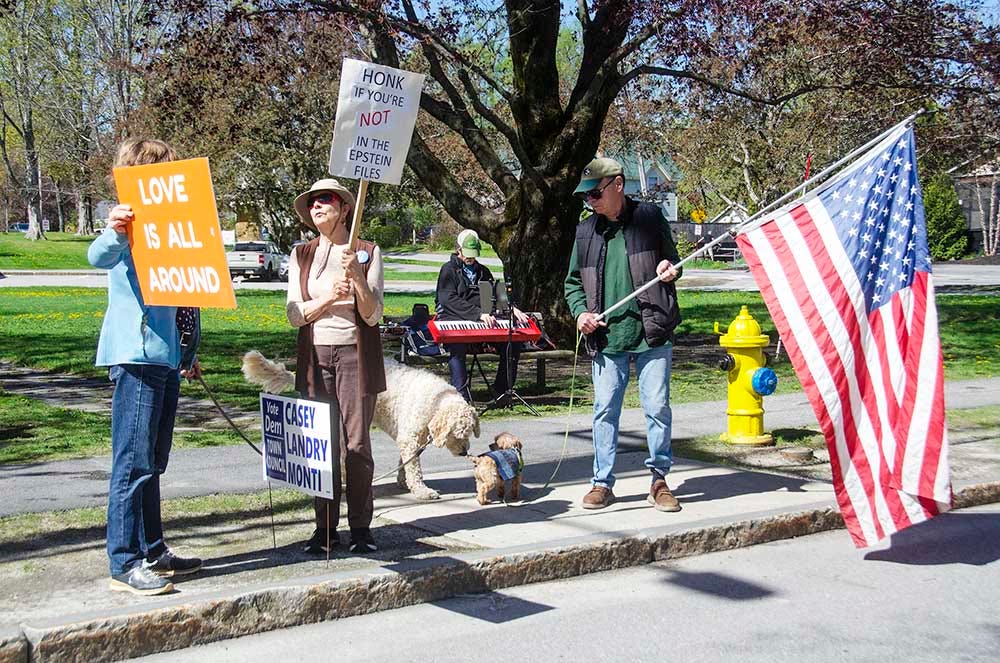
I’ve joined a group in Yarmouth, Maine that has protested in the street every Saturday morning for the past twelve months. Colorful signs, red hats, music and home baked cookies make the occasion festive.
But our purpose is serious. We are there to make a statement: that we care about and want to preserve our American democracy.
The feeling of joining others in solidarity is energizing and joyful. With all the troubling news, we certainly need more joy.
If you haven’t done so already, I encourage you to find your own community of support and action. This is one of the most powerful things you can do to support yourself and our country!
One small group can’t topple world powers that are causing so much harm, but a collective of small groups, acting consciously and cooperatively, with a compassionate focus will not only change the world, they will elevate the consciousness of the entire planet. You are all needed. —Sherri Mitchell, Penobscot Author and Leader

If you value this newsletter, please share it with your friends and colleagues!
Comments
Nothing yet. Say the first thing.
Sign in to join the conversation.