
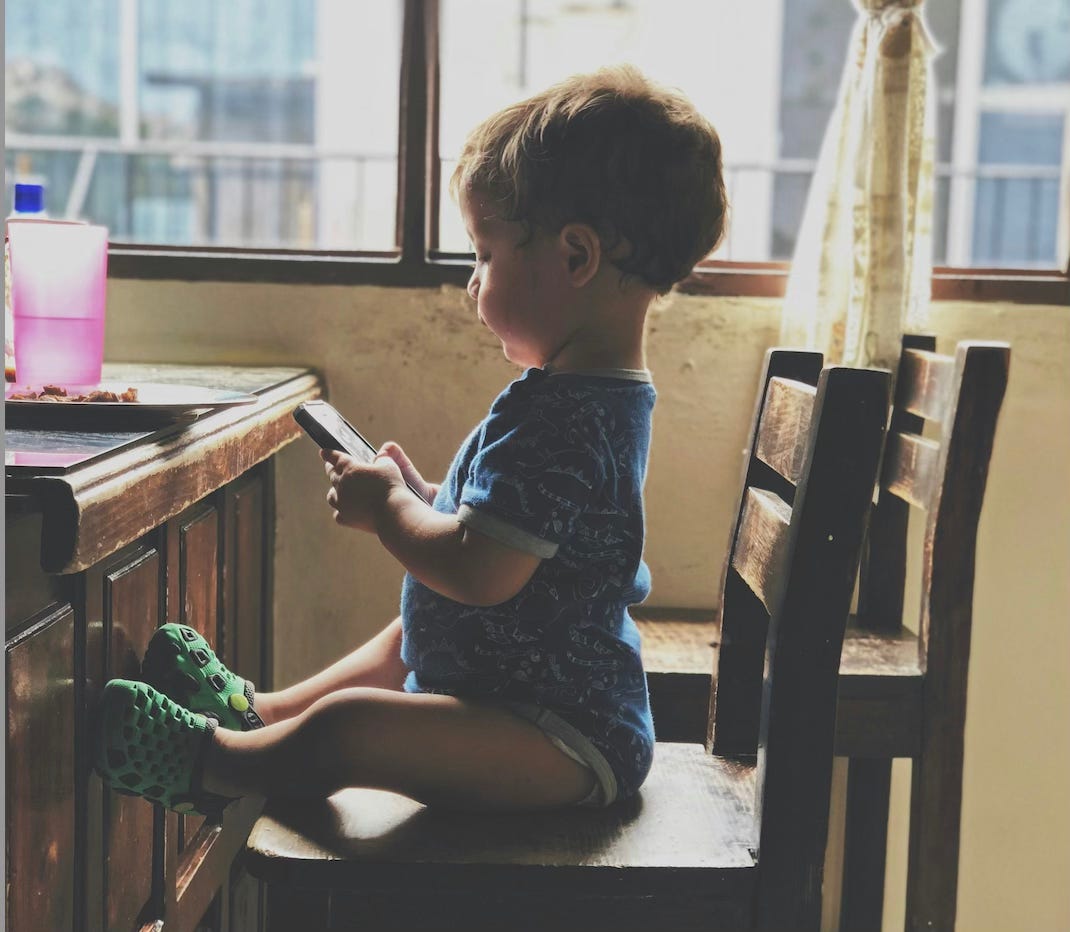
My primary job from the age of 14 to 19 was that of babysitter, and summertime nanny. Across hundreds of hours I cared for children of all ages, including live-in jobs where I stayed with families for a week, a month, or a summer. These were times of playing and coloring, strollers and scooters, pasta and popsicles, books and bedtime. It was practice in persuasion, and in tenderness: “Let’s get you tucked into bed now.” It was soul formation, theirs and mine. Growing up is after all chiefly about who we are becoming.
Babysitting teaches responsibility, sure, but it’s also its own masterclass in people, behaviors, relationships, leadership – in how families work. It’s show-and-tell, trial by fire, and you see different styles and methods parents use with their kids. We encourage our teens to babysit partly for this reason; there’s so much they can learn.
What’s obvious is that all moms and dads love their kids and want to raise them well. Everyone’s ideal is to raise a human who’s well-adjusted, capable, kind. Everyone wants a harmonious home and fruitful relationships between family members. The question is, how?
Not, I submit (and I’ve thought about this a lot), through gentle parenting. It’s gotten a lot of press in recent years, and I see many young mothers today feeling confusion and the weight of pressure - overt or subtle - because of it.
Gentle parenting seeks to communicate with children using empathy and validation, treat them with respect, emphasize connection, and avoid rewards or punishments. It asks children to process their emotions and consider how their actions impact others. It aims for a softer approach than traditional parenting styles and works to improve “a child’s self-awareness and understanding of their own behavior.” In some aspects it mirrors, and is sometimes used synonymously with, child-led parenting.
I like the ideas of connection, softness, nurture, and each family member being attuned to the others. Who doesn’t? Lovely. I just don’t think gentle parenting is the way to get there. I don’t think gentle parenting ends up with what it aims for, or that it delivers on its promises.
Let’s start with some foundational things that we know through our trusty guide, natural law, worth considering when we think about kids and raising them.
—What is. A child is a small, unformed human, with inherent worth, subject to appetites and passions and whose reasoning faculties aren’t yet operative; they develops as he ages. A parent is the source of the child’s life, responsible for his nurture and his de facto leader. An upbringing is a child’s growth of all three parts of being human – body, emotions, and thinking – over years. (But gentle parenting underemphasizes a child’s lack of reason, a parent’s role as leader, and the three-part nature of the child.)
—What is good. Children, like all humans, flourish when they enact the basic goods: life/health, beauty, knowledge, play, friendship, and practical reasonableness - basically wisdom. They flounder when they act against the goods. (But gentle parenting focuses on engaging primarily with a child around what he’s feeling, not about the goods in the situation.)
—Authority baked into the parent-child relationship. It’s a parent’s duty and responsibility to provide for and lead her child, and it is a child’s natural right to be cared for and led by his parents. Parent and child are equal in worth and dignity, but their relationship is leader-follower, not peer-peer. (But gentle parenting downplays the authoritative role and responsibility of the parent, instead asking the child to take the lead – for which he isn’t qualified or trained.)
—Appetites and passions. An appetite is a strong desire for something, a passion is a powerful feeling of enthusiasm about a thing, and both are strong drives within humans. They often lead us human to do what we want, even when it isn’t reasonable – because we enjoy short-term pleasure in the moment more than long-term good. Since young children lack reason, they are often driven by appetites and passions. (But gentle parenting ignores the reality and power of appetites and passions; it discounts the reality that indulging them when they oppose the goods leads to vice.)
—Moral formation. Parents are responsible to help children grow as whole people, and this includes moral development. Their job is to help kids learn that that our actions are moldable regardless of our desires. We have power and responsibility to consider our actions and direct them toward the goods, even when we don’t want to. This is virtue: habitually doing what’s good and right. Parents help children learn virtue through effort, repetition, and accountability. (But gentle parenting prizes processing emotion, validation, and the dynamics of the parent-child relationship in the moment over forming virtue.)
—Empathy is not a good. To have empathy is to actively identify with someone else and his experience, to “walk a mile in his shoes.” Seeking to understand another has value and may be appropriate, but is not a basic good. It’s not even a virtue. Empathy is based on feelings; these are one of the three facets of the human, and not more important than body or reason. And it must always be remembered that feelings are subjective, changeable, and sometimes pointed at bad. If I spend time empathizing with Jack the Ripper, I don’t flourish. Naming an emotion doesn’t justify it. So while at times empathy may be helpful, it’s far from a magic bullet. (But gentle parenting makes empathy a leader and other aspects of character development and of correction become subordinate to it.)
We want well-adjusted children, and this includes healthy emotions, self-regulation, and secure connections to parents. But we don’t want children who prioritize emotions over reason, whose first instinct in every situation is to look inward to see what’s happening inside, who feel entitled to have every internal state validated (by themselves and someone else) before they proceed. The priority must be on the goods: knowing them, pursuing them, becoming aligned with them, even when we at first don’t feel like it. When we adapt ourselves to the goods – objective, consistent, always wholesome and life-giving – we flourish. But too often, we ask the world to adapt to us (adult and child) and to our own subjective, changeable, and often comfort/pleasure-driven state. This isn’t healthy. It produces vice, not virtue. It damages rather than strengthens relationships.
Gentle parenting leaves children untrained in the most important things. It asks them to self-draw on a level of reflection and reason that they don’t yet have developmentally. And it puts the cart of emotion ahead of the horse of reason, at the child’s expense.
Instead, parents can use their authority to lead a child into a life of using reason to direct emotions, pursue good actions, and become well-regulated as a result. They can model it, teach it, and require adherence to it. When they do this winsomely and with kindness, it produces the best outcomes on all sides (see this). This is the “gentle parent” a child needs and can respect, and with whom she can feel safe and well-led.
So I say: be gentle as a parent, but don’t gentle parent. Your child doesn’t need you to validate her or help her figure out what she’s feeling every hour of the day. She does need you to correct her appropriately, demonstrate what kind of behavior is acceptable and fruitful (regardless of how she feels), and teach that resisting appetites not aligned with the good is necessary and required. To help her become a child of virtue instead of vice – because a virtuous life is full of flourishing, but a vice-filled life is full of misery.
Reasonable actions are those that lead to the good. Gentle parenting doesn’t cause children to act in real time in favor of life, beauty, play, knowledge, friendship, and wisdom (the basic goods). So it isn’t reasonable.
Growing up is about who we are becoming as humans. Here’s to raising virtuous children who are saturated, in every way, with the goods.
If you’re reading this via email, please consider pressing the heart (♡) at the bottom or top of this email. It allows my work to get more eyeballs on it and that helps. «Also consider commenting, sharing, or subscribing! :)»
This post is public so feel free to share it.
No posts
Comments
Nothing yet. Say the first thing.
Sign in to join the conversation.