
“Why is the virtual world worse than the regular world? We all know it is, but exactly why?”
This question launched what became a sweeping project in natural law - the age-old set of universal truths, derived from nature and common to all humans, that’s discovered through reason. (It’s 100% less boring than it sounds.) I asked it to my brother-in-law, a natural law expert, knowing he’d answer simply yet fully. He did. He gave two basic reasons:
The human person has three intertwined parts: body (embodiment), spirit (emotions/appetites), and mind(reason). To flourish, a person needs all three engaged, but the virtual world excludes the body.
Humans thrive as they make decisions that lead toward the good. The virtual world has few viable opportunities to pursue the basic goods: life, beauty, friendship, play, knowledge, and practical reasonableness (basically wisdom). It mostly offers cheap substitutes. And when we ignore or act against the basic goods, we tank.
That’s it. Satisfying, and brilliant in its simplicity.
The virtual world is worse than the real world in many ways, but one place that gets a lot of press is social media. And it should. Today we know very well just how damaging social media can be, especially at high volume and especially for young people. We know it’s addictive. We know it generates insecurity, comparison, envy, anxiety, depression, loneliness, vice, even suicide occasionally. There are so many studies. Frankly, we’re all tired of hearing it.
But social media’s still here and the damage isn’t abating. So we still need to talk about it.
Most attention is put on what consuming social media is doing to us, and rightly so. The average person spends 2.25 hours per day (which is 34 days in a year) on social media: a disaster. I think, though, that we pay too little attention to what creating social media is doing to us.
The number one career choice for Gen Z is being an influencer. In the U.S., 57% of Gen Z say they’d be an influencer if given the opportunity. It beat out all the other jobs by a wide margin. Why? First: fame. Second: money. The things everyone wants.
What is an influencer, exactly? It’s someone who can “shape the attitudes, behavior, or decisions of others through authority, knowledge, position, or the nature of the relationship with the audience.” Most often, it’s a person who films herself doing or talking about things and then broadcasts it to the world, hoping viewers will like it, want more, follow.
There are millions of types of social media influencers, because social media covers virtually everything. Influencers who talk about a specific topic – politics or nail care or fishing or exercise or homesteading or Marvel – have a better chance of not being ruined by the endeavor. They have a focus that’s outside themselves. They’re shedding light on an area of expertise, and this limits their scope in positive ways and can be protective. I’ve seen this play out with many, even my own family members. Their content’s not primarily about their life; it’s about <this topic>. A writer writes about her thoughts or perspective (as I am here); this type of influencer is similar - just communicating through video instead of writing.
The trouble is influencers who feature primarily themselves – their lives, activities, fashion, looks, makeup, “what they ate in a day,” family. These are the “lifestyle” influencers who live their lives on camera and on stage; the focus and point of the footage is themselves. (This used to be called ‘vlogging.’)
This is bad for people for three reasons. First, you can’t be present or live authentically when you’re thinking about an audience, and being present is requisite for a flourishing life. The lines between your life and performance become blurred, causing you to live badly. Second, you become highly self-absorbed, thinking constantly about how you look, angle, background, whether you’re funny enough, etc. Third, you objectify yourself, making yourself a product for sale. A human is never a means to an end; a life is always to be valued for its own sake.
So when people make themselves the subject and object of their own social media channels, things go badly. Character degrades. Relationships suffer. Superficiality increases. Mental health erodes. We saw early instances of this before social media existed via reality TV shows – “19 Kids and Counting” with the Duggers (I wrote about them here) and “Jon and Kate Plus 8”. They thought, “We’ll just do what we normally do but on camera; nothing will change!” – and were totally wrong. At great cost to themselves and their families. (Ruby Franke is a good recent example.) Now that social media’s here in force, we see it happening pervasively.
The bottom line is that creating and posting social media content destabilizes you, when your focus is yourself and your own life.
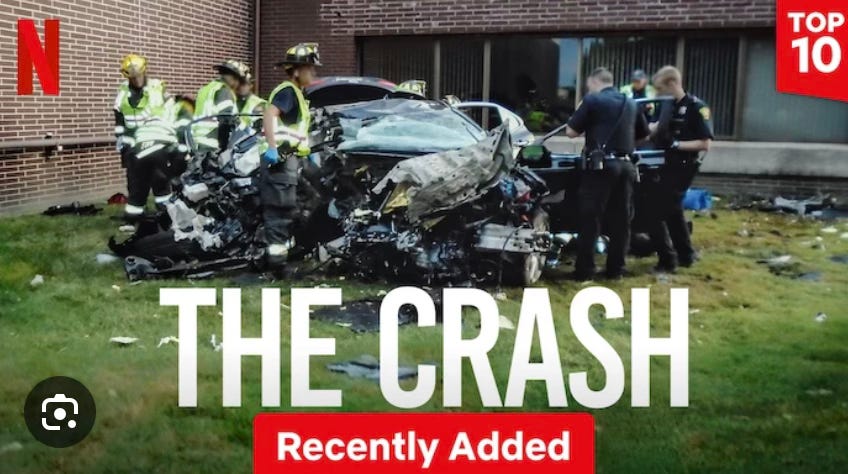
Case in point: last weekend two teen daughters and I watched the new Netflix documentary “The Crash.” A 17-year-old girl drives a car into a brick wall at 100 mph, surviving herself but killing her two passengers. One was her boyfriend. (Spoiler alert:) what looks like an accident is eventually tried as a murder, and Mackenzie Shirilla is convicted.
Mackenzie was a girl’s girl, into fashion, appearance, shopping, her phone. She got in a little trouble at school, smoked pot daily, had been with her boyfriend since 9th grade and lived with him (her parents approved). She was a high-drama girl, and had – the court process uncovered – a toxic relationship with her boyfriend.
And there was this: Mackenzie was very active on TikTok and aspired to be a social media influencer. Her life was content she farmed for her videos; she did it as a pastime. When I saw this I thought, “Ah, there it is.”
Even as Mackenzie is recovering in the hospital, her life-as-performance mindset continues on. As one report said:
“Shirilla didn’t let her hospitalization from a car crash that killed her boyfriend and friend stop the camera rolling. She posted images from her bed and a video of her mother wheeling her out. Around that time, a clothing company reached out to Shirilla to collaborate, her mother enthusiastically responded, writing: ‘Thank you for this opportunity. She’s been trying to contact you guys.’”
That she could still be focused on her social media activities at so tragic a moment is almost hard to believe. And when the documentary ended, I could not stop thinking about it.
Am I saying that living as an influencer (or trying to become one) caused Mackenzie to murder her boyfriend? No. Correlation isn’t causation. But I am saying that publicly exporting her life on the socials added to her destabilization, and would for anyone. You stand on loose gravel instead of foundation when you do that. Whatever instability you have in your life get amplified. Adolescents already struggle with identity, are insecure and vulnerable, even before a fixation with becoming Instagram-famous. To me it seems clear that the mindset and behaviors of being an influencer was one contributing factor in Mackenzie’s emotional instability.
Here is the path a lifestyle influencer takes, steps on the road toward destabilization (quotes are from influencers who started in the biz even before teenage years).1
Start with a concept of exhibitionism about daily life, erasing the separation between interior world and exterior world: “I’ve always loved the idea of being able to kind of put yourself out there for everybody to see. I’ve just naturally loved being able to have something that’s like, ‘Oh yeah, here’s me. Look at what I’m doing.’ I’ve always posted things about myself, just kind of open diary.” (-Raegan Best)
Add in the pressure to continue “creating” and posting, to augment likes and views: “It starts to really take a toll on your mental health… Because as soon as that camera’s off, I’m depressed and sad.” (-Sophie Fergi)
End up with a distorted view of self missing that your life and worth are intrinsic and innate, simply because you’re an unrepeatable human being. “When a camera is on, I have worth. That’s my worth right there – I am performing for you and that is what I’m here to do.” (-Piper Rockelle)
Honestly, it’s heartbreaking.
Folks, we need to think about this when we hear young people say they want to be influencers, to reevaluate the notion that it’s just “kids making silly videos to put them on the internet.” They’re cute, they may start as innocent, but this is not a harmless pastime. Francis Bacon said it well: “Fame is like a river, that beareth up things light and swollen, and drowns things weighty and solid.” Just so. We want and the world needs kids who are substantial, deep, thoughtful, developed humans – humans who have what they need to flourish – not superficial and destabilized and mal-formed.
Mackenzie Shirilla’s crash and its circumstances were tragic. And her habits before initiating the crash that killed two were also tragic in their own way – and preventable. Let’s be part of the prevention of this destructive path for others, however we can.
If you’re reading this via email, please consider pressing the heart (♡) at the bottom or top of this email. It allows my work to get more eyeballs on it and that helps.
«Also consider commenting, sharing, or subscribing! :)»
Thanks for reading For the Sake of the Good! This post is public so feel free to share it.
The Netflix docuseries, “Bad Influence: the Dark Side of Kidfluencing” is worth the watch to better understand these processes and see how insidious they are. The first two quotes are taken from the series directly. The third is a quote in an article about the feature performer in those series, Piper Rockelle, formerly the leader of “The Squad” (YouTube channel) and now an OnlyFans performer at age 18.
No posts
Comments
Nothing yet. Say the first thing.
Sign in to join the conversation.