

One of my daughters was, from the youngest age, distinctive in what she preferred to wear. She loved flashy jewelry, leopard print, scarves. She got this enormous white straw hat with a flashy gold ribbon on a thrift store outing and wore it daily, everywhere, the whole year she was 6. It was like living with the queen. And it worked for her – so well. The girl had style and fashion sense and wasn’t afraid to show it. To this day, she can pull off dynamic outfits that few others could.
She is, you might say, “authentic” in her wardrobe. She wears what she likes, how she likes it, and it suits her. When she does this, she benefits from it because she provides a window into her inner being – what she enjoys and makes her tick. And also we benefit from it because we know and understand her better, appreciate her intricacies more fully.
Authentic. It’s a word we hear all the time in the 2020’s, one everyone likes and gravitates toward. It’s one of the chief “values” of our day. But should it be?
Authenticity is about genuineness – something real, valid, not fake. Authentic is a candid photo instead of a posed one, clothes you choose instead of a uniform, a new haircut you like even if it bucks expectations (or your mom’s preference). When I’m authentic I’m “the real me:” candid, comfortable, showcasing strengths, able to be vulnerable. What I hope, when I reveal my authentic self, is that it’ll be well received by others – that I’ll be seen, known, and ultimately accepted. Authenticity is a precondition to real belonging and to intimacy with others.
Thus far authenticity sounds positive and healthy. So, is there a problem? Answer: yes. The desire to be authentic can become a trap. In our day, it often does. There are three reasons why.
First, we humans are complex, full-orbed beings who vary from context to context, mood to mood, situation to situation, viewpoint to viewpoint. What’s happening to and within us is subjective and constantly shifting. All three aspects of our selves – bodies, emotions, and thoughts – change in small and large ways, in one day and in one decade. Many things we’re focused on today won’t be important to us a year from now. This means that while we always value ourselves and our own dignity, we are unwise when we hold our preferences, emotions, positions too tightly. They are not fixed (and not more important than other claims on our being).
Second, over-focus on our state of being makes us self-absorbed and miserable. In trying to be authentic, we poll ourselves constantly, asking, “Does this feel like me? Suit me? Am I sufficiently comfortable?” (If not, then of course we must readjust to be more authentic.) But philosophy, religion, science, and data all reveal the same truth: the more we fixate on ourselves and our mood, the less content we are.
Third, when we focus on – and seek overmuch to express or jigger– our situation, mood, appearance, preferences to be authentic, we worsen our relationships with others. High allegiance to authenticity builds the mindset: “This is who and how I am, the real me, and you have to accept me like this.” We valorize loyalty to our own personality or perspective, regardless of others. What we feel then trumps what we do. We see authenticity of this type in Noah Kakan’s song “You’re Gonna Go Far:”1
So pack up your car / put a hand to your heart
Say whatever you feel / be wherever you are
This person is being authentic to self – going wherever, being whatever, saying whatever – the heart directs. What happens in relationship with others is secondary (as the song unpacks), and comparatively unimportant.
So, a drive to be authentic has its downsides. What we actually need to thrive is something else: integrity.
Authenticity has us looking inward at self, preferences, strengths, comfort level, but integrity’s gaze is more outward-looking. It requires us to think about ourselves in the broader context of humanity. Integrity is about the commitments that are inherent in the lives we are living.
What commitments, you ask? Well, none of us is an island. We’re intrinsically connected to the people and institutions in our lives – some given, some chosen. Take me: I’m a human, girl, daughter, sister, American, person of the 2000’s (all given). I’m also a wife, friend, mother, worker, neighbor, reader, baker (all chosen). In each of these contexts, I benefit from goods that come with the package. As a daughter I received food, clothes, love. As an American I get rights, leadership, paved roads. As a worker I receive purpose and money to live; as a reader I gain yummy foods. You get the point: I get a piece of the goods related to each. (Many are common goods – more about those here). Simultaneously, I reciprocate and do my part in those dimensions the best I can; I seek to do what’s good – making an effort and following through. This is what integrity means. It’s being constant across circumstances, and acting consistently in all my life commitments. It’s pursuing the goods within all my spheres and connections.
Integrity also includes commitments I choose, activities and recreation that add to my flourishing. I may join a church, play on a sports team, spring clean my house, take up the guitar. Following through on my undertakings, too, is about integrity. Can I count on myself to do the things I tell myself I’ll do (like I follow through on what I owe others or tell them I’ll do)? With others and myself, I cultivate trustworthiness and reliability. I’m dependable and will, by and large, finish what I start. That’s not to say that I must continue with every hobby I try or every effort I undertake; that isn’t realistic or feasible. But it does mean that if I make myself a promise about something important (tied to the goods), I can trust myself to not just drop it. I don’t let myself flake out on myself, like I won’t flake out on others.
Integrity is in all cases about truth; it’s connected to what’s objectively real. Maybe to a truth that has a claim on my existence – me as daughter, wife, employee, citizen, neighbor (and the duties that correspond to each). Or maybe to the truth of my word that I gave when I made a commitment, to someone else or myself. My thought, word, deed will align with what’s true.
I say authenticity can be the pretender of integrity because both can say, “Be true to yourself!” But authenticity means by it: “Look inward, assess how you feel, express yourself in ways that feel consistent with your preferences, ensure your maximal comfort.” It’s primarily subjective. Integrity, on the other hand, means by it: “Dependably fulfill your real commitments toward others in your life, and yourself, as you advance the goods.” It’s objective – or seeks to be.
The real challenge with authenticity is that it’s incomplete. It generally only identifies the “you” in “be true to yourself” with feelings, the spirit realm of self. It ignores your embodied aspects (where you live, who you came from, the duties of family, community, etc) and your rational aspects (what is objectively true and right and wrong to do). Authenticity today is often code for: “reject claims on you that don’t align with what your emotions say or your experiences direct.” That path leads away from flourishing.
What today supercharges the conversation about authenticity is digital life, especially social media. Gen Z particularly values authenticity, or so the researchers say; this generation “constantly seeks out authentic, connected experiences.” Because they like the idea of being authentic, the ring of authenticity is what social media serves up. Forbes reports, for example, that “TikTok embraced unfiltered, raw content from its inception” to maximize the drive for authenticity. And it’s true; part of the draw to scrolling TikTok, Reels, or Shorts is seeing the different personalities, topics, styles, and types of humor that come through. It feels real, fresh, fun. It’s the opposite of what’s disliked – a boring still photo, like this, of formally dressed people standing stiffly in front of their house:
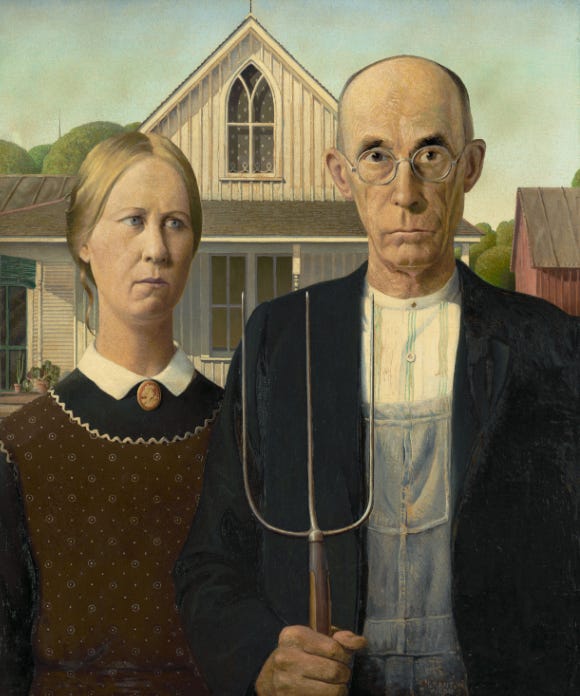
But is social media really a fount of authenticity, as Gen Z hopes and evidently craves? Because the idea of a bunch of unique, quirky, individualized people on social media letting us enjoy their authenticity is, paradoxically, not real. What’s broadcast as genuine, isn’t. First, as soon as you begin to capture yourself for an audience you exit what’s natural (truly authentic) and enter a performative space that’s by definition un-candid. What you were doing before someone a camera comes out is never what you do once it’s out. Second, when we all watch each other and take notes from each others’ behavior, we become more like one another and actually lose authenticity – the great flattening. Everyone becomes more the same. Third, the space in which we seek to be or become authentic becomes commercialized. Instead of securely enjoying or revealing the way we are, we’re coaxed into an idealized and hoped-for authenticity, just over the horizon. The “authentic you that hasn’t quite arrived yet.” It’s elusive – and expensive. Freya India, as often, says it best.
Everywhere I look it seems like someone is selling me my authentic self. Through cosmetic surgeries, through therapy, after downloading this app, I can discover who I really am. It’s reached the point where I feel like that’s what being young is now. Coming of age isn’t about fulfilling duties or responsibilities or milestones, it’s a search for one thing: finding your true self. Or, more accurately, buying it.
Not only does life online fail to deliver in our hopes and search for authenticity, it worsens the whole endeavor by convincing us others can coax or sell or convince us into it (and we should let them). They can’t and we shouldn’t. Freya concludes by saying that ultimately, there’s no fulfillment in celebrating a self in a vacuum; a self only has meaning or purpose in reference to others. Her point is similar to the “inward / authentic / insufficient” vs “outward / integrity / sufficient” paradigm we’ve looked at. She says,
I’m not convinced there’s even such thing as a self without other people—let alone an authentic one. There’s a vanity to even thinking there is a self to be found. We are our relationships with others. If you were left alone with all your products and clothes and aesthetic enhancements and never spoke to another person, you would not be your true self. You’d be nothing.
Exactly. We are not autonomous beings, we can’t be, and when we try to be, it goes poorly for us. What we need is an outward-focused life, being our piece of a glorious tapestry in which we are only one part – but playing that part as well as we can. Without excessive self-polling for comfort or met preferences, without undue navel-gazing, without continual consideration for how we look, seem, measure up to others’ ways of being. All of these sink us.
Instead, then, pursue, the basic goods. Grow in knowledge, build true friendships, play hard, love life, seek beauty (other than your own), invest in the common good. This is the way – for all of us. As Eddie LaRow recently wrote in The Authenticity Trap: “When we eat, work, rest, age, and even gain weight, we are not failing to become our true selves. We are living as creatures, which is precisely what we were made to be.” Just so – in enacting our real lives well we grow as full-orbed humans, not wooed by a never-ending drive to be authentic but instead acting well and with integrity in all our realms.
May it be so.
If you’re reading this via email, please consider pressing the heart (♡) at the bottom or top of this email. It allows my work to get more eyeballs on it, and that helps me a lot!
Thanks for reading For the Sake of the Good! This post is public so feel free to share it.
I like Noah Kahan’s music, and I think his popularity stems in part from the resonance listeners feel to the themes and questions he addresses in his music. It’s the reason I chose this lyric; it seems representative of the authenticity issue.
No posts
Comments
Nothing yet. Say the first thing.
Sign in to join the conversation.