
It’s finally spring in Vermont. The trees are budding, though not bloomed, and everyone in my neighborhood is out raking the dead grass and leaves from their lawns as I type this essay.
I greet the advent of spring and summer with a mix of physical longing and intellectual dread. My body craves sunlight and vitamin-rich greens and the scent of warm air and flowers and the feeling of warm rain on the skin. My mind resists the longer days with their extended “to-do” lists, the inevitable need for noisy air conditioners and sticky sunscreen, and, quite honestly, the yard work. I’ve mentioned this truth before: I like the results of gardens, but the work of it is a lot. In my ideal world, I am a serene lady gardener who, as they say in British novels, has a “man to do the rough work”.
But I am not a British lady gardener, so I go out in my thick shoes and gauntlet gloves with my baseball cap on and come back to the house a few hours later, covered in mud and scratches, wondering why I feel so urgent about the growing of flower? It’s something hardwired to do with ancient imperatives around getting a harvest—some gift or curse handed down from my Scots peasant ancestors.

The season of mucking around in the dirt has got me thinking of Jim Crace’s novel, Harvest, which tells the story of a fateful week in the life of a 17th century village through the eyes of a relative newcomer, Walter Thirsk. It’s a vivid, in-the-moment portrait of the lives of English peasants, living in the shadow of the manor house at a pivotal moment in the history of agrarian culture.
Thirsk is a good narrator because he is of both worlds: he came to the village as part of the master’s, ie landowner’s, household, but he married a villager. His ability to step back and describe the moment of transformation is the gift of a diverse “point of view:” the ability to think and observe cross-culturally in the largest sense—outside of one’s own experience, national identity, education, and even values.
In Harvest, the other main character is the land itself, so much so that it is often capitalized. Thirst himself describes where he lives as “It’s just The Village. And it’s surrounded by The Land”. There are dozens of descriptions of the Land, but this is the one that I thought about when I was battling the raspberry bramble yesterday.
It will not let us hesitate or test; it does not wish us to stand back and comment on its comeliness or devise a song for it…It wants to see us leathery, our necks and forearms burned as black as chimney oak; it wants to leave us thinned and sinewy from work. It taxes us from dawn to dusk, and torments us at night; that is the taxing that the thrush complains about.

Stevenson, like his fictional English ancestor, Walter Thirsk, has a uniquely cross-cultural and cross-disciplinary point of view, able to deliver commentary that has something like the perfect mix of intellectually astute and of the people. His core differentiator is that he hasn’t consumed politics as identitarian entertainment, so he articulates his economic theories without political bias or jargon. His literal kitchen table talks, delivered in his working class London accent, with very little production cut through all the bullshit.
In this most recent episode he was working his way through the current prognostications about the effects of AI. His take is that the “It’s like the Industrial Revolution, everyone calm down, we’ll be fine” line of reasoning is too easy. But—and this is why I like him—he makes his point from a different place. He goes right past the Industrial Revolution and starts with the Enclosure.

Harvest is novel of the Enclosure. Over the course of a week, the villagers’ master of the manor is displaced by a relative with a stronger claim to the Land and ambitions about an innovative new, more efficient way to mange it. Empowered by new laws and technologies, he plans to fence it off and raise sheep. He will sell the wool for money and can turn most of the villagers out of their homes as it is much easier and more profitable to tend sheep than to grow barley.
It’s a historical moment that doesn’t exist in the United States. Here, the land was free, once we stole it from the indigenous peoples, so most of us don’t have the same experience of diminishing land ownership (though interestingly, we still have public domain land that is used by ranchers.) England was different. For many hundreds of years even the land that was owned was operated in a kind of communal arrangement through an open-field system. There were parcels of land under the control of owners whose tenants were peasants that were only one step up from serfs. But once the harvest was in, that land reverted to the community for agrarian uses. In this way peasants could, essentially, subsistence farm, and it worked for more than a millennia.
But over a period of five hundred years, roughly between 1200 and 1700, the laws protecting the open-field system were dismantled, and enclosures—or fences—were built for sheep and other more easily monetizable crops, and the peasants were driven off the land. (Interestingly, the Black Plague disrupted this wealth transfer for a couple of hundred years or so because labor became temporarily scarce, so the peasants weren’t expendable in the same way.)
In Scotland it happened much more quickly. The Highland Clearances happened in about 50 years. To give you an idea of the scale: I read today that between 1811 and 1821 someone called the Duchess of Sutherland forced some 15,000 people off her estates and brought in approximately 200,000 sheep as they sought to maximize wool production. That’s just for one land holding. 15,000 people!
And in Scotland this process of enclosure also decimated Gaelic-speaking communities.
Enclosure, alongside new technologies that meant that artisans and cottage industries were no longer needed to create goods, was the primary mechanism by which a more or less self-sufficient peasant class was converted into a landless proletariat — people who could survive only by selling their labor. The process was completed just in time for the rise of the factory in 19th century, paving the way for the Industrial Revolution.

Why does this matter? Because the conditions are not the same now as they were before the Industrial Revolution, so the comparing what will happen with AI to that event is at best facile and at worst disinformation.
Stevenson, in his signature apolitical way, lays out a functionally materialist analysis of the myth of the Industrial Revolution as a difficult but ultimately good transition that lifted millions of people out of poverty. He points out that it took a hundred years, two world wars, and very serious union organizing for that prosperity to trickle down. And that millions of people lived horrible lives of endless, unsafe, exploitative factory work until it did.
Stevenson also points out that the benefits of the Industrial Revolution were primarily located in England and Europe, but that its effects were global. The English factory-made products undercut every market in the world, eliminating a generation of artisans and cottage industries. The profits that were realized powered British colonialism which, amongst many other effects, some of them good, many of them. not, ravaged the Indian economy, causing mass starvation, and was a lever of the British genocide in Ireland.
(Note that Stevenson doesn’t use the word genocide to describe the Irish famine, but I do.)
For Stevenson, the point taken from this history lesson is that of an economist, not a humanist. He says that the salient difference today compared to the 1850s is there is no longer a massive total addressable market that is ripe for generating profits. In the 19th century, the market for mass produced cheap goods was essentially limitless. And there was so much profit that it did eventually raise the standard of living for all industrialized nations, which in turn kept creating a market for the goods and products created, thus creating the relative affluence that exists in the Global North today.
(Stevenson wouldn’t call it the Global North, that’s me, as well.)
To this point, Stevenson hearkens us back to the apocryphal story of Henry Ford showing his factory to the union boss and telling him that he won’t have to pay union dues to the machines and the boss saying, but who will buy your Fords?
His question is: “who will buy things to keep a global economy going if the owners of AI disrupt all of the jobs again? “ His answer is that no one can and that the results will be catastrophic if we don’t do something proactive.
Stevenson is interested in influencing government tax policy, so he is laying out the reason why our leaders should care about setting up a system of taxation that provides for a healthy society and economy. He’s saying that if we are smart about how we tax and regulate AI, that we can all benefit again. He’s also warning that in the context of contemporary wealth inequality, even a technological advance that could produce leisure and art and prosperity, won’t unless we act quickly.

The problem, for me, is that I think the technology elites of today are different than the industry elites of the 19th century. I think that in the 19th century the titans of industry understood, at least intuitively, that you need a marketplace of buyers to build and sustain wealth. And a few of them, at least, valued the things that make society good and livable, like libraries and museums and schools, which is why the 19th century made it possible to have Carnegie libraries all over the world, and the 21st is giving us warehouses full of destroyed books.
Based on everything I can see, the dominant model for a 21st century oligarch has a different set of priorities.
I don’t think they care if they cause mass starvation and displacement with their AI and their data centers. I think it’s why they are putting money into going to Mars and building bunkers in New Zealand. They don’t need an addressable market to make them rich, they already have most of the wealth. And their ethics are based on a misplaced interpretation of Darwinian survival of the fittest that allows them to believe that the only thing that matters for humankind is preserving the species, which means saving themselves. Unlike Henry Ford, they don’t actually need people to buy cars. They just need unfettered and unregulated access to the money, materials, and labor that they need to built rockets ships and bunkers. And unfettered access is what they are getting from both the elected Democrats and the Republicans.
Which is why it’s incredibly important to take a different lesson from the Industrial Revolution than “everything will be fine after a bit of a transition.” The lesson is that for a technology transition to deliver prosperity in a concrete and equitable way, the material conditions of the general population need to be stable and resilient and the transition needs to be managed.
Since I do indulge in identitarian political entertainment, I will put this idea into a political formulation.
We will not succeed against the pillaging of the world by technology billionaires if we do not integrate a materialist narrative into our thinking about oppression and dispossession. Put another way: we will fail if we persist in defining “privilege” as having to do primarily with race and gender and ignoring the importance of class.
Yes, the Venn diagram of privilege very much overlaps with white skin and men, but without a consideration of economic status, i.e. materialist concerns, we will continue to lose elections in the way that we lost in 2016 and 2024 (and in other years in other countries). Without very clear, very bold policy proposals about ameliorating wealth inequality and making life affordable for everyone, we will continue to lose to right wing authoritarian parties. The data is looking very clear for anyone who chooses to see it.
To put it bluntly: too many of us Americans are unfortunately really very stupid about class issues and are unable to make a rational class critique of how we run our government and our society, and it’s a huge reason why we are in the predicament that we are in today.
American resistance to discussions of class seem to persist even amongst very educated people. I surmise that 100 years of propaganda about “Communism” has done its work in obliterating Marx’s very true and very necessary critique of the extortion of the many by a small class of owners and how that affects our society. Our fear of Soviet-style communism seems to have elided any possible historical context for Americans about what is a proletariat and what does it meant to own the means of production.
The headline: owning the means of production means you get to partake of the profits that are made from your labor in a way that is equitable. As in, it’s not cool that c-suite make a zillion percent more money than all of the rest of the people who work at a company. Nor is it cool that shareholders, who don’t produce any labor at all, also make a lot more than the people who work at the company. It’s pretty simple really, and I think most people actually do believe this, which means that the American fear of Marxism is honestly very weird.
I think it’s easier for Americans to see identitarian differences than class differences. In the UK, your class status is often delineated by your accent, so that for example, if you are a person of color who is very wealthy and educated at Oxford, you speak in a way that shows you are a member of the upper class. By contrast, in the US, where our accents are more regional than class-based, we can’t always tell, for example, if a white person is from a poor background.
But mainly, I think it’s our abiding love of American opportunism that blinds us. It’s because it is true that we have unique opportunities in the U.S. Here, it has been historically possible to become rich and transcend your class background, but the prospects of this are diminishing every day. It’s too much to bear that our great American myth of opportunity is greatly diminished. It’s somehow easier to try to make rules to police the speech of people who are racist and sexist than to do the long, slow work of confronting the increasingly universal effects of our broken economic system and organizing the political will to fix it.
I’m not saying that racism isn’t pernicious, and as a working woman I have no illusions about the attendant difficulties. I’m saying that we must be intellectually rigorous. I’m saying that we cannot ignore the very real way in which wealth inequality is making 99.9% of us, inclusive of all races and genders, very vulnerable to an incoming mass extinction event from the incoming AI Industrial Revolution.
We need to get really clear about who our allies are. Oligarchy is an equal opportunity oppressor. Oligarchy cheerfully and expertly exploits the identitarian discourse so that we think the things we should talk about and get angry over is Twitch influencers and white middle class wine moms.
Look, we are all the peasants in this scenario. And we are going to get turned off the land if we don’t start allying with each other. I’m sorry, but you are not serving anyone by boycotting Joe Rogan. Equally, you are not serving anyone by thinking that all Democrats are on the right side. They are not. Oligarchs come in all political shapes and sizes.

Which brings me back to the central metaphor of this essay, which is that the Land—that scratchy, exhausting place where we tend and harvest what we need to grow and thrive— is still—even hundreds of years past our agrarian forebears—the most powerful symbol of a means of production. It doesn’t matter if it’s actual land, or subject matter expertise, or creativity, or plumbing skills, or holistic healing. It’s a way to take care of body and soul.
The Land—in life and in metaphor—is a lot of work. It’s is full of scratching and rash-inducing things, like thorny raspberry bushes that go wild and protect their fruit from delicate fingers. The Land is muddy and heavy to shovel and till. The Land is frustratingly dependent on things we can’t control like sunshine and rain. And the Land is, above all things, inefficient in a way that will never, ever drive shareholder value.
To thrive we need to sacrifice our false gods of efficiency and fake civility and dreamy exceptionalism and push pass our sense of helplessness and our digitally-induced passivity and embrace the work, mud and grit of finding a way ensure the common good of our fellow humans.
How do we do this? What is to be done?
In Harvest, Walter Thrisk knocks his forehead three times against a rock as he leaves the now-empty village for the last time, with nothing ahead of him but a road to nowhere: a symbolic stigmata.
In Gary’s Economics, Stevenson speaks directly to camera and reminds his audience of his four word platform “Tax Wealth, Not Work” and says:
If we are willing and able to put for a moment our grievances down and work together for a share of the pie, what the struggle of history and…our great grandparents and parents show us, is that it is possible. It is possible that we can win, that you can come from a situation much, much worse than we are now, and you can make something better for your kids and grandkids.
At my house, I have written this essay and made beds for raspberries that are looking tidy, if scrawny, and planned my vegetable garden.
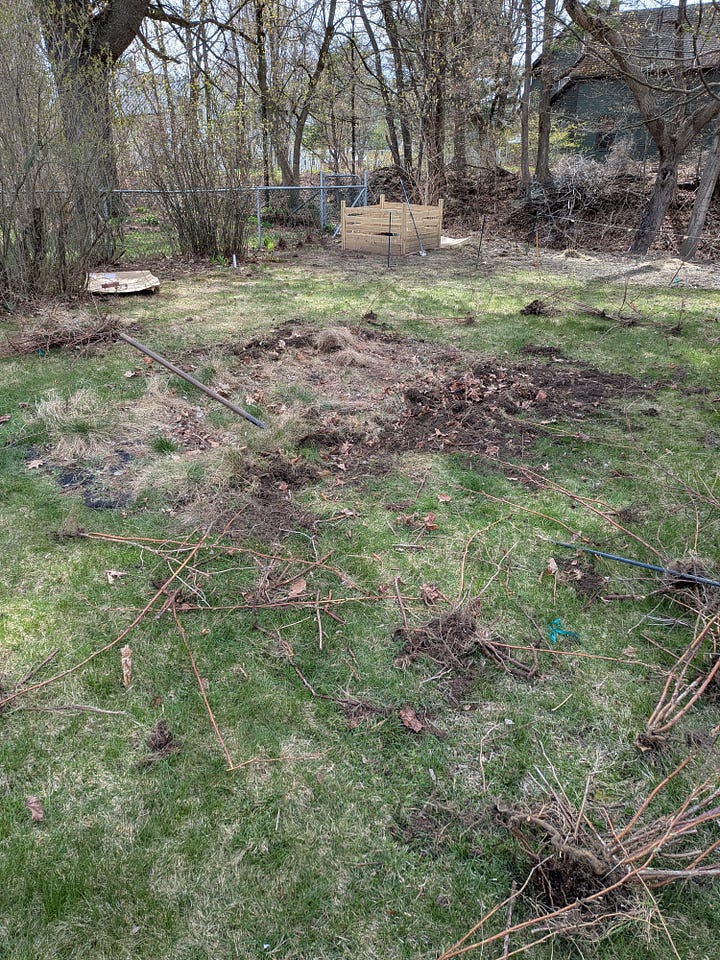
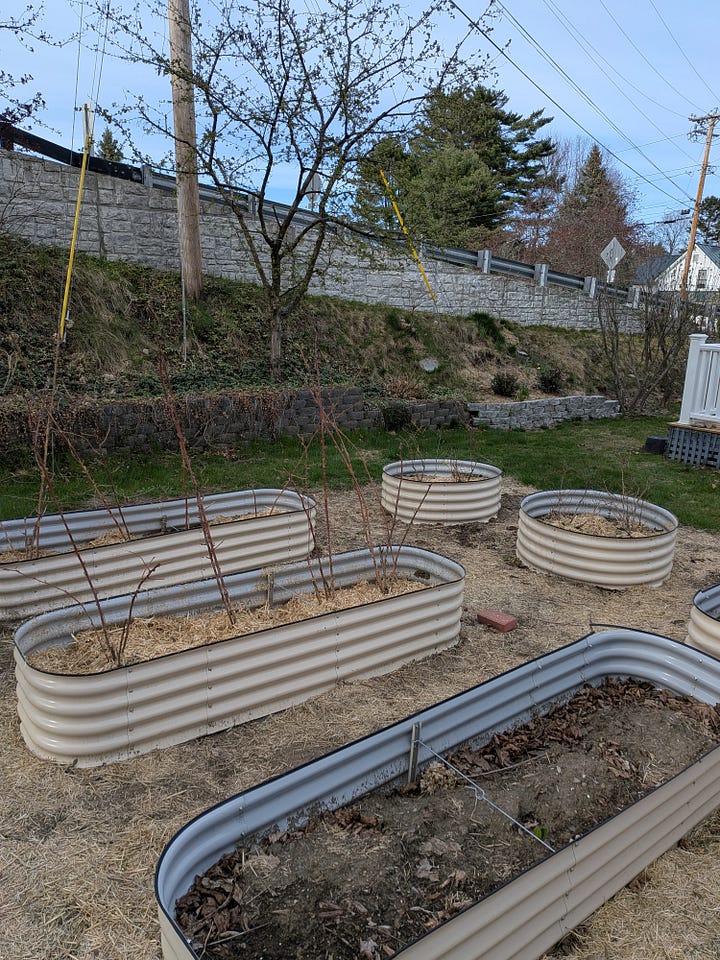
Let the hard work of planting and harvesting the seeds of revolution and raspberries begin!
Gary’s Economics: simple, direct to the point of comedy. UK-focused, but the principles are the same.
NYC Major’s Office. Mamdani is incubating a better future in NYC that could be adapted across the country.
This interview with Andrew Yang, Ed Elson and Scott Galloway on AI, taxation, and government. Yang and Galloway do a couple of rounds of debate on how big are the risks, whether UBI can work and what kinds of taxation are needed.
This NYT interview with Jia Tolentio and Hasan Piker: listen to the whole thing and think about it; don’t settle for the sound bite that is being used for clickbait.
Vote.gov: First register and then go and look for the local, state and national candidates who are offering actual policy positions about wealth inequality, affordability and corporate regulation. If the mainstream Democratic candidate isn’t offering a policy position on wealth inequality and affordability, find a candidate who is, and yes, this may well mean platforming an independent.
Comments
Nothing yet. Say the first thing.
Sign in to join the conversation.