
Become a paid subscriber to read about the whole trip, including the visit to Birchbark Books, and to see this week’s survivaLIST, including: a very good album, a list of sci-fi authors, a Suay-way to revitalize old clothes, and which Booker Longlist title I’m reading first.
Get 70% off an annual sub 'til August 30
When I got back to my house, I walked the perimeter like Murderbot, the same as we’d done all summer, stretching our legs after the day’s Zoom calls, laying our plans for the evening. The perennial garden has gone bushy, the bare spots filled in with creeping thyme and flax and weeds. The yarrow, roses and blue bottle are done, for now, having given way to the bright pink and yellow coneflower and coreopsis pick me girlies. Above it all, the towering elderflower bushes are fluttering their long limbs like a benediction.
The pile of blighted lilac branches on the driveway, still there, solarized to death as planned; the bleeding heart in the front that I’m worried about, neither better, nor worse; the hydrangea I had divided and re-planted, sporting a few new leaves. The carpenter had come and put up a scaffold where my rotten posts used to be, leaving his table saw and the good smell of wood shavings in the garage.
Inside, I dumped my backpack out onto the kitchen counter: lipsticks, pens, gum, notebook, headphones, sunscreen, charger, computer, bandaids, keys, work notebook, writing notebook; ditched my shoes, and went back out to the kitchen garden to pick the last of the raspberries, my daughter’s voice loud in my head reminding me not to waste them. Then I sat on the back steps to text a photo of ripening tomatoes as a cheerful accompaniment to the obligatory message: home safe!
Hard as I tried, I couldn’t stop myself from adding . . . I miss you.

Our plan is to start the trip from Vermont on a Friday, with the goal of being in Minneapolis by Sunday. I’ve decided to document the trip with my Polaroid—I have one pack of film, which is 8 photos. As per usual, I am unable to defer gratification and take two before we’ve even left.

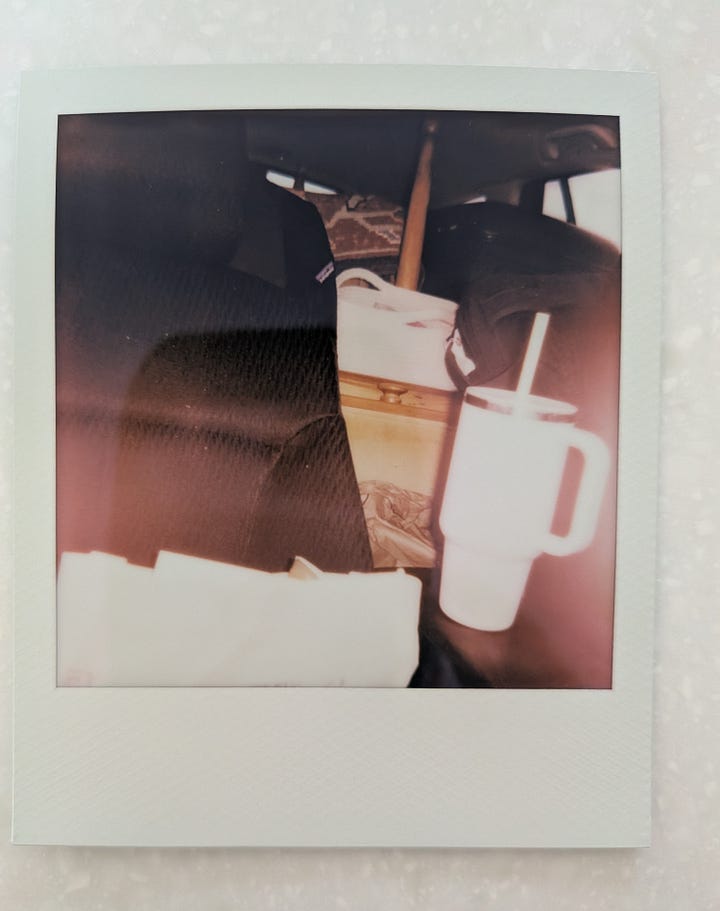
In the car, when it isn’t my turn to drive, I am rereading Jo Walton’s Among Others, because I’d read it too quickly the week before, and because my daughter isn’t finished reading it yet, so I can’t put questions and comments about it in the group chat with my son, who is the person who recommended it to me, because spoilers are a cardinal sin in my family. Also, it helps with the work anxiety that won’t release, even after hundreds of miles of driving due West. “There are books you can fall into and pull up over your head,” says the main character, Morwenna Phelps, and Among Others is that kind of book.
Morwenna, called Mori, is a Welsh teenager who’s lost her twin sister in the same accident that crushed her own hip, who’s run away from her abusive mother, only to be sent to an English boarding school by her definitely weird father. She’s alone and in pain and making her way through an entirely unfamiliar world. Her weapon and solace are books, especially science fiction; her approach is to be inexhaustibly curious about the spoken and unspoken rules of her new school and home, mapping what she sees back to the characters and philosophies that she finds in the books she checks out in very large quantities from both her school and the town library.
She’s also a practitioner of magic, educated in the rites and rituals that can stop a factory that’s polluting a forest, or prevent a malevolent visitation. She’s conversant with the local fairies, more at ease with their ways and rules than those of the posh girls at her new school.
Throughout both readings, the stuff about the fairies and magic seems utterly self-evident to me: of course there are fairies and magic and things and places unseen, anyone who reads anything knows this. Of course some people can see them and other people can’t. Of course an object made of something elemental like wood or stone that you’ve handled and known over months and years carries meanings and resonances that things that are new or synthetic do not.
What’s more oblique is Mori’s methodology for coping with pain and grief, which must be gleaned from her many, many allusions to the books that she’s read. Mori’s a smart girl, full of verve and wit, and she’s making connections fast. She is not pacing her dialog for people who multitask and watch Netflix. It feels like need-to-know stuff to me, this rapid-fire application of cultural and social cues taken from the great science fiction writers, diminished as I am from my day to day work, hobbling through each week feeling disfigured from accidents of time and place that are crushing my life skills.
“I have books, new books, and I can bear anything as long as there are books,” says Mori. Which, yes, of course, it’s why we are here, because we survive by books, but for Mori this is a different kind of magic, something stronger than what I know. I can’t put my finger on it, and I want to.
Comments
Nothing yet. Say the first thing.
Sign in to join the conversation.