
What makes a book sexy?
I don’t mean what makes a book romantic. Romance is the idea of love. It’s for the mind. I don’t mean what makes a book erotic either. I'm not asking what makes a book good for getting off.
I mean what are the qualities that make a book appeal to the falling in love part of your mind and the oh hello there parts of your body.
What is it that makes a book hot?
I got on to this line of thinking because of this Substack post:
I’ve read four of the five books mentioned: Bad Behavior, by Mary Gaitskill; Cleanness by Garth Greenwell; Luster, by Raven Leilani; Conversations with Friends, by Sally Rooney. And generally speaking, I agree with her. I might not have chosen the same excerpts, but these are definitely sexy books.
I got to thinking that maybe what makes a book sexy is what makes the world sexy, too. Something about the right mix of pleasure-causing qualities: beautiful bodies, yes, but also things like laughter, connection and music. Also things like the weather. A summer thunderstorm can be very sexy in a way that a day of freezing rain most definitely is not.
Then I remembered that viral tweet about Beto O’Rourke, the one where the person described him as “the guy who is all sweet and nerdy but holds you down and makes you cum until your calves cramp.”
I mean, it’s not exactly the canonical answer, but you gotta admit she’s on to something interesting with that juxtaposition.

I think that for a book, the state of being sexy has to do with getting the right mix of language that is sexually explicit and language that simply implies the idea of sex.
I think it also has to do with getting the right mix of the qualities of yearning and forbidden because they are both catnip for the brain.
I made a matrix1 to test this theory.
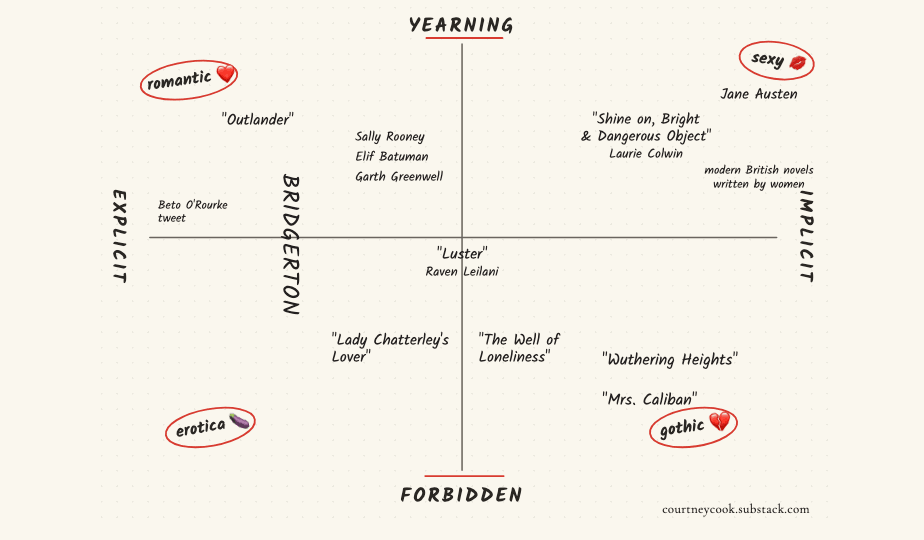
First of all, I think this is an excellent diagram that probably could become canonical. Not to brag or anything.
You can tell it’s good because it shows that talking dirty really is something that is best, if it happens at all, when whispered in the heat of, let’s just call it the moment. The placement of Bridgerton is key to this analysis. It’s pretty much the hard line after which everything that isn’t mediated by some amount of yearning veers into porno territory.
It also shows the way permission affects sex. Look at what you can get away with if you add a dose of “forbidden” to your explicit. If it was Lady Chatterley’s true and proper husband who “wound a bit of creeping-jenny round his penis,” it would be just plain embarrassing. But the forbidden gamekeeper? By firelight in his rough and tumble gamekeeper’s cottage? That’s the stuff that gets your book banned for 60 years.
Forbiddenness works on the implied side of the matrix, too. It helps when the writer can’t be explicit, as with Lady C’s Sapphic twin, The Well of Loneliness. Radclyffe Hall could never have used the same kind of detail in her love story between two women that D.H. Lawrence did for his love story between a Lady and her male gamekeeper, but she could imply it, which was all it took to fling open the door to queer literature in the 20th century.
But if sex is so forbidden that it cannot even be spoken of or that its consummation is so furtive as to ruin its natural shape, things get gothic fast. Yes, Catherine and Heathcliff can meet in the fairy cave at Penistone Crag, but even the most alert high school English student has to work hard to get the euphemism out of the metaphor. And whatever did happen at Penistone Crag, it’s certainly not enough to save Catherine and Heathcliff. And yes, Dorothy, the bored and lonely protagonist of Mrs. Caliban and Larry, aka Aquarius the Monsterman do get it on—at least I think they do, but it takes a very close reading to be sure. And anyway, if the sex is so forbidden that it is silenced, you’re always going to end up with a fire at the manor house or someone being carted away to laboratory to be studie.
But keep the faith, lovers, it’s not all goth and creeping-jenny. Look at what happens when you introduce a measure of yearning! Look how the longing that passes between Jamie and Claire transcends centuries and continents, conferring a very healthy dose of romantic. Yearning is also why the relatively graphic sex that is in Garth Greenwell’s, Elif Batuman’s and Sally Rooney’s writing feels vulnerable and intimate instead of cheap.
Yearning is also why Jane Austen’s books, which contain not a single shred of explicit sex, are still so sexy. In fact, it’s the yearning of it all that pushes Austen above her 20th century countrywomen on the sexy scale. Even though Elizabeth Bowen, Muriel Spark, Stella Gibbons, E.H. Young, et al, also give us delightful protagonists who are witty, independent, and capable and also get to hook up outside the boundaries of marriage, (even if the action is still firmly behind closed doors), they don’t long for their heart’s desire in the way that Austen’s characters do. I blame the two world wars. 2
And then there’s Raven Leilani’s Luster which sits at the epicenter of our four qualities, as the protagonist Edie brings the nakedness of her desire to a situation to which she is both entitled and not, during a time when loneliness has outstripped yearning. Her mix of vulnerability and drive opens up a dangerous intimacy that is outside the boundaries of my two dimensional matrix.
Maybe, of all the books I’ve gathered here today, Luster is the one that best represents “what is sexy?” in real life: confusing, gut-wrenching, exhilarating, heartbreaking, and very very hot.
I read a super sexy book this week: Laurie Colwin’s Shine On, Bright & Dangerous Object. It’s a novel that begins with a death and ends with the triumph of eros—a heady swirl of love, sex, music, and friendship.
The opening sentence is the books lowest point. The narrator, Elizabeth “Olly” Bax, tells us that her husband Sam Bax “died sailing off the coast of Maine, leaving me a widow at the age of twenty-seven.”
From there, the vitality of all three main characters—Olly, Sam’s older brother Patrick Bax, and, in the third act, the irresistible Charlie Pepper, takes over. Even the opening chapters, which tell the story of the aftermath of Sam’s drowning, are punctuated with a familial closeness and connection that is almost athletic. Family members stride in and out of rooms. Pots of coffee, ham sandwiches and brandy are consumed in large quantities. People sneak off for a good cry in the shower and then wash their faces and go out for walk on the sea cliffs. A doctor brings a “suitcase” of sedatives which are refused.
Even Sam is kept alive through storytelling. He was “filled with random, haywire energy” Olly tells us. She jokes that shared a bed with Sam’s “plaster tape and Ace bandages” from his injuries from motorcycle riding and rock climbing. It’s a quality that runs in the family. The Bax boys “were both filled with blind abandon.” The Bax family believe in playing tennis until you “felt you might collapse.”
Sam and Patrick never knew when to give up. They kept a big pitcher of water at the side of the net, and they played and drank under the hot sun until the water ran out. Then they held their heads under the pump and returned, dripping to the court wile the air dried them off.
The story of how Olly, Patrick, and Charlie move through the process of grieving Sam and rebuilding their own lives is brilliantly told, full of vulnerability, honesty, and a sprinkling of comedy that eventually leads to a surprisingly tender romance. It has a running through the rain to tell someone you love them scene. It has a scene in which two lovers play a Brahms sonata for cello and piano before an audience of other musicians. It has a summer party scene that I can only describe as part Gatsby and part Coachella.
Shine on, Bright & Dangerous Object begins with a death, but it’s not a book about a loss. It’s a book in which a loss underscores the absolute necessity of seizing your one wild and beautiful life with both hands.
I will tell you plainly, however, that the red hot sexiest thing about this book is that no one in it ever interacts with a screen.
That is, unless you count going to the cinema, which I don’t. No one looks at digital photo gallery of the bereaved. No one sends or receives an email. No one has even heard of sending a text. No one looks a fun fact up on a computer. The telephone, when there is one, is used to make arrangements to meet up in person.
It’s not just that it’s set in the era before technology began to mediate everything. It’s because it was written in a time when it was still fashionable for writers to carefully observe all manner of nuance. Colwin teases out the details of her character’s psychology and describes the shift of their moods in loving detail. Reading it, I was reminded of what it was like to notice tone of voice and changes of facial expression as a matter of habit, to be curious about the way in which someone arrived at a feeling or a belief, and for that understanding to unfold slowly.
At the same time, every page of Shine on, Bright & Dangerous Object is soaked in the detail of the physical world: the shape of a reading chair; the pattern on a curtain; how a room looks in firelight; the sound of people talking on the street; the smooth, heavy feel of a whisky glass; the scents of grass, and rain and musty cupboards and of sweaty moving men; the barometric change in the air as a humid and sticky afternoon erupts into a thunderstorm.
When, in the second Act, the two lovers come together for the first time, the hottest thing about it is how present they are to each other when they’re not making love. They cook little dinners. They share a cigarette, “watching the smoke trail to the window and under it and out into the night.” They listen to a record. They curl up next to each other in big leather chairs, wrapped in plaid blankets, reading books. Someone is always on their way to or coming from taking a bath.
And wherever they are, whatever they are doing, they are talking and listening, as in really listening, the kind of listening that involves more observation and fewer words.
I got to thinking that it’s been about twenty years since I didn’t have a laptop or a smart phone mediating my interactions with people—whether lovers or friends or family. By 2005 or so, we were already watching Netflix DVDs more often than we were reading together or just sitting around chatting. We were listening to music by ourselves, through headphones, not listening to together in a room. We were looking things up by typing them into a computer or a phone, not rummaging around in someone’s bookshelf to find a book and then a page and then reading aloud the answer.
Shine On Bright & Dangerous Object made me remember the before times.
I remember when my two best friends brought the collectors edition, two disc set of “Rattle and Hum” over to my house. We put it on the stereo in the living room and listened to it while looking at the album notes.
I remember driving in a pick up truck to the end of the paved road and parking on the gravel turnaround. We’d sit in the back, under blanket, making out ‘til the stars came out.
I remember when six of us got a Bronco stuck in the creek and there was no way to call anyone, so we tried until dark to get it out. When it was too dark to try anymore, we walked back along the dirt road, navigating by the minute difference in light in the night sky over the road compared to the dark of the woods, four or so miles to the local mountain lodge. We borrowed their land line to call my dad and then waited the hour it took for him to drive up the mountain to get us. We laughed and talked the entire time, mining the storehouse of all that we had stored up in our teenage minds to amuse ourselves.
I remember sitting across the table from someone I was in love with and talking and looking at each other, uninterrupted, until a clock on the wall said it was time, not because a phone buzzed.
I remember taking film photos of my children on the lawn of the Sydney Botanical Garden and then printing them out in the darkroom of the university where I would show up for class with printed sheets of paper that I had typed on a slowish desktop computer, printed in the school computer lab, and then edited with pen or pencil.
I remember the thunk of pressing the play button on a cassette player and the satisfying click of catching the lever of a lock inside of a car door with a wire coat hanger.
I remember reading “The Hungry Mind Review” in print on a Saturday morning.
I remember a world in which there was an ease between moments, a time when the size of the space between words was larger than a dynamic caption.
I think that what makes a book sexy is the same thing that makes a life sexy: it’s when we have space and time to shine a light on the bright, beautiful, and dangerous objects that make us whole.
Thank you New York Magazine for giving me The Approval Matrix, which is the hands-down best way to understand culture.
If you haven’t already, you MUST go and read up on yearning and every other marvelous thing about Jane Austen at The Austen Connection!
Comments
Nothing yet. Say the first thing.
Sign in to join the conversation.