
This piece is long because it has photos - you will likely need to open it and read it in your browser. Don’t forget to share this with a friend!
The Gini Coefficient is a thing that measures inequality on a scale of \0\ (perfect equality) to \1\ (one person holds everything). Pre-revolutionary France is often cited as an example of a high Gini Coefficent, probably because it offers a highly evocative example of what happens when a country achieves a wealth Gini between 0.60 and 0.68.
(To be extra clear, the guillotine is what happened. Heads rolled. A lot of them.)
Wikipedia tells me that 16,594 official death sentences were dispensed throughout France between 1793 and the fall of Robespierre in 1794, of which 2,639 were in Paris alone. In addition, something like ten- to twenty thousand people were executed without trial or died awaiting trial.
It started well enough; Robespierre & co. were inspired by Rousseau’s Enlightenment idea of a social contract in which everyone has rights and a government should be formed and managed by and for the “general will” of the polity—the people. It’s just that Robespierre added a caveat: a republic such as this could only happen after you purge anyone who disagrees with the “general will” as defined by the majority in power. Hence the Terror.
It’s not the first instance of a revolution turning into massacre and then regressing into authoritarianism (Napolean Bonaparte, anyone?), though it’s maybe the most famous. What’s wild is how often this pattern repeats itself. We humans cannot seem to learn that for democracy to exist, we have to find a way for all the people to coexist and participate in government, not just the ones who agree with us.
But I was on my way to talking about fashion.
It turns out that the French Revolution also revolutionized the way both women and men dress. I should have known this—it was France! of course the clothes mattered!

Anne Higonnet’s book, Liberty Equality Fashion: The Women Who Styled the French Revolution, tells the story of how three women changed global style just as surely as “The Declaration of the Rights of Men and of the Citizen” changed global governance: Thérésa Cabarrus (Madame Tallien), Juliette Récamier, and Marie-Rose Tascher de la Pagerie (Joséphine Bonaparte).
It’s a great book, I highly recommend it, but here’s the short version:
During the age of the monarchy (not just in France), sumptuary laws dictated how people of all classes dressed and the powerful medieval guilds dictated how much everything cost. After the fall of the monarchy, the revolutionary government defanged the guilds. At around the same time, colonialism, fueled by slave labor, gave Europeans access to cottons and linens made in South Asia. This created the conditions for a radical new approach to how ordinary people could dress that, as Higonnet tells it, was expertly curated by “the three graces,” Thérésa, Juliette, and Rose, who used their beauty, husbands, lovers, and connections to survive, and then thrive in revolutionary France.
My favorite of the three is Thérésa who, by the end of her long life had been married to or lovers with five of the most powerful men in Europe, given birth to 11 children, most of whom survived to adulthood and, most importantly for our purposes, turned the fact that she was released from prison hours before her appointment with the guillotine, wearing nothing but a cotton slip and with her hair hacked short by guards, into the fashion inspiration that would help her define a new style of dressing for women that would spread across the world.
Here’s a comparison of pre- and post-revolutionary dress, as seen in two portraits from the era. One is of Joséphine Bonaparte and the other is of Thérésa during the era in which she was partnered with Jean-Lambert Tallien who was the guy who led the coup against Robespierre.

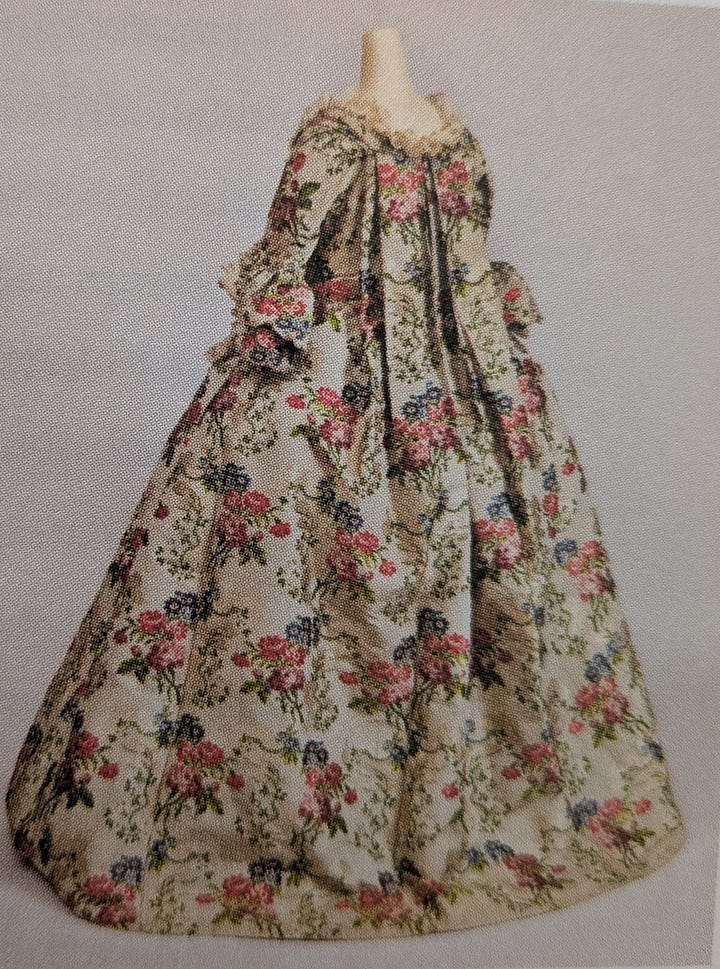

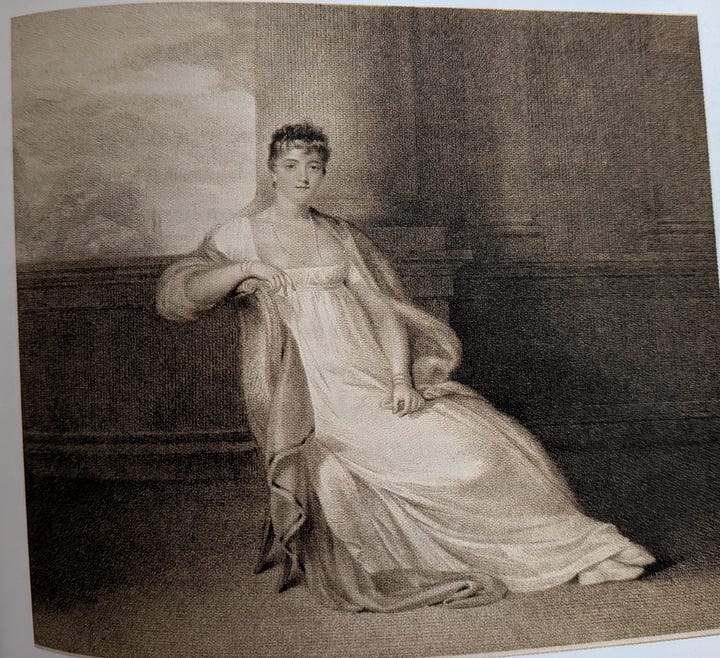
Notice Thérésa’s cropped pixie cut, and how she can sit comfortably. Notice that the natural shape of the women’s bodies can be seen—or at least suggested. (Higonnet writes that given how often Thérésa was pregnant, this style of dress was an asset in keeping her condition private. Look how easy it is to use a knee or an arm to conceal the belly.)
All three women became known for revolutionary style high-waisted dresses made from fine cottons and muslin, with long columnar skirts, simple hairstyles, and, for the first time, purses (because there was nowhere to hide a pocket in the new style). It was a style of dress that was easy and affordable to create; it could be sewed from a few yards of cloth in a day, and could be iterated on with jackets, scarves, and early versions of pashminas, also imported from South Asia. Best of all, it made breathing, walking, sitting, being pregnant, caring for children, and advocating for the rights of women as well as men, generally much easier.
On one side of this robe de style was the rumors that French women wore their thin white cotton dresses wet so that they would cling transparently to their bodies. So scandalous! So French! At the more popular end, women all over the world adopted and adapted the look with modest touches such as frills or scarves to cover the low neckline. (Think of the stylings of Jane Austen heroines.)
Fashion changed for men in this era too. The Third Estate borrowed the British suit and made it into a revolutionary uniform, creating solidarity in numbers by showing up in black suits, en masse, to the Estates General in 1789, called by Louis XVI to solve a financial crisis that he and all the other Louis from I to XV had created.

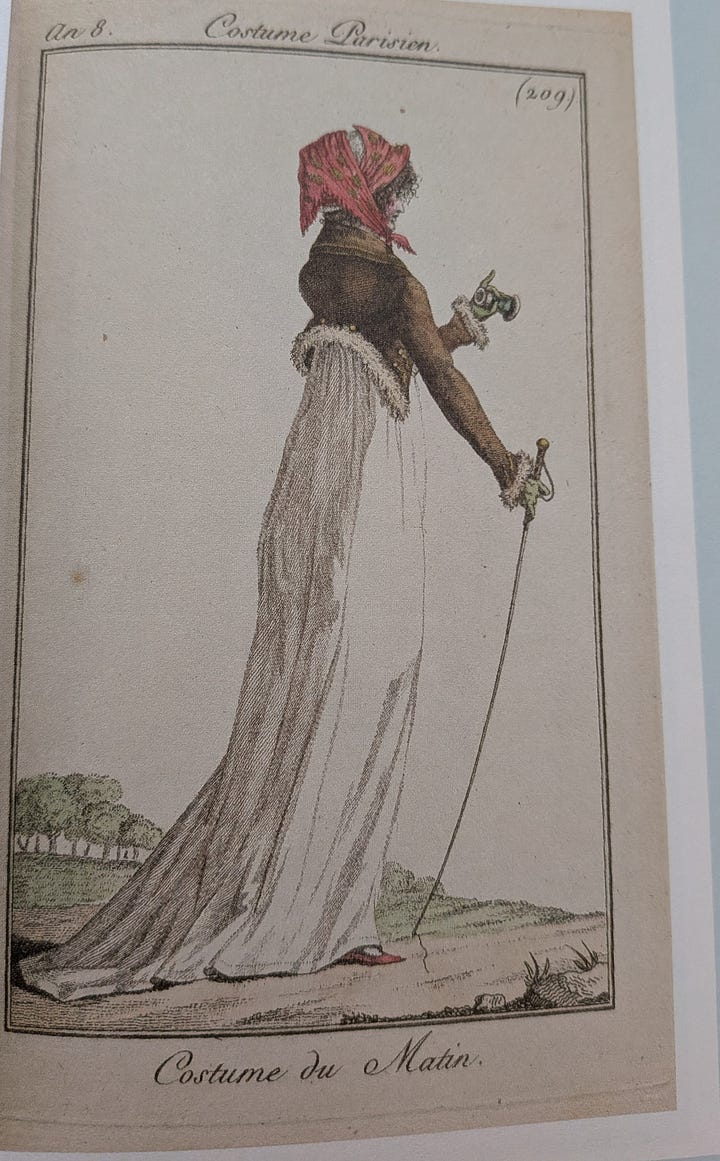
For men, the suit would go on to democratize menswear, almost without interruption.
For women, not so much. By the time that Joséphine was crowned empress, next to her emperor husband Napolean Bonaparte, he had dictated the style she would wear to the coronation: a heavy, structured satin, embroidered with gold metal thread and twisted gold fringe with a 24 yard long train in red velvet, lined with ermine an embroidered with gold bees—a train so heavy that Napoleon’s sisters had to be conscripted to walk behind and carry it.
As Higgonet writes, “she had been forced to submit to imperial style.”
In the U.S. right now, the Gini coefficient is .48 for pre-tax income, according to data from FRED and the U.S. Census Bureau.
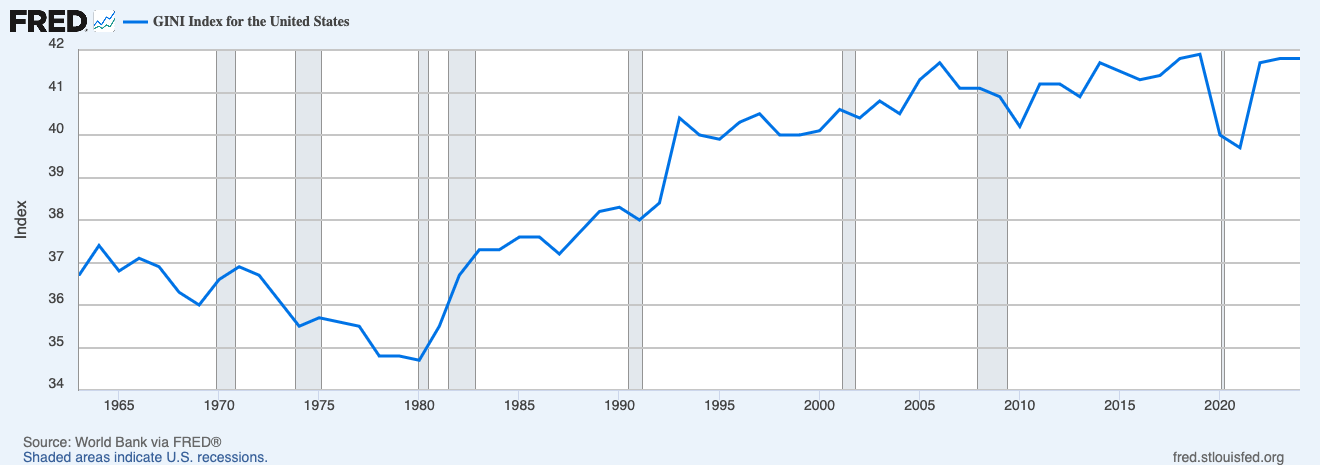
But if Gini is measured by wealth (accumulated assets/property) instead of annual income, the U.S. Gini coefficient is significantly higher, tracking at approximately 0.85
And since, as Mark Twain said, history doesn’t repeat itself, but it often rhymes, we find ourselves naturally and easily at the topic of today’s fashion revolutionaries: the Velvet Gang in Boots Riley’s new film, “I Love Boosters.”


The Velvet Gang are Corvette (Keke Palmer), Sade (Naomi Ackie) and Mariah (Taylour Paige) a group of friends who pay the bills by “boosting” clothes from the mega corporate fast fashion chain, Metro Designers, and reselling them on the street. They draw the ire of Christie Smith, the “science genius” behind Metro Designers, played to absolute perfection by Demi Moore in an icy blonde wig and asymmetrical tailored suits. Christie Smith is not just a corporate maven, she’s an adroit cultural operator who pays people to wear high tech, million dollar “skin suits” to give click-bait style interviews on identity issues to keep her customer base distracted.
Corvette is an aspiring fashion designer and when the sweet lines and deep turquoise tones of one of her own dress design gives her away on the security footage, Christie Smith retaliates by stealing Corvette’s designs and selling them in her stores. To get even more access, the Velvet Gang take jobs in one of the stores, which is when we learn that Metro Designers offers 30 second lunch breaks and requires employees to buy all their clothes from the store, resulting in near-negative paychecks.
Thus far, I’ve given you just the premise, not the zany part. This part is just business as we know it, with more colorful lens filters.
The zany part is when the gang encounter a booster who is at a whole new level, able to open a bag and vacuum up the entire contents of a store in a few seconds. This is the work of Jianhu (Poppy Liu) who is teleporting from a sweatshop in China where her family and friends are getting cancer from sandblasting the denim used in Metro Designers’ clothes.
This is why I love Boots Riley: he always includes a plot device. In this case it’s Jianhu’s teleporter machine, which is revealed to be a Dialectical Materialism machine that has three settings: teleporter - moves you fast from one place to another; deconstructer—reduces whatever you aim it at to its atomic state; and situational accelerator—takes whatever you aim it at to its next, most likely level.

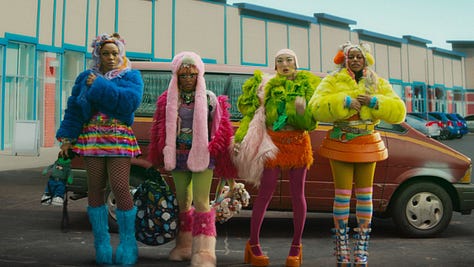
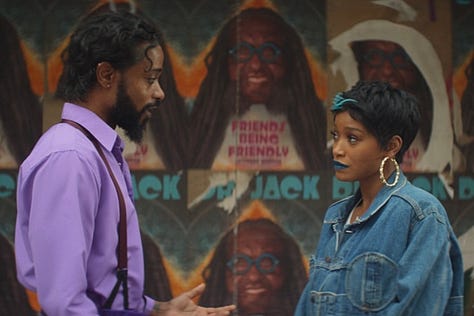
It’s the same revolutionary conditions, with a next level tool and now it’s four fashion-forward revolutionaries instead of three. And sometimes they get the buttons for the settings mixed up, which means it’s a wild ride— brilliant, action-packed, chaotic and colorful—as the Velvet Gang and Jianhu take aim at Christie Smith and her army of nefarious corporates.
Boots Riley has spent a lifetime learning to celebrate and create within the dialectical tension of living with honor and artistry inside of capitalism. He knows how to illuminate its contradictions.
In the film, the young boosters fight amongst themselves about what are their priorities for their own business versus their “boosting to survive” activities, a tension that becomes even more clear when Jianhu, with her even more stark working conditions, enters the picture. And the Christie Smith character’s adept use of tech-bro meets wellness guru rhetoric and her convincing “empowered woman” persona highlights the tensions within the so-called influencer class, as well as the all-too-often vindictive way that women can sometimes exploit other women.
In parallel to the boosters, a young white woman employee of Metro Designers, is doing old school labor organizing; she sees the connection between their efforts, but it takes a beat for the boosters to realize that they are all fighting for similar ends, but with different means.
How do we ally ourselves and prioritize our actions, when there are so many pressing needs? How do we collaborate despite not agreeing on every tactic? How do we assess our leaders and hold them accountable without expecting them to be perfect? How do we hold the different kinds of pain that come from our class, our race, our gender in productive tension? How do we overcome our fear of risk?
How do we let all of these questions percolate and still unify our movement?
Eric Langberg, a photographer and Substacker who has been active in the Los Angeles area community action against ICE had this to say about the movie. “It’s a roadmap, and it’s an argument that making a roadmap is a worthwhile endeavor, and it’s an empathetic understanding that some people might be confused by what we mean by that because they’ll need us to define what a “roadmap” actually is, and that’s okay.”
In “Boots Riley’s I Love Boosters Maps Out The Way To Keep Going” Langberg juxtaposes his thoughts about the movie with photos and narrative from the clashes between LA citizens and armed ICE agents in the past weeks. It’s a moving piece, worth reading in full, but I’ll just quote the last bit where he, like me, is navigating the dialectical tension:
The screenplay is a marvel of subconscious setup and payoff.
It layers in arguments, role reversals, realizations, turns, and revelations for each character, each person inadvertently revealing where they are on this journey and then tracing out their version of an arc to a similar realization . . .
Eventually, I realized I was crying, because this is a movie about navigating infighting by learning how to have grace and empathy for different people being on different parts of the journey… which must start with grace for yourself, and if you’re not there yet, that’s okay, but if you are, let’s go.
I love this. I know not everyone is there yet, but I am. I want more revolution, not less. I want to be outside boosting against the corporates, speaking against the erosion of civil rights, lobbying for anti-oligarchy politicians, not typing on my computer. And I want more people to go with me. If you’re not there yet, that’s ok, but if you are, can we make a plan to do our own version of situational acceleration? I’m so serious right now. And to you, Eric Langberg, I say yes, let’s go!
A recent New Yorker piece, called “Marx Brother” calls attention to one criticism of the film: that it glamorizes theft of property. Riley has been speaking as a radical for years, including arguing that capitalism creates a starving underclass and then punishes them when they do what they need to do to survive. To a recent complaint along these lines on X, Riley replied, “You didn’t hear a peep from them about Ocean’s 11, Heat, or the other millions of heist movies or 20,000 Mafia movies.”
Which, pretty much ends that discussion, IMHO.
The New Yorker article also gives us insight into Boots Riley’s nickname. It started with school children bullying him over a pair of Florsheim boots given to him by his father. Later, Riley embraced the name—and, with it, “a peacocking ambition to achieve mass visibility.”
I couldn’t help but connect this back to Thérésa Cabarru who stumbled out of three weeks of solitary confinement in terrifying prison, wearing only a nightgown, with her hair hacked off and went on to turn it into a revolutionary movement.
Here’s two amazing hours that will dispel the nonsense from the establishment right and establishment left about Hasan Piker. He’s doing more to build a progressive, democratic, and inclusive movement than almost anyone else I can name right now.
Comments
Nothing yet. Say the first thing.
Sign in to join the conversation.