
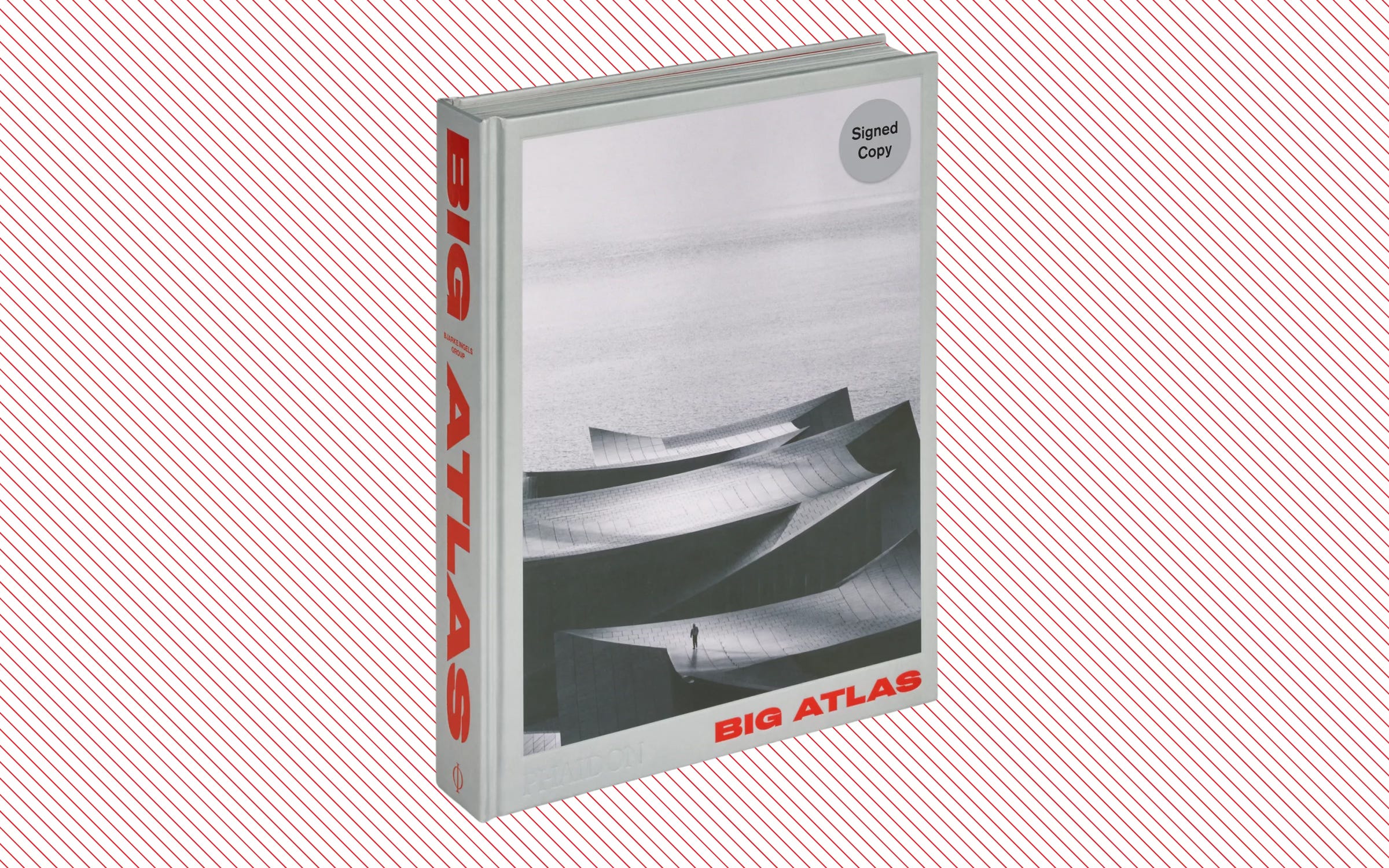
Welcome to the Book Review, a new monthly column from Scratching the Surface on books in and around design, architecture, and culture. Each month, we’ll do a deep dive into a new book or publication, either in the form of a review, an interview, or roundtable and share round ups of new books that arrive in the studio each month.

When I think about the Danish architect Bjarke Ingels, the first image that comes to my mind these days is not an image of one of his buildings but rather a still-frame of him skydiving off VIA 57 West, the New York apartment complex his, studio BIG, designed in 2016. The image is from Abstract, the glossy but hollow Netflix series that attempted to give designers the Chef’s Table treatment with high-concept, personal profiles of designers across the design fields. The scene from Bjarke’s episode felt like it actualized, in many ways, the image Ingels has always sought for himself: superhero. Perhaps more than any other architect of his generation, Ingels — and by extension, BIG — has always felt like more of a brand than a person. Indeed, he’s made a name for himself just as much through media appearances, television, and books, than through any single building. Especially over the course of a series of monographs — Yes is More!, Hot and Cold, Formgiving, and the newly released BIG Atlas — Bjarke has used these texts to craft a particular image, whether that be comic book hero or techo-optimist futurist, and build his brand.
Ingels got his start working under another master brander, Rem Koolhaas, at OMA. Koolhaas famously emerged, first, as a writer with his book, Delirious, New York which helped put OMA onto the map and position Koolhaas not only as an architect, but as some kind of public intellectual. This image solidified with SMLXL (1995), the building-sized monograph that mixed unrealized projects with information graphics on the office budgets and theoretical texts (where Koolhaas coins terms like “junkspace”) and an ongoing index of words and terminology. Ingels arrived at OMA a few years after SMLXL, during the time OMA was launching AMO, the firm’s think tank and strategy office, of which was a clear influence on Ingel’s approach to work. In 2001, he started PLOT, with OMA colleague Julien De Smedt, before going solo in 2006 with Bjarke Ingels Group, or BIG.
Like Koolhaas, Ingels positioned BIG as a thinky architecture firm, creating “oxymoranic buildings”, as Joseph Grima describes them in BIG Atlas. Consider CopenHill, a waste management plant with a ski slope on the top or the previously mentioned VIA 57 West, which Ingel’s coined a “courtscraper”, mixing the typologies of courtyard and skyscraper, and coining a new Koolhaasian term. Despite the branding of the projects, also like Koolhaas and OMA, BIG frequently returns to similar forms and processes: the hybrid buildings, the pixelated stacks, the twisted prisms, the slopes, and the loops. (This is not a critique of those building types, many of them, from both OMA and BIG, I enjoy, but rather an acknowledgement that differentiation happens, many times, in branding moreso than aesthetics.)
Alongside the buildings, however, Ingels continued to build a brand of his own through publishing. YES IS MORE! (2009), the firm’s first monograph, was written as a comic book — complete with panels, speech bubbles, and diagrams — creating a narrative where our hero must find a solution from an awkard site or demanding client, presenting the firm as upstarts and outsiders, heroes bringing forth a new architectural revolution. This was followed in 2015 with Hot to Cold, where the structure shifts from manifesto to taxonomy, showing 60 case studies on projects in harsh conditions, organizing the firm’s work around climate terms. 2020’s Formgiving, was published as the studio was increasing working with and around Silicon Valley (most notably designing Google’s Mountain View campus with Thomas Heatherwick, and what appears to have been nothing more than in-name-only position as Chief Architecture Officer for WeWork) and positioned the studio as techno-futurists. Organized around evolutionary trajectories—Making, Sensing, Sustaining, Thinking, Healing, and Moving—the book felt like a blending of Yes is More and Hot to Cold, blending manifesto with The back portion of the book was dedicated to BIG’s foreword looking speculations including structures on the moon and “Master Planet”, a comprehensive plan to create a fully-carbon neutral Earth. Taken together, this trilogy helped position Ingels, much like books did for Koolhaas, as a public voice for architecture and contributed to a sort of brand building: thoughtful but iconoclastic, future-looking but part of a linage, tech-savvy but climate conscious.
In the years since Formgiving, however, public opinion around Silicon Valley has soured and general audiences seem tired of performative media personalities . BIG’s latest monograph — the first from Phaidon — titled, simply, BIG Atlas, feels to me like a response to the previous monographs. Gone are the theoretical conceits or the innovative structures. This, in many ways, is a decidedly traditional monograph. In the press release announcing the book, Ingels wrote that he immediately liked the idea of a book “where the architecture is allowed to speak for itself, where I was not the voice.” Without this narrative stucture, the book opens up a new question: what is the Bjarke brand today?
Despite its name, BIG Atlas is structure not geographically but chronologically and only presents the firm’s built work (there are no moon colonies here) with short descriptions of each project. The book opens with a short foreword by Danish Architecture Center CEO Ken Martinussen and a long contextual essay by curator and writer Joseph Grima. Grima’s essay, for me, is the highlight of the book, offering a critical look at BIG’s trajectory, hinting at the brands of each of the previous monographs. The project descriptions, themselves, however, offer little information and read, at times, like ChatGPT summaries offering basic information. As John Hill wrote in his review,, “Like many architectural monographs, BIG Atlas is aimed at potential clients—at companies, institutions, and even individuals who want to situate themselves into the expanding timeline of Bjarke Ingels Group.”
This feels right to me. The brand being communicated here is not one of iconoclast or provocateur, not one of futurism or climate activism, but one of institutionalism and trust. These buildings have been built, the book proclaims, and you too can build a BIG building. Taken together, these four monographs trace the arc of the Bjarke brand from provocateur to insider-institution, from scrappy upstarts to fairly traditional bureaucratic office. To be sure, the brand building isn’t absent in BIG Atlas. “Bjarke Ingels stands in line with the great — Frank Lloyd Wright, Le Corbusier, Mies van der Rohe, Kenzo Tange, Alvar Aalto, and Jorn Utzon,” writes Martinussen exuberently in the book’s foreword. “Architects who didn’t just build but believed in architecture.” slightly goofy “Thanks to BIG for disguising the limit and expanding the reality of architecture, bringing joy to all of us.”
The book closes by breaking the form, with a series of photos of Bjarke and his child in Bukken Bruse, a 126-foot long ferryboat he redesigned for as his family’s dreamhouse. The previous pages take us around the world to BIG’s buildings from the last twenty years. There are some hits and some misses. Some buildings I still love and buildings that are less interesting to me. But it seems telling, that as we get to the book’s close, that the most important thing that was built wasn’t a building but a brand. We return, as we always seem to, to Bjarke himself.

A roundup of books that arrived in the studio this month. Links direct to Bookshop.org, where if you purchase through our links, we get some money back to help support the show!
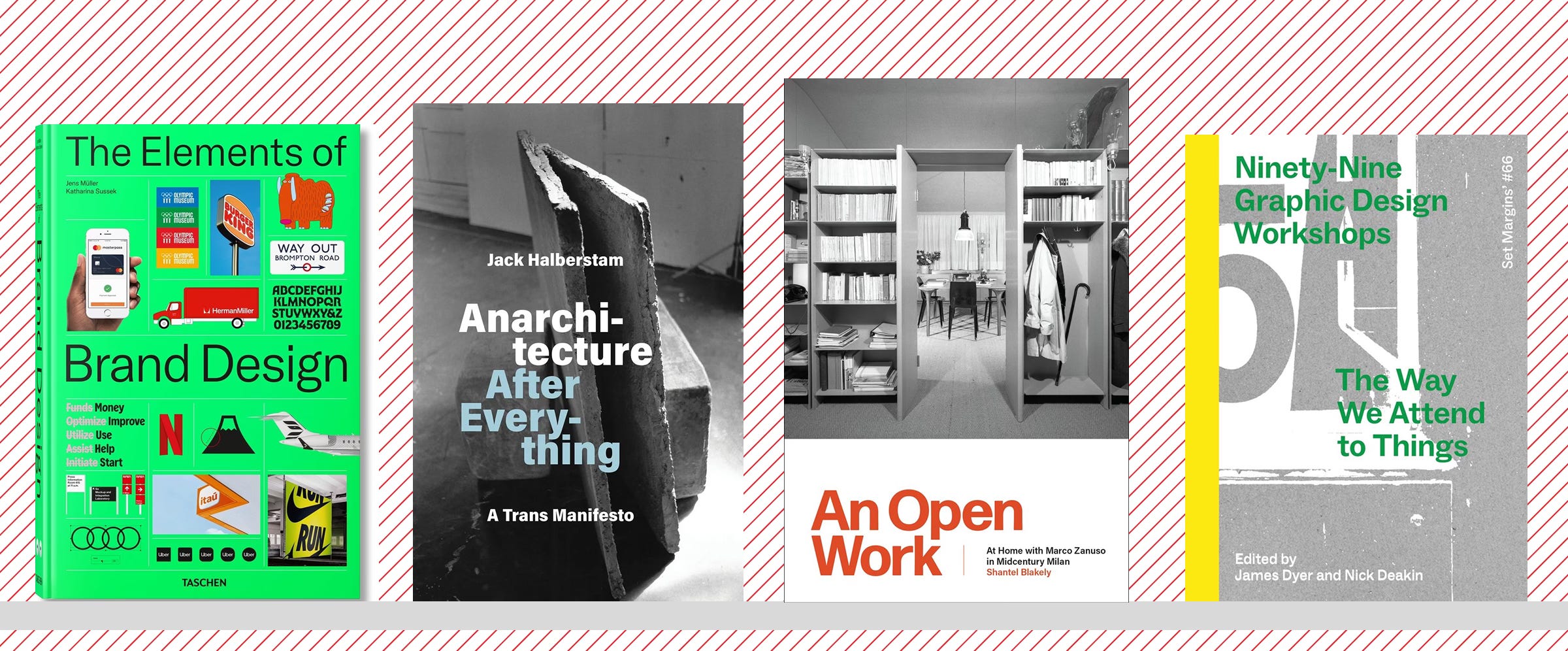
From the late 19th century, symbols and names were used to identify different products. Soon after, corporate colors arrived, then custom typefaces, and 'house styles' for brochures, posters, and packaging. Roll on a century, the digital revolution has brought about a whole new raft of media, brand touchpoints and consumer experiences. Today's designers and brand managers must keep interrogating the established principles to navigate these new playing fields. The work collected here proves that great brand creation and redesign are always rooted in conceptual individuality and visual originality. Jens Müller and Katharina Sussek have structured more than 100 case studies in 17 chapters, each exploring a core element of brand identity. (Taschen, releases July 13, 2026)
Anarchitecture, a radical aesthetic practice of unmaking the built environment, staged a vigorous confrontation with urban renewal and gentrification projects in the 1970s. In Anarchitecture After Everything, Jack Halberstam identifies a powerful lexicon of transformation within anarchitecture, joining the movement’s practices of cutting and splitting with the destabilizing power of transness to detonate acts of formal violence in our time. (MIT Press, August 18, 2026)
An Open Work investigates the celebrated, enigmatic Italian architect-designer Marco Zanuso (1919–2001). Zanuso’s buildings were widely recognized in Italy, and today his object and furniture designs, which won many awards in their time, can be found in prestigious museums worldwide, yet a lacuna has persisted in the literature. (MIT Press, October 20, 2026)
We live in a moment when our everyday experiences are distracted by a cynical attention economy; as such, there is an urgent need for a new kind of vigilant attention. In other words, how we experience the world depends on the ways we attend to it. The workshops in this book are practical challenges to the ways we think about the world we live in. Without relying on specialist equipment or subject-specific knowledge, they give clear instructions about how to be mindful of the real world in unusual ways.
No posts
Comments
Nothing yet. Say the first thing.
Sign in to join the conversation.