
🪸 We’re Superorganism, the first VC for startups that benefit biodiversity. Each month we publish thoughts from the frontline, company updates, and a round-up of new happenings in the nature tech world.
It’s finally summer, and the rush to the beach for holidays coincided with another great migration: the UN Oceans Conference, the third since 2017 to bring together ocean advocates, high-level officials, and ocean tech enthusiasts to Nice, France in June.
We joined our friends and colleagues at the heart of the French Riviera to talk all things oceans, replete with tallship conferences (thanks, Katapult), paddleboard networking (thanks, SeaTrees), and sunset-soaked side events (thanks, Ocean House).
At Superorganism, we’ve always been ocean-inspired. With 98% of the planet’s livable volume, 78% of the planet’s animal biomass, and 25% of the planet’s species, there is no question: we live on a blue planet. As the great Arthur C. Clarke said: “How inappropriate to call this planet Earth, when it is clearly Ocean.”
Plus, nudibranchs live there, and we think that’s pretty neat.

We’ve dedicated 20% of our fund investments to oceans, with companies like Ulysses, Sway, Spoor, and Inversa leading the way. But with UNOC bringing together hundreds of startups from across our ocean planet, innovation was on parade. We came back re-psyched on ocean tech and ready to dive in, go deep, and make some waves. (Salty about the wordplay? Shell of a lot more where that came from.)
Not all ocean tech is for us. As our friends at Propeller VC wrote about recently, ocean innovation cuts across many industries and sectors. As a VC for biodiversity, we focus on the slices of ocean tech that most impact species and ecosystems. Our three thesis areas (described here) help keep our focus broad on which sectors and technologies we can consider, and narrow on which opportunities are most ecologically additional.
While some sectors like fishing, energy, and coastal development have clear and direct impacts on ocean biodiversity, others are (literally) more upstream. Fertilizer runoff from industrial agriculture can lead to massive de-oxygenated “dead zones” when it reaches the ocean. Mercury from artisanal gold mining can bioaccumulate up food chains, causing health impacts to species, including us. Other pollutants entering oceans through water systems include:
Pharmaceuticals like antibiotics and birth control that can breed antibiotic resistance or interfere with other species’ reproductive systems.
Recreational drugs (see this famous study on eels and cocaine in the Thames).
Diseases like toxoplasmosis, a common parasite in cats that can also impact species like sea otters.
Pollutants like microplastics, which are themselves harmful, and which in turn frequently carry additives that can mimic biological hormones.
Heat from industrial applications (including data centers), which can affect delicate ecosystem functioning.
We keep these factors in mind as we look for startups whose work may, on its surface, be on-land. Sway displaces thin-film, single-use plastics with a biodegradable alternative, ThriveLot transforms yards from fertilizer-heavy lawns to native species, BluumBio remediates sites that contain heavy pollutants like oils and PFAS. We remain deeply interested in startups producing new alternatives or interventions that can help keep waterways clean, and prevent pollutants at their source.
Downstream in the ocean itself, we prioritize the greatest possible overlaps in understanding and benefiting nature. (For more on other sectors like energy and shipping, see The Ocean Returns, Investable Oceans, and 1000 Ocean Startups.)
Key habitats in the ocean like mangroves, seagrass, kelp forests, ice, and coral reefs have declined significantly in the last few decades:
35% of mangrove forests lost between 1980 and 2000.
30% of seagrass lost since 1980.
50% of coral reef cover lost since 1950.
50% of Arctic ice sheet lost since 1979.
20-40% of global kelp forests are severely degraded or lost.
Addressing the drivers of loss is a whole other bucket of innovation, but we also get excited about working against the tide: restoring ecosystems, at scale.
Seagrass meadows are a good example of an ecosystem that benefits from a tech boost. Seagrass is a triple-threat ecosystem for carbon, communities, and biodiversity, but to date, these have been replanted by hand, either by scuba divers, snorkelers, or wading in the intertidal. This has limited even the most ambitious seagrass restoration projects to the hectare scale. Ulysses is building autonomous robots to plant seagrass, effectively an ocean tractor row-cropping seagrass meadows. This level of kilometer-scale restoration ambition is cost-prohibitive (read: impossible) without tools like those Ulysses are developing.
Other ecosystems are seeing scaled restoration concepts as well. Kelp forests are getting boosts from companies like Seaforester seeding kelp forests with “green gravel.” Coral reef companies like Coral Vita ($8M Series A), rrreefs, and Coralmaker are building out the tech stack needed to restore both the coral organisms and the physical substrate of healthy reefs. Arctic ice companies like Real Ice are working to create new ice using pumps and water hoses, preventing annual loss.
Increasingly, nonprofits and conservation organizations are also using technology to increase the speed and scale of their work. Coral Gardeners has unveiled CG Labs, a tech-laden arm of the nonprofit building tools for AI fish recognition, 3D reef photogrammetry, acoustics, deployed cameras, and more. Their aim is to build tech that supports their restoration efforts, then bring that to other conservation organizations worldwide.
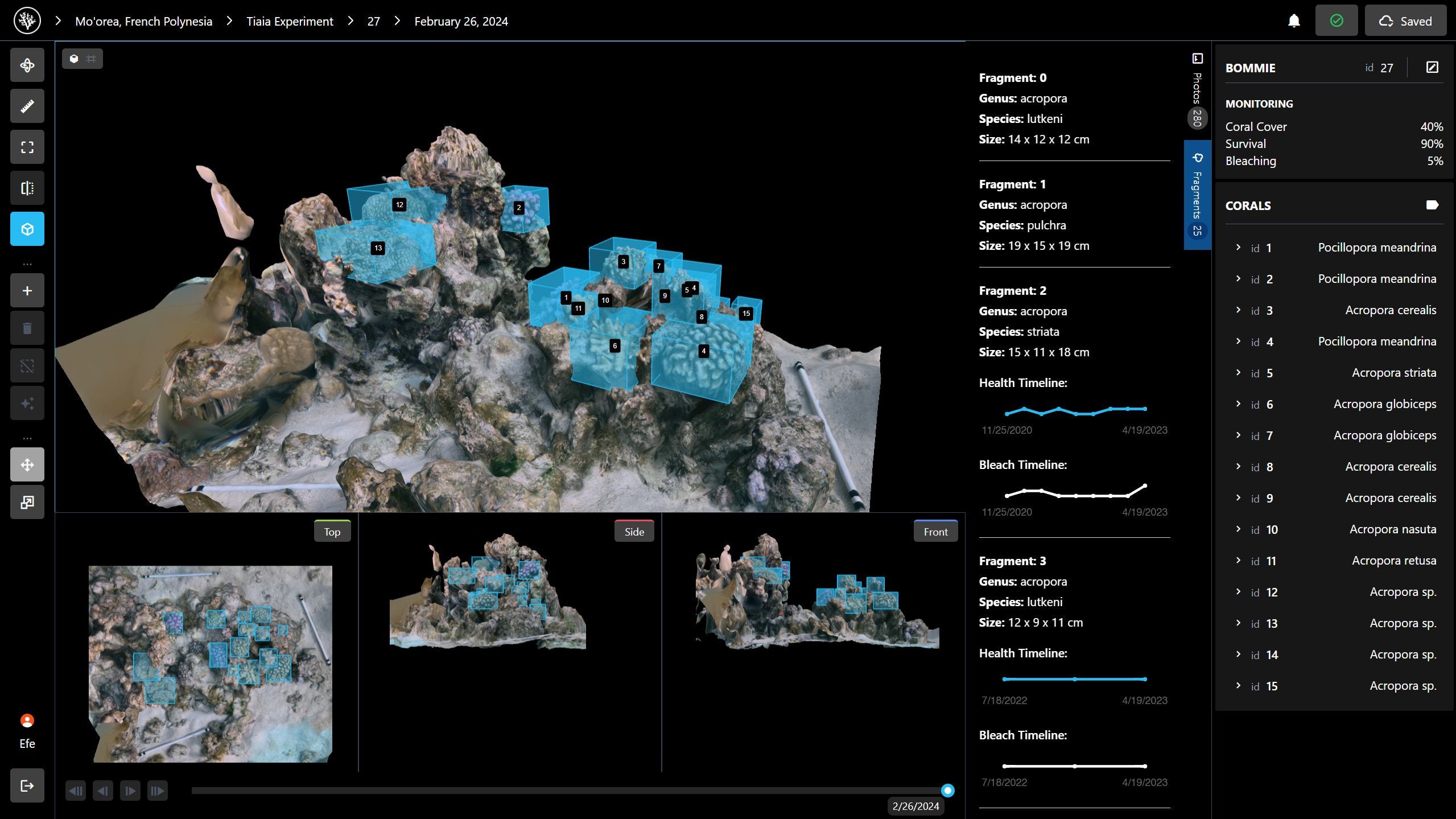
Crucially, ecosystem restoration projects should always be done with local communities engaged. In Western Australia, Tidal Moon is reviving ancient markets for sea cucumbers, training local Indigenous youth to dive, harvest, and restore seagrass. Done in partnership with global conservation orgs, local universities, and novel tech, it’s a prime example of the integrated community approach.
Business models here can be tough: we’ve seen carbon credits, aquaculture, ecotourism, service-based models, compliance-based restoration, and more. We’re always on the lookout for innovative approaches.
The key concept is scale. Patches of restoration are critical, and done with local conservation and community partners are the most durable of restoration efforts. But if we are to address the magnitude of loss that we have seen in the past half-century, we need to build a workshop full of tools that will allow us to work backwards from the future we want, rather than forwards from the present we have.
With the tragic loss of lives during Texas flooding in the recent news, flooding and coastal management is top of mind. Flooding is the most frequent and expensive natural disaster in the U.S., responsible for about two-thirds of the total cost from all natural disasters since 2000. Flooding and sea level rise is already here, and only getting worse: one-third of the global population currently live in flood zones.
In the US alone, flooding and sea level rise have had major effects. Louisiana has already lost over 5,000 km2 to the sea – an area larger than Delaware. In just four states (Florida, North Carolina, New York, and New Jersey) $9.5 billion has been spent on beach nourishment (replacing beaches with new sand) since the 1930s, representing about 61% of the national total.
The total cost of floods in the United States is estimated to be between $179.8 billion and $496.0 billion per year. The total cost to taxpayers since 1980 is estimated at about $1 trillion.
The build-out of coastal resilience and flood prevention works in the US alone is not just a critical need, but a multi-billion opportunity. Individuals, communities, and even insurance companies are investing in a new wave of resilience strategies in anticipation of higher sea levels, and worsening storms.
Companies like NaturX ($5M raised), ECOncrete ($21M raised), and Kind Designs ($11.5M raised) use physical structures to protect shorelines and prevent storm surge. Critically, these structures are also built to work alongside nature, creating a substrate for oysters, corals, or mangroves to settle and thrive. In a different approach, startups like Levitree inject woody biomass deep underground, to elevate wetlands and infrastructure.
As the US federal government begins to remove support for core ocean and meteorological datasets (3K ocean datasets removed in 2025 alone), weather and ocean modeling is becoming more critical for the private sector to maintain. Startups like Sorcerer ($4M raised) and Windborne ($25M raised) aim to provide higher-quality weather data via micro weather balloons, while companies like Actea and Ocean Ledger improve fidelity and insights from remotely sensed ocean data.
Meanwhile, companies like Hohonu use distributed tidal gauges to provide fine-grain tidal charts and flood warnings to municipalities, and distributed ocean sensors like Sofar Oceans ($73M raised) track weather and sea surface data oceanwide.
While space tech pushes the frontiers of humanity into outer space, we are equally interested in “inner” space: the companies pushing the boundaries of human exploration in the oceans.
The deep ocean is inhospitable to humans, and doubly so for tech. It crushes, corrodes, and drowns. Tech has to withstand pressure, salt, currents, wildlife, biofouling, deployment and retrieval difficulty, surface chop, storms, communication barriers, darkness, cost, and frigid temperatures. Aside from that, ocean tech is easy.
(Side note: how the hell did we miss out on naming it “deep tech”?!)
Because the ocean is famously large, robotics and autonomy are top priorities. Companies developing autonomous or controlled vehicles in the ocean are driving both industry use cases and scientific exploration. So far, the largest rounds have been defense-focused, companies like Saronic which raised a massive $600M round this year. Others examples have focused on industry use cases, like the Xocean $119M round focusing on energy and offshore wind asset monitoring. These autonomous surface vehicles (ASVs) follow in the steps of companies like Saildrone ($250M raised) and Liquid Robotics (acquired by Boeing for $300M) in bringing autonomy to industry.
Companies like Bedrock ($35M raised) and VATN ($16.5M raised) are building out next-generation autonomous underwater vehicles (AUVs), while startups like Orpheus are using deep-ocean landers to explore the abyssal plains. Ulysses meanwhile aims to expand beyond seagrass towards modular tech allowing for customized missions that both read (monitor) and write (manipulate).
It’s not enough to go there: you also have to understand it. Sensor companies like Aquatic Labs and Subtidal build new sensor suites to improve our understanding of carbonate chemistry and unlock the ocean’s carbon drawdown potential. Other sensor payloads like Planblue develop hyperspectral imaging to measure photosynthesis, carbon stock, and more.
Above the surface, our investment Spoor is supporting energy abundance by using computer vision in tough marine environments to detect and monitor bird species near offshore wind infrastructure. This helps identify less-harmful future sites, speeds up permitting times, and ensures ongoing compliance.
Taken together, these technologies are revolutionizing how we will operate in the oceans for the next 100 years.
While we’ve called this a deep dive, there’s so much more to explore: we could write entire posts on food security (40% of the world depends directly on the ocean for sustenance), the manyfold ways climate is affecting oceans and vice-versa, or framing the urgent debates on deep sea mining. Our broadest view, though, is this: as human populations grow to 10 billion, we’re excited for technologies that can help us better work with and steward the ocean, home to 98% of Earth’s livable volume.
Our fate as a species is completely intertwined with our oceans’. For those companies helping us feed humanity, explore the unseen, and regenerate our planet, we see nothing but rising tides.

Welcome Kit McDonnell to the Superorganism team! Kit is our first hire into the organization, and will be overseeing how we support the nature tech ecosystem broadly, from our portfolio outward. A biologist, startup operator, advisor, and lover of all things art and nature, Kit is a natural cross-pollinator and we can’t wait to see the impact she has.
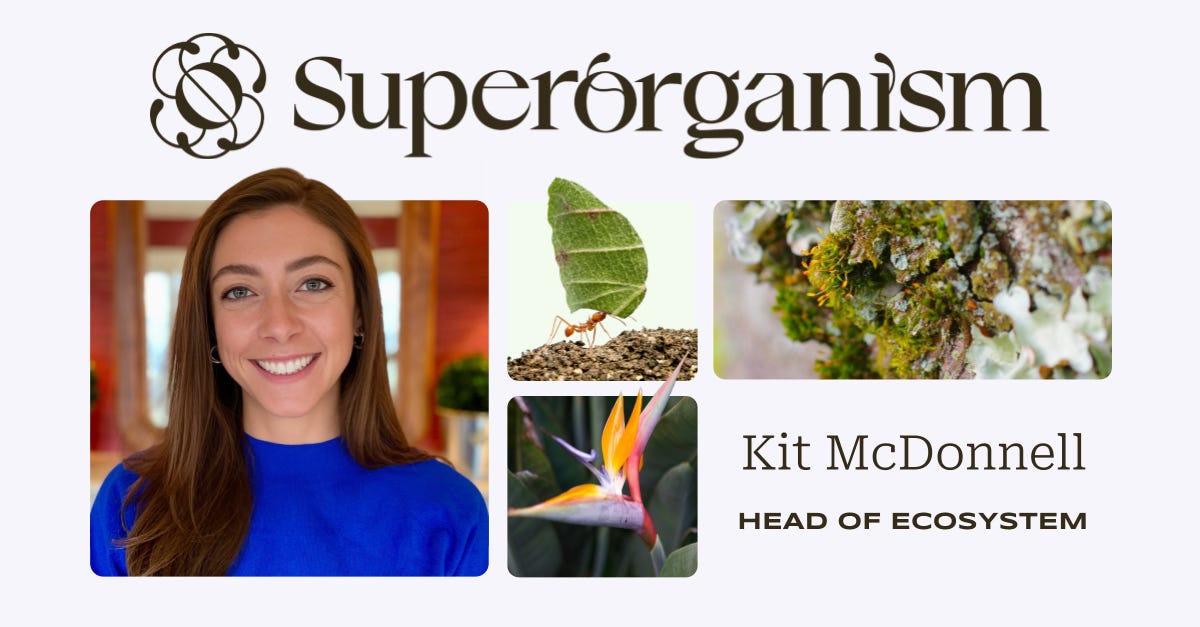
A recognized leader in the bioeconomy, Kit has shaped industry agendas at the intersection of biotechnology, climate, and culture across startups, public companies, and global institutions. She’s led transformative initiatives at LanzaTech, Ginkgo Bioworks, Inc., Enko Chem, and the Field Museum, such as the industry leading Ginkgo Ferment conference and the first-ever fragrance from an extinct flower. Trained as a systems biologist (partial to ants!), Kit brings a rare talent for connecting emerging technology with real-world impact.
Say hi to Kit and share ideas on how we can collaboration on our welcome post here.
We’re on the hunt for an incredible addition to our investment team. Ideal applicants should bring experience in sourcing and supporting startup investments, along with passion for nature and ecosystems.
For more, you can see the job description here, and apply here by August 5th.
One of our newest investments, LGND, announced its $9M raise as it seeks to build the core infrastructure to accelerate geospatial AI.

Over the past year, they’ve been building a new kind of infrastructure for Earth data. The core of their work is on geospatial “embeddings” – a data encoding type that produces scalable Earth datasets faster and more affordably than traditional approaches. Embeddings can be queried, tuned, and deployed in real time, and the platform gets smarter with every interaction.
This is the missing variable that solves the geospatial AI equation. LGND’s embeddings library plus AI earth models like Clay, Prithvi, or Terramind results in a map of the world you can talk to. Count the industrial farms in Texas, monitor the Amazon for new logging roads, find the best locations for new solar farms – you can now query the planet, get results as fast as ChatGPT, and build applications on top.
Tools like this are what the three founders each dreamed of their whole careers: Nat Manning (Kettle, Ushahidi), Dan Hammer (Ode Partners, Global Forest Watch, Earth Genome), and Bruno Sánchez-Andrade Nuño (Mapbox, Microsoft Planetary Computer).
We’re psyched to support LGND as they build the load-bearing structure of the next generation of geospatial applications. Congratulations Dan, Nat, and Bruno, and welcome to the Superorganism community!
Updates from our portfolio companies, and from us at Superorganism.
🏄 Our companies Sway and Ulysses were accepted as two of six presenting at this year’s Progression Conference on July 30th, register here.
🛰️ Array Labs revealed details publicly about its upcoming satellite cluster
🌐 Cecil announced partnerships with Felt and Space Intelligence, launched Impact Observatory and JRC Deforestation and Degradation (EUDR) datasets, and dove into the nuances of metadata.
🌱 Foray’s CEO Ashley Beckwith was interviewed for the Grow Everything podcast.
🍄 Funga unveiled a refreshed website, spoke at Duke, and partnered on its first restoration project.
🍫 Planet A Foods is a finalist for the prestigious Deutscher Gründerpreis 2025, and was named a “Rising Star” with the 2025 Game Changer Award.
🦅 Spoor partnered with Fugro to advance offshore bird monitoring, and the British Trust for Ornithology concluded an extensive review of Spoor’s accuracy and reliability in a variety of onshore and offshore environments.
🪸 As for us at Superorganism in May and June…
Spoke at an Envest/SOSV Redesign Panel and on the case for biodiversity investing during London Climate Action Week
Got deep with ocean friends at the UN Oceans Conference in Nice
Attended events during SF Deep Tech Week
Want to join a Superorganism company? Check out our Jobs Board, with 47 active jobs currently available. Start your nature tech career today!
🤝 Friends of the Fund
Why JPMorgan hired NOAA's Sarah Kapnick as chief climate scientist | CNBC
The Climate Tech Investor Who Won’t Touch DAC | Heatmap News
Database of 300 climatetech accelerators (including nature tech) | NatureTech Memos
Blue Corridors by Ode Partners launches
🦧 Conservation
Jaguar recovery unites Brazil and Argentina in conservation effort | Mongabay
Imperiled in the Wild, Many Plants May Survive Only in Gardens | Yale e360
Uganda's rhinos are back after a decade without a single birth | CNN
Wolves in Japan: could their reintroduction restore nature’s balance? | South China Morning Post
Urban rewilding has brought back beavers, hornbills and platypuses to city parks – and that’s just the start | The Conversation
Elk could be back in UK after 3,000 years | BBC
Hundreds of Capybaras ‘Conquered’ This Town. Now What? | NYT
Western Australia coral at unprecedented bleaching levels in Ningaloo Reef | Guardian
Florida's coral reefs are dying, but this race is on to save them | The Guardian
A Mesoamerican reef fish signals marine ecosystem recovery after Malthusian overfishing | Nature
How fish farming is devastating marine life with a single salmon consuming up to 350 wild fish | The Scotsman
Python hunt in Florida to remove invasive species surpasses goal | Miami Herald
The Environmental Toll of Rubber in Tires: Deforestation in Southeast Asia | Yale E360
Collapsing bird numbers in North America a 'sign of a biodiversity crisis' | Guardian
💰 Nature Finance
Only 5% of companies have a biodiversity strategy. The rest face a $44 trillion risk | Equities
Why we should take a venture approach to protecting nature | WEF
Nature's investment frontier | Forest Trends
A new model for nature markets | Blue Green Future
Khaki is the new green: Climate-tech startups pivot to defense | PitchBook
The case for connectivity credits | Sophie Gilbert
Biodiversity-related risks of the French finance system | Joshua Berger
2025 State of the Voluntary Carbon Market (SOVCM) | Ecosystem Marketplace
🦠 Conservation and Health
Co-benefits of nature for birds, people, and climate in the United States | ScienceDirect
‘Explosive increase’ of ticks that cause meat allergy in US due to climate crisis | Guardian
Weedkiller ingredient widely used in US can damage organs and gut bacteria, research shows | Guardian
🔬 Science
The origin of vertebrate teeth and evolution of sensory exoskeletons | Nature
Axolotl Discovery Brings Us Closer Than Ever to Regrowing Human Limbs | ScienceAlert
Octopus Arms Have Their Own Microbiome, Study Finds | The New York Times
How Herbicide Drift from Farms Is Harming Trees in Midwest | Yale School of the Environment
California Hummingbird Beaks Have Changed Since the 1980s | Yale Environment 360
What makes a coral reef such a biodiversity hotspot | Oceanographic Magazine
Turbocharged Mitochondria Power Birds’ Epic Migratory Journeys | Quanta Magazine
Fish like rainbow trout suffer pain when killed by air | Earth.com
The spatial distribution of tests of conservation interventions does not align with global conservation needs | ScienceDirect
Fossil footprints confirm the earliest human activity in North America | New Atlas
🤖 Nature Tech
Earthscale launches its first product
No bones, no scales, no problem: The first lab-grown salmon sold in the U.S. | WaPo
Biomimetic chemical microhabitats enhance coral settlement | Trends in Biotechnology
Using AI to Understand What Animals Are Saying | TIME
Explore the amazing world of trees with World Wide Wood | Google
Beehives Equipped With AI and Robotics Support California Almond Crop | Bloomberg
📜 Policy
A Rare Showing Of Bipartisanship Stopped The Senate's Public Land Grab | Atmos
China is building the world’s largest national parks system | NatGeo
USAID Cuts to Conservation Programs Threaten Global Biodiversity | Yale Environment 360
The Threat to the National Environmental Policy Act in the Age of Climate Change | Heatmap News
New pope speaks out about urgent need for climate change action | Yale
“Why Are We Funding This?” | American Scientist
The U.S. Can’t Afford to Lose the Biotech Race with China | Time
Trump To Rescind Roadless Rule, Which Protects 58 Million Acres Of Forest Land | NPR
Is the time right for a global agency to regulate gene editing? | Nature
The Supreme Court Just Started a Permitting Revolution | Heatmap News
Climate Startups Are Pausing Operations, Cutting Staff and Entering Bankruptcy as Trump Policies Bite | WSJ
Schwarzenegger tells environmentalists to 'stop whining' and get to work | AP
No posts
Comments
Nothing yet. Say the first thing.
Sign in to join the conversation.