
The SuperJoost Playlist is a weekly take on gaming, tech, and entertainment by business professor and author Joost van Dreunen.
"Optimism and realism." That's what Asha Sharma asked of Xbox staff in a memo on June 10th. It's code for: you're not going to like what I'm about to say.
She may have well told everyone, “The honeymoon is over.”
After more than three months defined by a growing infatuation with Xbox’s new CEO, the industry is sobering up. Layoffs are coming, and on Friday, a rumor surfaced that Microsoft may yet spin off Xbox entirely. Since then, Bloomberg reported that several of Xbox’s subsidiaries are now in negotiations to buy themselves out.
All of it falls in line with my initial predictions at the start of Sharma’s tenure.
While a spin-off is unlikely to happen anytime soon, the change in tone tells you where we are on the roadmap: after initially winning over skeptics and naysayers, Asha is now switching lanes to the unpopular part of the job.
We can see a first outline of how Microsoft’s gaming division is likely to change.
Succinctly, its former CEO, Phil Spencer, ran Xbox as a games executive managing a platform. Sharma, in contrast, is a platform operator running a games business.
Viewed through the lens of the Play Pendulum, the distinction matters. I’ve long argued that games alternate between periods of content innovation and distribution innovation. During content cycles, success comes from making the next hit. During distribution cycles, success comes from making content cheaper, easier, and more accessible. Sharma’s Xbox increasingly looks like a company adapting to the latter.
Consequently, I predict that everything that follows from here echoes that principle. After sticking the initial landing, the next 100 days will give us a clearer sense of how Sharma imagines Xbox’s future.
As one of the largest game companies in the world since the acquisition of both ZeniMax Media in 2021 and Activision Blizzard in 2023, Xbox is adjusting to its new economic circumstances. Having spent well over $80 billion on content acquisitions in recent years, the company's subscription-based service, Game Pass, has so far failed to deliver on its lofty goal of reaching 100 million subscribers. To address this, Microsoft recently removed Xbox’s entire management team, including its former CEO, Phil Spencer, and his right-hand, Sarah Bond.
The appointment of Asha Sharma as the new CEO was not without challenges.
Following an initial wave of obvious and largely misogynistic criticism, public sentiment turned in her favor. Her background as an operator at Meta, Instacart, and Microsoft CoreAI raised fears that she, a newcomer to games, would quickly move to centralize the entire operation around artificial intelligence. But she proved critics wrong. Her quick execution on key issues and improved transparency alleviated initial concerns.
Now, after her first 100 days as the new boss, Sharma is gearing up for the job she was actually hired to do: whip Xbox back into shape. The games industry at large is up 4.5 percent year-over-year, and Xbox's presence across PC, console, and mobile ostensibly means it can compensate for losses in one area with gains in another. But things aren't going to get better by themselves.
In a recent interview with Bloomberg, Sharma outlined the problem. Software sales had declined from $5.7 billion to $5.3 billion since last quarter, and hardware sales are down 33 percent. Xbox, she concluded, was "not in a healthy spot.”
She’s right, of course.
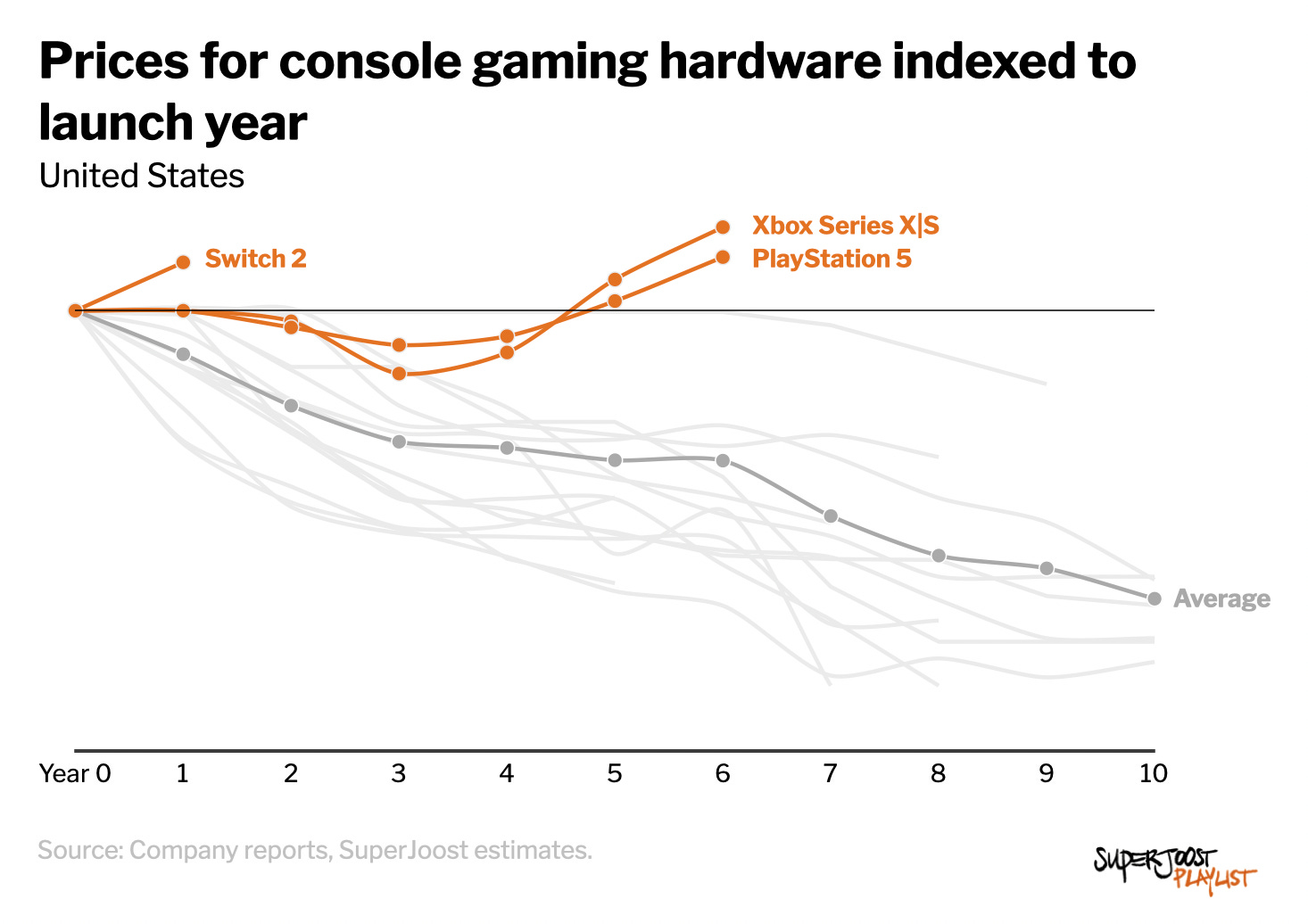
The cost of memory and storage has gone up almost 3x since she took the job, and console gaming, the “core” of Xbox, isn’t getting any cheaper. Despite all the price increases, both the Switch 2 and the PlayStation 5 are outselling the Xbox. Ironically, as the Microsoft mothership continues to pour billions into data centers and the chipsets to power them, its own subsidiary now faces shortages and high prices for hardware components. The chipmakers even have a phrase for it: they're "post-consumer" now, selling to hyperscalers rather than gamers.
It’s especially vexing this late in the console cycle, when console manufacturers historically cut prices to sway risk-averse buyers to finally upgrade their hardware. Xbox and its peers are forced to do the opposite, against their own institutional logic.
Instead of trying to solve its issues with more and fancier technology, Sharma is focusing her attention on increasing the value of its ecosystem for both consumers and creatives.
Comments
Nothing yet. Say the first thing.
Sign in to join the conversation.