
Just a few years ago, venture capital took a liking to video games and quickly became a key source of funding for creative projects. Drawn by the outsized success that separates the winners from everyone else, and by the similarities between online games and software-as-a-service, VCs initially positioned themselves as an alternative funding source to publishers and platforms. And what venture funds couldn’t provide in terms of strategic support, like marketing and a broader network, they made up for with relatively loose terms for creatives and, you guessed it, big checks.
That changed rather dramatically in the wake of the pandemic, when consumer demand softened, and growth slowed. After reaching a peak of $20.1 billion in 2021, total deal value fell to $4.9 billion by 2023, roughly a 75 percent drop. A series of painful misses scared investors, and the world moved on to AI.
In 2026, we’re starting to see a careful return of venture funding to games. According to PitchBook, over the first half of 2026, total deal value has already reached $7 billion, roughly matching all of 2025. Just this week, Makers Fund, one of the largest gaming-focused venture funds, closed its $250 million Fund IV. (Disclosure: Makers Fund was an investor in SuperData and I’m an advisor.)
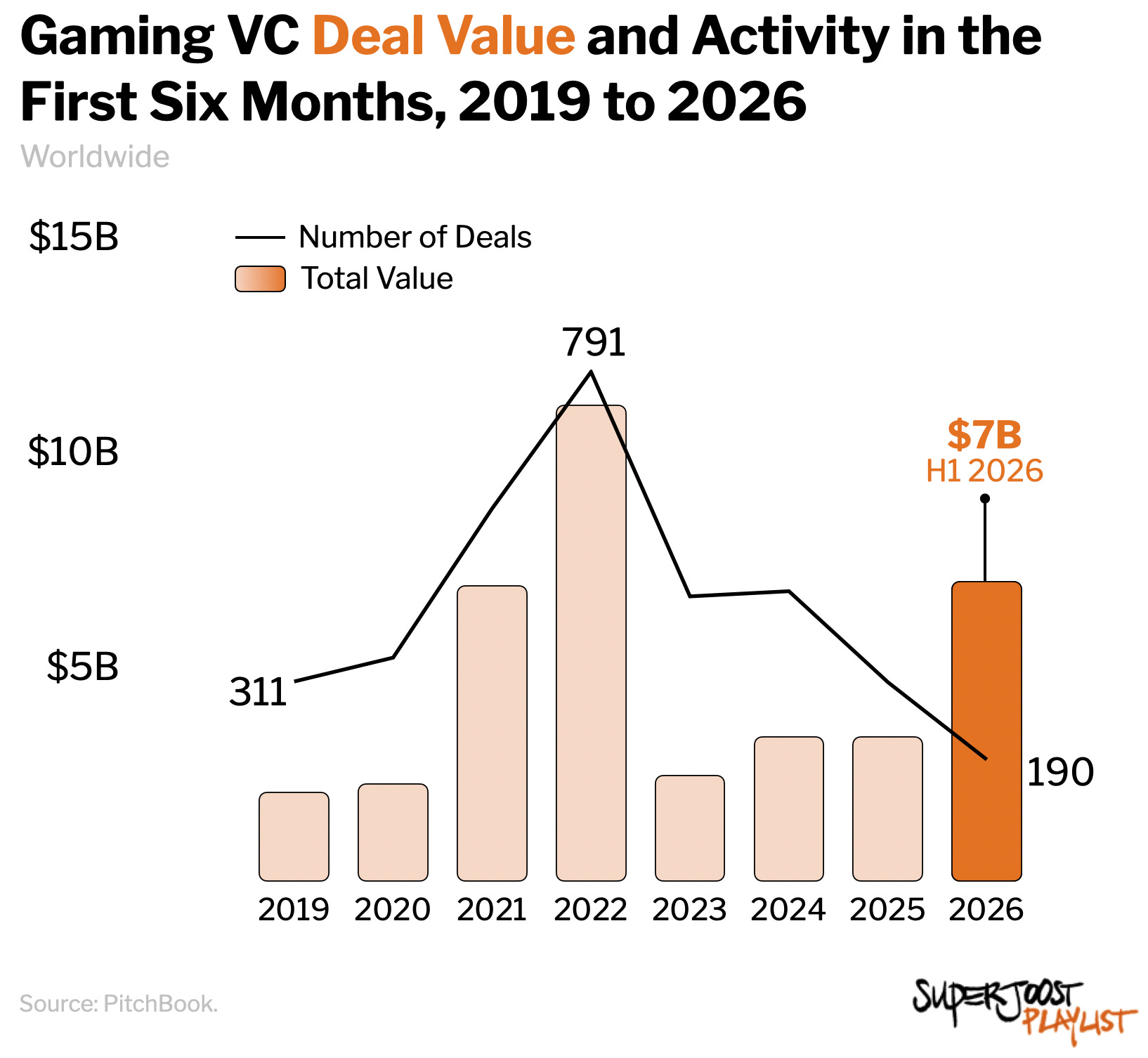
There’s one notable difference, however.
Over the same period, the bulk of investment money isn’t going into creative projects so much as into the AI plumbing around them. Every one of the quarter’s five largest raises went to a model or tooling company, while the biggest game-studio round was just $70 million. Two of the largest raises, both in June, were a $310 million Series B by Odyssey and $320 million by General Intuition (I’m scheduled for an interview with GI’s CEO and fellow Dutchman in NYC, Pim de Witte. More on this soon!).
Venture capital is coming back to games, yes, but it’s not investing in games.
So far, 2026 is telling us that investors are pouring money into the technology that makes games cheaper and easier to build. Which raises the more interesting question: if making games becomes cheap, what becomes valuable?
It makes my conversation with Ben Feder, managing partner at TIRTA, all the more timely. Among his other roles, Ben is the former CEO at Take-Two. He stood at the beginning of what is now the biggest franchise in gaming (and perhaps in entertainment), and has seen would-be competitors and presumed disruptive technologies come and go. I wanted to know: what does he make of all this excitement around AI? Did investors get it right when they downgraded Take-Two’s stock after Google announced Project Genie? And if AI makes development cheaper, will we see more layoffs?
What follows is a transcript of a recent back-and-forth conversation between Ben Feder and me. I was an invited guest on TIRTA Ventures’ investor call. I pushed back where I could, mostly on the human side. Feder and I approach the current moment somewhat differently. He sees technological change as a catalyst. I tend to think the real disruption happens in the new distribution channels and business models built around it. Ultimately, we ended up in much the same place: the more powerful the technology becomes, the more valuable human creativity becomes. What follows is where we landed, lightly edited for length and clarity.
Sydney: Welcome, everyone. Before we begin, I’m going to give a brief disclaimer. Today’s discussion is for general informational and educational purposes only. We are not offering or selling any securities on this call, and nothing discussed should be construed as an offer to sell, a solicitation of an offer to purchase, or a recommendation regarding any security. Nothing discussed today constitutes investment, legal, or tax advice.
My name is Sydney, and I lead investor relations at TIRTA Ventures. The reason we are hosting today’s call is very simple: it is not every day that video games make the news, let alone the major headlines. I want to introduce today’s speakers, Ben Feder and Joost van Dreunen. Ben is the founding partner of TIRTA. He is the former President of International Partnerships at Tencent, former CEO of Take-Two Interactive, and founding partner and vice chairman of Zelnick Media Capital. Today he leads our team at TIRTA, with a singular focus: building the premier specialist venture capital firm investing in the future of interactive entertainment.
Joining him is Joost, a globally recognized expert on the business of video games. Joost teaches at NYU Stern School of Business and is the author of One Up: Creativity, Competition, and the Global Business of Video Games. He co-founded SuperData, which was acquired by Nielsen, and today he advises gaming startups, contributes to major media outlets, and publishes the weekly SuperJoost Playlist, read by 17,000 industry professionals. I am one of those readers.
At TIRTA, we have gotten a lot of questions about what’s happening in this space. And rather than answer them one by one, we wanted to open up the discussion to the broader community. So without further ado, let’s get into it.
Ben Feder: Thanks, Sydney, that’s super helpful. Joost, thank you for joining us first and foremost. For those of you who don’t know, I met Joost about a decade ago. Actually, I did the math this morning: it was a decade and a half ago. You came to my office.
Joost van Dreunen: That’s right.
Ben Feder: Well, why don’t we get started? I’ve been getting questions lately from existing and prospective LPs about where we are in the video game business. A lot of headlines: studio closures, layoffs, restructuring at Xbox specifically, changes in distribution models, announcements from Sony. At the same time, gaming remains a massive global business. Major releases like GTA VI and new technologies like generative AI are generating a lot of excitement. So help us take the industry’s temperature. Is gaming genuinely troubled? Is it simply correcting after a period of overexpansion, or entering a new cycle of opportunity? Where are we today, and what should investors be watching?
Joost van Dreunen: Right. So first, thanks for having me. I always appreciate the conversation. And I think that after a decade or so, we’ve only improved. We only get younger this way.
The industry is similar in my mind. The major trend that I see is that so often do investors and observers look at the games industry purely from a technological perspective and say that’s the big driver of growth and of change. And historically that’s correct, during some periods. What we’re seeing today is, as you say, a correction, and particularly it’s a blossoming of innovation around distribution. How do we get content to consumers at different channels, different price points, and so on. And as a result, a lot of the existing industry has to change. What used to work well no longer does.
When I see on the horizon something like a GTA VI coming in, the size of the files alone, just the software package alone, far exceeds what’s capable of putting on a physical carrier. That’s part of the reason we’ve had this transition away from physical media into more digitally distributed channels. And this is why you now see the console makers give up on discs. Sony announcing a disc-less PlayStation 6 in 2028. And so in many ways, those changes are what drive a lot of the conversation nowadays, like who is capable of actually making them.
A precedent here would be, let’s say, 2010, when smartphone gaming really was finding its first shape. Of course the smartphone was first introduced in 2007. In 2009 free-to-play was allowed, and that led to this bloom. A similar distribution innovation, if you will. But what it meant was that you had legacy publishers kind of taking a backseat, watching newcomers come in, like a Tencent, which just blew everybody away and became very dominant. And so it is currently a market correction that is not just changing how consumers access content and how we monetize it. It is also going to change the structure of the landscape overall. And I think that that’s an incredibly interesting time. That’s where you have a lot of change. It’s a natural movement of the components, and that’s a great time to invest. This is the moment when risk is high, but also opportunity. And so that, for me, is the temperature in the industry.
Ben Feder: Would you say the layoffs are mostly about an unsustainable cost structure, or in the case of Game Pass an unsustainable business model? That’s the supply side. But on the demand side, it’s still healthy?
Joost van Dreunen: Demand is healthy. Play is a natural instinct for people; it doesn’t go away. Just because the music industry doesn’t know how to make a buck doesn’t mean that people stop singing and dancing. That’s sort of the academic way of looking at it. Play is no different. What I think happens is that discipline is lacking. And so let’s throw somebody under the bus, let’s take Xbox. I think Xbox has done the obvious thing in the wake of the pandemic: using cheap capital to expand very quickly, to basically emulate this Netflix model for games and come up with a huge catalog. Missing in the equation there, it turns out, is discipline. A lot of people building stuff with no accountability, just kind of throwing it into the Game Pass offering to see if it works. Of course, most of it didn’t. A different example would be Take-Two Interactive, much more disciplined. Sure, they’re late on mobile in that sense, but they have managed to turn that to their benefit over time. And so in many ways it’s an opportunity for legacy firms to do better, to improve their models. But it requires an internal degree of innovation and financial discipline that is not equally distributed across the industry.
Hey! I’m running a sale during Gamescom 2026, giving you 70 percent off the annual subscription. You’ll get full access to my upcoming release: a 20-year analysis of the games industry’s consolidation, plus updated data on the rise of digital platforms.
Ben Feder: Yeah, I think that’s super helpful. From my point of view, I see this more as a reset and not a retreat. Business models are being rebuilt. Sony is building a new business model. I think GTA’s blockbuster economics will show the industry becoming more digital, more direct, more concentrated. And we see venture opportunity that lies at the center of all of these changes. So I think it’s good news for us.
Joost van Dreunen: Well, let me ask you that question then, because I’ll take the mic and turn it. In my experience, what’s so obvious is that a lot of people come into the industry kind of new. They’ve been in it for two years, five years, and that’s good and well. But you have incredible wisdom, having seen the industry evolve over several eras. So how do you read this? How do you take some of these developments? Is it disruptive? You mentioned already that it’s a correction, but if you were in the driver’s seat of a large publisher today, as you were in the past, how would you navigate the current challenges?
Ben Feder: Well, look, we’re big believers that games reinvent themselves whenever technology changes. Some of this is correction, some of it is just a natural evolution of technology. I’m old enough to remember CD-ROMs, and for the first time, video games could encompass larger worlds. Then broadband access created persistent multiplayer, and then the smartphone expanded the audience even more. And today we think AI and creator tools are changing who can play, who can build games, and how quickly they can build them. So each technology shift changes the industry power structure. Take-Two represented, and still represents, premium packaged content. Tencent, as you alluded to, demonstrated that connected platforms and live communities are important. And Epic, which is the other company I’ve been involved with, also showed that players can become creators and economic participants. All of that indicates to me an industry that is vibrant, that adapts to change much more quickly than any other media form. And for us, as investors in change, we think these are really interesting transition points: both the tools and the infrastructure on the one hand, and new digital experiences on the other, that emerge when technology makes the previous way of creating and distributing obsolete. So these are all very interesting areas for us to think about. And in some ways the issues going on at Xbox and the studio closures are what people used to talk a lot about, creative destruction. I think that’s what’s going on here. Some of the old needs to be destroyed in order to create room for the new.
Joost van Dreunen: It’s a common cycle. The death of one thing is the birth of another, and the games industry has proven out to be exactly that. A lot of what I think is the source of innovation is the business models you build around these new technologies. I was listening to a talk by Tim Sweeney a few weeks ago in Chicago, and as the CEO of Epic Games, he’s a huge fan of AI. He sees it as a tool that makes things more efficient. He sees AI as a catalyst for growth, et cetera. Where do you sit on that spectrum, and how would you apply that in an organization?
Ben Feder: We’re obviously big believers that it changes everything. We invest in three areas: content, infrastructure, and tools. But they’re all part of a single value chain, honestly, and all part of a single ecosystem. I agree with Tim that it changes everything. I think he’s in a very interesting position owning the Unreal Engine, because one of the big questions we have is whether startups really supplant the incumbents, or the incumbents can adapt and basically become distribution channels for new technologies. I think Tim’s in a position where he can become a distribution channel for some of them. The question we always like to ask is, can the startup get distribution before the incumbent gets the technology? And I think it’s still a jump ball, for a lot of industries, including ours. So we’re focused on all of those areas: digital experiences, creative tools, and infrastructure. And we think our operating expertise and knowledge about the industry is helpful for that.
Joost van Dreunen: At the same time, there is the mental inertia that decision-makers have. Historically, a new thing shows up, and in some cases they go too fast; in some cases, companies move too slowly. When it comes to VR, let’s talk about Meta. They spent what, eighty billion dollars trying to make Reality Labs a thing? That never really came off the ground. They did everything by the book, it seemed, but it didn’t work. So what distinguishes the perspective here? How do companies know when to grab it with both hands, and handle some of the obstacles that come along the way? You and Tim are proponents, but there are quite a few people who are skeptical, whether investors or players, who say, well, AI may or may not be a benefit. How do you separate those different aspects of a new technology as it introduces itself?
Ben Feder: I think that’s a trick. There are two things I want to say about that. One, with respect to Meta specifically. I don’t think it’s bad news when a company fails at an innovative initiative. I think companies should do that. A company that bets the entire farm on it, so that if the technology fails you sink the company, that’s a mistake. But I think every company that has had a successful initiative probably had ten failed initiatives, and nobody remembers anymore. You have to try new things, as long as what you try doesn’t sink the company entirely.
I’m old enough to remember when Andy Grove wrote his book, Only the Paranoid Survive, trying to distinguish between what’s a technology wave and what’s a technology tsunami. It’s important to understand what can sink you and what can’t. I don’t think there’s any doubt at all that AI is the kind of technology that fundamentally transforms industry, fundamentally transforms society. The doubt for me is how quickly can incumbents adapt to that. Some are either organizationally, institutionally, technologically, or business-model-wise just incapable of responding with the kind of alacrity and speed that’s required. And for venture investors, that’s sort of what you look for: how do you get to the point where the incumbents can’t build it themselves and they have to buy, and that creates opportunity for us? Or they can’t even buy, and then there’s just an opportunity to build an independent company. And for a venture investor, that’s the best opportunity, where you really can take share.
So whether you can tell or you can’t tell is part of that judgment. The real thing is you need to try a bunch of stuff. And with respect to Meta, I think Mark Zuckerberg has always been desperate to find the next computing platform. He may have found it not in the goggles, but in the Ray-Ban glasses. Desperate to find it, because owning the next computing platform matters, and there always is a new one. The iPhone is kind of long in the tooth at this point. So what’s the next big thing? I don’t blame them for trying. Eighty billion dollars seems like a lot of money, but the risks are big and the payoff’s big.
Joost van Dreunen: Yeah, it’s an existential question for companies like Meta. They knew from the moment that Apple started changing its policies for targeting on its platform that they were so dependent on somebody else that they needed to have full control over their own ecosystem and platform. So that makes a lot of sense.
Ben Feder: That’s exactly right.
Joost van Dreunen: And that’s a high-stakes game. That’s not for the faint of heart. You must invest, but eighty billion dollars still seems a substantial amount.
Ben Feder: Compared to what Google spends in CapEx every quarter.
Joost van Dreunen: Well, there’s always a bigger fish. And you mentioned Google. I remember in January when Project Genie was announced, this demo of a prompt-based 3D navigable environment that was going to compete with the large open-world games out there. They do make a good first impression. Shares for a lot of the major publishers dropped like seven, eight percent on the news alone in January, and some have still to recover from it. It seems, however, that what really seals the deal is just having great digital experiences. Content is a key component in all this excitement around technology, but it still comes down to the user and their experience in the end. So in the slew of companies that probably come across your desk, how do you distinguish between them?
Ben Feder: I’m sorry, between —
Joost van Dreunen: Between the content creators and the sort of former mid-level managers at established publishers with a wild idea. How do you separate the good from the bad in those conversations? Which creative has a vision that you think is appropriate for the next five to ten years?
Ben Feder: Well, what I used to say when we would green-light projects at Take-Two is, I can tell the good from the bad. A lot of people can tell the good from the bad. The trick is to tell the good from the great. And in some ways it’s always hard to know. So the only thing you can do is try a lot of things, like we were talking about before, and see what works. It’s a commonplace in the venture business that you back the jockey, not the horse, and we look for certain kinds of entrepreneurs, ones that are interested in the industry and have a particularly interesting point of view. Very often they specifically come from outside the industry, not from inside, because they can look at it with fresh eyes. The worst pitch we get for a game is, this is a game I always wanted to play, so I’m making it. And we look for real economic opportunity.
So these days we look more at companies trying to solve distribution problems, companies trying to solve infrastructure problems. I think as AI matures, the technology is the right thing to focus on in the early stages of technology adoption. Eventually all this technology is going to be available to all the creative types. And at that point, and I don’t think that is too long in coming, we expect to see an explosion in creativity. What you can do with AI tools is so powerful, and requires so much less capital and so much less expertise from a creative person, that you can develop great creative experiences that you and I can’t imagine today.
We like to say that what consumers are going to be doing with their time on computers five and ten years from now may not look anything like the definition of a video game today. In the same way that GTA looks nothing like Pong. And we don’t pretend to know what that’s going to be, because it hasn’t been invented yet. We have no doubt at all that it will get invented, and exciting new experiences will be highly personalized, highly experimental, and some of them will be super strange. But we look for that. And in fact, all the great IP that you see today is the result of mostly people from outside the industry having a great creative idea, and riding a macro wave, usually a technology wave. That creates an opportunity, because in mature industries we find that consumers don’t really have an open mind to try new things. We get pitched all the time about consumer ideas that are in mature parts of the industry, and we’re like, I’m sorry, do you have half a billion dollars in your back pocket? Because that’s what it’s going to take. But in times like these, where there’s enormous change, people are willing to try new things because it’s so cool. And it’s cool because it’s new. And it’s new and it’s really disruptive. And they’re willing to open their minds and open their wallets. We think that’s an interesting time to develop intellectual property. It’s an interesting time to develop new communities.
Joost van Dreunen: Yeah, I agree. I guess the final question I have for you, very briefly, would be a self-critical one. I think you and I will agree that the games industry is fascinating because we’ve spent so much of our careers on it. At the same time, it seems to always be this adoptive layer for new technologies. So the question is, is gaming another one of these vanguard industries that’s going to popularize it in a way? I know my version of this, but what makes it so special to you? What’s the finesse that only a seasoned investor knows about this, having seen it for so long? What makes it specifically attractive in the context of these large technological changes? What makes games such a focal point for financial attention?
Ben Feder: Well, first of all, it’s the only section within the entertainment business that’s really growing. It’s where the eyeballs are. Nobody’s watching network television anymore; they’re playing video games. It’s attractive because when it hits, it hits really big. A successful video game franchise can become a global franchise, which can become a global community, and that’s an enduring source of value. It used to be that investors thought of the game business more like the movie business, which is kind of hit-based. And there are certain remnants of the business that are hit-based, and therefore, by the way, uninvestable. But lately games last for decades, and communities last for decades, and it’s not the entertainment business. Maybe it’s more like the SaaS business. But you said it: investing in games is really a specialty sport. Creative execution, technology, distribution, platform relationships, production discipline, community dynamics, all of these come into play. And for many investors, creative businesses look like a black box. Experience helps you recognize patterns inside that box, particularly with respect to evaluating teams and processes, and what kind of early signals you look for that a conventional financial analysis just won’t give you.
Joost van Dreunen: That’s great. I imagine we could talk for hours here. I want to be sensitive of time. Sydney, are we...
Ben Feder: We did promise thirty minutes, so I do want to leave some time for Q&A. But thank you. I know we could go on forever, but thank you for your insights.
Joost van Dreunen: Thank you.
Ben Feder: Sydney?
Sydney: Yes, thank you both. I also wanted to flag that we have a question from the audience to begin. I share this question, actually: what’s the biggest mistake smart people are making about AI’s impact on the video game industry? And this is for both of you.
Ben Feder: I’ve got an answer. But Joost, do you want to try, or...
Joost van Dreunen: Biggest mistake. You go ahead. It seems like you’re closer to the fire in that sense.
Ben Feder: Yeah. I think it’s assuming AI’s primary impact will be making games cheaper to produce. That’s what everybody’s focused on. Can you do it faster, can you do it cheaper? Because cost is a real problem in the business, especially around blockbusters. And I think AI will certainly lower costs, and it will accelerate development. But cheaper content doesn’t necessarily mean better games. And as content becomes abundant, originality, taste, discovery, and community all become much, much more valuable. The real opportunity is not just producing games more efficiently. It’s creating new forms of play, dynamic worlds, intelligent characters, experiences that respond to an individual player. So AI amplifies all these things, and as I said, I think there’s going to be an explosion in creativity, and in what individuals can do. Because if you don’t need a thousand people to create a video game, or multiples of that, and you can do it with a few people that don’t need specialty knowledge or organizational prowess just to organize all those people, then the scarce resource will no longer be the ability to make content, but knowing what to do with it. And that creativity, I think, is what really gets unleashed with AI. So we think we’re entering a period of creative abundance, where the traditional scarce resources are no longer scarce. And what becomes the true scarce thing is really, really great creative ideas, and execution. I don’t think it’s ever going to be easy, but it’ll be a lot easier.
Joost van Dreunen: Yeah, I definitely agree with you on this one. The nature of all this is that AI removes some obstacles. Where my focus would be, based on historical patterns, is the point you make about new ways of playing. I would add to that new business models, new ways of organizing companies. What made digital distribution so popular in the early 2000s with Valve, when they launched Steam, was of course that everybody had broadband access and everybody had computers at home. And here’s all of a sudden a digital platform where now third parties can publish their big or small games on somebody else’s pipeline. And that eventually led to the success of a whole new category of gameplay. Smartphones, same thing. In principle it’s the technology, it’s the machine itself and the computational power. But really it’s the business model. The smartphone was adopted widely because of the ecosystem for app developers around it. And then you can add some economic moments, saying, well, all of a sudden people lose their jobs and now they reinvent themselves as one-person shops to make very cool things for the App Store. That all coincided. So there’s a bit of luck involved, and a moment that has to happen. But it’s always going to come down to human ingenuity and creativity. That’s the investable asset, more than anything else, in my mind.
Ben Feder: Do you think there’s an analogy in video games to what’s going on with the SaaS business, where everything was winner-take-all in the old world? We’re entering a world where the marginal cost of software is no longer free. It’s been true for decades that the marginal cost of an extra unit of software is basically zero. But the marginal cost of an extra token is not zero when you enter the AI world. So the cost structure changes, and as a result it becomes much more variable. And the consumer experience, for businesses and consumers, I think will require some sort of variable pricing associated with it. And that will create new types of pricing models as well, not just business models.
[Transcript ends here.]
One final observation is that there’s a useful irony in all this.
During the last venture cycle, investors poured billions into studios because making high-quality games was expensive, difficult, and scarce. This time, much of the money is flowing toward technology designed to make that process cheaper.
And if AI succeeds, it will commoditize some of the very capabilities investors are currently paying enormous sums to build. More people will be able to make more games, faster and for less money. History tells us that the bottleneck will simply move somewhere else.
Feder calls that scarce resource creativity. He would know. I’d add judgment: knowing what to make, how to distribute it, how to monetize it, and, crucially, whether anyone actually wants it.
AI may make games cheaper to make, but it won’t make great games easier to identify. Or, put differently: the cheaper games become to make, the more valuable good judgment becomes.
Comments
Nothing yet. Say the first thing.
Sign in to join the conversation.