
This summer, I had the opportunity to attend several conferences and speak at a few of them. One thing I noticed almost everywhere I went was how much people were talking about artificial intelligence. There were sessions about AI, vendors promoting AI tools, and plenty of conversations about what AI might mean for education. Then, being a little self-aware, I went back and looked through some of my own articles and realized that I had written quite a bit about AI myself.
That caused me to step back and think about what I am actually seeing when I am on the ground working with school systems. My conclusion is that many people in education are slightly behind when it comes to AI, but I do not mean they are behind because they have not purchased or deployed the latest technology. I am not sure that chasing every new AI tool would be a good strategy anyway. Actually, I am pretty sure that would be the wrong strategy. Many people are still trying to understand what AI actually is, what it can realistically do, and how we should work with it.
I often encounter people at two very different extremes. On one side are those who believe AI is the best thing since sliced bread and will quickly solve nearly every problem we face. On the other side are those who have tried it a few times, received an inaccurate or generic response, and concluded that AI is not all that impressive. From my experience, both groups are seeing part of the picture, but neither perspective tells the whole story.
I have spent a few years now building AI into the systems that run my companies. I have worked across multiple models and used them for writing, analysis, research, automation, data interpretation, and operational problem-solving, including the development of custom software applications. That does not make me the smartest person in the room on AI. It does mean I have logged enough hours with these systems to see them differently than most people in education do.
When I talk with my employees about AI, particularly when I hire someone new, I often explain it using a fairly simple analogy. AI is like a highly motivated recent college graduate you have just hired. This new employee wants to do a good job, wants to impress you, and wants to give you the answer they believe you are looking for. They also have an incredible amount of knowledge and an extraordinary ability to process information. In some ways, they may appear to be one of the smartest people on your team.
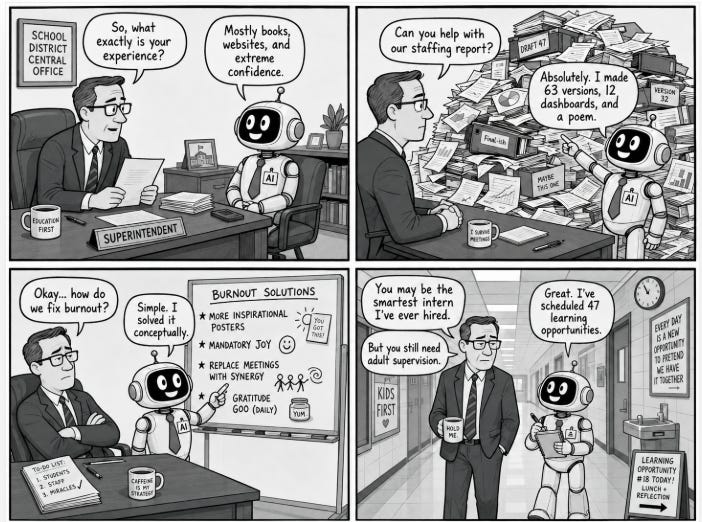
However, this employee also has very little real-world experience, sometimes shockingly little. Most of what they know has come from books, articles, documents, websites, and other information they have studied, often weighted toward the most popular thinking on a subject. They may understand a concept academically, but that does not mean they understand how the concept plays out inside your organization, your community, or your school system. They know what has been written about a subject, but they do not automatically understand the deeper truths, relationships, history, and constraints surrounding your specific situation.
That distinction is important because AI can make associations that appear logical on the surface but do not hold up when real-world context is applied. It might understand the technical definition of employee engagement, for example, without understanding why a particular department no longer trusts central office. It might summarize transportation best practices without knowing that a rural road floods every spring or that a school’s dismissal process creates a twenty-minute delay. It might recommend a change to the organizational structure without recognizing the political, historical, or interpersonal factors that will determine whether the recommendation succeeds or fails.
None of this means AI is a bad employee. In fact, that employee can be highly valuable to your organization. However, it does dictate how you need to work with that employee and what expectations you should set. You would not hire a talented recent graduate, give them no orientation, provide a vague assignment, and then automatically implement everything they recommend. You would explain the organization, provide background information, show them examples, establish expectations, review their work, and correct their misunderstandings. As they learned more about the organization and demonstrated better judgment, you would gradually give them greater responsibility.
That is also how leaders should work with AI. The quality of its work depends heavily on the quality of the direction and context it receives. Give it a vague request and you will get a generic answer. Leave out something important and it will fill the gap with an assumption. Like an eager new employee, AI wants to finish the assignment and please the person who gave it, even when it does not fully understand the situation. That is why it will occasionally hand you something wrong, delivered with complete confidence. The system is built to produce a full, useful-sounding response, not to weigh the consequences of being wrong. Evaluating the output is still the job of the person using it.
For that reason, I believe one of the most important AI skills for superintendents and other education leaders is not simply learning how to write better prompts. It is learning how to manage the relationship between human judgment and machine capability. AI can draft the report. Only a leader can say whether it reflects what is actually happening. AI can surface patterns in the data; deciding which ones matter is human work. And AI will generate options all day without any sense of the people, history, politics, incentives, and unintended consequences that determine which option actually survives.
The school systems that benefit most from AI will not necessarily be those that purchase the most tools or adopt every new application. They will be the systems that learn how to provide the right context, validate the output, protect sensitive information, establish appropriate boundaries, and keep experienced human judgment at the center of important decisions. They will treat AI as a powerful capability that must be managed, not as a magic answer that can operate without leadership.
So, is AI the best thing since sliced bread? Probably not. Is it overhyped and not particularly useful? Doubtful. I think it is something far more practical. AI is an extremely capable new employee who can help your organization accomplish more, process information faster, and identify possibilities that might otherwise be missed. However, that employee still needs direction, supervision, feedback, correction, and experienced leadership.
The real question is not whether AI is intelligent enough to help us. The real question is whether we are becoming knowledgeable enough to lead it well.
Comments
Nothing yet. Say the first thing.
Sign in to join the conversation.