
This cycle, the mail in Jefferson County, Colorado included a federal letter with a number in it: more than 90 million dollars, the funding attached to the district’s 74,000 students. The letter says the district’s policies violate Title IX. The district says those same policies are required by Colorado law.
That is this cycle in one image. Arguments districts had watched from a distance arrived as letters, effective dates, funding clocks, and final paychecks. Some are still in court while they are being enforced.
The two weeks around July 1 were dense with conversion. Device statutes became enforceable in a half-dozen states. Grant-funded staff in 32 Illinois school buildings worked their last day. The Supreme Court settled one Title IX question and left others open. The FCC opened a review touching the internet funding nearly every district receives. And the two datasets underneath enrollment projections, county child counts and births, both updated.
The operating task is simple: label each fall-plan assumption as settled, in motion, or frozen. Then ask whether the plan treats it that way.
Operator’s Read: Separate athletics from facilities, records, notification, and state-law conflicts.
On June 30, the Supreme Court ruled in West Virginia v. B.P.J. that states may reserve girls’ sports teams for biological females. The court was unanimous on the Title IX question, split 6 to 3 on the constitutional one, and upheld laws in West Virginia and Idaho.
The legal conclusion is narrower than the headline. The ruling is permissive, not mandatory: states and schools may draw the athletic line this way, but districts are not required to do so, though state law might. It also speaks to sports, not restroom access, records, parent notification, or classroom practice.
That is where the letters come in. The Education Department issued an enforcement action to Jefferson County over policies the district says Colorado civil rights law requires. Kansas City, Kansas received a Letter of Impasse, and the department announced with the Justice Department that enforcement will proceed, including possible court action and loss of federal funding. The Kansas City theory is novel: not disclosing a student’s transgender status to parents violates FERPA. Three other Kansas districts received warning letters.
Those theories were not settled by B.P.J. They are operating conditions now, not legal conclusions from that ruling. The same pattern is showing up in facility policy: on July 1, a California statute took effect requiring all-gender restrooms in schools, while a federal investigation in Denver treats a similar facility as a violation.
Operating Move: Do not manage this internally as one “Title IX issue.” Athletics may be settled; records, facilities, notification, and conflicting state/federal obligations remain in motion. General counsel, student services, athletics, HR, and communications should map the exposure before a letter arrives with the district’s name on it.
Operator’s Read: Treat competitive grant positions as in motion until cash and availability are clear.
On June 30, four education organizations filed suit in federal court in Massachusetts over roughly 1.9 billion dollars in appropriated education funds the Office of Management and Budget has not released, including research and statistics work, comprehensive centers, and innovation grants. Of the 235 million dollars Congress appropriated in February for Education Innovation and Research, 65 thousand dollars has been made available.
The dates matter as much as the dollars. Portions of the withheld funds expire beginning September 30. Funds not released by their dates lapse back to the Treasury. The withholding does not have to be ruled illegal to constrain districts. It only has to outlast the clock.
A second mechanism showed up in another case. In a June court filing reported by Education Week, the administration signaled it intends to re-cancel more than 200 court-protected school mental health grants using a different regulation. Winning under one authority does not prevent cancellation under another.
Meanwhile, the first-round layoffs landed. As of July 1, more than 200 school employees across 32 Illinois buildings are out of work, many of them community schools coordinators. One quieter signal belongs here: there has been no reported repeat of last July’s withholding of the roughly 20 billion dollars in formula funds that flow to states on July 1. The competitive grant money is the story this year.
Operating Move: Federal grants now carry three risks together: withholding, expiration, and re-cancellation after a court win. Any FY27 position or program built on a competitive federal grant needs a contingency line.
Operator’s Read: Treat health benefits as a structural trend line, not an annual renewal problem.
The first national study of what health benefits are doing to district budgets was released on June 22 by AASA and ASBO International, drawing on 767 superintendents and school business officials across 42 states. Ninety-eight percent said rising health care costs are having a measurable budget impact. The drivers they named were prescription drugs, high-cost claims, and specialty medications such as GLP-1s.
The coping mechanisms are the signal: 52 percent have pulled from reserves; 46 percent have modified benefits packages; about a third have delayed hiring; and 31 percent have deferred technology or instructional materials purchases.
Each is a one-time answer to a recurring bill. Reserves spend once. Deferred purchases return. A modified benefits package walks into bargaining, where it becomes someone else’s headline.
There is also a quiet split in who pays how. Urban districts leaned toward trimming coverage generosity. Rural and suburban districts leaned toward deferring instructional investment instead. Same bill, different students absorbing it.
Operating Move: Cabinet should name the benefits trend line by September, not discover it in February. A reserve draw may balance one year while weakening the next.
Share The Superintendent’s Field Guide
Operator’s Read: Citizenship is legally clearer; enrollment confidence remains an operating risk.
On June 30, the Supreme Court struck down the executive order that sought to end birthright citizenship, ruling 6 to 3 that children born in the United States are citizens at birth, regardless of their parents’ status.
For schools, this removes a large question mark. Roughly 4.6 million U.S.-born children under 18 live with a parent who lacks legal status, by one recent estimate. That specific uncertainty is now resolved.
The legal conclusion and the operating condition are different. Citizenship at birth is settled. Enrollment suppression, however, did not come from this order alone. It came from enforcement activity, and spring reporting indicates that activity is shifting toward status-based targeting rather than receding.
In other words, the fear is redistributing, not resolving. A family with a U.S.-born kindergartner and an older sibling on temporary status did not stop worrying on June 30. They changed what they worry about.
Operating Move: Student services, enrollment teams, and family liaisons have something concrete and true to say to hesitant families, but counsel and communications should review registration language before it goes out. Enrollment projections in immigrant-heavy communities should treat the ruling as a partial correction, not a reversal.
Operator’s Read: Screen-time policy now has enforcement dates and a federal funding lever.
On June 25, the FCC voted to open one of the broadest E-Rate reviews in years. E-Rate discounts internet and network costs for nearly every district, and the questions go well past mechanics: whether filtering should extend to students’ personal devices on school networks; whether parents should be able to opt out of screen-based instruction; and whether the commission’s 2011 finding that social media is not inherently harmful to minors should be revisited.
A companion proposal would tighten administration, including registration requirements for consultants and a ban on percentage-based consultant fees. AASA’s read is blunt: the rulemaking puts E-Rate at risk.
This lands as the state-level version becomes enforceable. On July 1, bell-to-bell device bans and phone-policy deadlines took effect in Georgia, Indiana, California, and other states, with roughly three dozen states now restricting student devices by statute or policy. The newer statutes reach smartwatches, tablets, and headphones, not just phones.
Operating Move: Technology directors, CFOs, principals, curriculum leaders, and board-policy teams need this on the same agenda. The proceeding could rewrite screen-time expectations and restructure the funding stream the network runs on.
Operator’s Read: AI governance is arriving through tenancy settings, not procurement.
At the ISTE conference in Orlando, held June 28 through July 1, Google announced that Classroom is coming to Gemini, its AI assistant. The pitch is that AI will work from a teacher’s actual class context: rosters, curriculum, and student work. Google says adaptive study tools for students on school accounts are coming soon, alongside new distraction-control features for Chromebooks and free AI training for every educator in the country.
No board voted on any of this. That is the signal.
A feature update does not get a meeting on the calendar. When AI arrives inside a platform the district already licenses, privacy review, bias questions, and the instructional case default to whatever the settings are on the day the feature ships. The training offer works the same way: when the vendor supplies professional development for free, the vendor’s framing becomes the default understanding of what the tool is for.
AI has appeared in this brief three cycles running: decisions ahead of policy, organized pushback, then a purchased tool that sat unused. This cycle it stopped asking. The question is no longer whether a tool gets adopted or used. It is whether anyone in the building is deciding.
Operating Move: Before school opens, the technology director should own tenancy settings, counsel should own FERPA and state privacy review, curriculum should own instructional use, and HR or professional learning should own vendor-led training.
Operator’s Read: Check facilities assumptions against current child counts and the birth pipeline.
The two datasets under enrollment projections updated this cycle, and they point the same direction.
On June 25, the Census Bureau released its Vintage 2025 county population estimates, the first to carry full age detail from the 2020 Census forward. The South was the only region to grow across every age group, while child populations declined across the Northeast, Midwest, and West. Within metro areas, outlying counties, the exurbs, grew at more than double the national rate.
Five days later, the CDC posted its first quarterly read on 2026 births. The general fertility rate for the first quarter came in at 53 births per 1,000 women of childbearing age, continuing the record-low trend. The declines are no longer concentrated among teenagers. Rates fell year over year for women in their twenties, the cohorts that produce most of the kindergartners of the early 2030s.
Put the two together and the direction is set. The children who will fill classrooms in the early 2030s are being born now, in smaller numbers, and in different counties than the ones where most buildings stand. Exurban growth counties have the opposite problem: capacity arriving slower than families.
One caution: the federal government has spent the past year encouraging Americans to have more children, and the birth numbers kept falling. A capital plan should not count on policy turning the birth rate around.
Operating Move: Before any boundary, bond, or facilities decision, the COO, CFO, demographer, facilities team, and board-policy lead should ask whether the plan still matches the county child-count map and the birth pipeline for 2031-2032.
Operator’s Read: Closure planning is now a governance-control decision, not only facilities.
Closing schools is becoming a question of when, not if, even where the levy passes. The harder question is who controls the decision.
Nevada offers the clearest inside view. Douglas County, a 4,500-student district that has lost 17.4 percent of its enrollment since 2016, closed a school this summer for the first time in 18 years. The district is on state fiscal watch with a 5.4 million dollar deficit, and its board voted in June to begin consolidating two more schools. The stated reason: avoid receivership. Close buildings while the board still chooses which ones, or continue until the state makes the choice.
The formula trap is blunt: under Nevada’s funding model, losing 250 students in a year can cost the district roughly 2.5 million dollars.
Clark County, down from a peak of 320,000 students to about 280,000, is taking the long route. A draft facilities master plan covering its 400 buildings maps closures, rebuilds, and repurposing, with closures beginning around 2030. Plan now, close later, and control the sequence.
One line from the same reporting deserves its own paragraph. Washoe County, the state’s second-largest district, is now smaller than Nevada’s charter school authority, roughly 59,000 students to 60,000.
Detroit is running a third playbook: publishing the per-school math, building by building, revenue against cost against utilization, for 19 small schools it is monitoring, while slating almost none of them to close. The math is public. The decision is explicit. The community sees it coming years away.
Operating Move: The superintendent, CFO, COO, facilities team, and board need a timeline before the deficit creates one. Districts that plan early, like Clark County’s 2030 sequencing, keep the choice of which schools, when, and on whose terms.
This cycle, the forces converted.
An org-chart story became enforcement letters with dollar figures. A budget dispute became a lawsuit with expiration dates. A screens debate became statutes with effective dates and a federal docket number. Policy positions districts had been tracking as news became things with their name on them.
In Ahead of the Curve terms, this is what the move from watching a system to operating inside one feels like. The signals did not get louder. They got closer.
The practical move is to stop treating all assumptions as equally stable. Use the fall plan as the worksheet:
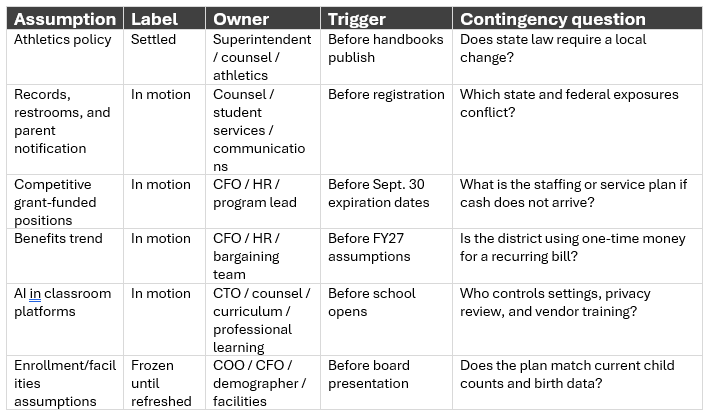
Most of what changed was already true. It just became enforceable. The calmest cabinets will be the ones that update their labels now, in July, while the labels are still cheap to change.
Comments
Nothing yet. Say the first thing.
Sign in to join the conversation.