
— Dr. Andrew Mellin, VP and Chief Medical Information Officer at Surescripts
Two weeks ago, Anthropic announced Claude for Healthcare. Buried in the announcement was something that should matter to every physician drowning in prior authorizations: a pre-built “prior authorization review” skill.
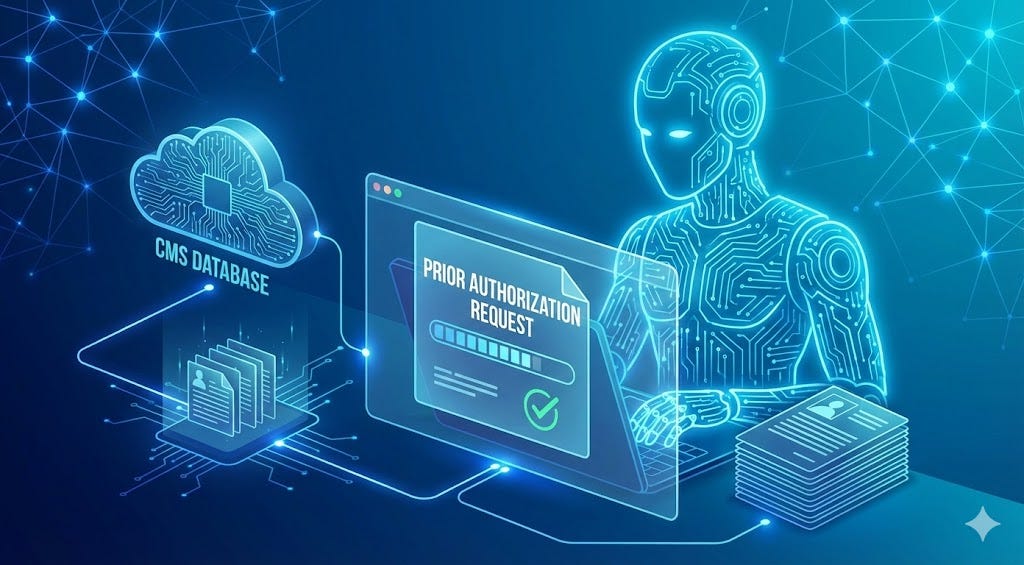
The skill can pull coverage requirements directly from CMS databases, cross-reference clinical criteria against patient records, and propose determinations with supporting documentation. It’s a template that healthcare organizations can customize to their specific workflows.
This isn’t a chatbot that answers questions about prior auths. It’s an agent that can actually do prior auth work.
Meanwhile, an open-source project called Clawdbot has exploded from obscurity to 40,000+ GitHub stars in under three weeks. It’s showing what becomes possible when AI stops waiting for you to visit a website and starts living in your existing tools.
These two developments point to the same future: AI that works in the background, handles administrative tasks autonomously, and reaches out to you when it needs input—rather than the other way around.
Here’s the fundamental limitation of ChatGPT, Claude, and every other AI tool most physicians have tried: you have to go to them.
You open a browser tab. You type a question. You get an answer. You close the tab.
This is useful, but it’s not transformative. It’s a slightly better search engine with a conversation interface.
Background agents are different. They run continuously on your computer or in the cloud. They can connect to your email, calendar, and messaging apps. They can monitor for specific events and take action without being prompted. They can message you first.
Think about the difference between checking a website for flight delays versus having a colleague who texts you: “Your 3pm flight is delayed two hours. I’ve already rebooked you on the 4:30pm. Want me to notify your dinner meeting?”
That’s the shift we’re talking about.
Clawdbot is an open-source AI assistant created by Peter Steinberger, an Austrian developer. He built it initially as a personal assistant for himself, then open-sourced the code in early January 2026.
The response was explosive. Within three weeks, the project accumulated over 40,000 GitHub stars and an active Discord community of thousands of contributors.
What makes it different from ChatGPT or Claude?
Clawdbot runs on your own computer and communicates through the messaging apps you already use: WhatsApp, Telegram, Slack, Discord, iMessage. You don’t visit a website. You text it. It texts you back. It can also text you first.
Users are automating things like: morning briefings that summarize their email and calendar, contextual reminders based on location and time, flight check-ins without any manual intervention, and inbox management that handles routine messages automatically.
One user described rebuilding their entire website via Telegram while watching Netflix in bed [source].
The project demonstrates something important: the technical pieces for always-on AI assistants exist today and people are using them right now.
Anthropic’s Claude for Healthcare announcement on January 11th included several features relevant to practicing physicians.
The platform now connects directly to the CMS Coverage Database, including both Local and National Coverage Determinations. It can access ICD-10 codes for medical coding and billing. It connects to PubMed for literature searches with proper citations.
But the prior authorization skill is what caught my attention.
Prior auth reviews require working across fragmented information sources: coverage requirements that vary by payer, clinical guidelines, patient records, and appeal documentation. The process is time-consuming, frustrating, and often feels designed to deny care rather than facilitate it.
Anthropic’s skill template can pull coverage requirements from CMS or custom policies, check clinical criteria against patient records in a HIPAA-compliant environment, and propose a determination with supporting materials for human review.
Combine what Clawdbot demonstrates with what Anthropic is building, and you can see where this is heading.
Imagine an AI that monitors your EHR inbox for prior authorization denials. When one arrives, it automatically pulls the relevant patient records, cross-references the denial reason against CMS coverage criteria, identifies the documentation gap, and drafts an appeal letter. It then sends you a message: “Prior auth denied for Mrs. Johnson’s rituximab. I’ve drafted an appeal based on her inadequate response to two DMARDs. Review attached. Want me to submit?”
Or imagine it monitoring for lab results that require follow-up, drafting patient messages for routine results, flagging abnormals that need your attention, and scheduling follow-up appointments based on your protocols.
The individual tech components to do this exist today. What’s missing is the integration layer that connects them to clinical workflows and EHR systems.
The question isn’t whether AI will handle prior authorizations. It’s when, and which organizations will implement it first.
If you’re in a position to influence IT decisions at your organization, these announcements give you leverage. The technical barriers are down. The compliance frameworks exist. The question is no longer “can we do this?” but “when will we start?”
And if the pace of the last three weeks is any indication—a personal project becoming a 40,000+-star phenomenon, major AI companies racing to release healthcare-specific tools—that implementation timeline may be shorter than anyone expects.
Comments
Nothing yet. Say the first thing.
Sign in to join the conversation.