
Hi, it’s Greg and Taylor. 👋 Welcome to Supercompanies, our weekly newsletter about building the world’s most valuable companies.
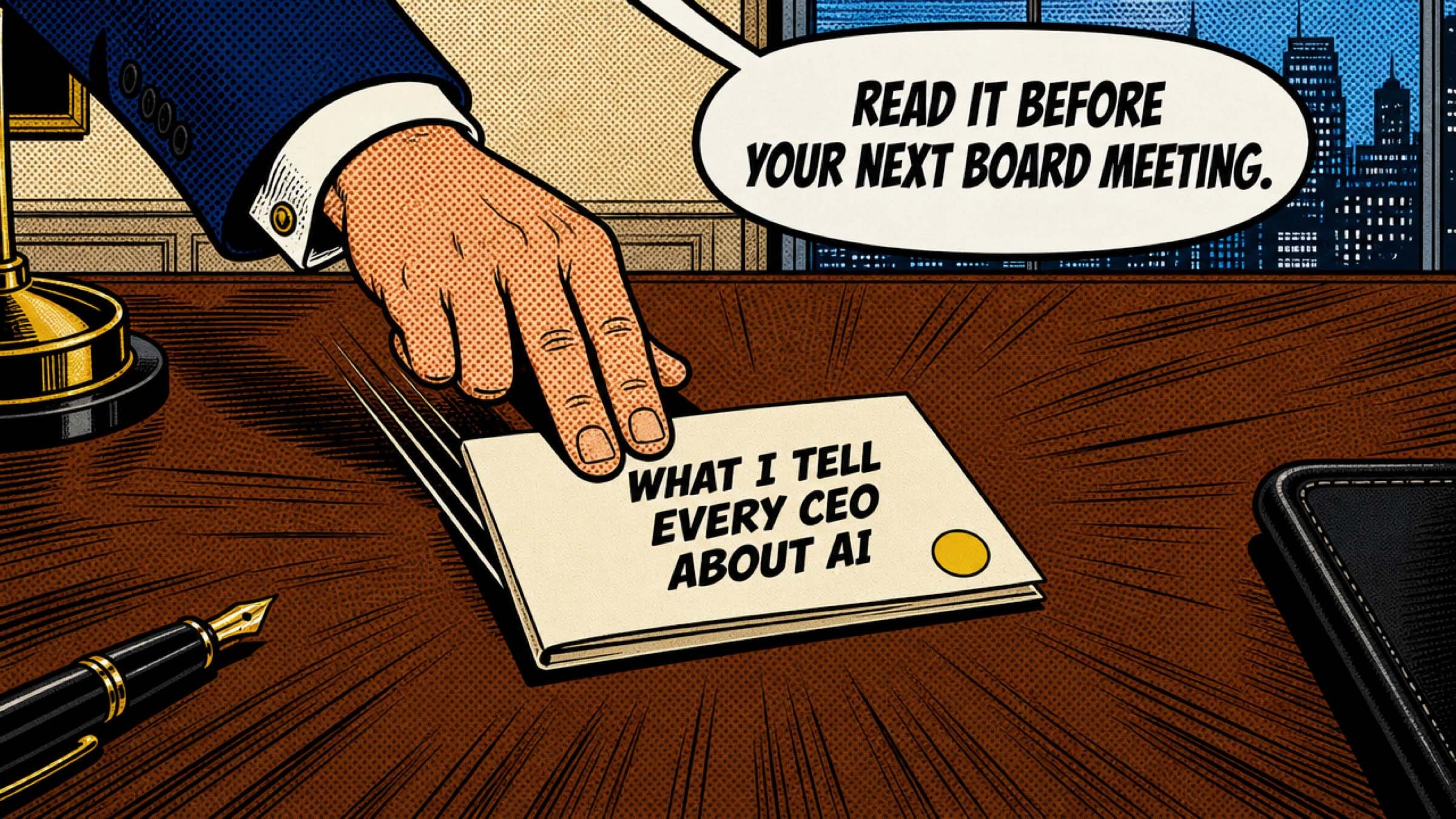
I talk to CEOs every week about AI. The conversations are remarkably similar - the same inflated expectations, frustrations, and thinning patience. Here’s the advice I find myself giving most often.
- Greg
1. You are the Head of AI.
Not literally - you will need a dedicated person for that. But you can’t outsource the conviction. If you’re constantly asking your Head of AI to “prove the ROI of AI,” you’ve tied one hand behind your back. The mindset of a supercompany CEO isn’t, “Where is the ROI?” It’s, “There’s ROI here - let’s find it.” That’s a fundamentally different starting point, and your entire organization takes its cue from which one you’re operating from.
2. Lower your near-term expectations. Raise your medium-term ones.
Right now, every CEO seems to have collective amnesia about the take-off time for a new enterprise-wide technology. Remember your “digital transformation program?” AI is no different except the pace is faster, the breadth is wider, and the upfront uncertainty is higher. And the hype is out of control. As the first head of AI for your firm, show patience and restraint over the next 12 months, then expect more once your AI investments start to kick in.
3. You need to build your own agents.
I am CEO of an AI company and I waited too long to build my own agents. Now I have a bunch running (and breaking) and a much better appreciation of the value and cost of getting agents to actually do work.
If you haven’t personally struggled through building an agent (like my current favorite, the AI Chief of Staff), you don’t understand what you’re asking of your people, you don’t really grasp the potential - so you come across as a well-intentioned cheerleader at best. And if you can’t figure it out, get the smart AI kid in the office to sit with you for an hour every week for a month. Yes, you need to do this - just spend an hour less in the golf simulator.
4. You’re dramatically under-investing in the transformation layer.
A lot of effort and money has been spent over the last 2 years getting ready for AI - the AI tech stack. But the final layer in that stack is missing or under-funded, and that’s the last mile to AI ROI. Do you really think that employees, who have been told for three years that AI will take their jobs, are all of a sudden going to adopt these tools after you rave about Claude at the company All Hands? Get real, and invest in the hard part - the change management.
5. Don’t blame the LLM.
When adoption and time-to-value is slow, the instinct has been to switch platforms. ChatGPT is flatlining - let’s get Claude in here instead (see Anthropic’s trailing 12-month revenue growth). That almost never fixes the problem. The issue is usually lack of connected data, no training and change management, or the lack of “out of the box” use cases or agents. Switching LLMs just resets the clock on adoption without addressing any of the real blockers, so stop falling for the shiny new AI.
6. Don’t deploy too much AI.
Three LLMs is too many right now for most organizations. In large enterprises, we often see Microsoft Copilot, plus ChatGPT AND Claude, and maybe some Gemini thrown in for good luck. I get it - offer choice, show your commitment to giving employees the best tools, etc. But at this stage, you will confuse most of your workforce. Pick one primary platform, go deep, and get your people genuinely proficient on it before adding complexity. Every additional AI tool fragments adoption, splits your training efforts, and makes the enablement challenge harder. Depth beats breadth at this stage.
7. Avoid the 12 month stall.
Year one was exciting - you rolled out the tools, ran pilots, had some early wins, and a handful of power users emerged. Maybe you even talked up all this with your board. Now you’re 12 to 18 months in and the momentum has flatlined, either because your expectations were too high in the first place, your transformation program wasn’t strong enough, or this stuff just takes time. You’ll be tempted to get skeptical, de-invest or tune out. Instead, get specific: which teams are stuck, what’s blocking them, and what would it take to move them from experimenting to actually working differently?
8. Pick a team and 10x the investment.
Most AI workforce enablement is a mile wide and an inch deep. That’s a good place to start but you also want a “lighthouse team” where the AI transformation happens faster, with greater intensity (and results). So if you’re spending $50 a month per employee on AI across the org, pick one group and spend $500 - and make it happen much faster. The team should be big enough to be meaningful and small enough to be manageable, and with a leader that will go all in. It does not matter if it’s functional, geographic or a business unit. What matters is that in 6 months, the rest of the organization can see that this team now operates AI-first.
9. AI token-maxxing is stupid. So is AI token-minimizing.
Many CEOs want a single, CFO-proof, org-wide ROI number. It doesn’t exist. And a bunch of MBB consultants won’t help. Instead: make some assumptions on org-wide productivity gains, invest in a serious transformation program, and accept that you won’t have the full picture for a year or two (sooner for smaller organizations). That’s what you are paid to do - make the big bets. Compare your inference costs to headcount costs. In that context, the numbers stop looking scary. And a hiring freeze usually helps your managers take this transformation a little more seriously.
10. War-game the AI-native competitor.
Most CEOs think about the AI threat as a product/service disruption but the bigger threat is a business model disruption. What happens when an AI-native competitor can deliver what you charge $50,000 for at $5,000 because their cost structure is fundamentally different? That’s not a product problem - that’s an existential one. Run this exercise with your leadership team: ask them how they would respond if an AI-native competitor offered a better product/service inside a pricing/value model that your customers could not resist. It might change how urgently you approach your own AI transformation.
Have a great week,
Greg and Taylor
No posts
Comments
Nothing yet. Say the first thing.
Sign in to join the conversation.