
So, I’m on the job market. 62 applications sent so far. Only one interview, and I’ve lost count of how many rejection letters.
Education is always a tough market, but this administration has brought it to a new low. Enrollment is down, funding has been cut across the board, academics are exhausted and fearful, courses are being cancelled and banned. Not only do people no longer value education, but they don’t really trust it. People in power don’t want you to be educated, because then you’ll figure out what they’re up to. So, they make sure that education is perceived as superfluous, nefarious, pretentious, uncool.
When being given advice on how to tailor my CV to these new, horrible times, I was told to remove all the references to D.E.I. terms like “gender” and “race” and “feminism” and “intersectionality.” Welp, if you know me at all by now, you know that all of those things are literally what I DO. I mean, yes, social and political philosophy, too, and an indefensible love of Nietzsche, but I’ve published a lot of work on D.E.I.-related topics. You take that off your CV, it looks like you haven’t published anything. And then you probably get a lot of rejection letters.
More importantly, some of the most essential work we can do in this world is educating for justice, and that is what I’ve been doing, and if I can’t do that anymore, if WE can’t do that anymore… entire histories fall, voices get erased. This is, of course, exactly what they want.
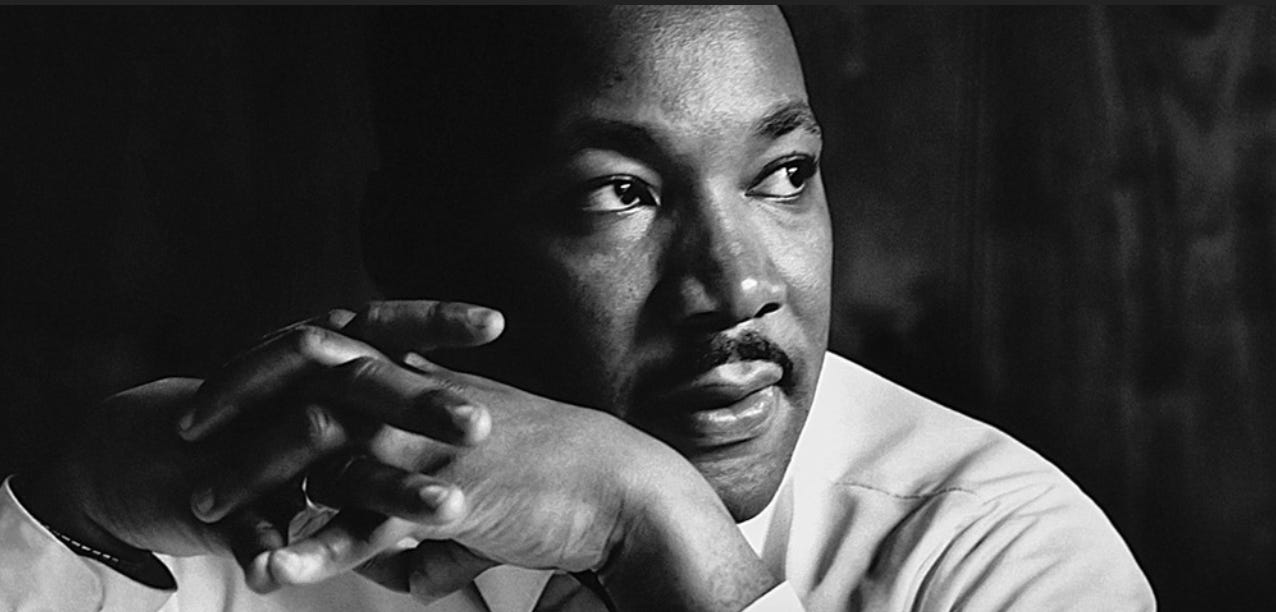
(pictured: Reverend Dr. Martin Luther King, Jr., contemplative, hands entwined)
I’m thinking about this on MLK Day for a reason. Reverend Dr. Martin Luther King, Jr.’s birthday is actually on the 15th, but we celebrate it on the third Monday of January. For now. This might be the last one we have.
I teach Dr. King often. My favorite will always be “A Letter from Birmingham Jail” (cuz political philosopher), but I also adore “Loving Your Enemies,” which was a sermon he gave in 1957. Dr. King and I disagree on a very foundational point. I do not believe that gods are necessary for love or for justice or for morality. I believe that thinking (the Socratic kind) is necessary for those things. And gods and thinking are often antithetical. And though I find religion monstrous, it is an excellent tool to think against.
In “LovingYour Enemies,” Dr. King suggests that God is in all of us, and because he believes that, he can advise us to find God in everyone, even our enemies, and that will help us to love them. New age movements do this same thing in a different way, suggesting that love and hate are just ego, and that “true love” can be felt when we understand everyone as a part of the same consciousness. (Eckhart Tolle is famous for this.) I agree that love and hate are both egoic responses, but nevertheless, I think Dr. King would “love” the man who is trying to erase his legacy. And the legacy of all the other people who fight for historically-neglected voices, narratives, and freedoms. So what good is love doing here?
Though Dr. King promotes critical thinking, he disconnects thinking from love. Loving someone because you believe you’re connected to them through some universal god is kind of the opposite of thinking. Thinking, then, can create something far stronger than love. It isn’t necessary to love someone in order to respect them as fellow human beings. Believing this makes love far too partial, far too demanding, oftentimes far too religious, and most people are incapable of it. (I’m working on publishing a piece on this right now; more soon.) But according to Hannah Arendt, we are all capable of thinking, and hence, of morality. And in this way, we can learn to respect other people, to endeavor never to harm them. This is much more important than loving them.
But for those who abdicate thinking, and hence, morality, and who intentionally endeavor to harm others…? We owe them neither love nor respect. If we hate them, it harms us, so don’t hate them, if you can help it, I guess (maybe depends on the day), but you certainly don’t have to love them.
In “The Purpose of Education,” Dr. King worries about the role of institutions of higher education, stating that people misunderstand the purpose of an education - which is to foster critical thinking and to build character. He’s right that many institutions, and even many educators themselves, have lost sight of this imperative. But you wanna know who most certainly has not? Those of us teaching gender, race, feminism, intersectionality, etc.. No one is more aware of the purpose of education than we are. And without this imperative, yes, education can become what Dr. King feared - a mode of exploitation, a means to an end, and/or a method of promoting the exact opposite of thinking - unthinking.
“To save man from the morass of propaganda, in my opinion, is one of the chief aims of education. Education must enable one to sift and weigh evidence, to discern the true from the false, the real from the unreal, and the facts from the fiction,” writes Dr. King. This is education’s purpose, and if we devalue this, we create a society of people who will fall for anything, and who will perceive the person who disagrees with them as their enemy. And trust me, they will not love that enemy.
And they will be oblivious to the systems in place that brainwash them into hate and division. Because education - real education, the kind Dr. King promoted, which fosters critical thinking - is under attack. And it’s losing people like me, who really wanted to make the world better through educating, but who now have no pathway by which to do so.
So, it turns out, the PhD that I nearly killed myself to achieve may not actually get me anywhere. That’s why I spent this past year writing a contemporary romance novel. It was an escape, yes, and the most joyful thing I’ve ever done, but it’s also a back-up. I feel more likely to have success as a writer than as a teacher. What a weird world. Thank you for weathering it with me, friends.
With love, Your Friendly Neighborhood Philosopher
Comments
Nothing yet. Say the first thing.
Sign in to join the conversation.