
When the Sunday Assembly (SA) movement started in London in 2013, we were unusual in the spectrum of humanist, atheist and alternative spiritual and community groups. While we were clearly offering an alternative - a very real and practical Sunday morning alternative - to church, we were not ‘anti-religion’. In a BBC interview after only the second London assembly, SA co-founder Sanderson Jones said that
“Of course we are not taking the mickey out of the church. If anything, we are trying to build upon it.”
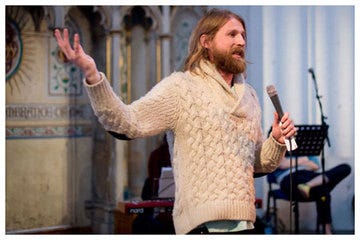
This was a clear and ambitious stance, and continues to be so. Twenty years ago I was occasionally part of a humanist group consisting of grumpy old white people who spent their Friday evenings complaining about God. We used to observe that arch-atheist Richard Dawkins spent more time with God than the Pope did!
Sunday Assembly has always been about moving past the futile ‘does God exist or not?’ deadlock and offering a way for people to come together under the motto Live Better, Help Often, Wonder More. This is a great rallying call, by the way, and there are plenty of parallels in the religious world such as ‘Self, Service, Spirituality’. Sunday Assembly felt a bit different then to the more established humanist organisations, and so we didn’t engage much with them early on.
It seems to me that both groups have moved on a little in the intervening decade. Sunday Assembly now goes by the term ‘secular congregation’ rather than ‘atheist church’ (even if the latter did get a lot of press attention in the early days). Humanist groups too seem to have, at least in part, gotten over their deistic focus; the American Humanist Association now carries the strapline Good Without A God. (I did say mostly…) . You don’t have to be a humanist to join in with Sunday Assembly - but we share a very great deal of common ground.

In the last year or two we have been begun to connect with some of these other organisations and are finding that, although there are distinctions, we definitely have common cause. At a local level, Sunday Assemblies in places like Fort Worth TX and Las Vegas NV have been making connections with branches of the American Humanist Association and promoting each other’s events. At the national level, many American assemblies are now listed with AHA local chapters on their website.
Our common cause may be extending. In a recent newsletter from the American Humanist Association, AHA Organizing Director Jake Via wrote about attending an event with people of various faith backgrounds. He went to an Interfaith America Civic Pluralism Fellowship, concerned about how he would be received. Instead, he heard from people of various faiths who all felt under attack by political extremism masquerading as Christianity. He writes:
“Two weeks ago, I had the opportunity to attend the kick-off of an Interfaith America Civic Pluralism Fellowship. I’d be lying if I said I wasn’t apprehensive. Even as individual humanists, we seem to disagree on partnering with theists, for various reasons.
And I get it. Many of us hold a lot of trauma even decades after we left our past beliefs behind, myself included. In addition, we all know the statistics on how distrusted atheists are. So it was with great trepidation that I entered that space.
Do you know what I found? A few dozen frustrated but motivated people of various faith backgrounds who all felt like their community was under attack by the same thing we are: a brand of political extremism masquerading as Christianity.
That realization forced me to confront my own walls. Like many of us, I had built them a long time ago—partly from bias, partly to protect myself as I deconstructed, but mostly from a deep-seated, rational response to rejection. I’d forgotten they were even there. It’s way past time for what remains of those walls to go.
Because we are not alone. There are millions of our fellow Americans who are lonely, afraid, and looking to connect—not on principles of belief, but on principles of goodness, kindness, and creating communities where every need is met and no one goes to sleep afraid.
As part of the fellowship, I’ll be working on a “BridgeBuilders Playbook” with several other fellows from other faith backgrounds. The goal is to outline how we can build joint service projects locally with communities of different beliefs.
This is where you come in:
Are you already doing this work?
Do you have ideas, successes, or failures to share?
If you do, please hit reply (to jvia@americanhumanist.org) and let me know so I can add your wisdom to the playbook.
This fellowship gave me hope. Tuesday’s elections added to that hope. And every email from each of you on how humanism is being put into action—and how our communities are supporting each other—pours rocket fuel on that flame. Thank you for being you. I’m damn proud to represent us in the Interfaith America space.
Working with sympathetic church organisations is nothing new for Sunday Assembly. From the earliest days, Sunday Assembly chapters have been helping out at church-led soup kitchens, packing parcels for the homeless and serving in homeless shelters. Indeed, we like to co-operate with churches at this level, as it allows us to get into conversations with their congregation members about how being religious is not a necessary part of being a good person. One of our most popular T-shirts proclaims that ‘Good is great’.

So here is an opportunity to extend this work from charitable goals to something more fundamental: wresting back the good (in community, inclusion and solidarity) from those who would manipulate it to divide, exclude and attack our fellow people.
If this resonates with you, find your local Sunday Assembly on our online map. If there isn’t one (yet), maybe you’d like to start one? Look at our start-up guide. Or (if you are in the USA) check out the American Humanist Association chapter links. There is also Humanists UK on the other side of the pond.
Please share this Substack newsletter with those who you think may share our (and your) ideals. It’s free to subscribe.
No posts
Comments
Nothing yet. Say the first thing.
Sign in to join the conversation.