
Before SunDAO, I spent years as the Ecosystem Projects & Funding Lead at the Interchain Foundation. I managed a $40M treasury supporting 25+ teams building across the Cosmos ecosystem.
That job taught me more about what makes blockchain projects succeed or fail than any investing masterclass ever could. I wasn’t evaluating deals from the outside - I was funding them, working with the teams, watching the ones that thrived and the ones that didn’t, and trying to figure out the difference.
Here’s what I took away - and how it directly shapes how SunDAO evaluates deals today.
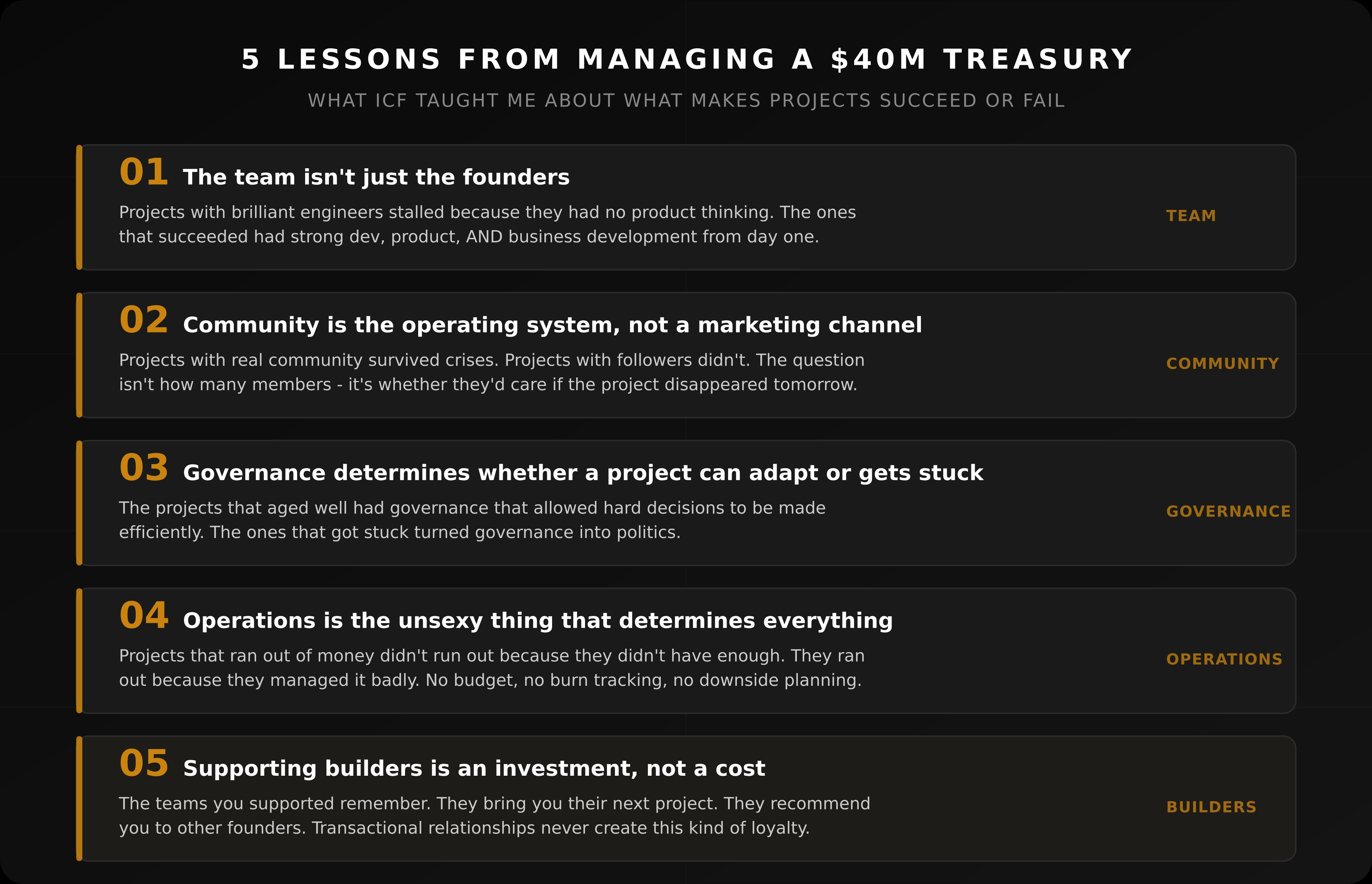
When you fund 25+ projects, you start seeing patterns in how teams are built. The ones that succeed almost always have the same structural pieces in place, even if they look different on the surface.
A strong software development team is the obvious starting point - you need people who can ship robust code, manage technical debt, and keep up with how fast this space moves. But I watched projects with brilliant engineers stall because they had no product thinking. Nobody was doing user research. Nobody was asking whether what they were building actually solved a problem someone cared about.
The projects that surprised me were the ones where the product team was empowered to make decisions. Not just executing a spec, but actively running experiments, testing with users, iterating based on what they learned. The difference between a project that ships features and a project that ships solutions is usually a product team that’s been given real authority.
And then there’s business development. I saw technically excellent projects die quietly because they never figured out distribution. They built something good and waited for the world to notice. It doesn’t work that way. The projects that grew had someone - or a team - actively building partnerships, working on tokenomics, thinking about user acquisition from day one. Not after the product launched. From the beginning.
At SunDAO, when we evaluate a deal, I look at the team composition before I look at the technology. If the founding team is three engineers with no product or BD function, I already know what’s going to happen. The code will be solid and nobody will use it.
This one took me a while to fully understand.
In traditional venture, “community” means social media followers and Discord members. In blockchain, community is the operating system. It’s your validators. Your developers. Your governance participants. Your token holders who actually care about the protocol’s direction.
I managed or interacted with community across multiple channels at ICF - leadership communications, moderation, guidelines, support systems for builders and token holders. The projects with strong communities didn’t just grow faster. They survived crises that would have killed projects without that foundation. When something went wrong - a bug, a governance dispute, a market crash - the community either rallied around the project or walked away. The ones with real community rallied. The ones with followers walked.
This is why SunDAO itself is built as a DAO and not a traditional fund. We believe the model we invest through should reflect the model we invest in. Our members aren’t passive LPs. They source deals, evaluate them, vote on them, and invest alongside each other. That’s community in the structural sense, not the marketing sense.
When I evaluate a startup’s community strategy now, I’m not counting Discord members. I’m asking: do these users actually care if this project disappears tomorrow? If the answer is no, the community is decoration.
At ICF, I saw governance from the inside. Attracting talented leaders, making strategic decisions rooted in a clear vision, managing internal processes, deploying policies for transparency. I also saw what happens when governance fails - when decision-making is unclear, when there’s no accountability, when the public doesn’t know what’s happening or why.
The blockchain projects that aged well were the ones with governance structures that allowed them to make hard decisions efficiently.
The ones that got stuck were usually projects where governance became political. Where decisions took months because nobody had the authority to say “we’re doing this.” Where transparency was promised but never delivered.
At SunDAO, we built transparent governance into the investment process itself. Members see who voted what. Votes are visible. Reasoning is discussed in private member channels. We publish why we pass on deals.
Treasury management. Budgeting. Invoicing. Payments. HR. Legal. Admin.
Nobody wants to talk about this. Everyone wants to talk about product and technology. But I managed a $40M treasury and I can tell you: the projects that ran out of money didn’t run out because they didn’t have enough. They ran out because they managed it badly. They didn’t budget. They didn’t track burn rate. They didn’t plan for market downturns. They hired too fast and couldn’t course-correct.
Operational discipline is the least glamorous predictor of startup survival, and it’s one of the most reliable.
When SunDAO evaluates a deal, we look at how the team handles operations. Do they know their burn rate? Do they have a runway plan that accounts for a bear market? Have they thought about legal structure, compliance, token custody? These questions are boring. They’re also the difference between a team that lasts three years and a team that lasts eight months.
One of the most valuable things I did at ICF was supporting builders through funding - accelerating their projects, sponsoring promising ones, bringing them into the ecosystem.
The return on builder support was never immediate. You fund a team, they build something, maybe it works, maybe it doesn’t. But the teams you supported remember. They bring you their next project. They recommend you to other founders. They become part of your network in a way that transactional relationships never do.
This directly shaped how SunDAO treats portfolio companies. We don’t just write a check and disappear. We set up dedicated communication groups with founders. Our members actively engage - asking questions, providing technical input, making introductions. One of our portfolio companies failed last year, and the founders are giving us equity in their next project. That doesn’t happen if you’re just a line item on a cap table.
Managing a $40M treasury across 25+ teams gave me something you can’t get from reading pitch decks: pattern recognition. I know what team dysfunction looks like before the team knows it. I know what bad treasury management leads to twelve months before the money runs out. I know that the project with a mediocre pitch but a strong community will outlast the project with a brilliant pitch and no community.
These are patterns I watched play out dozens of times, with real money and real teams.
SunDAO exists because Chris and I wanted to build an investment vehicle that applies these patterns systematically. Not just our patterns - the patterns that 70+ experts bring from their own experience. A security auditor’s pattern recognition is different from mine. A validator’s is different from a VC’s. When you combine all of them on a single deal, you catch things that any individual investor would miss.
That’s the real thesis behind SunDAO. Not “collective intelligence” as a buzzword. Collective pattern recognition as a practice.
SunDAO Ventures is an investment DAO where 70+ blockchain experts collaborate on due diligence and co-invest in frontier blockchain infrastructure. Founded by former ICF Ecosystem Lead Daiana Marculescu and ICF Technical Director & BIS Managing Architect Chris Zhong.
This post is for informational purposes only and does not constitute investment advice.
No posts
Comments
Nothing yet. Say the first thing.
Sign in to join the conversation.