
Last week I called the daily practice of gratitude a defiant act of rebellion. This week, the receipts.
For most of human history, gratitude belonged to philosophers and theologians. Cicero called it the parent of all virtues. Simmel called it the moral memory of mankind. They were right, but they were reasoning from observation, not evidence. Science has only caught up to them in the last two decades, and what it has found is not soft. It is structural, measurable, and in some cases visible on a brain scan.
In 2016, a research team at Indiana University led by Prathik Kini ran a study with people already in counselling for anxiety and depression. One group was asked to do something almost embarrassingly simple: write a letter of gratitude to another person once a week, for three weeks. No new medication. No extra therapy. Just letters.
Three months later, after the letter writing had stopped, the researchers scanned everyone’s brains. The group who had written gratitude letters showed significantly different activation in the medial prefrontal cortex, the region just behind your forehead responsible for value judgement, moral reasoning and how we think about other people. The letters had stopped weeks earlier. The brain hadn’t gone back to how it was.
That is the part worth sitting with. A chemical hit fades in minutes. This didn’t. Gratitude, practised consistently, appears to leave a structural trace.
A more recent study, published this year and drawing on resting-state brain scans from 363 young adults, found something that complements this nicely. People with a stronger disposition toward gratitude showed distinctive connectivity between the amygdala, the brain’s threat detector, and the putamen, part of the reward system. That connection helped explain why grateful people reported greater emotional well-being. Two different regions of the brain, built for entirely different jobs, working together differently in people who practise gratitude. Not a metaphor. A mechanism.
That same Indiana University research programme in 2016 also produced a separate, larger study, led by Joel Wong, on close to 300 people, mostly students already seeking counselling for anxiety and depression. He split them into three groups. One wrote a letter of gratitude to someone, once a week, for three weeks. One wrote about their deepest thoughts and feelings on negative experiences. One did no writing at all.
The gratitude letter group reported significantly better mental health four to twelve weeks after the exercise ended than either of the other two groups. Wong’s team found the effect worked in four specific ways. It unshackled people from toxic emotions like resentment and bitterness. It helped even when the letter was never actually sent. The benefits took time to show up rather than arriving instantly. And it left a lasting, measurable effect on the brain.
The unsent part matters. This isn’t about needing the other person to respond, or even to know. It is about what the act of naming your gratitude, in detail, in writing, does inside you.
Wong’s researchers also noticed something in the language itself. People writing gratitude letters didn’t just use more positive words. They used fewer negative ones, and more “we” words. The shift wasn’t from bad to good so much as from isolated to connected. Which is, in miniature, the entire argument of this series.
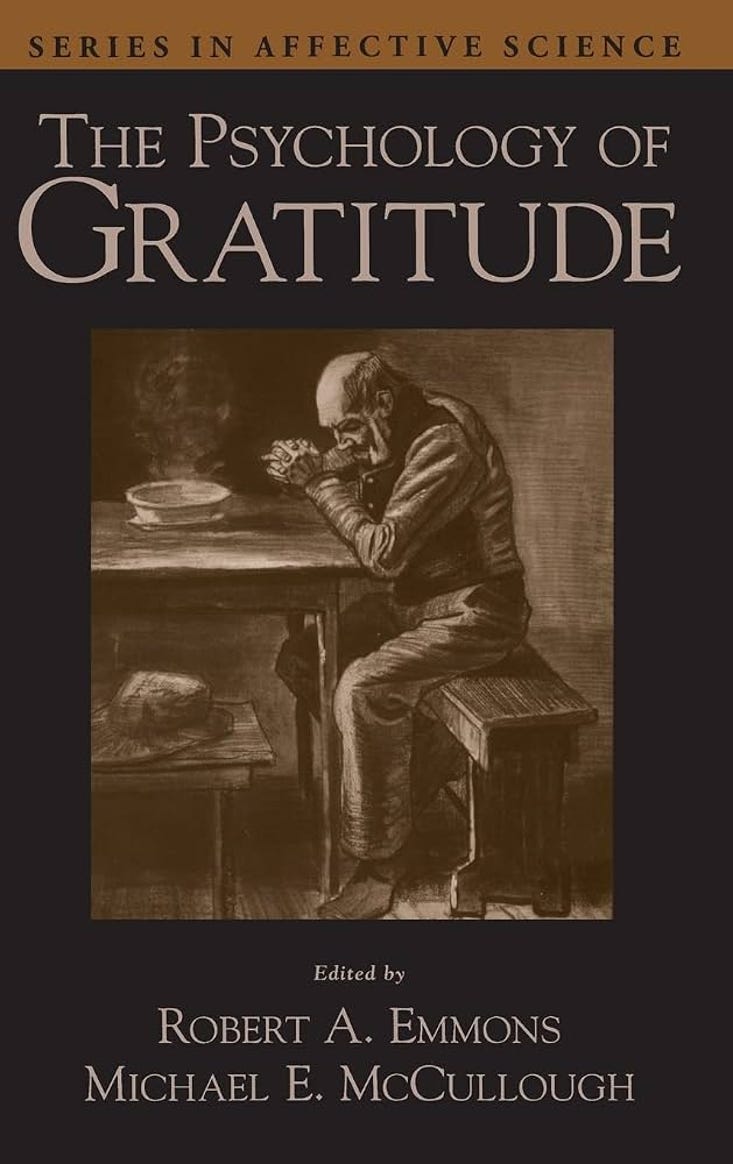
Our brains evolved to prioritise threat. Robert Emmons and Michael McCullough, the two psychologists who did more than anyone to turn gratitude into a serious field of research, point to this as the real obstacle. We are wired to notice the rustle in the bushes, not the calm of the clearing. That bias kept our ancestors alive. It also means, left unchecked, our attention defaults to scarcity, grievance and fear, which is precisely the emotional terrain that extraction culture and grievance politics both know how to farm.
Gratitude works against that wiring on purpose. Psychologist Barbara Fredrickson’s broaden-and-build theory, one of the most replicated frameworks in positive psychology, shows that positive emotions like gratitude widen what she calls our thought-action repertoire. Fear narrows your options. Gratitude broadens them. It builds, over time, real personal, cognitive and social resources you can draw on later, not just a nice moment in the present.
Worth pausing on the field this comes from. Positive psychology has real critics, and they have a point worth taking seriously. It has, at times, been used to paper over structural problems, telling people to think their way out of low wages, discrimination, or a broken system, as if the fix sits entirely inside their own head. It has been co-opted by corporate wellness programmes that would rather hand out a gratitude journal than fix the conditions making people miserable in the first place. None of that is what I’m arguing for here. This is not a case for Pollyanna thinking, for smiling through injustice, or for treating gratitude as a substitute for structural change. The research I’m drawing on measures something narrower and more useful than that: what a specific, deliberate practice does to an individual nervous system under strain. It says nothing about whether the system itself is fair. That fight still needs fighting, with clear eyes, not rose-tinted ones.
This is why I call gratitude an act of rebellion, and not just a nice habit. Grievance culture needs your brain running on threat, comparison and scarcity, because that is the wiring that keeps people angry, isolated and easy to point at a target.
It is a measurable one, built one letter, one specific moment of noticing, at a time. Protecting your own mind from that wiring is an act of self-care. Teaching the people around you to do the same is an act of resistance. That is why this is worth sharing, not just reading.
Robert Emmons at UC Davis, who has spent more than fifteen years studying this, links a consistent gratitude practice to measurably lower cortisol, the body’s primary stress hormone, commonly cited at around 23 per cent lower in people who practise gratitude regularly. Chronic elevated cortisol wears down the immune system, disrupts sleep and keeps the body in a low grade state of alarm. Bring it down, and the body gets to stand down too.
Put plainly, across physical, psychological and social measures, Emmons’ research links regular gratitude practice to people who sleep longer, get sick less often, feel more optimism and joy, and are more generous, more forgiving, and less lonely. Not one of those outcomes is trivial. Several of them are exactly what a fractured, anxious country needs more of.
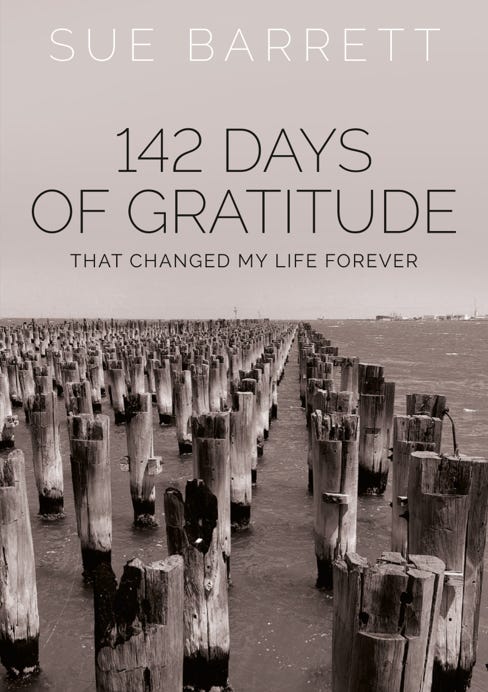
I can vouch for this part personally, and not from a study. In 2014, I started writing down three things I was grateful for every single day. I kept going for 142 days. It changed me. Not slightly, not temporarily, much better, in ways that are still with me over a decade later. It’s the reason I ended up writing an entire book about it in 2018. I’ll tell you exactly what happened, and why three things a day was the number that mattered, in Part Four.

Arthur Brooks, writing in the New York Times, made a point that will be useful for anyone who thinks gratitude only counts when it’s spontaneous: you don’t need to feel grateful first. Acting grateful, on purpose, on the days it feels forced, still produces the benefit. He suggests three ways in:
Interior gratitude, a running list of what you’re grateful for
Exterior gratitude, actually telling people, and gratitude for the small and ordinary things most of us walk straight past.
That third one matters most for what’s coming in this series. Because the next question isn’t just what gratitude does to an individual brain. It’s what a culture built on the opposite of gratitude, on manufactured scarcity, status anxiety and endless comparison, does to all of us at once. That’s Part Three.
Pick one. Try it as your own experiment, the same way the researchers did.
Write a letter of gratitude to one person who mattered to you. Not an email, not a text, an actual letter. Be specific, the exact moment, the precise thing they said or did, and what it meant to you at the time. This is Wong’s study, and I can tell you it works, because I lived it before I ever read the research.
About a year before my father died, I wrote him a six-page letter in font 10 bullet points of everything he meant to me and our family. I gave it to him. He kept it in a shoebox with the other special things that mattered to him. When he died, I used that same letter to write his eulogy, in the second person, speaking directly to him, and read it to the whole congregation. He knew what he meant to us before he died, because I had already told him.
I’ll tell that story properly in Part Four. For now, just know this: you don’t have to send it. You don’t even have to show anyone. Write it, read it back, and notice what shifts. However, if there is someone in your life you might not have forever, don’t wait permission or a research paper to tell you it’s worth sending.
Instead of a general list, pick one thing today and go deep on it. Not “my health” but the exact second your body let you do something you needed to do. Not “my colleague” but the precise sentence they used that made your day easier. This is the specificity Kini’s brain scans picked up on, vague gratitude fades, specific gratitude leaves a trace.
Tell someone directly, today, in person or by voice note, one thing they’ve done that you’re grateful for. Don’t write it, say it. This is Brooks’ exterior gratitude, and it’s the version that builds connection between two people, not just inside your own head.
Pick one ordinary thing you use without thinking, clean water, a road, a working streetlight, and spend two minutes actually thinking about the decades of decisions, labour and maintenance behind it. This is Brooks’ third strategy, gratitude for the small and overlooked, and it’s the one that trains you to see the interconnection this whole series keeps coming back to.
You don’t need to do all four. Pick the one that feels most useful today. Try it once, notice what happens, then decide if it earns a permanent place in your week.
Since I’m asking you to write one this week, it’s only fair I write mine first.
I started this Substack as an open channel, a way for me to make sense of a world that increasingly didn’t. I didn’t expect it to resonate the way it has.
When I bump into some of you in person, the first thing you often tell me is how much this is helping you too, that what I share makes the noise around us feel a little less chaotic and a little more navigable. Online, those of you who endorse and help broadcast what I write tell me I’m not just talking to myself in an empty room. And those of you who comment, under the articles themselves, questioning, adding a source I’d missed, building on something I’d only half worked out, make every newsletter richer than anything I could have written alone.
I’ve spent a lot of my life feeling like I didn’t quite fit anywhere, too curious for one room, too idealistic and too much for another, always slightly outside whatever group I was standing in. This newsletter turned out to be the room I built instead. And you’re the ones who showed up to it.
So, consider this my letter. Specific, not vague: your questions have sharpened my thinking. Your contributions, your ideas, your own hard-won wisdom, have turned this from one person’s newsletter into something closer to a shared collective knowledge resource, richer than anything I could have built alone. Your encouragement has kept me writing on the weeks it would have been easier not to. Your willingness to sit with hard, uncomfortable ideas alongside me is, frankly, rare.
I am deeply grateful to you all.
Every solution begins with a conversation. This newsletter has been one, with you.
You know what to do.
Sue Barrett is founder and CEO of Barrett Consulting Group, Democracy Watch AU and Before You Vote, and writes Every Solution Begins with a Conversation on Substack. suebarrett.substack.com | beforeyouvote.com.au © 2026 Sue Barrett
· The Daily Practice of Gratitude as a Defiant Act of Rebellion
Comments
Nothing yet. Say the first thing.
Sign in to join the conversation.