
It starts with insecurity, not the dramatic kind, just the ordinary, everyday sense that you might not quite be enough. It reaches for accumulation to settle the question, a purchase, a promotion, a bigger house, proof that you matter. Accumulation delivers a brief answer, and then, reliably, it wears off. What’s left in its place isn’t contentment. It’s distance, from the people around you, from the labour and interdependence that made your comfortable life possible in the first place, and distance breeds more insecurity, not less. So the loop reaches for accumulation again.
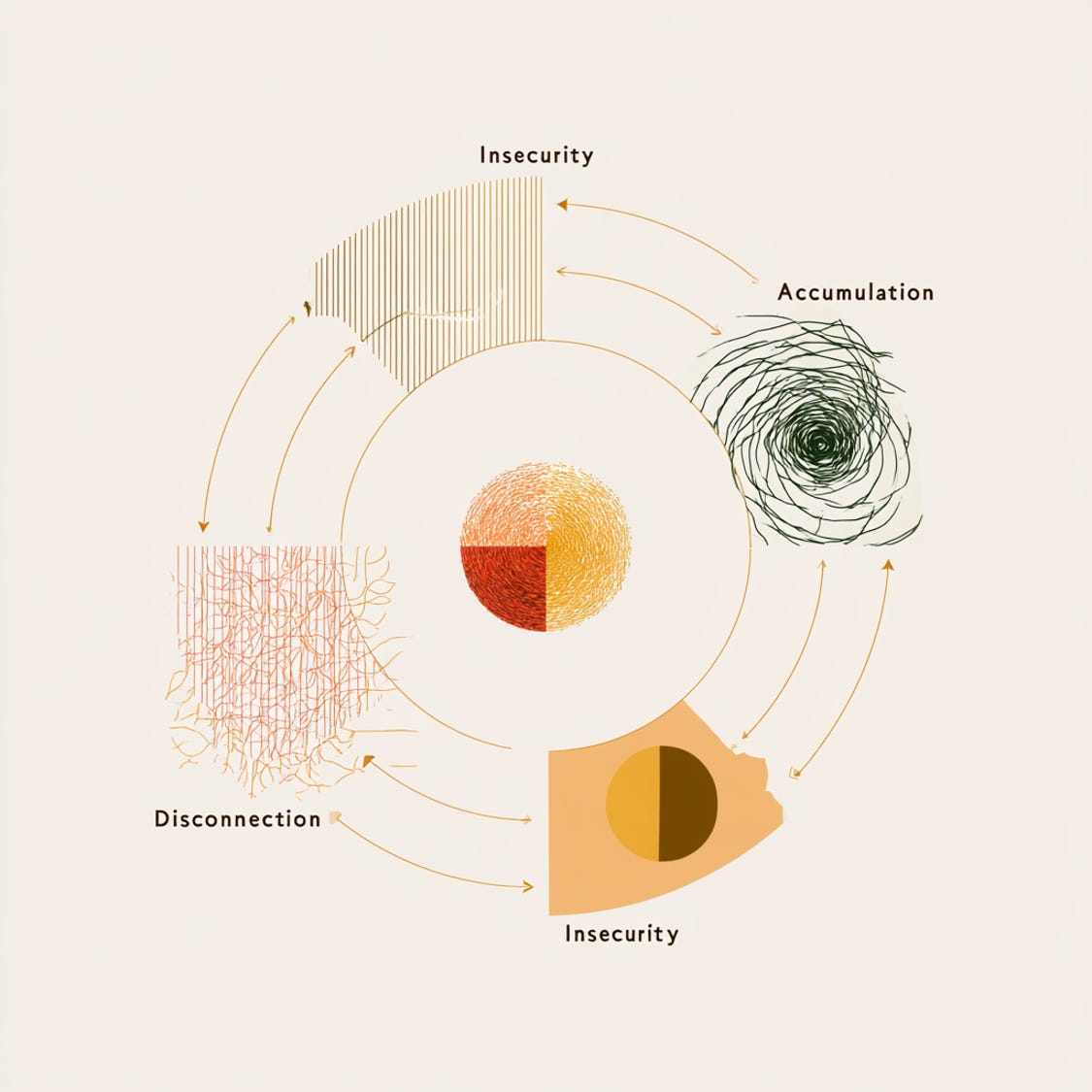
And it doesn’t only run in one direction. Just as insecurity can drive someone into the loop, research on loneliness and materialism shows the reverse holds too, disconnection itself can send a person reaching for accumulation as a substitute for the connection they’re missing. That’s what makes it a loop rather than a slide. You can enter it from either end, and once you’re in it, each stage feeds the next.
That is materialism, properly understood.
Not a character flaw belonging to the wealthy, not a symptom of not having enough. A cycle, insecurity into accumulation into disconnection into more insecurity, that runs on every income bracket, because the thing it’s actually responding to, the fear of not being enough, doesn’t check your bank balance before it takes hold.
Worth pausing on the word itself, because materialism carries two entirely different meanings depending on where you encounter it.
In philosophy, materialism is the view that everything in existence, thoughts, feelings, consciousness included, is physical, or the product of physical processes in the brain. It’s a claim about the nature of reality, going back to ancient thinkers like Democritus, and it sits opposite idealism, the view that mind or idea is what’s fundamental. That is not the materialism this piece is about, and the two are logically unrelated, a committed philosophical materialist doesn’t necessarily care about owning things, and someone caught in the loop this piece describes isn’t necessarily making any claim about the nature of consciousness at all.
This piece uses the other one, the psychological and consumer research definition.
Psychologists have been measuring materialism formally since 1992, when Marsha Richins and Scott Dawson defined it as a value built on three things: placing possessions at the centre of your life, judging your own and other people’s worth by what they own, and believing that acquiring things is the route to happiness. Three decades of research since has confirmed what that definition implies, all three of those beliefs are reliably linked to lower wellbeing, not higher. The textbook version of materialism was never a description of a healthy relationship with money. It was already, from the outset, a description of the loop.
What’s changed is not the cycle itself. Humans have run this loop for as long as we’ve compared ourselves to our neighbours. What’s changed is that the loop used to have off switches. It doesn’t anymore. And that’s where this piece has to start, because until you can see the whole cycle clearly, insecurity, accumulation, disconnection, and back again, gratitude looks like a nice idea rather than what the research actually shows it to be: one of the only things capable of interrupting it.
Picture someone who has just bought the biggest house on the street. For a moment, they have exactly what they wanted. Then they notice the neighbour’s renovation. Or the extension two doors down. The goalpost doesn’t stay still just because you finally reached it, it moves to wherever the next person’s fence is. The loop doesn’t stop once you’re wealthy. It just changes what it’s insecure about.
Frank Mols and Jolanda Jetten’s research, in their book The Wealth Paradox, found exactly this. In general, the wealthier people get, the meaner they get. Prejudice, status anxiety and hostility toward outsiders aren’t confined to hardship, the way we usually assume. They show up just as often, sometimes more often, once people already have plenty. Swap worrying about rent for worrying about whether your kids will out-earn you, whether your house is in the right postcode, whether you’ll still be invited to the right things if the money ever dries up. The comparison shifts to a higher tier. It doesn’t switch off.
There’s a second stage to the loop at this altitude too, quieter and just as corrosive. Wealth buys distance. Enough money and you never have to queue at Centrelink, never have to ride the bus that’s running late, never have to notice the bin collection, the pothole repair, the aged care worker doing a double shift, because someone else, invisibly, is already handling all of it on your behalf. You stop bumping into the everyday struggle other people are having, not because it stopped existing, but because you can now afford not to see it.

That distance is the disconnection stage of the loop, and it does something to a person. It gets easier to be judgemental about lives you no longer have any contact with. It gets easier to treat the people who keep your world running, the driver, the cleaner, the delivery worker, the nurse, as functions rather than as people, invisible right up until the moment something breaks and you’re suddenly furious that the tradesman is late or the flight is delayed.
I wrote in Part One about the strangers whose decades of unglamorous work keep clean water running out of your tap without you ever thinking about it. Money doesn’t remove that dependence. It just makes it easier to forget it exists, right up until the one week it doesn’t. And forgetting it, the research suggests, doesn’t settle the insecurity underneath the loop. It just removes one of the few things that used to interrupt it, the daily, ordinary reminder that you rely on strangers, and they on you.
Paul Piff and his colleagues found the mirror image on the other side of the ledger. Across a series of studies, it was consistently the people with less, not more, who gave away a bigger share of what they had. Not because having little makes you virtuous, but because when you’ve had less, you’ve usually needed someone else’s generosity to get by, and you can’t forget you’re dependent on strangers when you’ve never had the money to buy your way out of noticing them. The loop still runs at every income level. It’s just that scarcity, unlike wealth, rarely buys the distance that lets you stop noticing.
It didn’t used to be like this. You could walk away from the shop window, switch off the television, and the comparison would stop for a while, there were whole hours of the day when nothing was trying to make you feel like you didn’t measure up. Now it’s in your pocket. The feed never runs out of other people’s highlight reels to hold up against your own life, and it never switches off.

Comparing ourselves to others isn’t some modern character flaw. It’s ancient, and it once served us well. For most of human history, you compared yourself to the fifty or so people in your village, because knowing where you stood in that small group actually mattered, for status, for cooperation, for survival. The comparison had a natural ceiling. You couldn’t see into the lives of strangers on the other side of the world, so you didn’t try to measure yourself against them.
Now you can see directly into the curated, filtered, highlight-reel lives of millions of people you will never meet, all at once, all the time. The same wiring that once helped you gauge your standing among fifty neighbours is now running that comparison against the entire planet, every single day, and it was never built to handle a sample size that large. No wonder it leaves so many people feeling like they’re falling behind a race they never agreed to enter.
This is where FOMO and FOLO come in, two names for the same anxious engine, running in opposite directions to keep the loop turning.
FOMO, the fear of missing out, pulls you forward, that holiday, that event, that trend, if you don’t grab it now you’ll be left behind.
FOLO, the fear of losing out, does the opposite work, it keeps you white-knuckled on what you’ve already got, terrified that letting go of anything, a possession, a status, an advantage, means someone else gets ahead while you fall back.
Between the two, there’s no rest. You’re either anxious about what you haven’t got yet, or anxious about losing what you have. Both keep you looking outward for the next thing to secure your sense of enough, and neither one ever actually arrives at it.
This isn’t a minor discomfort. A 2025 meta-analysis pooling 32 studies and more than 26,000 students found a consistent correlation between FoMO and both anxiety and depression. The engine keeping the loop running isn’t just annoying, it’s measurably wearing people down.
Every scroll is somebody’s holiday, somebody’s renovation, somebody’s better body or better kitchen or better life, presented as a moment shared between friends rather than what it actually is, a performance of insecurity that someone else is profiting from. The line between content and advertising has all but disappeared.
Almost everything in your feed is selling you something, even when nothing is technically for sale, it’s selling you the feeling that what you have isn’t quite enough, and FOMO and FOLO are simply the two settings that feeling runs on. That’s not a side effect of the algorithm. It’s the business model, and it’s why the loop that used to switch off for hours at a time now runs continuously, feeding the insecurity stage of the cycle every waking minute of the day.
So, the wealthy aren’t more materialistic because they have more money. They’re just the easiest version of the story to point at, the mansion is a better photo than the anxiety underneath it, or the disconnection hiding behind the hedge. The harder truth is that materialism isn’t a rich person’s problem.
It’s the loop, insecurity into accumulation into disconnection into insecurity again, amplified now by a machine that never switches off, and it works on everyone the same way, always promising that the next thing, the next purchase, the next comparison won, will finally be the one that settles whether you’re enough.
A 2025 meta-analysis in the Journal of Consumer Behaviour, pooling 72 studies across more than 44,000 people, put a number on something many of us have felt without ever measuring it.
Materialism’s damage to social wellbeing, to loneliness, trust and relationship satisfaction, is larger than its damage to individual wellbeing like self-esteem or life satisfaction.
We tend to talk about materialism as something that hollows out the person chasing it. The evidence says it does more damage to the people standing next to them, which makes sense once you see the disconnection stage of the loop for what it is, not a side effect, but the mechanism itself doing exactly what it does.
Partners get measured against an ideal of ambition and status. Friendships get quietly sorted by usefulness. A life organised around the loop is, structurally, a life organised around scarcity, there is always more to want, which means there is always a reason to feel short-changed by what is already in front of you.
Gratitude and materialism, researchers including Jeffrey Froh have found, tend to move in opposite directions, not as a strict either-or, plenty of people hold some of both, but as a real tension where more of one tends to mean less room for the other.
This shows up earliest and most starkly in adolescents, whose sense of who they are is still being assembled largely from what the world around them keeps insisting matters, and who are entering the loop earlier and faster than any generation before them.
I wrote three sentences in my book back in 2018 that has outlasted almost everything else I put on that page, because the years since have quietly gone about proving it correct.
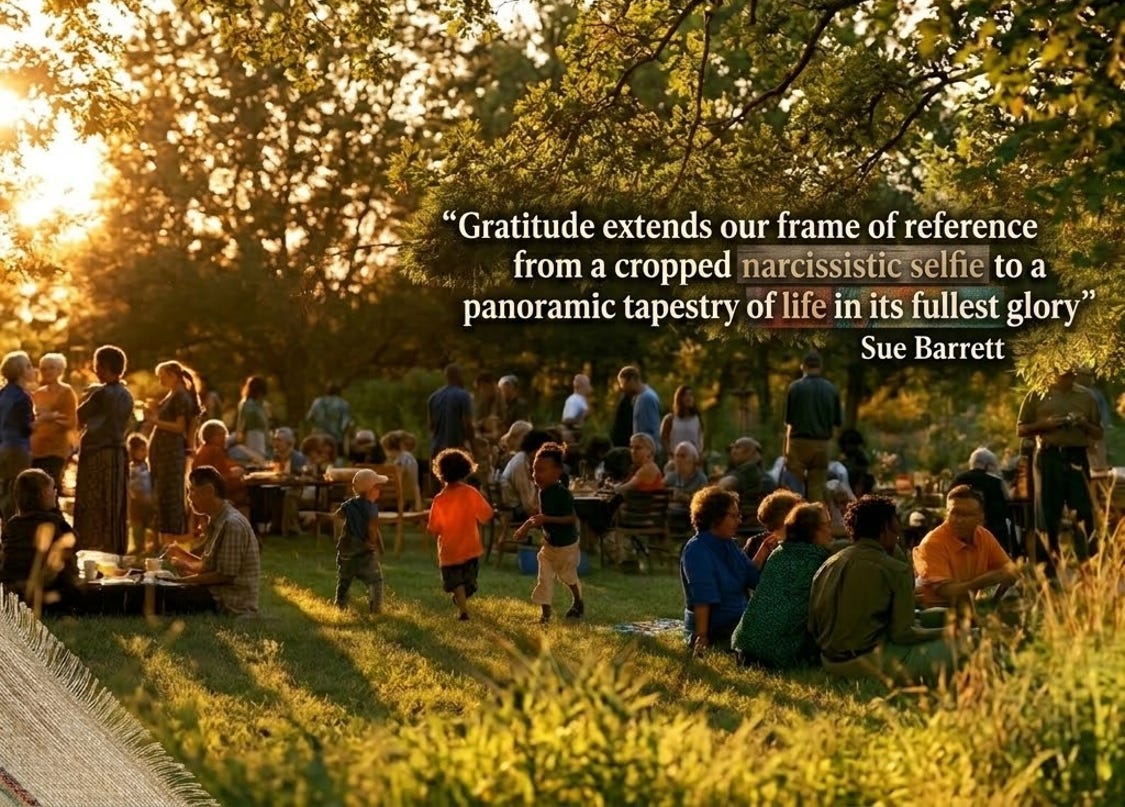
The practise of gratitude moves us away from myopic thinking. It helps us to uncover connections, find pathways and reveal relationships. Gratitude extends our frame of reference from a cropped narcissistic selfie to a panoramic tapestry of life in its fullest glory.
That sentence names exactly where the loop does its damage. It crops the frame. It trains the eye to hold on your own reflection, your own status, your own accumulation, until that reflection is all the frame has room for. It does this regardless of what is actually inside the frame to begin with, a modest life or an extravagant one, the cropping works the same either way. Widening the frame back out doesn’t add anything new to the picture. It just helps you notice what was surrounding you the whole time, other people, interdependence, the panoramic tapestry that never actually left, it was only ever waiting to be seen.
This year, a study published in the European Journal of Social Psychology by Agata Gąsiorowska and colleagues found exactly where that interruption happens. Across four studies and more than three thousand people in the United Kingdom, Mexico and South Africa, deliberately chosen for their cultural and economic range, they tested whether gratitude actually causes a reduced desire for money, not just accompanies it.
It does. And they found precisely why.
It increases social connectedness, the felt sense of being held by relationships rather than standing in the world alone. And it increases self-transcendence, the sense of being part of something larger than your own immediate wants. Both of those sit at exactly the point in the loop where disconnection would otherwise take hold. Activate them, and there’s simply less room left for the pull toward money and status to fill. The effect was strongest in people who had attached the most symbolic meaning to money in the first place, the exact people the loop has its deepest hooks in.
This isn’t gratitude making someone feel briefly pleasant about what they already have. This is gratitude reaching into the one stage of the loop where it can actually be interrupted, before accumulation curdles into distance, and loosening it.
Worth being straight about what this isn’t.
It doesn’t land the same way for everyone, people with certain attachment patterns or a strong pull toward comparison can find it harder to access, not because they’re doing it wrong, but because the starting point differs. It can also, in some contexts, tip into a sense of indebtedness rather than connection, gratitude curdling into obligation instead of ease. And materialism itself isn’t purely a personal failing to be willed away, it’s often inherited, passed down from parents, absorbed from peers and culture long before anyone chooses anything. None of that undoes the argument. It just means gratitude is a genuine lever on one point in the loop, not a switch that turns the whole cycle off.
This is where the personal and the systemic stop being separate conversations.
A culture that keeps everyone’s frame cropped down to their own accumulation, regardless of how much or how little sits inside that frame, is not an accident. It is, in no small part, the business model.
Extreme individualism benefits the corporations and interests that profit from a population stuck in the loop, each person chasing their own private version of enough, endlessly, alone, and never quite arriving.
It is also a much harder population to turn against itself, to convince that a neighbour’s gain must be your loss, that generosity is for suckers, that the wealth pump draining upward is simply the natural order of things rather than a design choice someone benefits from.
Interrupting the loop is not only good for your own nervous system.
It is a quiet, deliberate act of non-cooperation with the entire architecture of manufactured scarcity this newsletter keeps naming in other forms, week after week.
There’s a question worth sitting with here, because it changes what this piece is actually asking of you. Have we reached peak materialism? Has the loop finally started running out of road, leaving more people burnt out, in debt, anxious and no closer to enough than when they started running it?
If we have, the interesting part isn’t the diagnosis. It’s what comes next. A society that has genuinely exhausted its faith in accumulation doesn’t automatically default to something better. It can just as easily curdle into cynicism, isolation, or the kind of grievance politics this newsletter keeps naming, people convinced there’s nothing left to hope for, and someone else to blame for that.
Or it can turn toward exactly what the research in this piece points to, connection, self-transcendence, a wider frame. The gap left behind when the loop stops delivering has to be filled with something. Gratitude is one answer for what that something could be. It isn’t the only one on offer, and the ones currently being offered loudest, by people with a great deal to gain from your resentment, are worth watching closely.
That’s really the question underneath everything else in this series. Not whether the old promise has failed. It has. The question is what we choose to build in the space it leaves behind.
The strongest answer to anyone tempted to write this off as convenient sentiment for a wellness newsletter arrived this year in the Proceedings of the National Academy of Sciences. A megastudy led by Nicholas Coles and Michael McCullough, the same McCullough behind the research at the centre of Part Two, tested six brief gratitude practices against control tasks across 34 countries and nearly 11,000 people, from Canada to Kazakhstan, Norway to Nigeria.
The practices worked. Improved mood. Greater optimism. Higher life satisfaction. Reduced envy.
However, the honest version of this finding matters more than the tidy one: the effects were modest, not transformative, and they varied sharply by country. The impact was strong in Mexico. It was close to zero in Norway. That is not a flaw in the research, it is the research doing its job properly, refusing to pretend gratitude is a universal switch that works identically on everyone, everywhere. What it does show is that the interruption is real and it travels, even if how far it travels depends on the culture it lands in.

The materialism loop does not care how much you own. It will find the gap either way, the newer phone you don’t have yet, the bigger house next door, the promotion someone else got, the holiday you saw in someone’s feed. That gap is not a personal failing. It is a designed feature of the world you are living in, built to keep the frame cropped and the cycle running.
Interrupting it is not a single grand gesture.
It is a decision you get to make several times a day, every time you notice the gap opening up and choose, instead, to look at what is already standing in the frame with you.
This week, pick one moment. When you catch yourself wanting something because someone else has it, stop before you act on it. Ask what you already have, right now, in that same part of your life, connection, capability, comfort, that you have not actually paused to notice in a long time. Not instead of the want. Alongside it. Then watch what happens to the size of the gap.
Research on gratitude interventions also suggests it’s not about finding the one perfect practice and sticking to it forever. Combining a few different approaches, a letter here, a specific noticed moment there, tends to work better than repeating the same exercise on autopilot. So, if what you tried last week has started to feel routine, that’s your cue to switch it up, not a sign it’s stopped working.
That is the whole practice, and it costs nothing to try.
The choice sits in front of you more often than you think, and every single time, it is entirely yours to make.
Next week, the story this whole series has been building toward. My father. The betrayal. The 142 days that became a book. And exactly what changed, and why it has stayed changed for over a decade since.
Every solution begins with a conversation. This week’s starts with a question about what you’re actually looking at, and what’s been standing just outside the frame the whole time.
You know what to do.
Sue Barrett is founder and CEO of Barrett Consulting Group, Democracy Watch AU and Before You Vote, and writes Every Solution Begins with a Conversation on Substack. suebarrett.substack.com | beforeyouvote.com.au © 2026 Sue Barrett
Comments
Nothing yet. Say the first thing.
Sign in to join the conversation.