
For those new to the Substack, welcome. I’m Erica, and while my creative work ranges widely, I write mostly about jiu-jitsu here—from the professional scene to my own personal experiences.
Every year in March, I write a piece to commemorate the anniversary of my first jiu-jitsu class. This year’s edition was tough to write, and the matter is about as close to my heart as it can get.
I hope you enjoy it.
When my water broke and I was admitted into the hospital in February, the experience reminded me of a jiu-jitsu competition in a number of ways:
Instead of a game plan, I had a birth plan–a set of well-considered intentions for how I wanted the next day or so to play out, if given the choice.
Instead of a coach, I had a doula–someone to advocate for me and keep the circumstances in perspective.
The same way I did before a tournament, in the weeks before birth, I packed a bag of everything I could need when it was finally “go time”: change of clothes, favorite snacks, tokens of encouragement to see me through the physical and mental gauntlet that would unfold in the hours to come.
I entered the labor and delivery ward the way I would when I entered the bullpen. I had traded a mouthguard and a gi for a monitor and hospital gown, but the mentality was the same: reminding myself to trust in everything I had done to prepare, trying to stay calm and positive, and doing my best to remain alert but serene in the expanse of idle time between waiting for something to happen and having something actually happen.
But the most important parallel between my recent experience of birth and past experiences of competition is this:
When you didn’t get the result you wanted…
When reality falls short of your expectations…
When something ends up happening for which no game plan or practice could have prepared you…
How do you move forward?
Before birth, the only other time in my life where the reality of an experience so diverged from my expectations is when I last competed in jiu-jitsu in 2024.
If you asked me what I wanted most at the beginning of 2024, it was to win both Pans and Masters Worlds at Brown Belt and–if my coach thought I deserved it, to get my Black belt at the end of the year. I felt that if I achieved those goals, I could be at peace with a new set of goals: getting pregnant and starting a family. I knew that my goals related to jiu-jitsu would be easier to achieve before having a baby than after it.
When I walked onto the mat at the Atlanta Open in February 2024, I considered it the first step in a “last dance” year of focus on competitive jiu-jitsu. It only took thirty seconds to completely obliterate any chances of that year going anywhere according to plan. My knee got blown out in a freak accident in my first match.
My MCL, partially torn, healed on its own. I had to have surgery to fix my meniscus and reconstruct my torn ACL.
I had envisioned 2024 as a year I’d spend getting onto the podiums at IBJJF competitions. Instead, I spent the better part of it struggling to get up and down the stairs.
I got back on the mats in 2025, fully returned to sport after the knee injury and surgery. When I found out that I was pregnant midway through the year, I figured that no matter how hard the pregnancy and postpartum period was, nothing could be more painful, more humbling, more heartbreaking, or more mentally trying than the time I spent sidelined, relearning how to walk.
Unfortunately, I was wrong.
I hadn’t given much thought to what happens after giving birth until I did it. Once it did, I thought that I’d experience what most mothers with a hospital birth do:
I would have a sleepless night in the recovery ward with the baby crying in a bassinet at my bedside.
After a series of routine checks and tests for me and baby in the next day or two, we’d both get discharged.
A nurse would roll me out of the hospital in a wheelchair while my husband followed closely behind carrying the baby in a new carseat.
At last, we’d secure the baby in the car for the very first time and drive home: the new parent version of a “happily ever after.”1
Instead, what happened was this:
My baby spent his first hour in my arms, but the rest of his first night in a transition ward for an issue they suspected would resolve overnight.
That issue resolved overnight, but the medical team had uncovered another major problem.
The next morning, a doctor told me that my baby had a birth defect, that he needed to go to the NICU, and that he was being scheduled for surgery in the next 48 hours.
“Except during the nursing shift changes, you can visit him whenever you want in the NICU,” he said, trying to comfort me.
He couldn’t tell me when I might hold my baby again.
No one could tell me when my baby might come home.
There are many statements and sayings about the benefits of jiu-jitsu, some more trite or cliche than others. That it’s “the gentle art,” that it’s “for everyone,” or that “technique matters more than strength.”
The only one that I fully endorse from my last nine years in the sport is this: practicing jiu-jitsu can make you more comfortable in uncomfortable situations.
I’d like to tell you that jiu-jitsu helped make me stoic or that it allowed me to bear my son’s NICU stay and his ongoing medical situation with grace.
It didn’t—but had I never trained or had I quit, I would have been far worse at managing the situation I’ve found myself in over the last six weeks.
The other jiu-jitsu adage I’m starting to believe is this one: that the best way of measuring progress isn’t if you can beat the person in front of you. It’s if the current version of you can beat the previous version of you.
Even though the current version of me has a reconstructed knee, a postpartum body, no sleep, a baby, and more “life” to grapple with—both related and unrelated to the baby—the white belt version of me wouldn’t stand a chance.
As I write this, it’s been just over a month since my baby got discharged from the NICU. He needs some serious medical care in the coming year, and I’d be lying if I said it won’t be stressful to manage.2
After I tell them about the baby, many people tend to ask me how I am doing. The answer changes, but if you asked me today, I’d tell you this:
That it’s been hard for me to go out in the world and see other new moms with less complicated circumstances, and how it makes me grieve certain early motherhood experiences I didn’t have or will not have.
That my plans for my return to work and return to sport (again) are less clear than they otherwise would have been with a totally normal baby, and how I’m anxious about reintegrating these two spheres of my old life into my new one.
But what matters most is this:
He is home, and aside from these temporary circumstances, he is healthy and thriving.
He will come back from this.
Nine years into jiu-jitsu, I know that I can come back from this, too.
I have to.
For the both of us.
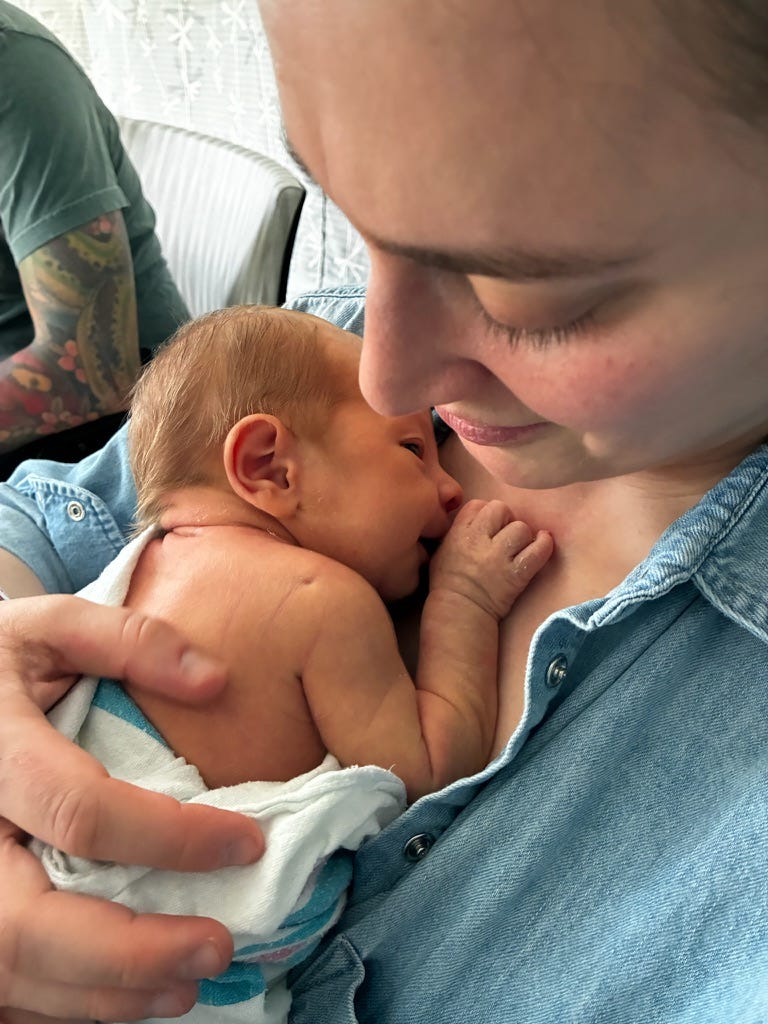
Except when you “ride off into the sunset” as a new parent, you don’t know if it’s a sunset or a sunrise because of how little you end up sleeping and how much you end up losing track of time.
What that looks like so far: attending various doctor’s appointments, developing proficiency around new types of medical equipment, planning for hospital stays throughout the summer, and doing it all on minimal sleep and volatile postpartum hormone levels.
No posts
Comments
Nothing yet. Say the first thing.
Sign in to join the conversation.