
https://substack.com/@allen473199/note/c-299787335
In a natural, healthy society, the goal of medicine would be to heal people so that they no longer need the system. In the current corporate medical system, that outcome is a financial failure.
The machine of modern medicine now functions as a profit-driven financial engine wrapped in the language of medicine.
A person who feels perfectly healthy walking into a routine check-up now walks out as a chronic patient with “in need” of prescriptions. The modern-day “check-up” acts as an entry portal into the lifelong pharmaceutical funnel.
Health policies, routine schedules, and regulatory guidelines have been systematically optimized to maximize recurring revenue streams. Health is no longer the primary goal if it ever was.
By transforming healthy citizens into lifelong, chronic patients through mandatory check-ups and expanded pediatric schedules the system has successfully engineered a highly predictable, multi-billion-dollar recurring subscription model.
This structural shift is not an accident. It is the result of deliberate financial and administrative engineering.
………………………………………………..
https://substack.com/@barbaralee2/note/c-299822935
I suggest a new kind of insurance. Pay the doctor a royalty for every day his patients don’t need his services. He gets nothing when they are sick. Ya think that might be an incentive to make people healthier?
……………………………………
https://substack.com/@allen473199/note/c-299832995
That describes a legendary concept from ancient China where physicians received a retainer for keeping patients healthy. Instead of a fee-for-service model, the physician was paid when the patient was well, and payments stopped when the patient became sick.
The doctor’s income depended on keeping you well. Not on treating you once you were broken.
The Huangdi Neijing (The Yellow Emperor’s Inner Canon), one of the oldest medical texts in existence, put it plainly: “The superior doctor prevents sickness. The mediocre doctor attends to impending sickness. The inferior doctor treats actual sickness.”
………………………………………………………………………………………………………………………
by Suavek
To this day, Traditional Chinese Medicine and its diagnostic methods function perfectly well without the concept of completely fabricated “viruses.” While this is certainly worth noting, the primary focus of this article is on the practical implications of differing perspectives regarding the funding structures of the medical system—particularly in the context of conflicts of interest and moral considerations. Naturally, this topic can only be briefly outlined here.
A popular narrative in modern healthcare discussions claims that ancient Chinese physicians were paid only when their patients remained healthy. According to this story, payments stopped immediately if a patient became ill, aligning the doctor’s financial success directly with the patient’s well-being. This article examines historical documents, ancient medical texts, and legal records to separate romanticized folklore from factual reality. While the story functions as an excellent philosophical metaphor for preventive healthcare, historical evidence reveals that ancient Chinese medicine actually relied on a mix of state salaries, private fee-for-service models, and traditional market trade.
In international business strategies and modern medical debates, a specific historical anecdote is frequently cited: the legendary Chinese medical payment model. The story states that families paid a regular retainer fee to their doctor to keep them healthy. If a patient fell sick, the doctor’s income stopped, and the physician had to provide treatments for free until health was fully restored.
This story is attracting great interest among people who criticize the modern system of fee-for-service payment—under which hospitals earn more when people are sick. However, to understand if this system truly existed, we must examine the actual written records left behind by ancient Chinese societies.
I suggest that we examine the long era of traditional Chinese medicine in a nuanced way and avoid generalizing its history, which spans more than two thousand years.
In fact, there was an era in ancient China that is particularly noteworthy. Medicine was not always subordinated to the capitalist laws of profit, for it was understood that such principles were simply incompatible with the ideal of preserving human health.
The Zhou Dynasty (11th-3rd century BC)
During the Zhou Dynasty (11th-3rd century BC), a state-funded healthcare system existed in China that organized doctors into specialized roles, including internal medicine and surgery. According to records, medical staff were evaluated on success rates to determine their pay, highlighting a system focused on maintaining natural internal balance. Read the full story at The Rites of Zhou ( Hektoen International ). This article, too, is not free of propaganda, as at one point it speaks of the existence of “epidemics” without explaining that, in reality, these could simply be cases of mass poisoning—which, in most instances, are linked to volcanic eruptions. ( To find all articles on this topic, please use the search bar at the top right of this Substack and enter the title of the article series: “ NO PANDEMICS ”, “The Birth of the Contagion Lie ”, or search for the term “ Spanish flu ” ).
Here is an excerpt from the article on *The Rites of Zhou*, published in *Hektoen International*:
Ping Yu
Bethesda, Maryland, United States
Chi Lu
Lexington, Kentucky, United States
“( … )
An issue of interest is that shamanism, while quite common in early cultures and always mixed with medicine (as shown here in the Southerners’ proverb quoted by Confucius), was never part of the medical system described in the Rites of Zhou. In fact, there were several sentences in another part of the book talking about the official shamans,16 perhaps indicating that medicine had already been somewhat separated from shamanism during the Zhou Dynasty.
As the supreme officials of medicine, the Principal Physicians’ main duties were issuing orders and managing collected drugs and herbs. They were assigned work places where they could be easily visited by the people. Because of its importance, the service of Principal Physicians had thirty employees, more so than the sum of the other four divisions. Also, Principal Physicians was the only division of medical professionals that included the first-class physicians. The Principal Physician in charge made a preliminary diagnosis then sent the patient to a Physician for Simple Ailments or one for Ulcers, who were expected to keep records of the cases seen and the outcome of their treatment. At the end of each year, the Principal Physicians analyzed the documents and decided the next year’s wage and benefits for these physicians according to their performance. If their patients were virtually all healed, they would be assigned to the “upper level” and probably have their benefits increased. But if many of their patients were not cured, those physicians would be placed in the lower levels, with less income and benefits for the next year.14,17
( … ).”
Full article :
The most famous medical text in Chinese history, the Huangdi Neijing (The Inner Canon of the Yellow Emperor), compiled around the 2nd century BCE, explicitly states:
“The superior doctor prevents sickness. The mediocre doctor attends to impending sickness. The inferior doctor treats actual sickness.”
Because ancient literature heavily shamed doctors who only treated advanced illnesses, modern readers naturally assumed that financial systems matched this philosophy. For prevention—when correctly understood—and the long-term maintenance of health were already regarded back then as the highest fundamental medical principles.
Historical documents show that an universal, nationwide “pay-only-when-healthy” system never existed for the general population. Instead, the medical economy of ancient China was divided into distinct professional tiers:
Imperial and State Physicians
During the Zhou Dynasty (11th to 3rd century BCE), China developed an early, publicly funded healthcare system. As recorded in the classical text The Rites of Zhou, institutional medical professionals received fixed wages and benefits directly from the government royal treasury. Their pay depended on their official rank, audit results, and success rates, rather than a monthly subscription paid by individual citizens.
Private Healers and Traveling Doctors
For the vast majority of ordinary Chinese peasants and citizens, healthcare was an open market. Doctors operated under variations of the following economic models:
Fee-for-Service: Patients paid a direct fee in cash, grain, or cloth after receiving a pulse diagnosis, acupuncture treatment, or herbal prescription.
No Cure, No Pay Agreements: In severe or risky cases, a family might sign a private contract with a doctor. The physician received a large payment only if the patient survived or recovered.
Retainer Fees for the Elite: Wealthy elite families occasionally hired a private physician to live on their estate. While this resembled a retainer fee, the doctor was expected to treat existing chronic issues and prepare daily longevity tonics, not just maintain baseline health.
Economic Mechanisms of Modern Capitation Systems
Even though the “healthy payment plan” is historically portrayed in an exaggerated and overly generalized manner, the underlying concept could be of great importance for modern medicine. This conclusion rests solely on the following distinction:
Fee-for-Service Model -> Incentivizes: More tests, surgeries, and hospital stays -> Continuously rising insurance costs
Ancient Chinese Ideology -> Incentivizes: Better nutrition, lifestyle changes, and (genuine) prevention.
The principles of unregulated capitalism (”everything not explicitly prohibited is permitted”) and the current global power dynamics successfully prevent any sensible reforms. For over a century, we have been told that any compromise—that is, a “golden mean”—between the profit motive and state regulation of corporations amounts to a form of communist paranoia that is doomed to fail. Incidentally, in my view, Cuba’s current healthcare system—despite its various flaws—could serve as a case study worthy of closer examination. Unfortunately, however, we cannot delve deeper into this topic within the scope of this brief article. As a passionate advocate of nuanced perspectives and the search for a golden mean, I would merely like to note that a system entirely subordinate to the pursuit of profit can never embody the moral qualities being sought.
In systems like the British National Health Service (NHS), general practitioners receive a fixed amount of money per year for every patient registered on their list, regardless of whether that patient is sick or healthy. According to the propaganda of the pharmaceutical industry—which wields power over the healthcare system while falsely labeling it a “state healthcare system”—this concept is supposedly intended for preventive purposes and the preservation of citizens’ general health. We must categorically reject this assertion.
Prevention is an illusion not only in Great Britain but wherever Rockefeller medicine is practiced. True prevention requires comprehensive education regarding lifestyle, nutritional advice, and the actual functioning of the body—but certainly not preventive screenings aimed at subjecting healthy people to overtreatment for the sake of profit.
While ancient Chinese philosophy aimed at active well-being, modern financing models carry the risk that a physician might withhold necessary but financially unattractive treatments from the patient, offering instead profitable treatments that are unnecessary or even harmful.
The prevailing financing structure creates specific economic incentives to satisfy pharmaceutical industry investors while disregarding the vital interests of patients. The WHO is an organization whose primary task is to boost investor profits and, in the process, plunder national economies.
Conclusion
The notion that citizens in ancient China—across the board and throughout every historical period—paid their doctors only when they were healthy is a romanticized distortion of a profound philosophical truth.
Ancient medical texts demanded that physicians protect health before disease appeared, but economic survival forced doctors to charge fees for services rendered. Nevertheless, this somewhat generalized perspective serves as an inspiring starting point for modern healthcare reforms and highlights that a physician’s ultimate goal should always be a population that requires no medical intervention.
Contrary to propaganda claims, modern financial systems not only fail to reflect this Chinese philosophy but actually lead to the economic rationing of medical treatment, or conversely, to health-endangering over-treatment. Prepaid medical interventions create an incentive to constantly reduce services while raising capitation rates; this aims to guarantee maximum profits for service providers and satisfy investors in the pharmaceutical industry. It is to be expected that the WHO—an organization established primarily to boost the profitability of this interest group—will, following the introduction of digital IDs and CBDCs, make access to medical services contingent upon compliance with mandatory vaccination schedules. The introduction of the vaccine passport during the “Covid” plandemic served as a trial run for implementing this criminal scheme. This danger is currently either ignored by the public or goes unnoticed because of “second-stage” propaganda—in which alleged “freedom fighters” on the internet blithely continue to spread the “virus” narrative—and because of censorship. I see the only way out of this situation as being for readers to share articles like this one and to avoid recommending authors who propagate half-truths within the echo chamber.
The issue of false binary logic actually relates to propaganda that has persisted for over a century. Citing the disastrous nature of communist economies, we are told that the economy regulates itself—provided the state does not impose any regulatory framework. This conflates moderate capitalism with a “social face” (the “social market economy” of the 1960s and 70s) with the predatory system of extortion that prevails today. Propaganda falsely labels regulatory measures as “communist” solely to ensure the economy primarily serves the top ten thousand. Yet, moderate regulatory frameworks have nothing to do with communism, nor do they destroy the economy; they simply refer to laws that everyone—including major corporations—is expected to obey.
Labeling today’s economic system “neoliberalism” is, in reality, a mere euphemism that masks a predatory form of economic extremism. Democratic civil rights appear to have already been largely abolished in the wake of the plandemic. With the introduction of digital ID numbers and the elimination of cash, the last line of defense for freedom could be lost.
References
Hektoen International. A publicly funded health care system of China in 11th to 3rd century BC as recorded in the Rites of Zhou. Hekint Journal (Documentary evidence of historical state salaries).
The Guardian. Notes and Queries: Chinese medical payment models vs the NHS. The Guardian Archive (Modern analysis of capitation systems). [Editor’s note: While this source provides a few useful pieces of information, I do not recommend it.]
………………………………………………………………………………………………………………………
https://suavek1.substack.com/p/the-false-binary-logic-part-2-profit/comment/311078710
( … ). Then, at the age of 19, I came to Hong Kong. I was able to witness the events of the last ten years of British rule and was fascinated by the way the two cultures had blended so successfully in so many ways. Sadly, the colonial system had by that point pretty much banished Traditional Chinese Medicine from official recognition but it was tolerated in the form of small private practices dotted all over the colony. But it was the fact that TCM was practised at all in Hong Kong that struck me, but the fact that the average Hong Kong Chinese person was well versed in the basics of TCM. They knew when their body was “overheated” due to eating too much fried food and they even cooked certain foods and soups at different times of the year in line with seasonal changes and the effects that had on the body as well as making use of the different seasonal ingredients available. There were also (and still are) herbal teashops in every town where people would pay just a few dollars (equivalent of say 50p) and choose from a range of teas which were said to alleviate different ailments. Some were actually fleshing and quite sweet. Others were incredibly bitter and you almost had to hold your nose and gulp it down (the most common being 24 herb tea). During the hot and humid summers, soups and teas were designed to draw the heat and humidity from the system. During the cool dry winters, it would almost be the opposite case where soups were designed to replace the moisture, especially concentrating on organs such as the lungs. This was all common knowledge even for people in their teens during the 1980s but sadly I see an increasingly sick society that queues for the latest government sponsored jab and takes their kids to the allopathic doc at the slightest sign of a cough or runny nose. ( … ).
………………………………………………


………………………………………………………………………………………………………………………….
………………………………………………………………………………………………………………………….

Dr. Mike Yeadon’s Substack #1 :
https://drmikeyeadon.substack.com/
( Notes : https://drmikeyeadon.substack.com/notes, and other activities on Substack : https://substack.com/@drmikeyeadon )
The Telegram channel of Dr. Mike Yeadon ( other Telegram channels with his name are fake ! ) :
https://t.me/DrMikeYeadonsolochannel
A collaborative Substack by Dr. Yeadon and Suavek ( Dr. Mike Yeadon’s Substack #2 ) :
Fraud Prevention Hotline / suavek1.substack.com
…………………………………………………
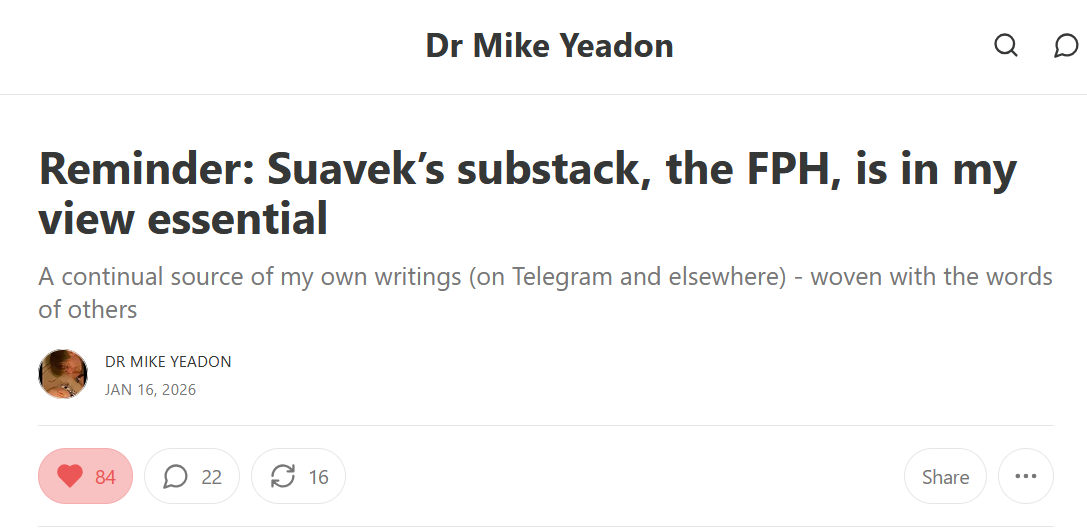
Source :
https://drmikeyeadon.substack.com/p/reminder-suaveks-substack-the-fph
…………………………………………………
Source :
https://drmikeyeadon.substack.com/p/scorpions-in-the-dock
Consider subscribing to my friend Suavek s publication an essential move please. There you can find many posts from my Telegram channel collated with other material in a skilful way. Fraud Prevention Hotline
Best
Mike
……………………………………………………
DEAR FRIENDS,
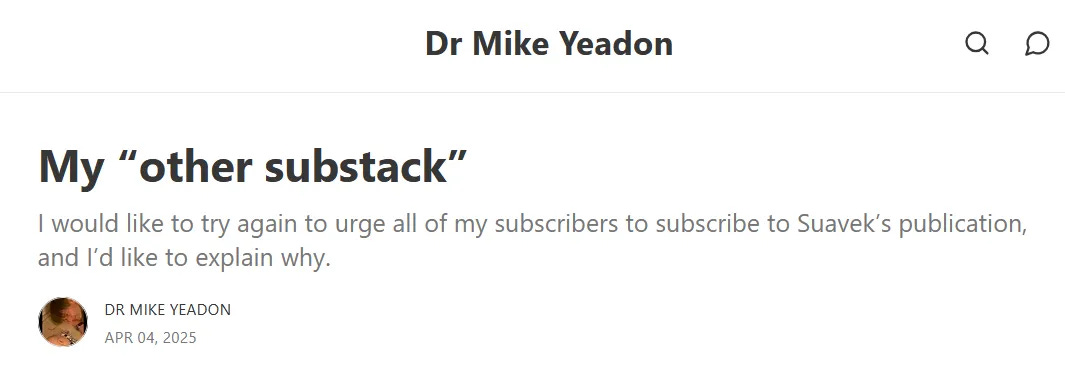
The two Substacks, Dr. Yeadon’s and Suavek’s, have merged into a single, highly informative entity. The Fraud Prevention Hotline is now officially Dr. Yeadon’s Substack No. 2. You can find his statement on this at the following link :
https://drmikeyeadon.substack.com/p/my-other-substack
…………………………………………………
Before publishing an article, there isn’t enough time during the editorial process to discuss every detail. In case of doubt, each author is therefore only responsible for their own statements.
…………………………….
We urge you, if possible, to add both Substacks to your recommended list in your Substack. Thank you very much in advance,
Mike & Suavek
………………………………
The possible support goes to Suavek. Any support is especially welcome at this time, and is VERY appreciated, but of course is not mandatory, as this Substack is free. I extend my sincere thanks to those who have supported me so far.
You can either do something against or for something :
Comments
Nothing yet. Say the first thing.
Sign in to join the conversation.