
Over the next 10 weeks, as we count down to the start of CREATIVE SHIFT on 7th September 2026, I’ll be sharing some of the themes, questions, and insights that arise through the process of creative self-inquiry that sits at the core of the programme.
If you’d like to join the waitlist, you’ll find a link at the bottom of this post.


Whenever I introduce the Play module inside CREATIVE SHIFT, I begin in exactly the same place - with the word itself - P L A Y . . .
Because whenever I mention play, I know that people will have very different reactions to it. For some artists, the word feels exciting and liberating. For others, it feels uncomfortable, frivolous, or even slightly irritating.
Over the years, I’ve realised that many of us carry all sorts of associations about play. Perhaps play was something we were encouraged to leave behind as we got older, perhaps it was something that never encouraged at all. Perhaps it was considered less important than being productive, and perhaps we learned that the “real work” was the serious work, and play belonged somewhere else - or nowhere at all.
So before we even begin exploring the role of play in a creative practice, I think it’s worth pausing to ask:
What does play mean to you?
Because I suspect many artists are already playing more than they realise.
If the word itself doesn’t sit comfortably with you, you could substitute it for exploration, experimentation, curiosity or discovery. I often use these words interchangeably. When I look at my own practice, I can identify subtle differences between them, and they perhaps sit at different stages of my process. But at a broad level, they are all pointing towards the same thing:
The willingness to step beyond what you already know.
To try something, to test something, to follow a thread of curiosity and see where it leads - and that, for me, is where development begins. Because our work cannot really change if we’re only willing to repeat what we’ve already done.
If we always use the same materials, the same processes, the same solutions and the same approaches, then our work is likely to remain exactly where it is.
Development requires movement - and movement requires a willingness to explore.
One CREATIVE SHIFT participant, Elli Woodsford, described part of her experience as realising that she "needed to step out of my comfort zone."
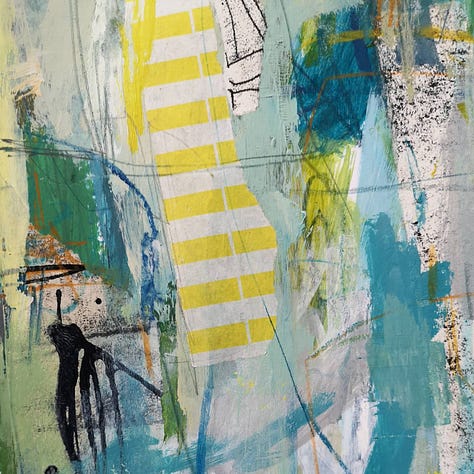
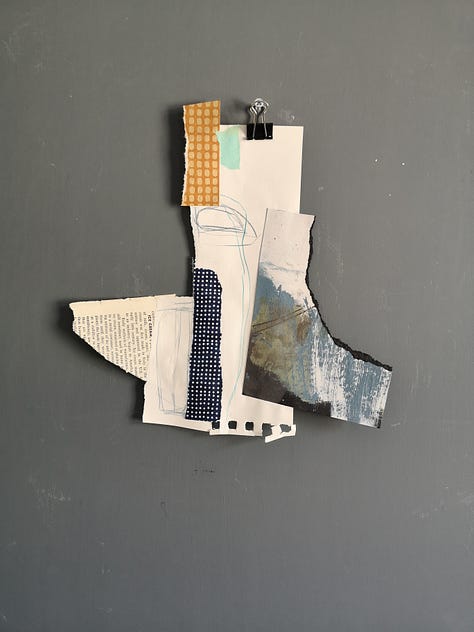
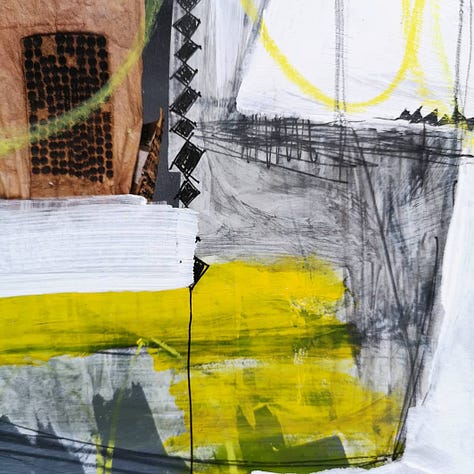
Inside CREATIVE SHIFT we talk about two broad approaches to play.
The first is what I call open play - a wide-open exploration where possibilities are allowed to emerge.
The second is intentional play - where you’re investigating something more specific, perhaps a colour, shape, material, process or question that has arisen through your work.
Neither approach is better than the other. Both have value, both have a place. And often we move backwards and forwards between them throughout the creative process.
In my experience, intentional play often begins with reflection. It begins with noticing, looking at our work and asking questions.
What am I enjoying here? What feels as though it has energy? What’s missing?
What would happen if I pushed this further? What am I curious about?
Those questions become the starting point for exploration.
The play itself becomes a way of investigating the answers.


This is why I think play is such an important part of a creative practice.
When we’re willing to play, explore or experiment, we’re giving ourselves permission to step beyond what we already know. We’re allowing ourselves to follow a question, test an idea or try something different without needing to know in advance how it’s all going to turn out - and that’s the part which isn’t always comfortable.
Most of us like to feel capable. We like to feel as though we know what we’re doing. We like to have some sense of where we’re heading - play asks something different of us. It asks us to enter a place of uncertainty. To try things without any guarantee they’ll work. To be open to making something we don’t particularly like, or heading down a path that ultimately isn’t the right one… but that isn’t failure - I don’t think it’s possible to ‘fail’, it’s simply part of the process of finding out 💫
Another participant, Linda Nettle, described CREATIVE SHIFT as encouraging her to "push my limits, dare a bit more."
Every time we explore an idea, we’re learning something. We might discover a material we enjoy working with, a colour relationship we’d like to pursue, a shape that keeps appearing, or an approach that feels completely wrong for us. All of that information is valuable because it helps us understand our work more deeply. The point isn’t really whether an experiment succeeds or doesn’t move forward. The point is that we’re paying attention to what happens.
And without that space, it’s very difficult for our work to shift, evolve and become something new. It’s how our work gradually becomes more personal, more distinctive and more our own.
So perhaps the question isn’t whether play belongs in a creative practice.
Perhaps the question is:
What becomes possible when we finally give ourselves permission to do it?
If these kinds of conversations resonate with you, CREATIVE SHIFT is my annual course for artists and creatives who want to develop a deeper understanding of themselves, their work and their creative practice.
The next CREATIVE SHIFT begins in September. If you’d like to hear more when booking opens, you can join the waitlist below.

No posts
Comments
Nothing yet. Say the first thing.
Sign in to join the conversation.